Press Conference Announcing the Results for the Fiscal Year Ended - - PDF document

press conference announcing the results for the fiscal
SMART_READER_LITE
LIVE PREVIEW

Press Conference Announcing the Results for the Fiscal Year Ended - - PDF document

Press Conference Announcing the Results for the Fiscal Year Ended March 31, 2012 (FY2011) Minutes Date: April 27, 2012 (Friday), 15:00-16:15 Comments by Ryuji Yamada, President and CEO FY2011 Results Highlights and FY2012 Forecasts


slide-1
SLIDE 1

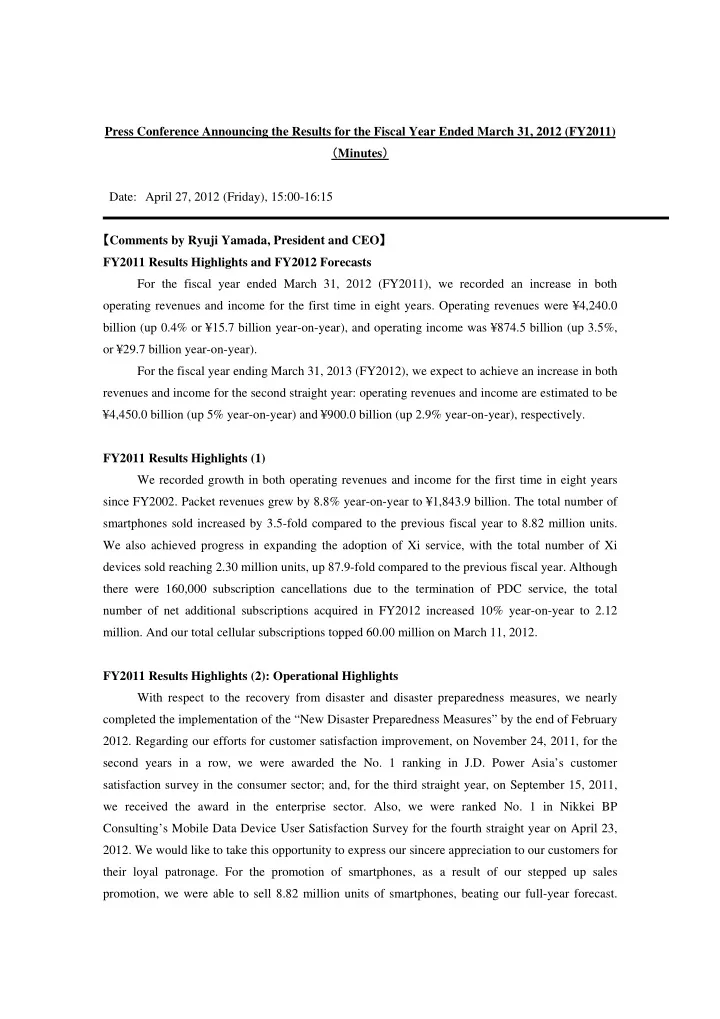
Press Conference Announcing the Results for the Fiscal Year Ended March 31, 2012 (FY2011) (Minutes) Date: April 27, 2012 (Friday), 15:00-16:15 【Comments by Ryuji Yamada, President and CEO】 FY2011 Results Highlights and FY2012 Forecasts For the fiscal year ended March 31, 2012 (FY2011), we recorded an increase in both

  • perating revenues and income for the first time in eight years. Operating revenues were ¥4,240.0

billion (up 0.4% or ¥15.7 billion year-on-year), and operating income was ¥874.5 billion (up 3.5%,

  • r ¥29.7 billion year-on-year).

For the fiscal year ending March 31, 2013 (FY2012), we expect to achieve an increase in both revenues and income for the second straight year: operating revenues and income are estimated to be ¥4,450.0 billion (up 5% year-on-year) and ¥900.0 billion (up 2.9% year-on-year), respectively. FY2011 Results Highlights (1) We recorded growth in both operating revenues and income for the first time in eight years since FY2002. Packet revenues grew by 8.8% year-on-year to ¥1,843.9 billion. The total number of smartphones sold increased by 3.5-fold compared to the previous fiscal year to 8.82 million units. We also achieved progress in expanding the adoption of Xi service, with the total number of Xi devices sold reaching 2.30 million units, up 87.9-fold compared to the previous fiscal year. Although there were 160,000 subscription cancellations due to the termination of PDC service, the total number of net additional subscriptions acquired in FY2012 increased 10% year-on-year to 2.12

  • million. And our total cellular subscriptions topped 60.00 million on March 11, 2012.

FY2011 Results Highlights (2): Operational Highlights With respect to the recovery from disaster and disaster preparedness measures, we nearly completed the implementation of the “New Disaster Preparedness Measures” by the end of February

  • 2012. Regarding our efforts for customer satisfaction improvement, on November 24, 2011, for the

second years in a row, we were awarded the No. 1 ranking in J.D. Power Asia’s customer satisfaction survey in the consumer sector; and, for the third straight year, on September 15, 2011, we received the award in the enterprise sector. Also, we were ranked No. 1 in Nikkei BP Consulting’s Mobile Data Device User Satisfaction Survey for the fourth straight year on April 23,

  • 2012. We would like to take this opportunity to express our sincere appreciation to our customers for

their loyal patronage. For the promotion of smartphones, as a result of our stepped up sales promotion, we were able to sell 8.82 million units of smartphones, beating our full-year forecast.

slide-2
SLIDE 2

During the month of March, in particular, we sold a total of 1.67 million units, our record high for a single month. This was attributable to the enrichment of product lineup, launch of new billing plans and new services for smartphones and other factors. As part of our efforts toward the transformation into an integrated-services company, we commenced “NOTTV” broadcasting service for smartphones and entered into business collaboration with Radishbo-ya Co. Ltd. in the field of commerce business. We would like to extend our deepest apologies to our customers for any inconveniences caused by the series of service interruptions. As of the end of March, 2012, we have nearly completed the implementation of principal countermeasures and we will continue to undertake thorough measures aimed for reliability improvement. FY2011 Results Highlights (3): Key Factors behind YOY Changes in Operating Income Voice revenues, excluding the impact of “Monthly Support” discounts, decreased by ¥135.9 billion compared to the previous fiscal year. Packet revenues, on the other hand, grew by ¥153.4

  • billion. The negative revenue impact from “Monthly Support” discounts was ¥38.9 billion. Other

revenues increased by ¥15.7 billion year-on-year due mainly to the growth in the number of subscriptions to “Mobile Phone Protection & Delivery Service” and credit payment revenues. Equipment sales revenues increased by ¥21.5 billion compared to the previous fiscal year. With respect to operating expenses, equipment sales expenses grew by ¥58.2 billion year-on-year as a result of a ¥32.2 billion increase in the cost of equipment sold and a ¥26.0 billion increase in distributor commissions. Other expenses dropped by ¥9.8 billion from the previous fiscal year, owing primarily to a decrease in handset repair expenses as a result of a decline in the number

  • f handsets submitted for repair.

As a result of the foregoing, operating income increased by ¥29.7 billion from the previous fiscal year to ¥874.5 billion. Changes in Operating Income (FY2010-2011) When the impact of the revisions made to the loyalty point program, etc., during FY2010 is excluded, operating income essentially recorded an increase in all four quarters of FY2011. In particular, operating income for FY2011/4Q posted a year-on-year increase of 51.5% as we adequately controlled the levels of our distributor commissions despite heated competition. Cellular Services Revenues (Voice + Packet) Due to the denominator used in ARPU calculations having been affected by such factors as the increase in the number of devices owned by a single customer as a result of the growth in demand for a second mobile device and diversification of customers’ usage behavior due to the

slide-3
SLIDE 3

availability of prepaid billing plans and other options, we believe the importance of making a performance comparisons using the ARPU as a benchmark is diminishing. Therefore, going forward, we would like to explain our performance using total cellular service revenues as an indicator. Packet revenues have been maintained higher than voice revenues after overtaking them for the first time in FY2010/4Q. FY2011/4Q packet revenues expanded steadily to ¥472.2 billion, up 9.0% year-on-year. For details concerning the ARPU, please refer to page 47 in the appendices. The full-year voice ARPU for FY2011 decreased by ¥330, while packet ARPU increased by ¥130 compared to the previous fiscal year. As a consequence, aggregate ARPU for FY2011 dropped by ¥200 from the previous fiscal year. Total Handset Sales The cumulative number of handsets sold in FY2011 was 22.09 million units, up 15.9% from the previous fiscal year and significantly higher than our initial forecast of 19.80 million units. In FY2012, we will aim to sell a total of 23.8 million units, up 7.7% year-on-year, by aggressively promoting smartphones and Xi-enabled devices. Subscriber Migration to FOMA/Xi Although we had anticipated in our earlier forecast that some 200,000 subscriptions will remain on the PDC network and cancel their contract upon the termination of service on March 31, 2012, the actual number of cancellations was limited to approximately 160,000, of which mova subscriptions accounted for approximately 56,000. Our FY2011 full-year churn rate was 0.60% (or 0.58% when the impact of PDC service termination is excluded). FY2012 Results Forecasts: Highlights We will aim to increase our operating income to ¥900.0 billion for FY2012, compared to ¥874.5 billion for FY2011. Although voice revenues excluding the impact of “Monthly Support” discounts are expected to decline by ¥130.0 billion compared to the previous fiscal year, packet revenues are projected to grow by ¥250.0 billion as a result of the expanded uptake of smartphones. We set a target to sell 13 million units of smartphones. Because of the projected growth in smartphone sales, the negative revenue impact from the “Monthly Support” discount program is likely to expand to ¥200.0 billion. On the other hand, we expect a ¥170.0 billion improvement in profitability in the equipment sales-related business as a result of the transition from the conventional “Direct-wari” handset discount program to the “Monthly Support” program as well as the projected increase in the number

  • f handsets sold and other factors.
slide-4
SLIDE 4

With respect to the costs for the “NOTTV” business and other initiatives for future growth, we are expecting cost increases of approximately ¥20.0 billion for the launch of mmbi business and approximately ¥10.0 billion for the start-up of cloud services. In addition, in relation to the PDC service terminations in FY2011, we expect to incur some ¥30.0 billion for the removal and disposal

  • f PDC equipment. As a result of these measures and cost efficiency improvement of approximately

¥20.0 billion, we will aim to achieve operating income of ¥900.0 billion for FY2012. Cellular Services Revenues (Voice + Packet) When the impact of “Monthly Support” discounts is excluded, cellular services revenues have continued to increase after hitting a bottom in FY2011, but when the impact of “Monthly Support” discounts are factored in, unfortunately, the downtrend of cellular services revenues still continues. However, we hope you will understand that numbers indicate that the genuine revenues from cellular services are essentially recording growth. FY2012 Business Management Policies The major goals of our business management in FY2012 are the “achievement of operating income target of ¥900.0 billion” and “realization of Medium-Term Vision 2015.” To these ends, we will focus on the expansion of net additions by promoting the sales of smartphones and Xi devices, provision of cloud-based services, transformation into an integrated-services company centered on mobility, and further improvement of customer satisfaction and reinforcement of safety/security measures including the countermeasures against the service interruptions. Smartphone and Xi Device Promotions and Expansion of Net Additions Initiatives for Net Additions We would like to leverage our unique position of having comprehensive strengths to compete in the market. In FY2011, the net outflow of subscribers to other carriers using Mobile Number Portability (MNP) system was 800,000. In FY2012, we will aim to reduce the number of MNP

  • utflows to about half the level of FY2011. We intend to compete with other carriers leveraging our

strengths in the five key areas of product lineup, network, services, improved price competitiveness and safety/security offerings. With respect to the products, we plan to prepare a lineup comprising a wide array of

  • smartphones. The recently launched “GALAXY Note” and “Disney Mobile on docomo”

smartphones enjoy great reviews by the users. In the summer, we plan to launch “Raku-Raku Smartphones” that feature easy operations. The smartphones to be released in FY2012 will basically offer Xi-compatibility, so we will take proper measures to expand Xi service areas.

slide-5
SLIDE 5

In the area of services, we plan to introduce innovative services that are uniquely available from DOCMO using cloud technology, such as “Shabbette Concier” voice agent and “Translator Phone” services. “Shabbette Concier,” in particular, have been extremely well-received by customers, garnering some 40 million accesses to this service in the single month of April. We will also tackle the expansion of “dmarket” content stores. Regarding price competitiveness, we would like to offer our products at prices on par with

  • ther carriers to prevent MNP outflows. As for billing plans, we will shortly launch the “Plus

Xi-wari” discount campaign and consider introduction of other billing options for “Raku-Raku Smartphones” in the future. We also intend to increase the amount of discounts offered under the “Monthly Support” program to lower our handset prices to a level comparable to those of the competition. Previously, our latest smartphone models were offered at an effective price between ¥20,000 and ¥25,000 per unit. Even at such price, we were able to sell 8.82 million units of smartphones during FY2011. In FY2012, however, we intend to lower the effective purchase price to a level comparable to the competition, i.e., around ¥10,000-15,000 per unit. Also, we believe that it would be beneficial to have handsets that are effectively free, such as models that we have sold in the past. Although we would like to avoid being drawn into the quagmire of a price war, we would like to

  • ffer our products in a price range that can compete favorably with other carriers.

As for the safety/security-related initiatives, our recently launched “Disaster Voice Messaging Service” have been extremely well-received by users. We also plan to strongly promote the “Area Mail” alert service after expanding its applications. We plan to comprehensively tackle the above-mentioned areas. Net Additions Our total number of net additions for FY2011 was 2.12 million, inclusive of the 160,000 subscription cancellations resulting from the termination of PDC service. For FY2012, we set a target to acquire 2.80 million net additional subscriptions. Stepped Up Promotion of Smartphones During FY2011, we sold a total of 8.82 million smartphones, including the 1.67 million units sold during the single month of March 2012. In FY2012, we will aim to sell 13 million units, achieving 60% of this target (or 7.50 million units) with Xi-enabled devices. According to a customer survey, answers naturally show that many young users are interested in purchasing smartphones, but results showed that elder customers responded that they would also like to take on the challenge of a smartphone. We therefore plan to bring down the effective prices of smartphones so that more customers will find it easier to purchase smartphones.

slide-6
SLIDE 6

Market Share of Smartphone Sales According to a market share analysis by carriers of smartphones sold at mass retailers, we controlled a market share of approximately 46% for the full year of FY2011. Even in FY2011/4Q when the competition intensified, our market share grew to 50%. These numbers reflect the results

  • f a survey covering only mass retailers in Japan, and we are proud to have achieved these high

levels of market share. Aside from mass retailers, we are also selling smartphones through other channels, such as our exclusive docomo Shops. According to another survey that compared the market share distribution between Android and other operating systems for mobile phones, Android phones accounted for approximately 70% of the total number of smartphones sold in FY2011. Smartphones (Product Lineup) We plan to unveil our FY2012 summer collection in mid-May. Models such as “GALAXY Note” and “Disney Mobile on docomo” that went on sale in the spring have been enjoying excellent reviews by customers. We also released models compatible with the “NOTTV” broadcasting service. We expect that about 70% of the smartphones offered in our FY2012 summer collection will be Xi-enabled. “dmenu”/ “dmarket” These are services that we plan to strongly appeal to customers in competing with other

  • carriers. As of March 31, 2012, there were approximately 900 content providers offering a total of

some 4,600 sites to the “dmenu” portal. In FY2012, we aim to increase the numbers of “dmenu” content providers and sites to over 1,000 and 10,000, respectively. Our “dmarket” content market currently offers four stores, of which the “VIDEO store” is gaining great popularity. In the approximate five months from the service launch in November 2011, its total subscriptions have been growing at a remarkable pace, topping 1 million as of April 24,

  • 2012. We believe this service was well suited for customers’ demands. In FY2012, we intend to add

new stores of other genres to this content market. Although we have not yet made a final decision, we are currently contemplating the launch of an “ANIME Store” around the summer of this year. Expansion of Xi Subscriptions The total number of Xi subscriptions as of March 31, 2012 was 2.22 million. We will aim to grow the number to over 10 million by March 31, 2013. Xi Product Lineup We aim to increase the proportion of Xi-enabled devices to approximately 70% of the total

slide-7
SLIDE 7

models offered in our FY2012 summer collection. “Plus Xi-wari” Discount Campaign In order to stimulate demand for a second mobile device, on May 1, 2012, we plan to launch the “Plus Xi-wari” discount campaign. It will reduce the Xi packet charges for users subscribing to Xi-enabled tablets or Wi-Fi routers as a second device. Under the previous campaign, we offered discounts only to existing subscribers using a Xi-enabled smartphone. This time around, we expanded the eligibility to FOMA subscribers, including those using a feature phone as their first handset. “Xi” Area Expansion Plans We raised our Xi population coverage target as of March 31, 2013 to 70% compared to 40% in the initial plan. Total Xi-related capital expenditures for FY2012 is estimated to be some ¥170.0

  • billion. We plan to increase the cumulative number of Xi base stations to 21,000 by March 31, 2013.

At the end of March 2012, we achieved 100% population coverage in all ordinance-designated cities across Japan. In our previous plan, we had presented that we intend to raise the maximum speed of Xi service to 100Mbps in FY2012/3Q, but we revised it to 112.5Mbps. With the LTE standard, when a contiguous bandwidth of 15MHz is used, the maximum transmission speed can be enhanced by upgrading the device from the conventional Category-3 handset to a model carrying Category-4

  • capabilities. Because we are now confident of the possibility of introducing Category-4 handsets as

part of our FY2012 winter collection, we made an upward revision to the planned maximum transmission speed to 112.5Mbps. Provision of Cloud-Based Services DOCOMO’s Clouds Although among DOCOMO’s clouds consist of the “personal” cloud, “business cloud,” and network cloud, we would like to call your attention to the network cloud. Network cloud refers to a platform that allows us to deliver added-values through the advanced information and communication processing capabilities residing in the network. With the network cloud, the tasks commanded by a device connected to the network will be performed using the information processing capability of the network and returning the processing results back to the devices. In

  • ther words, because the processing takes place in the network rather than in the device, a large

number of users can take advantage of the network’s processing capability, which enables us to deliver advanced services at extremely reasonable rates.

slide-8
SLIDE 8

“Shabbette Concier” Voice Agent Function We launched “Shabbette Concier” voice agent function on March 1, 2012. The service was downloaded onto a total of approximately 1.57 million devices as of April 25, 2012, garnering some 40 million accesses in the single month of April. “Shabbette Concier” allows users to activate various smartphone features or search content through voice commands. It is an extremely convenient service for users, as it can also serve as a conversation companion. Provision of Intelligent Network Functions DOCOMO’s network cloud performs various tasks by having the device access the network, performing information processing in the network, and returning the results to the device. It can be utilized regardless of the handset model. We have built various information processing capabilities into the network, allowing us to deliver value-added services such as “Shabbette Concier,” “Translator Phone,” “mail translation function,” and “Disaster Voice Messaging Service.” By contrast, Apple’s “Siri,” which is a service similar to “Shabbette Concier,” is enabled by Apple’s proprietary device-specific cloud, so the service is accessible only through the iPhone. Going forward, we would like to leverage the intelligence built into the network to invent many

  • perator-unique services such as the “Translator Phone” and “Shabbette Concier” so as to avoid

becoming a “dumb pipe.” “Translator Phone”/Mail Translation Function We already commenced the “Translator Phone” service on a trial basis, supporting translation between Japanese and English/Chinese/Korean. From around June, we plan to add more languages such as French, German, Italian, Spanish, Portuguese, Thai and Indonesian. The mail translation function is a feature that automatically translates text messages written in Japanese into other languages simply by pressing the “translate” button. It then transmits the message to the desired destination. Initially, we will support translation between Japanese and English/Chinese/Korean. Messages written in foreign languages can also be translated into Japanese after receiving and processing them in DOCOMO’s network. The service is scheduled for launch in late May. Construction of Personal Cloud As a “personal” cloud-based service, we launched “Data Security Service” on March 22, 2010. We will actively expand our “personal” cloud services from around the summer of 2012, launching a new cloud service that keeps users’ photographs, video or other data, and enables the use of “dmarket” content over multiple devices.

slide-9
SLIDE 9

Planned Actions in New Business Areas We intend to employ measures to expand the size of new businesses, focusing specifically on eight business areas. The size of revenues from new business for FY2011 was approximately ¥400

  • billion. We will aim to grow it to ¥500 billion in FY2012 and to ¥1 trillion in FY2015. In the area of

media/content, we launched “NOTTV” broadcasting service. In commerce, we invested in Oak Lawn Marketing and made it our consolidated subsidiary. Moreover, in the future, we also plan to be engaged in the organic-vegetables sales business through the acquisition of Radishbo-ya. In the area

  • f M2M business, we launched “docomo DriveNet” service and started offering prepaid data billing

plans for Sony Computer Entertainment’s “PlayStation Vita” gaming console. As for the finance and payments business, we offer “iD” and other credit payment services. In medical/healthcare, we entered into an agreement with Omron Healthcare to establish a new joint venture in health and medical care business with the goal of starting operations in the summer of 2012. Besides the above, we will also strive to expand our aggregation/platform business as well as our environment/ecology businesses. NOTTV NOTTV commenced broadcasting services on April 1, 2012. The broadcasting service has been drawing a lot of attention as it offers many entertaining programs. Although the number of compatible devices is currently limited to two models, we plan to add another five models in the spring/summer of 2012. Further Improvements in Customer Satisfaction and Reinforcement of Safety/Security Measures Improvements in Smartphone Customer Satisfaction We will strive to maintain the No. 1 ranking in customer satisfaction. To this end, we have

  • pened smartphone lounges and sponsored smartphone classes at our nationwide docomo Shops on a

weekly basis. These have been attended by many customers. From March 2012, we started offering “Smartphone Anshin Remote Support,” a service that allows our call center staff to provide remote assistance to smartphone users. We have begun releasing compatible devices. Actions for Improvement of Network Infrastructure We would like to extend our deepest apologies for inconveniencing many customers as a result of the series of service interruptions. Reflecting this experience, we are now implementing thorough measures, for example, by conducting the installation of additional packet switches during the late-evening hours on weekends in various locations across Japan. We are committed to continuing our endeavors to improve the network infrastructure.

slide-10
SLIDE 10

Disaster Voice Messaging Service This is a service that enables users to deliver voice messages using the phone number of the destination after converting it into a data file, even when it is difficult to establish voice connection in the aftermath of a disaster. The service has been downloaded to some 2.5 million devices. We are encouraging customers to download this service because we believe that it will be very convenient in the event of a disaster. “Area Mail” Emergency Alert As of April 25, 2012, 1,036 out of Japan’s total slightly less than 1,800 municipalities have introduced “Area Mail” for the delivery of disaster/shelter information by national or local government institutions. The adoption gained momentum after we waived the charges and started

  • ffering the service for free in July 2012 [sic]. “Area Mail” allows municipalities to transmit their
  • wn local information to the residents in the area.

Additional Disaster Preparedness Measures We believe we need to make thorough preparations in view of the possibility of a major earthquake directly striking the Greater Tokyo area and other disasters. For energy conservation, we will pursue “Green Base Stations” and the like. In addition, we have started work on the dispersion

  • f key facilities currently located in the Tokyo metropolitan area to Western Japan (Kansai and

Kyushu) since 2011, with the aim of completing the relocation within FY2012. Capital Expenditures The full-year capital expenditures for FY2012 are estimated to be ¥735.0 billion, compared to ¥726.8 billion for FY2011. The factors behind the increase include approximately ¥17.0 billion for additional outlays for the dispersion of key facilities, and approximately ¥30.0 billion for the improvement of network infrastructure in response to the series of service interruptions. Previously, we had planned to spend approximately ¥40.0 billion in CAPEX for the improvement of network infrastructure in FY2012. In light of the recent service interruptions, we decided to add another ¥30.0 billion. As a consequence, we plan to appropriate a total of some ¥70.0 billion for the improvement of network infrastructure in FY2012, including the outlays required for the upgrade of packet switches and other measures. During FY2011, we worked on the restoration of equipment and facilities damaged by the March 2011 earthquake and implemented new disaster preparedness measures. In FY2012, we will move ahead with the dispersion of key facilities while making efforts to improve the efficiency of capital investments. As a result these factors, the annual CAPEX for FY2012 is projected to be

slide-11
SLIDE 11

¥735.0 billion. Shareholder Returns We plan to increase our annual dividend for FY 2012 by ¥400 to ¥6,000 per share of common

  • stock. This is expected to raise our dividend payout ratio to 44.7%. Previously, we provided

dividend hikes once in every two years. With the increase of ¥400 per share this time, we will be providing a dividend increase for the second year in a row. We made a decision to increase our dividends because we now see a good prospect of achieving the ¥900.0 billion operating income target for FY2012 as set forth in our “Change and Challenge” action plan. Also, this is because many investors have expressed a preference for a dividend hike as a direct means of providing returns. Going forward, we will continue to endeavor to improve the satisfaction of our customers as well as our shareholders. To summarize our performance in FY2011, we believe that we were able to deliver consistent results that will serve as a driving force for our future growth. We successfully improved the level of customer satisfaction, significantly increased the number of smartphone users, reinforced services that are uniquely available from DOCOMO, and enriched the portfolio of Xi services. With respect to smartphones in particular, we made an upward revision to our full-year sales forecast from 6.00 million units to 8.50 million units. We are very grateful that a larger-than-expected number of customers purchased smartphones as a result of our setting a high target and sales promotion efforts. The expanded sales of smartphones lead to the growth of packet revenues, and significantly contributed to the expansion of the subscriber base that will serve as a foundation for our transformation into an integrated-services company. As a consequence, we were able in FY2011 to achieve an increase in both revenues and income for the first time in eight years. On the other hand, we truly regret that we caused a lot of inconvenience to our customers as a result of the series of service interruptions reported in FY2011. We completed the implementation of principal countermeasures by March 31, 2012, and we will commit ourselves to taking proper measures for further network improvements on an ongoing basis. On account of our setting a goal of selling 13 million smartphones in FY2012, we have the responsibility to build a network that can sufficiently handle such an increase in devices. During FY2012, we would like to further accelerate the actions undertaken to date. We will enrich our network cloud and other services that can only be provided by DOCOMO, and step up

  • ur sales efforts toward the goal of doubling our user base of smartphones from approximately 10

million as of March 31, 2012 to nearly 20 million by March 31, 2013. Leveraging the expanded subscriber base, we will accelerate the initiatives aimed at accelerating our transformation into an

slide-12
SLIDE 12

integrated-services company. For FY2012, we aim at a continuation of 2011 and achieve growth in both revenues and income for two consecutive years. This will put the Company on a growth track to achieve our Medium-Term Vision 2015. Before closing, we will add some supplementary explanations concerning the results for FY2011 and the forecasts for FY2012. Operating income for FY2011 recorded an increase compared to the previous fiscal year. We also achieved a growth in income before income taxes, but net income recoded a decrease compared to the previous fiscal year. As we explained when we announced the results for the first nine months

  • f FY2011, this was due mainly to the enactment of a corporate tax reform bill that resulted in a

decrease of deferred tax assets. The size of this impact is estimated to be ¥41.0 billion. Accordingly, there was a proportional increase in our corporate tax payments, which resulted in the year-on-year decrease of net income after tax. However, excluding the tax impact, we believe the general uptrend

  • f our business remains intact.

Details concerning this matter are provided on page 31 of the earnings release. However, in the earning release, we are required to measure the impact at the timing of enactment of the law. When we announced our FY2011/3Q results, we estimated that the impact would be ¥36.5 billion based on the calculation as of FY2011/3Q (at the timing when the law was enacted). Due to subsequent changes, the full-year impact calculated as of March 31, 2012 increased to ¥41.0 billion. [Questions and Answers] Q: What is the subscription rate of “Xi Kake-hodai” (flat-rate billing plan for unlimited voice domestic calls)? A: To date, approximately 80% of total Xi subscribers have joined “Xi Kake-hodai.” Q: Can you comment on the planned revisions to Xi packet billing plans in the future? A: With the launch of “Xi Start Campaign 2” on May 1, 2012, the monthly upper limit charges of Xi flat-rate billing plans will be discounted by ¥1,000 from the regular rate. After October 1, 2012, customers will be able to enjoy unlimited data access for a flat monthly rate for usage up to 7GB per month. Although this is still under study, we are currently contemplating the introduction of a new plan for relatively light-usage customers whose monthly data usage does not exceed 7GB, setting the threshold for unlimited access at approximately 3GB and charging additional fees based on a tiered pricing model for any usage in excess of the threshold. We will make an official

slide-13
SLIDE 13

announcement once the studies are completed, but our plan is to prepare multiple options so that customers can choose a plan that suits their usage behavior. We are also looking into the possibility of introducing less expensive data billing plans for “Raku-Raku Smartphones” in view of the projected migration of existing “Raku-Raku PHONE” users to “Raku-Raku Smartphones.” Q: Can you comment on the lawsuit that Japan Communications, Inc. filed against you? How do you plan to create a win-win relationship with MNVOs? A: We basically believe that there are considerable opportunities for us to coexist with MVNOs in the market. Q: I believe you increased the amount of sales incentives from February in an effort to compete against other carriers during the spring peak-sales period. How did this impact your FY2011 results? A: The total amount of our distributor commissions for FY2011 was slightly over ¥360.0 billion, which was approximately ¥26.0 billion, or 7.7% higher compared to the previous fiscal year. Although we believe we spent the least amount for distributor commissions among the major

  • perators in Japan, a considerable year-on-year increase was recorded.

Q: You mentioned during the presentation that you plan to focus on the competition in product prices in FY2012, but you also explained that one of the factors behind the projected increase in

  • perating income for FY2012 will be the improved profitability of equipment sales business

resulting from a reduction in distributor commissions. Can you give us a more detailed explanation as to how this can be achieved? A: In our current plan, we estimate that the distributor commissions for FY2012 will increase by approximately 3% compared to FY2011. Having said that, however, we plan to rely on the “Monthly Support” discount program, a system which defers the recognition of expenses, as the primary means for providing handset discounts. Essentially, the introduction of “Monthly Support” should result in a proportional decrease of distributor commissions. In actuality, however, we have been seeing a growth in distributor commissions as well. Please understand that this implies that we are providing discounts to customers in ways that are different from what the financial results indicate. In FY2012, we intend to compete in the market leveraging our comprehensive strengths. Although we want to avoid being drawn into the quagmire of a price war, we also know that the customers’ attention is riveted on handset prices. According to a survey we conducted on subscribers who have switched to other carriers using the Mobile Number Portability (MNP)

slide-14
SLIDE 14

system, only less 20% of the total respondents cited “the purchase of the iPhone” as the reason behind their decision, and over 80% answered that they decided to port out to other carriers due to the availability of “cheaper handset prices” or “cash rebates.” As we compete in the market taking advantage of our unique position of having comprehensive strengths, we will address the issue of handset price competition. With respect to the competition of handset prices, our products were previously offered at an effective market price of between ¥20,000 and ¥25,000 per unit after applying the discounts

  • ffered under the “Monthly Support” program. This fiscal year, we will increase the amount of

discounts so that we can reduce the effective price to ¥10,000-15,000 per unit. We have splendid products such as the “GALAXY” series. We would like to compete against other carriers by

  • ffering these products at a price on par with them. However, we do not intend to compete only
  • n price; we will exert our comprehensive strengths that also include other elements.

Q: This is a question regarding the lawsuit with Japan Communications, Inc. According to the explanation by Japan Communications, they claim that some additional cost elements were added later by DOCOMO to the cost price of interconnection fees. What are your views on this claim? Japan Communications also claims that you informed them that you would suspend the connection to your network if they do not agree to your cost calculation method. Japan Communications also claims that their objections were never accepted in the several rounds of negotiations with you, and because you disconnected the connection thereafter, they had no choice but to pay the suggested charges. Are these claims true? A: Because the case was filed to the Tokyo District Court, we would like to properly explain our views in the course of the trial. DOCOMO’s interconnection charges are defined in the interconnection agreement and they are calculated in compliance with the applicable guidelines, laws and regulations. As such, we do not see any issues in our interconnection calculations. Through these claims, I believe Japan Communications, being the first MVNO for us, wanted to claim that there was a calculation method that the parties agreed to in a memorandum of understanding preceding the interconnection agreement. However, our interconnection agreement is applied not only to Japan Communications, but equally and universally to all MVNOs. Our interconnection agreement is developed for this purpose, and parties that entered into an agreement with us have given their consent to its articles. Thus, the adequacy of the interconnection agreement shall not be determined by any other individual agreements. Also, as Japan Communications admits, it was Japan Communications that unilaterally rejected the payment of charges. The provisions of our interconnection agreement allow us to disconnect the connection if charges are not duly paid, but we did not resort to such an action. We have never made any threatening comments suggesting that the service would be terminated, nor did

slide-15
SLIDE 15

we actually disconnect the connection. Q: Regarding the issue of radio wave emissions from base stations, a lawsuit was filed against KDDI in Nobeoka, Miyazaki for the possible health impacts caused by electromagnetic radiation from base stations. The sentence is due in October. What are your views on this case? A: Concerning the radiation of electromagnetic waves, there is a set of international guidelines recommended by the WHO, and Japan’s own Radio Radiation Protection Guidelines. We follow both guidelines. The guidelines can be roughly divided into two types of rules: those concerning the emission from mobile devices and those relating to the radio radiation from base stations. With respect to the signals from mobile devices, the Radio Radiation Protection Guidelines define the permissible level of radiation exposure (localized SAR) when people talk over the phone. We publish in our website that all of our devices have satisfied the defined values. Regarding the base stations, the said guidelines define the permissible maximum signal strengths from base

  • stations. The strength of radio signals emitted from DOCOMO’s base stations is usually kept to a

very small fraction of the permissible level, i.e., in the order of few tenths or ten-thousandths of the designated level. Base station signals may possibly cause adverse effects if emitted from a close range of within 60cm of the human body. The Radio Radiation Protection Guidelines therefore forbid entry into locations where signal strengths exceed the defined levels. We do not foresee any problems arising from this rule because our base stations are usually located in high places. We are aware that many discussions have been made on the subject of the health impact of electromagnetic radiation, but there is no scientific evidence to date that proves that “there is an effect on the human body.” Having said that, however, we will keep a close eye on future developments because electromagnetic wave radiation from mobile phones was ranked as category-2B in the carcinogen assessment by IARC. Q: Next year, WHO is expected to conduct an overall review of its risk assessment. You also cited “concerns about adverse health effects” as one of the risk factors for your business in your Annual Securities Report. If there are any concrete concerns, what kind of impact should we anticipate on your business next year? A: At this point, we do not foresee any problems unless something very significant is newly

  • discovered. We have stated the impact of radio signals as one of the risk factors in our Annual

Securities Report. Although there is no evidence to establish the adverse health effects from the use of mobile phones, concerns against adverse health impact could potentially lead to lawsuits

  • r other events. That is the reason why this was included in the risk factors.
slide-16
SLIDE 16

Q: Across Japan many opposition campaigns have sprung up concerning electromagnetic waves, and some local governments have enacted relevant ordinances. What are your views on these developments? A: When we construct a base station, we think it is essential to provide the local residents with a thorough explanation on the international guidelines promoted by the WHO and Japan’s Radio Radiation Protection Guidelines. When a build a base station, we provide an explanation to the local residents on compliance with all the applicable laws and regulations. In cases in which there are no applicable laws or regulations, we provide an explanation within the scope of our internal rules. We always communicate that “Mobile phones are used by 6-7 billion people around the world. Based on scientific findings made to date, we can rest assured if Radio Radiation Protection Guidelines are observed.” Q: Please elaborate on your business management policies toward the achievement of ¥900.0 billion in operating income. A: We are projecting a constant decline in voice revenues due to the expanded adoption of VoIP and

  • ther factors. Packet revenues, on the other hand, have been growing, driven mainly by

subscriber migration to smartphones, which generally results in an increase in packet ARPU. When we simulate our future business environment around the year 2020, assuming that all subscribers will have switched to smartphones, we believe it will be very important for us to transform into an integrated-services company through a convergence with various other industries to achieve growth in revenues. For this reason, we have embarked on new businesses at a time when our balance of payments is favorable. Q: Please comment on your future approach to data offloading as a means for accommodating traffic growth. A: We intend to actively pursue data offloading as a measure to accommodate the growth of traffic. We plan to increase the number of our Wi-Fi access points to approximately 30,000 by the summer of this year, and thereafter, bring it to around 100,000 as necessary. We need to tackle the issue of control signaling and employ measures to reinforce our servers in response to the series of service interruptions. We would like to implement measures that can realize stable network operations even if our total number of smartphone users grows to 50

  • million. We believe that Wi-Fi systems will be able to handle a portion of the traffic from 50

million subscribers, but the majority of the traffic needs to be processed with our own mobile

  • network. We have not set any numerical targets concerning the amount of data to be offloaded.
slide-17
SLIDE 17

Q: In the last 12 months or so after the uptake of smartphones began to expand, we have seen an increase in the number of handset-related issues. How do you plan to respond to this? A: We are very sorry for any inconveniences we may have caused to our customers. Smartphones are tiny PCs, and technological advancements are rapid. Although we have exerted maximum efforts to eliminate bugs, some have slipped through the net. We are committed to doing our utmost to minimize the number of bugs. We hope you will look forward to our future improvements. Q: Can you comment on your policies concerning the models and proportion of Xi devices to be

  • ffered in your FY2012 product lineup? Also, do you plan to continue releasing new feature

phone models? A: We plan to unveil our FY2012 summer handset collection in the middle of May. We will give you more details on that occasion; but basically, most of the models are expected to be

  • smartphones. Feature phones will be limited to special models such as the Kid’s PHONE. Our

plan is to increase the proportion of Xi-enabled devices to approximately 70% of the total

  • collection. When we introduce the winter collection for FY2012, the percentage of Xi-enabled

devices will likely be even higher due to the expectation that LTE-compatibility will become the norm by then. Q: You gave up the plan of establishing a new joint venture to develop semiconductors for mobile

  • devices. Will this have any impact on your future handset procurement?

A: We heard that there is a slight shortage of supply of Qualcomm’s chipsets due to the heightened demand for smartphones all over the world. At this juncture, however, we do not foresee any significant impact, and we will take proper measures to prevent any significant impact arising from this problem. Q: Can you explain your global business expansion plans for FY2012? A: So far, we have made investments in overseas carriers as part of our global expansion initiatives, and we will continue to seek good investment opportunities going forward. In addition, as exemplified by our investment in net.mobile AG, which was aimed at expanding our platform business, we would like to invest in areas in which rapid growth is expected. We will address

  • pportunities not only in the network-related businesses but also in value-added services.