Press Conference Announcing the Results for the First Nine Months of - - PDF document

press conference announcing the results for the first
SMART_READER_LITE
LIVE PREVIEW

Press Conference Announcing the Results for the First Nine Months of - - PDF document

Press Conference Announcing the Results for the First Nine Months of the Fiscal Year Ending March 31, 2007 (Minutes) Date: January 31, 2007 (Wednesday), 3:00 p.m.-4:00 p.m. Comments by Mr. Nakamura, President & CEO For the first


slide-1
SLIDE 1

1

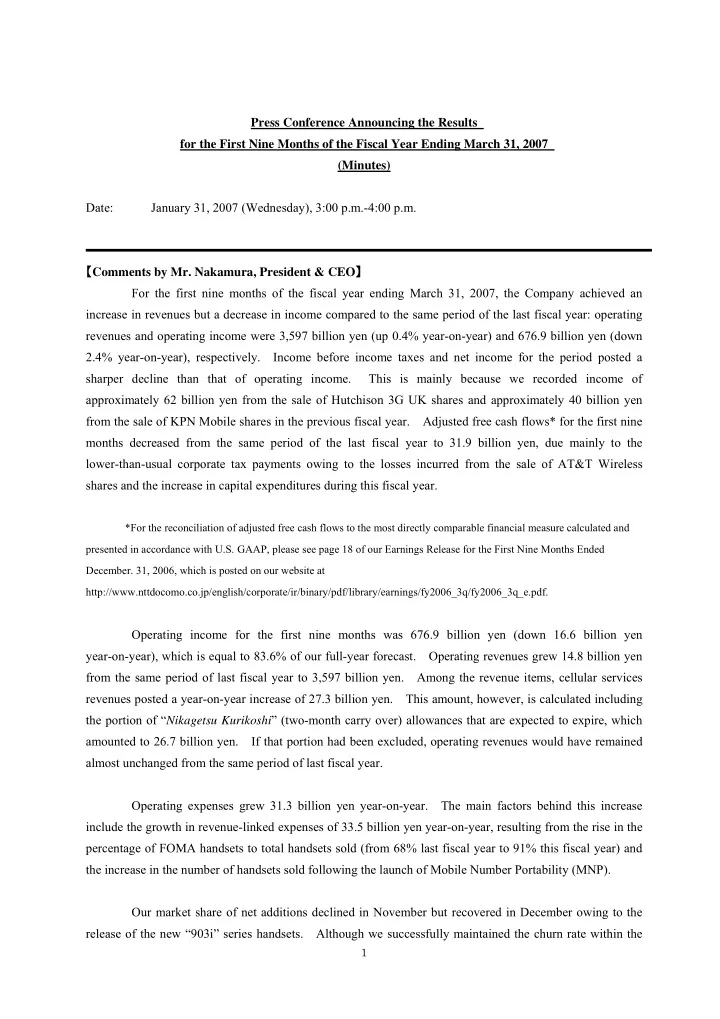
Press Conference Announcing the Results for the First Nine Months of the Fiscal Year Ending March 31, 2007 (Minutes) Date: January 31, 2007 (Wednesday), 3:00 p.m.-4:00 p.m. 【Comments by Mr. Nakamura, President & CEO】 For the first nine months of the fiscal year ending March 31, 2007, the Company achieved an increase in revenues but a decrease in income compared to the same period of the last fiscal year: operating revenues and operating income were 3,597 billion yen (up 0.4% year-on-year) and 676.9 billion yen (down 2.4% year-on-year), respectively. Income before income taxes and net income for the period posted a sharper decline than that of operating income. This is mainly because we recorded income of approximately 62 billion yen from the sale of Hutchison 3G UK shares and approximately 40 billion yen from the sale of KPN Mobile shares in the previous fiscal year. Adjusted free cash flows* for the first nine months decreased from the same period of the last fiscal year to 31.9 billion yen, due mainly to the lower-than-usual corporate tax payments owing to the losses incurred from the sale of AT&T Wireless shares and the increase in capital expenditures during this fiscal year.

*For the reconciliation of adjusted free cash flows to the most directly comparable financial measure calculated and presented in accordance with U.S. GAAP, please see page 18 of our Earnings Release for the First Nine Months Ended

  • December. 31, 2006, which is posted on our website at

http://www.nttdocomo.co.jp/english/corporate/ir/binary/pdf/library/earnings/fy2006_3q/fy2006_3q_e.pdf.

Operating income for the first nine months was 676.9 billion yen (down 16.6 billion yen year-on-year), which is equal to 83.6% of our full-year forecast. Operating revenues grew 14.8 billion yen from the same period of last fiscal year to 3,597 billion yen. Among the revenue items, cellular services revenues posted a year-on-year increase of 27.3 billion yen. This amount, however, is calculated including the portion of “Nikagetsu Kurikoshi” (two-month carry over) allowances that are expected to expire, which amounted to 26.7 billion yen. If that portion had been excluded, operating revenues would have remained almost unchanged from the same period of last fiscal year. Operating expenses grew 31.3 billion yen year-on-year. The main factors behind this increase include the growth in revenue-linked expenses of 33.5 billion yen year-on-year, resulting from the rise in the percentage of FOMA handsets to total handsets sold (from 68% last fiscal year to 91% this fiscal year) and the increase in the number of handsets sold following the launch of Mobile Number Portability (MNP). Our market share of net additions declined in November but recovered in December owing to the release of the new “903i” series handsets. Although we successfully maintained the churn rate within the

slide-2
SLIDE 2

2

range of our projections, we were not able to acquire as many subscribers who switched to DoCoMo from

  • ther carriers using MNP as expected, which resulted in the recent market share figures. By releasing

more new models, e.g., “One-segment” TV-enabled phones and the “703i” series, starting from late February to March in time for the spring sales season, we will strive even harder to achieve our target market share of net additions. Our cellular churn rate for the third quarter was 0.93%, which we maintained below the 1% target in

  • ur business plan. The low churn rate figures indicate that the market response to MNP has so far been

relatively quiet. We have continued to make steadfast progress with regard to the migration of subscribers to the FOMA network even after the launch of MNP. The total number of FOMA subscribers reached 32.11 million, or over 60% of our total cellular subscribers, as of December 31, 2006, showing favorable progress toward our goal growing FOMA subscribers to two-thirds of our total cellular subscribers by March 31, 2007. The cellular MOU per subscriber for the third quarter was 146 minutes, down 5 minutes, or 3.3%, year-on-year. The MOU performance has improved slightly compared to the first half of this fiscal year and we intend to keep a close eye on future MOU trends. ARPU for the third quarter decreased from the second quarter to 6,670 yen, but the pace of decline has slowed. While the downtrend of voice ARPU continues, packet ARPU posted year-on-year increases in five consecutive quarters since the third quarter of last fiscal year. [Future Action Plans] With respect to our initiatives relating to billing plans, the user base of our “pake-hodai” flat-rate package grew to 8.56 million as of December 31, 2006, nearly doubling in the last 12 months, as a result of the lifting of “pake-hodai” subscription restrictions in March 2006, and enriching the services through the introduction of “i-channel” and various music services. Because the increase in the uptake of “pake-hodai” is expected to contribute not only to the retention of existing customers but also to boosting revenues, we will strive to further expand its user base by contiuously increasing the variety of services accessible from “pake-hodai”. In view of the planned full-scale deployment of HSDPA and enrichment of video content, we plan to introduce two new flat-rate billing plans shortly: one dubbed “Pake-hodai full” for access via full-browser handsets in March 2007, and another called “Biz-hodai” for flat-rate packet communications via smart phones such as “M1000” and “hTc Z” in April. Both services will be offered for 5,700 yen (tax excluded) per month. Through the introduction of these new billing plans, we believe we can provide users with an environment through which they can access PC websites from full-browser devices more comfortably than

  • before. They are also expected to create new ways of usage, such as viewing videos on PC websites from

handsets compatible with Windows Media Video, e.g., P903iX.

slide-3
SLIDE 3

3

The provision of “Biz-hodai” service will also enable us to respond to advanced communications needs of our enterprise customers, allowing them to access corporate LAN systems from mobile devices. In addition, we are planning to introduce a FOMA 64kbps data-card flat-rate packet billing plan this autumn to replace the existing flat-rate plan via the PHS service. In the area of handsets, we plan to release new models that offer distinctive characteristics in time for the spring sales season, including the ultra-slim “μ-series” handsets that are only 11.4 mm thick and a double-screen model equipped with a versatile touch panel. The models in the “70X” series lineup are generally slim, light and compact, and they were developed with a special focus on exterior design. We also plan to release four more “One-segment” TV-enabled handsets, each of which offers unique capabilities: the BRAVIA phone and AQUOS handset featuring sophisticated screen quality, a slim model from Mitsubishi less than 20mm thick, and a model from Panasonic featuring long TV viewing hours. As for services, the combined subscriber base of our push information delivery services (“i-channel” and “Tokudane News Bin”) has risen to over 8.9 million as of December 31, 2006. The uptake

  • f “i-channel”, in particular, has grown at a remarkable pace, and its subscriber count is expected to top 10

million by the end of March 2007. The revenue contribution per subscriber from “i-channel” service was 370 yen for the third quarter of FY2006. We therefore expect this service to make great contribution to our revenues for the next fiscal year, because it could generate incremental revenues of approximately 45 billion yen with a subscriber base of 10 million. The membership of our DCMX credit payment service has grown at a pace faster than expected to

  • ver 1.5 million. The number of installed “iD” payment terminals (reader/writer machines) has grown as

planned to approximately 100,000 units as of December 31, 2006. We have been promoting the use of this service especially in convenience stores to accelerate the uptake of the mobile credit payment service, and convenience store chains such as Family Mart, Lawson and am/pm are planning to complete the installation

  • f “iD” payment terminals in all of their outlets by spring this year. The use of mobile credit service in

taxis is also expanding, and we hope this will provide users with an opportunity to utilize the mobile credit service more actively in their everyday life. We have aggressively rolled out FOMA base stations both indoors and outdoors in accordance with

  • ur plans. The coverage of HSDPA service, which enables packet access at even faster speeds, is planned

to reach 70% of the populated areas in Japan by the end of March 2007. The full-year capital expenditures are currently estimated at 916 billion yen, but it may end up higher than this forecast because we have been rolling out base stations faster than planned, and the total number of FOMA base stations as of March 31, 2007 is expected to be higher than the number presented at the time of the announcement of our first-half results on October 27, 2006. As for international services, we have made favorable progress in forming an operator alliance in

  • Asia. As announced in December, its name “Conexus Mobile Alliance” was officially adopted and a new
slide-4
SLIDE 4

4

partner, SMART, of the Philippines, has recently joined the alliance. The alliance will operate in nine countries and regions, and we intend to strengthen our international roaming and other services through this partnership. The user base of roaming-enabled handsets has grown to 3.2 million as of December 31, 2007. The percentage of own-handset roamers, who bring their own handset abroad to use roaming service, grew sharply to over 50% of our total roaming users. Leveraging the release of the 3G roaming-enabled “903i” series handsets, we aim to further grow our roaming revenues going forward. 【Questions and Answers】 Q: Your net income decreased 21.8% year-on-year for the first three quarters of FY2006 (April-December 2006), and 28.4% year-on-year in the third quarter (October-December 2006). What are the reasons for this decline? A: Income before income taxes and net income decreased sharply compared to the same period of last fiscal year primarily because we recorded a total of approximately 102 billion yen in non-operating income during last fiscal year, as we received proceeds from the sale of KPN Mobile shares of approximately 40 billion yen in the first quarter and the sale of Hutchison 3G UK shares of approximately 62 billion yen in the third quarter. Q: It seems that you are appropriating a large amount of capital expenditures for information systems in the fourth quarter. What kind of investments are you planning in concrete terms? A: This relates to the investment required for our new billing system, which is currently planned for introduction in the fall this year to replace the existing billing system. Q: What do you think about the track record of subscribers porting into and out of DoCoMo using Mobile Number Portability (MNP) compared against your initial projections? Do you foresee the need to revise your full-year results due to the impact of MNP? A: Our assessment of the overall market landscape following the launch of MNP is as follows: the percentage of subscribers porting out from DoCoMo to the total number of port-outs in the market is almost proportional to our cumulative market share, but we only acquired approximately 20% of the total port-in subscribers in the market. Softbank has acquired port-in subscribers proportional to its cumulative market share, but lost more port-out subscribers than its cumulative market share. au therefore increased its subscribers by the number tantamount to the discrepancy of port-ins and port-outs

  • f DoCoMo and Softbank combined.

Our full-year results will be affected by our sales performance during the coming spring sales season, which will begin in late February. As you may have noticed from the reduction in the market price of handsets, we have been increasing our distributor commissions, thus the full-year figures may vary depending on the actual handset sales during the spring campaign. The chances of an upward revision would be slim and I believe the circumstances will be tough. Because of MNP, it is difficult to predict how many handsets will be sold this spring. Q: How do you analyze your current score of port-ins and port-outs?

slide-5
SLIDE 5

5

A: According to a survey that we conducted to our customers, the main reasons why customers ported out or in are different among the three carriers. Subscribers who switched to DoCoMo from other carriers raised our “Family Discount” package and the design of our handsets as the primary reason for choosing us. When we single out the customers who ported into DoCoMo from Softbank, network quality was indicated as the primary reason. On the other hand, when we analyze the port-outs from DoCoMo to au, the “MY-wari” discount and other service charges were raised as the principal reason. However, when compared the number of subscribers who indicated network quality as their primary reason for their carrier selection, the number of customers porting into DoCoMo from au and the number of those porting out from DoCoMo to au were almost

  • identical. Subscribers who switched from DoCoMo to Softbank seem to have been influenced by

Softbank’s “Yoso-gai Wari (unexpected discount)”, because many raised the service charges as the main reason. Q: Give us your prospects on the growth of non-cellular services revenues, particularly the credit business revenues. A: The revenues from our credit payment business have not yet grown sizable enough to single out as an independent revenue item. We believe we are still at a stage of making investments in various basic facilities, so we cannot comment on the details concerning our credit business revenues. Q: You mentioned your plan to launch a new flat-rate service for Internet access via PCs in the fall this year. Why is the transmission rate limited to 64kbps, when many other services offer much faster speeds? A: We are launching this 64kbps flat-rate service for PC access as a replacement for the existing PHS flat-rate plan, which will be discontinued. The introduction of a full-scale flat-rate package for access via PCs is for future study. Q: How do you foresee future ARPU trends? A: During the last few years, voice ARPU has been declining at an annual rate of 5-6%, whereas packet ARPU has increased 6.5% every year. In absolute terms, voice ARPU has declined by approximately 300 yen every year from 4,000-5,000 yen per subscriber, while packet ARPU, on the other hand, grew by slightly over 100 yen from 2,000 yen per subscriber, which means we have not been able to completely

  • ffset the decline in voice ARPU by the rise in packet ARPU.

We believe packet ARPU will continue to rise in the future as we enrich our service offerings, but it is premature to determine at this point whether it can grow enough to completely offset the decline in voice ARPU. Q: Give us an overview on the outlook of your business plan for the next fiscal year. A: The ARPU trend and the number of net additions will definitely have a large impact on our revenues. The ARPU figures will be affected by how much we can offset the decline in voice ARPU by raising packet ARPU. Previously, the flat-rate package had a negative impact on our revenues, especially in the early days after its introduction, but nowadays it has become a positive factor, because subscribers who previously were low packet users began to join this service and pay a flat fee of 3,900 yen every month.

slide-6
SLIDE 6

6

In addition, the number of “i-channel” and other push information delivery services are growing sharply. We believe these two services will hold the key to our revenue growth in the future. The impact of MNP is subsiding month by month and we believe the competitive environment will return to normal in the next fiscal year. The introduction of MNP has not increased the total number of net additions in the market significantly, nor has it created new demand for cellular phones. We believe the total number of net additions in the market in the next fiscal year will be limited to approximately 80% of that of the current fiscal year. The question is how we can grow our revenues under such circumstances. On the expenses side, the key factor that would affect our sales cost would be the timing in which the market returns to normal competition, eliminating the impact of MNP. In my view, I believe the market will return to the state before the introduction of MNP at some point. Capital expenditures are another major element of our costs, but since our base station construction has already peaked, we believe we will be able to reduce our capital expenditures in the next fiscal year at least to a level lower than the current level. Q: When do you plan to enhance the transmission rates of your HSDPA service to 7.2Mbps? A: We have not made any decisions yet concerning the HSDPA speed enhancement to 7.2Mbps, but we are conducting studies to introduce this at an early date. Q: Recently, it is taking you nearly 6 months to actually release new products after unveiling them. Why is it taking so long? A: Due to competitive reasons, we have been unveiling new products earlier than before, which results in a longer lead time for their actual release. This, however, does not imply a delay in our development schedule. Q: Give us your outlook on your base station deployment plan for the next fiscal year and beyond. A: This fiscal year is the peak of our base station roll-out, but we will continue our coverage/quality improvement efforts in rural areas, city centers and inside buildings. Although we have not finalized a detailed plan yet, I believe we will probably need to spare several hundred billions of yen every year for the installation of base stations. Q: Give us updates on your current handset inventory level. A: At present, we believe our inventory is controlled at an adequate level. We will maintain a certain level of inventory prior to the March sales season after the new models become available in February, but basically, we believe we have maintained our inventory at an adequate level. Q: Explain your distributor commission strategy during the high sales period in the coming spring. A: Because we cannot precisely predict the impact of MNP, the actual amount of distributor commissions may vary depending on the volume of our handset sales. We will basically look at our sales

slide-7
SLIDE 7

7

performance and set commissions taking into consideration the price differential between our handsets and au’s. Q: Handset sales may be slow in January and February, but what kind of strategies are you planning to adopt for the important month of March, given that you lost to au in October-December 2006? A: As I stated on many occasions, MNP is not a one-time event. We must satisfy our customers in every aspect of our services, including the network, handsets, billing plans and others. We are not planning to do anything special just for the sake of the spring sales season. We must continue down-to-earth efforts, improving the network and offering handsets that will be well accepted by our customers. We will compete by leveraging all the efforts undertaken until now, including the release of new products, which will mostly become available before March, and the enrichment of music and other services. Q: What is your plan regarding the release of new HSDPA handsets in the future? A: As for the “70X” series phones, we will add models as adequate to maintain a wide variety of handsets in this product series. With respect to the “90X” series, on the other hand, we are basically studying to install HSDPA in future “90X” handsets as a standard feature. Q: Are you planning to seek damage compensation for the collection of defective batteries produced by Mitsubishi Electric and the lost revenue opportunities? A: We have so far attached priority on the replacement of batteries and we have not yet had any talks with Mitsubishi Electric regarding the costs incurred. We will study it after we have a better idea as to when we can complete the collection and replacement of the batteries. Q: The Mobile Business Study Group under the Ministry of Internal Affairs and Communications is expected to hold deliberations on the issue of SIM lock and MVNO. We would like to hear Mr. Nakamura’s personal views on these matters and your requests to the Study Group. A: The SIM lock issue encompasses very difficult discussions. We will never be able to maintain a viable business if the SIM lock is unlocked and a DoCoMo subscriber who bought a handset at an inexpensive price from us is allowed to switch the carrier immediately and enter into a service contract, for example, with Softbank. We cannot rule out potential risks of illegal shipment of handsets overseas either. I therefore believe it will not be possible to unlock the SIM unless handsets are sold at higher prices reducing the subsidies to distributors, or handsets are sold to subscribers together with a service contract defining the period of use under the same carrier. Another major problem is the difference in the technical standards adopted. The handsets to be offered by DoCoMo, Softbank and eAccess will be interoperable because they are based on the same W-CDMA

  • standard. au, on the other hand, uses a different standard called cdma2000, so even in the event au

unlocks the SIM, the handset cannot be used on the networks of other carriers in Japan. In other words, the conditions for competition will inevitably be different between the W-CDMA and cdma2000 camps. In addition, if the SIM is unlocked, users may no longer be able to use i-mode and other sophisticated services offered by each carrier, and the phone’s functions could be limited to voice calls and short messages only.

slide-8
SLIDE 8

8

Furthermore, if the market prices of handsets go up, users will likely replace handsets less frequently than before, which will reduce the total amount of handset sales from the current level of 50 million units per year. Its impact on players other than carriers, such as the eleven Japanese handset manufacturers and numerous distributors, needs to be duly considered. The issue of unlocking the SIM needs to be discussed taking into account the quality of services offered to customers, the competition amongst mobile carriers, the impact on manufacturers and the mobile industry as a whole, as well as implications in terms of Japan’s global strategies. Regarding MVNO, DoCoMo has never raised any objection to the introduction of the MVNO system. We, however, believe that this should be negotiated between the parties in a way that will allow them to create a WIN-WIN situation, and we hope the Study Group will intensify its deliberations on this matter taking various issues into consideration, e.g., the actual traffic conditions on the network and whether it is adequate to obligate carriers to grant MVNO access or introduce quasi-obligatory regulations. Q: After given instructions from the Japan Fair Trade Commission (JFTC) regarding the representations used in the advertisements of mobile carriers, I believe the mobile phone industry is now discussing whether to introduce industry-wide rules or stipulate new rules in accordance with the regulations set forth by the

  • JFTC. What is your view on this issue?

A: We are still discussing with the relevant parties in the industry, and I do not think we have found a clear direction for the future yet. Because we already have rules set forth by an association responsible for promoting the enhancement of telecommunications services, our basic position is to add more rules where necessary, and review carefully so that we can share a clearer view on what has to be observed. As far as I understand, the mobile carriers are currently in the middle of discussions as to how to ensure compliance with the rules.