
SLIDE 1
Presented by: Dr. Earl R. Perkins
LAUSD Office of the Superintendent – School Operations
Assistant Superintendent
Tuesday, February 11, 2014 at
Presented by: Dr. Earl R. Perkins Assistant Superintendent LAUSD - - PowerPoint PPT Presentation
Presented by: Dr. Earl R. Perkins Assistant Superintendent LAUSD Office of the Superintendent School Operations Tuesday, February 11, 2014 at FOCUS OF DISCUSSION About LAUSD 3 Common Categories of Disaster Plan, Prepare
Presented by: Dr. Earl R. Perkins
LAUSD Office of the Superintendent – School Operations
Assistant Superintendent
Tuesday, February 11, 2014 at
About LAUSD 3 Common Categories of Disaster Plan, Prepare and Respond LAUSD Response and Recovery Emergency Operations Plan in LAUSD School Site Emergency Management Organization Chart Emergency Operations Center (EOC)
Health and Safety – Response and Resolution Technology Back Up and Recovery Plan Emergency Communication Plan References and Resources
1
Notes: (1) includes classroom teachers and non-classroom teaching positions, such as instructional coaches. (2) Includes school-based administrators and non school- based ESC and central office administrators. (3) Includes non-teaching and non-administrative certificated personnel, including nurses, counselors and school psychologists.
Second largest in the nation, the Los Angeles Unified School District in 2012-2013 SY enrolled 655,716 students in kindergarten through 12th grade and 255,697 adult education students, at over 1,278 schools and centers.
SCHOOLS AND CENTERS STUDENT ENROLLMENT SCHOOL DISTRICT EMPLOYEES
*Figures reflect October 2011 data. **Count does not reflect total enrollment of Special Education students, including those attending regular Pre-K to 12th-grade LAUSD schools.
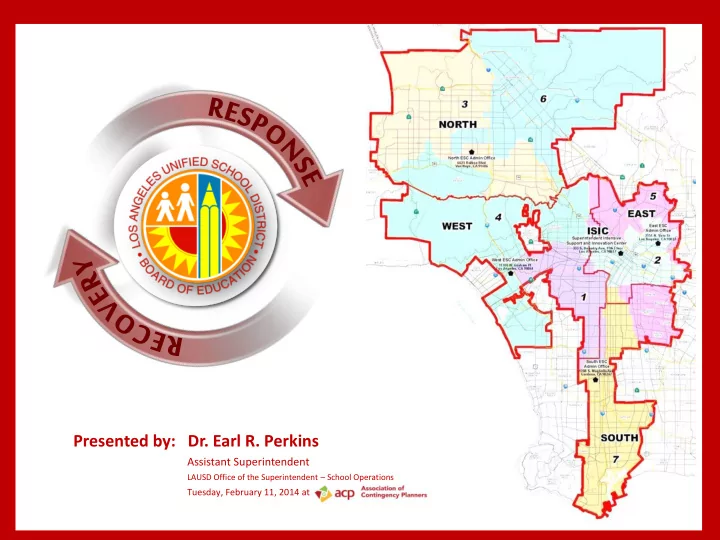
LAUSD reorganized in 2012-2013 SY into five Educational Service Centers (ESC), serving elementary, middle and senior high schools.
ESC North 6621 Balboa Blvd., Van Nuys, CA 91406 (818) 654-3600 ESC South 1208 Magnolia Ave., Gardena, CA 90247 (310) 354-3400 ESC East 2151 North Soto St., Los Angeles, CA 90032 (323) 224-3177 ESC West 11380 West Graham Place, Los Angeles, CA 90064 (310) 914-2102 Intensive Support & Innovation Center (ISIC) 333 South Beaudry Avenue, 11th Floor, Los Angeles, CA 90017 (213) 241-0167
LOS ANGELES UNIFIED SCHOOL DISTRICT
2
3
PLAN
Emergency Supplies
Supplies
Management Supplies
students on respirators)
PREPARE
Emergency Preparedness at Schools (STEPS)
Procedures
RESPOND
Active Shooter on Campus Aircraft Crash Animal Disturbance Biological or Chemical Release Bomb Threat Bus Disaster Disorderly Conduct Earthquake Explosion/Risk of Explosion Fire in Surrounding Area Fire on School Grounds Flooding Loss or Failure of Utilities Motor Vehicle Crash Public Health Emergencies Psychological Trauma Suspected Contamination of Food or Water Threat of Violence Tsunami Response Unlawful Demonstration/Walkout
4
The safety of children is the top priority in the Los Angeles Unified School District during a disaster! We plan and prepare for various emergency situations and work to mitigate hazards of all kinds in and around
dangerous person scenarios annually.
If there is an emergency at school, school personnel have been trained, and will react quickly to protect children. Students will not return until the buildings have been inspected and it is determined to be safe to enter.
Schools will act with the safety of students in mind, and school officials will always follow the directives of the police department and the fire department. In rare instances, where more distance is needed to ensure student safety, students may be relocated to another school site.
Section 3100 of the Civil Code stipulates that all public employees are “Disaster Service Workers” and as such, LAUSD employees will be tasked to care for students during a disaster as part of that responsibility.
If it is hazardous for students to be released, everyone will be kept inside the school until they are notified by the authorities that it is safe.
5
California Education Code, Sections 35295-35297 (The Katz Act), Section 40041, 40042. Requires that a school site disaster plan outline roles, responsibilities, and procedures for students and staff. It also requires that the school site emergency management
2400, and be ready for implementation at all times.
The California Emergency Services Act, provides overall statewide authorities and responsibilities, and describes the functions and operations of government at all levels during extraordinary emergencies, including wartime. Section 8568 of the Act states, in part, that "...the State Emergency Plan shall be in effect in each political subdivision of the state, and the governing body of each political subdivision shall take such action as may be necessary to carry out the provisions thereof." Local emergency plans are, therefore, considered to be extensions of the California Emergency Plan.
6
In LAUSD, response levels are used to describe the type of incident. Deciding factors include: areas affected, extent of coordination or assistance needed, and degree of participation expected from the School District. Response levels are closely tied to emergency proclamations issued by the head of local government.
7
This chart can be expanded or abridged to meet the scope of the incident that is being managed. This chart shows the management
response to an emergency. The
to various elements of the emergency will report in to the people listed on the chart. If no one is assigned to a position, it is assumed that the person who manages that position is keeping, and doing, the responsibility for the unfilled position.
The Incident Command System
Note: This organization Chart is based on ICS and adapted for LAUSD use. The Principal and School Safety Committee should use discretion in making further modifications to address specific needs of the school. The first name in the box represents the primary responsible person ; the second name denotes the backup.
SCHOOL SITE EMERGENCY MANAGEMENT ORGANIZATION CHART
Incident Commander 1._________________ 2._________________
Public Information Officer _____________________ Safety Coordinator (Optional) ___________________ Planning/Intelligence 1.__________________ 2.__________________ Operations .______________ 2.______________ Logistics 1.________________ 2.________________ Finance/Administration 1.______________ 2.______________ Communications 1.__________________ 2.__________________ Documentation 1.__________________ 2.__________________ First Aid/Medical Team(s) 1.____________________ 2.____________________ Security/Utilities Team(s) 1.____________________ 2.____________________ Fire Suppression/HazMat Team(s) 1.____________________ 2.____________________ Request Gate Team(s) 1.____________________ 2.____________________ Search and Rescue Team(s) 1._________________ 2._________________ Assembly Area Team(s) 1._________________ 2._________________ Psychological/First Aid Team(s) 1._________________ 2._________________ Reunion Gate Team(s) 1._________________ 2._________________ Supply/Equipment 1.________________ 2.________________ Transportation 1.________________ 2.________________ Staff Accounting 1.______________ 2.______________ Cost Accounting 1.______________ 2.______________
LOS ANGELES UNIFIED SCHOOL DISTRICT
LOS ANGELES UNIFIED SCHOOL DISTRICT • SCHOOL OPERATIONS – EMERGENCY SERVICES (213) 241-5337
8
meet the realities of the situation.
financial reasons.
Superintendent informed of the progress and strategies being implemented during the response.
acts as Safety Officer to make sure that the safety of students and staff and others on the site is the highest priority. The positions of information officer and liaison can also be performed by the Emergency Manager when designated persons are not available.
Communications System.
where resources cannot accomplish needed changes.
be in the EOC throughout the response and use a "hands-off" approach to managing response activities.
9
An emergency requires constant management. This means that the Emergency Operations Center shall have management represented AT ALL TIMES. In the District, this responsibility falls upon the Emergency Operations Center Director, who is appointed by the Superintendent.
10
The District Office of Environmental Health (OEHS) is responsible for maintaining district compliance with all environmental health and safety rules, regulations and laws. OEHS has a team
with conducting inspections, providing guidance, responding to emergencies and assisting in clean up and recovery from environmental mishaps and
and response guidance documents that are aligned and in compliance with Federal, State and local laws and regulations. OFFICE OF ENVIRONMENTAL HEALTH AND SAFETY (OEHS) MAINTENANCE & OPERATIONS Local Maintenance and Operations Areas will inspect all utilities at shelter sites to make sure they are functioning
placed on emergency requests where there is an immediate threat to life, safety and health. CAFETERIA EMPLOYEES The cafeteria should be given high priority for checking after an emergency because of possible safety hazards and the need for the cafeteria staff to have access to food. Cafeteria workers inventory food and water on hand and if instructed by the site administrator prepare food for the next meal. They are to prepare cold meals, such as sandwiches, using perishable food first. They are to report status to the Cafeteria Manager and Satellite Kitchen Supervisors. TRANSPORTATION EMPLOYEES
EMERGENCY OCCURING WITH STUDENTS ABOARD BUSES All drivers whose buses are enroute will pull to the side of the road, away from tall buildings, trees, street lights, and power lines if possible. They are not to stop on or below overpasses or bridges. Driver will move the bus, if necessary, and park in a safe location. The driver may also drive to the nearest LAUSD school. Drivers will have roster of all students. If students are walked to a school site, information regarding the names of students and location will be left on the bus. Drivers will wait for further instructions from the school administrator if contact with Dispatch cannot be made. EMERGENCY OCCURING WHILE STUDENTS ARE IN SCHOOL Buses will not attempt to pick up and return students to their sending school/home until authorized by District’s Emergency Operations Center via Transportation Bus Operations Dispatch, School Police or Transportation Branch Staff. OUT-OF-AREA TRIPS Drivers on special trips outside the District will attempt to make radio contact with their Dispatch office and to return to the nearest District secondary school. The driver and student must remain at that location until they can return safety to their sending schools/ home.
Operations Staff Support
11
RESPONSE AND RESOLUTION
SERVING SAFE FOOD
The LAUSD Food Services Division is responsible for the
second largest National School Lunch Program (NSLP) in the United States. This amounts to approximately 650,000 student meals served daily. The Newman Nutrition Center, the Division’s packaging facility, prepares 220,000 of those meals every day and distributes them to satellite kitchens. Overall, the Division serves meals to more than 500,000 kids daily in more than 1,100 different locations.
Thousands of District students are transported many miles to and from school every day. After any disaster, many students may not be able to return home until the roads and transportation systems are restored. It is the responsibility of the school staff to protect and care for the students until they are reunited with their parents, guardians or their approved
the case of an emergency. LAUSD School Administration works with the Food Services Manager to determine what foods are available for emergency use at the site, and plan for the purchasing and storage of additional emergency foods. The availability of food products from LAUSD Food Services will vary depending on the type of cafeteria at a school. Due to storage issues and delivery schedules for schools, Food Services cannot guarantee that a three day supply of food will always be available at each school site cafeteria.
12
RESPONSE AND RESOLUTION
SERVING SAFE FOOD
SCHOOLS SERVING FOOD
NEWMAN NUTIRITION CENTER
LAUSD emergency protocols anticipate that a three-day food supply will be made available at each school in the case of an emergency.
products, such as fruit and vegetables
as graham crackers and cereals
produce Newman Nutrition Center Sites (satellite kitchens) will have:
including graham crackers and cereal
meals such as frozen burritos (lack
prohibits the storage of additional food items not on the menu)
Emergency Supplies
School are able to purchase and store shelf-stable meals. Each meal consists
package of graham crackers. Elementary and secondary schools serving food not delivered from the Newman Nutrition Center will have the following types of stored food:
13
14
LAUSD INFORMATION TECHNOLOGY DIVISION DISASTER RECOVERY AND BUSINESS CONTINUITY PLAN
The Disaster Recovery and Business Continuity Plan program is devoted to protecting the District’s technology investments and efforts in development of the 21st century learning environment.
DISASTER RECOVERY BUSINESS CONTINUITY Recovery of critical technological systems in the event of major disaster Continuity of business processes in the event
15
Why is the Disaster Recovery and Business Continuity program necessary?
Many of LAUSD’s mission critical functions rely
could potentially be crippled if there were ever a major disaster within LAUSD’s Data Center. The Disaster Recovery and Business Continuity program addresses the most “At Risk” business processes:
FOOD SERVICES
STUDENT TRANSPORTATION
SCHOOL POLICE PAYROLL FACILITIES SERVICES SCHOOL & STUDENT INFORMATION
LAUSD’s Wide Area Network is composed of Four Nodes. Schools connect through their local node to access business and educational applications and to the internet.
Van Nuys
A
West LA
B
Central LA
C
Gardena
D
As part of the data recovery and business continuity program, data back at the backup site guarantees faster recovery to primary data center.
Why is the Disaster Recovery and Business Continuity program necessary?
DATA NETWORK
16
In the event of a district-wide emergency, senior high schools and middle schools have radios that can contact School Police dispatch on “Frequency 2” of their school base station. School Police Dispatch will set aside frequency 2 for school communication.
450 Mhz FREQUENCY 2
In the event of a district-wide emergency, the EOC will use Bus Channel 5 as the command
emergency, when all other means
District executive staff has the ability to use hand-held radios tuned to LAUSD Bus Channel #5. This channel, which is one of five normally used by school buses, is a clear channel for the entire District.
800 Mhz FREQUENCY 5
17
The Blackboard Connect service provides the District with time-sensitive information-via voice, text, e-mail and more. It alerts its stakeholders and enhances their safety by keeping them informed, involved and prepared. Blackboard Connect gives the ability to notify and update the entire District within minutes of a time- sensitive situation. From any location, information can be dispensed using concise, on-time messaging that helps contain rumors, control media spin and restore safety. The system provides information and reassurance to parents, faculty and media-all while communicating with the District Emergency response teams and staff. Web EOC
Web-EOC is internet- based Emergency Operations Management software that is installed on the District network and is used for EOC communications and response documentation.
18
19