presentations some hints some hints How to give good seminar - - PDF document

presentations some hints some hints how to give good
SMART_READER_LITE
LIVE PREVIEW

presentations some hints some hints How to give good seminar - - PDF document

1 presentations some hints some hints How to give good seminar Friedemann Mattern , ETH Zurich presentations March 2013 Why should we care? Presentation skills are required in professional life Present yourself, your research,


slide-1
SLIDE 1

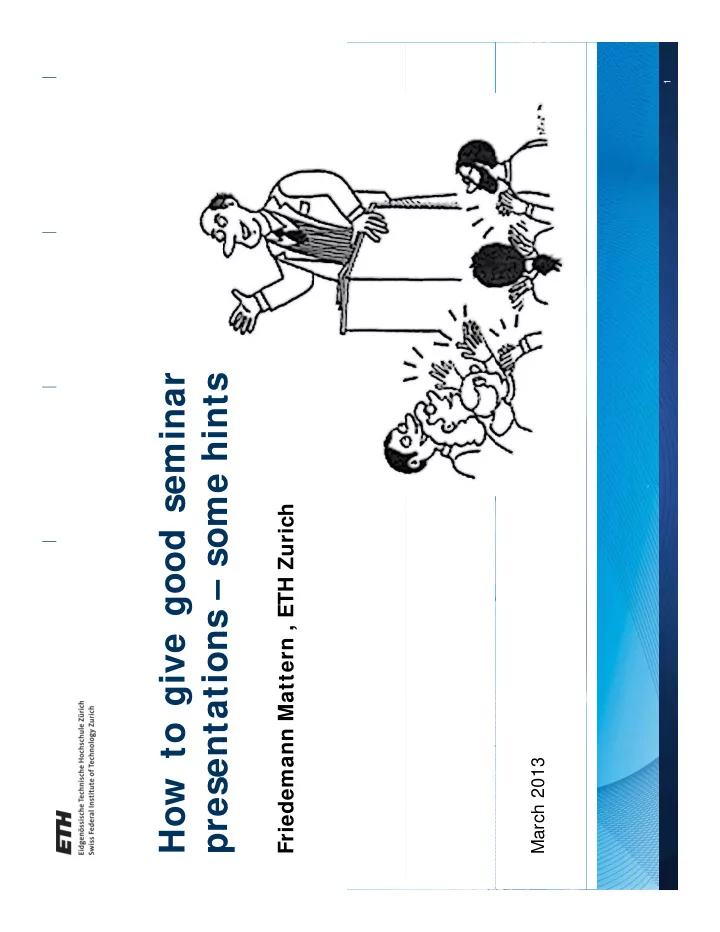
How to give good seminar presentations – some hints

Friedemann Mattern , ETH Zurich

presentations some hints

March 2013

1
slide-2
SLIDE 2

Why should we care?

Presentation skills are required in professional life

Present yourself, your research, your company, an idea, a product… You are often evaluated based on a presentation

In the context of this seminar learn how to present In the context of this seminar, learn how to present

scientific content

Also learn

How to digest different knowledge sources and make a consistent

picture out of it picture out of it

To present the result in a structured way, adequate for the audience To make and defend your point in front of a group

5

slide-3
SLIDE 3

The 80-20 rule of presentations

80% presentation, 20% content?

No!

Clearly, content is crucial But content does not get through if presentation is

Confusing Boring Too advanced (or too easy) for the audience Too long (or too short) Too long (or too short) …

6

slide-4
SLIDE 4

Outline

Basics Preparing the slides

h

Giving the presentation

7

slide-5
SLIDE 5

Goal: Maximize benefit for the audience

((For once, you are a teacher!))

C id t t l t d i f th t ti

Consider structure, layout, design of the presentation What can be assumed the audience knows?

What not?

How can we arouse interest in the audience? Maximize knowledge transfer Think of your audience – assume you are part of it

8

slide-6
SLIDE 6

When preparing a talk…

For whom is the presentation?

Target audience, knowledge, expectations

What is the message you want to convey? What is the purpose of your presentation?

Teach, inspire, sell, convince,…?

What (technical) equipment do you have available?

Room projector blackboard light Room, projector, blackboard, light, …

In the context of this seminar, the answers should be given!

9

slide-7
SLIDE 7

Academic presentations

Limited time (e.g., 20, 30, or 45 minutes)

Fix your milestones Know when you should be where in your talk Be ready to shorten your talk dynamically

B d t ti f th di d l i t lk

Be prepared to questions from the audience delaying your talk

Message

Message

A novel scientific result, a report on

your and/or others’ work

Make clear what is your contribution

and what is general knowledge or results achieved by others

10

slide-8
SLIDE 8

Plagiarism

Make a clear difference between your results and

those of others

Report all your references and cite them properly

Briefly in the talk, but fully in the written report

Plagiarism has many forms

Copy & paste without explicit citation

py p p

Paraphrase of text without reference Unacknowledged adoption of ideas, structure, design, …

Keep your presentation prosaic, objective, factual

Convince with arguments, not with rhetoric

g ,

You are not a salesperson

11

slide-9
SLIDE 9

You are not a salesperson

12

slide-10
SLIDE 10

Academic presentations (I I )

Try to convince, not to persuade

I think you should be more li it h i

Read and use the literature in a critical way

The authors are almost always right

explicit here in step two

Read and use different references

Typically, scientific articles are more

yp y, reliable than information on the Web

You should understand 100% You should understand 100%

  • f what your are saying

13

slide-11
SLIDE 11

“Whereof one cannot speak, thereof one must be silent” thereof one must be silent

„Wovon man nicht reden kann,

d üb h i “ darüber muss man schweigen“

Ludwig Wittgenstein

(last sentence of his Tract Log Phil 1922) (last sentence of his Tract. Log. Phil., 1922)

14

slide-12
SLIDE 12

I ntellectual challenge and clarity of thought

?

Information processing in your head

15

slide-13
SLIDE 13

I nformation processing

Use your own words

Do not paraphrase or just translate from

h l

?

  • ther languages

Be careful with foreign languages

Be careful with foreign languages

E.g., “Operating system” (EN) Betriebssystem (DE)

  • not: Operationssystem

Focus on relevant aspects

Identification of “the” relevant aspects is the most important point But go into details when necessary or appropriate

Avoid abbreviations and acronyms whenever possible Avoid abbreviations and acronyms whenever possible

16

slide-14
SLIDE 14

Preparation

Observe and evaluate other

speakers

Do they do it well? Why? How? Do they do it well? Why? How?

Practice your talk

Make a true “dress rehearsal”

Test your presentation

Test your presentation

Animations, colors, …

Know your audience Know your audience

Competences, expectations

D l

17

Dress properly

slide-15
SLIDE 15

Preparation (I I )

Complete your preparation on time

Not just the night before…

Be on time the day of the presentation

Take some time to check projector and laptop configuration Take some time to check projector and laptop configuration What if something does not wok?

Be prepared for spontaneous drawings

Clean the blackboard Make sure chalks / markers are available Make sure chalks / markers are available

18

slide-16
SLIDE 16

Be prepared to questions and discussion

Allow time for it Your answers should show that you are Your answers should show that you are

competent

How you reply to questions could be an How you reply to questions could be an

important issue when your talk is used to evaluate you (e.g., as part of a job interview)

19

slide-17
SLIDE 17

Outline

Basics Preparing the slides

h

Giving the presentation

21

slide-18
SLIDE 18

Slide layout

Rule of thumb: only one train of thoughts per slide

Bullet points / key phrases better than complete sentences

Slide title should summarize the content of the slide

In a meaningful and self-contained way

In a meaningful and self contained way

Sometimes people only read the title of a slide ( newspapers)

F d i t ti id l d t t

For academic presentations avoid logo, name, date, etc.

  • n every slide

This is not a sales pitch Background noise Risk of drawing off attention from content But: Corporate design?

But: Corporate design?

22

slide-19
SLIDE 19

Slide layout (I I )

Font

Sans serif (e.g., “Arial” or “Tahoma”) Do not mix (too many) different fonts (size / style) on a slide

Font size Font size

Must be “big enough” (rule of thumb?)

  • 12pt, 16pt, 18pt, 20pt, 24pt, 28pt

p

Bullet points

D “ ” ( h 7 i i lid )

Do not “exaggerate” (no more than ~ 7 main items per slide)

23

slide-20
SLIDE 20

Slide layout (I I I )

Avoid overloading your slides

Not meant to provide full content

Be careful (and frugal) with animations No point in quickly browsing through slides

  • ne has not enough time for presenting

g p g

24

slide-21
SLIDE 21

I mages, plots, and diagrams instead of text

“A picture is worth a thousand words.”

But: avoid too striking pictures

( l h k / k (unless you want to shock / provoke your audience)

Plots / diagrams must help you in

making your point

They must be easy to explain / understand They must be easy to explain / understand

Photographs convey emotions, graphics

g p y , g p and drawings convey exactness

25

slide-22
SLIDE 22

Schemes and graphics, an example

A cluster has the following form: id t CLUSTER [ ] IS id t ident = CLUSTER [parms] IS ident cluster_body END ident CLUSTER <parms> IS <ident> REP = <type_spec> <procedure>... END id t cluster_body = REP = type_spec routine {routine} routine = procedure END <ident>

cluster body

routine procedure

Much better:

  • Striking
  • Less text
  • Less text
  • Less forward references

26

slide-23
SLIDE 23

The power of colors

27

slide-24
SLIDE 24

Outline

Basics Preparing the slides

h

Giving the presentation

28

slide-25
SLIDE 25

Start with an outline of the talk?

A matter of taste Do not spend too much time explaining the outline

High risk of boring your audience List few, self-explaining items

, p g

A (negative) example:

Introduction [Necessary?] Topic 1 Subtopic 1 bla bla [Avoid nested bullet points in the outline!] T

i 2

Topic 2 … Topic 7 [too many items!] S

[N ?]

Summary [Necessary?]

29

slide-26
SLIDE 26

Make a good start

Be happy! Look at your audience

Not at slides, laptop, window, … Not at one single person (e g

professor)

Not at one single person (e.g., professor)

Friendly start of the talk

y

Welcome Present yourself Present your topic Present your topic If applicable, put your presentation in context

(e.g., relation to previous presentations in the seminar)

30

slide-27
SLIDE 27

Beware of yourself!

Look

At your audience

Speak

Slowly (enough) Loud (enough) Fluently Free (do not memorize your talk!)

Free (do not memorize your talk!)

Pause if necessary or appropriate

Move

Move

Slowly (avoid hopping around) Use your mimic (hands / body)

Do not stand between the projector and the projected area

Do not stand between the projector and the projected area

31

slide-28
SLIDE 28

During the presentation

Engage with your audience

Eye contact Questions Provocations, contradictions, surprises? (risky, but effective)

Motivate your audience

Why is your presentation worth listening to?

h h l ?

Why are you worth listening to?

Remain authentic stay calm be flexible

Remain authentic, stay calm, be flexible

Be ready to react to questions, interruptions

32

slide-29
SLIDE 29

Almost done

Do not leave important questions unanswered

at the end of the presentation

Open issues should be explicitly addressed (e.g., future work)

Provide a summary of the main message of your Provide a summary of the main message of your

presentation

Try to close the circle: link the results at the end to the

ti ti ti t th b i i motivating questions at the beginning

Make clear that the end of the talk has come

Make clear that the end of the talk has come

Keep on looking at the audience Thank and the audience Ask for questions Ask for questions

33

slide-30
SLIDE 30

Summary

Understand your topic Be well prepared

Be well prepared

Structure and balance your talk well Think of your audience

Think of your audience

Keep the time Stay calm, be flexible

Stay calm, be flexible

… and it will be a great success!!

34

slide-31
SLIDE 31

How to give good seminar presentations – some hints

Friedemann Mattern , ETH Zurich

presentations some hints

Pictures from: www.leander.lib.tx.us/ LILT/citing and www1.ku-eichstaett.de/PPF/PDMueller/lerntech/referat/

36