Presentation to VRIC: Global Genomics & Bioinformatics Research - - PowerPoint PPT Presentation

presentation to vric global genomics bioinformatics
SMART_READER_LITE
LIVE PREVIEW

Presentation to VRIC: Global Genomics & Bioinformatics Research - - PowerPoint PPT Presentation

Presentation to VRIC: Global Genomics & Bioinformatics Research Institute (GGBRI) May 24, 2017 Agenda Global Genomics & Bioinformatics Research Institute (GGBRI) Capital Request Recruitment Request 2 GGBRI Overview


slide-1
SLIDE 1

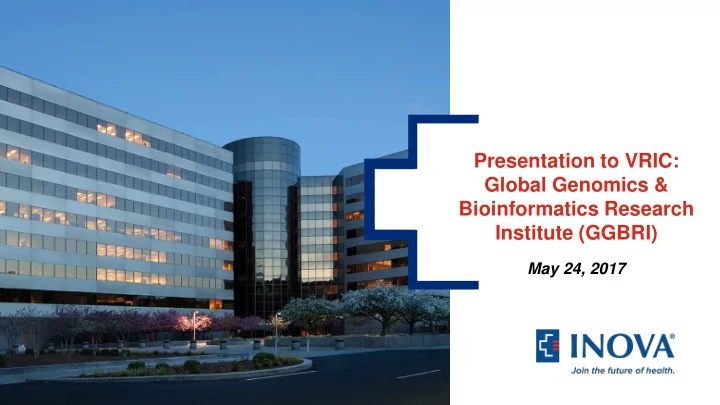
Presentation to VRIC: Global Genomics & Bioinformatics Research Institute (GGBRI)

May 24, 2017
slide-2
SLIDE 2

Agenda

  • Global Genomics & Bioinformatics Research Institute (GGBRI)
  • Capital Request
  • Recruitment Request

2

slide-3
SLIDE 3

GGBRI Overview

slide-4
SLIDE 4

Virginia as a Global Life Sciences, Research & Commercialization Leader

Commercial Life Science Companies Clinical Services Translational Research

Entrepreneurs Venture Capital Accelerators Biomedical Sciences Research

+ University and Commercial Partners

Engineering:

Biomedical, Mechanical, Materials

Sequencing

Computational Science Bioinformatics Big Data

4

slide-5
SLIDE 5

GGBRI Strategic Objectives

  • Improve the health of all Virginians
  • Form collaborative partnerships that fully leverage and integrate, rather than duplicate, the

strengths of Virginia’s health, research, and scientific assets from Virginia’s research universities and the commercial sector

  • Partner with NSF, DOD, NIH and other research sponsors to leverage new research and

innovation to drive regional and statewide economic development

  • Attract the world’s most outstanding eminent research scientists to Virginia as part of a

globally leading life science and research ecosystem

  • Leverage new scientific discoveries and intellectual property into new drugs, devices, and

novel therapies

5

slide-6
SLIDE 6

ICPH Campus

Clinic

A

Cancer Institute

B

Research - GGBRI

C

Technology

D

Conference Center

E

A B C D E

6

slide-7
SLIDE 7

Strategy and Focus

  • GGBRI Mission

− The overarching mission of the Institute is to improve the quality of the human condition and its environment

  • Five key areas of research

− Genetics and Genomics, understanding how the genome regulates its function in health and disease − Structural Biology of Disease/Systems Approach − Developmental Biology − Computational Biology − Biomedically Directed-Engineering

7

slide-8
SLIDE 8

Institute Design

  • Retained HDR, an internationally leading healthcare and research design and

architecture firm

  • Examined other U.S. and international research institutes for design best

practices

  • Developed core design principles:

– Space flexibility – Space that facilities active collaboration – Space that includes key shared cores, including a biorepository

8

slide-9
SLIDE 9

Governance

  • Established the GGBRI as a Virginia non-stock corporation; anticipate seeking tax

exempt status

  • Named Dr. John Niederhuber as GGBRI CEO
  • Created an initial five person Scientific Advisory Committee (Dr. Margaret

Shupnik, Dr. Steve Rich, Dr. John Niederhuber, Dr. John Deeken, Dr. Deborah Crawford)

  • Intend to establish an External Advisory Committee of nationally and

internationally recognized scientific leaders

9

slide-10
SLIDE 10

Update on Collaborative Partnerships

  • Inova-UVA signed MOU; held research retreat; established $500,000 joint seed fund for

collaborative research – 27 proposals received, funded nine; GGBRI collaboration for Institute renovations and build out, Institute planning, and recruitment

  • Inova-GMU signed MOU; GGBRI collaboration for Institute renovations and build out and

for development of proteomics core

  • Inova-VCU research retreat held; GGBRI collaboration for recruitments and programs and

pharmacogenomics research collaboration based on UVA/VCU discussions

  • Inova, Virginia Tech, UVA analytics retreat held with interested commercial partners;

working to establish predictive analytics partnership

  • Inova, UVA, and VCU co-hosted the V Foundation’s “Virginia Vine” cancer research event
  • UVA introduced the GGBRI partnership at the MedImmune BioHealth Capital Region Forum

and the Cavendish Institute and the Cavendish Global Health Impact Forum

  • Met with VEDP to discuss commercial partnership recruitment opportunities

10

slide-11
SLIDE 11

Capital Request for Lab Renovations and Enhancements (Budget Item 478.20 A.2.)

slide-12
SLIDE 12

Statutory Requirements

  • Partnering Entities (Budget Item 478.20.B.1): Inova Health System, University
  • f Virginia and George Mason University.
  • Vetting Process (Budget Item 478.20.B.2): The Institute’s Bylaws establish a

Scientific Advisory Committee (SAC) with responsibility to review the initial plan for lab renovations and enhancements and/or research equipment to ensure that the renovated facilities and equipment will support state of the art research in the areas of genetics, functional genomics, functional biology, biology driven engineering, bioinformatics, personalized medicine and related translations

  • research. Such vetting has taken place and the unanimous action of the SAC

approving such plan is documented in our funding request.

12

slide-13
SLIDE 13

Statutory Requirements

  • Matching Funds (Budget Item 478.20.B.3-4)

– As reflected in Inova’s Letter of Commitment included with our funding request, Inova Health System has committed to contribute a minimum of Forty Million Dollars ($40,000,000) to be used for the Capital Project (renovations, enhancements, and build out) – As reflected in their respective Letters of Commitment included with our funding request, UVA and GMU have committed to collectively contribute a minimum of Twenty Million Dollars ($20,000,000) to be used for the Capital Project, at least half of which is from New Resources.

  • “New Resources” – None of these funds have been appropriated by the General

Assembly for some other purpose, and none are being re-purposed for the Institute.

13

slide-14
SLIDE 14

Design – Selection of HDR

  • HDR selected through a competitive qualification & interview process
  • HDR qualifications:

– #1 Healthcare Design Firm

  • Modern Healthcare (for 13 consecutive years: 2003-2016)
  • World Architecture Survey and Building Design + Construction

– #1 Science & Technology Design Firm

  • Building Design + Construction
  • +250M SF research space completed

– 9 Lab of the Year Awards from R+D Magazine

  • 2016 Special Recognition for Design for University of Texas MD Anderson, Zayed Building for Personalized

Cancer Care

  • National experts in translational health sciences lab facilities

– UVA School Of Medicine MR #4 Building

  • Extensive experience in adaptive reuse and renovation projects

14

slide-15
SLIDE 15

Design Concepts

15

  • Applied best practices from state of the art

research labs:

– MD Anderson BSRB – UCSF Diller Cancer Center – Moffitt Cancer Center – Johns Hopkins Kimmel Cancer Center – UT MD Anderson, Zayed Building for Personalized Cancer Care

  • Generation of ideas facilitated by:

– Collaborative work environments that foster teaming and open communication – Ease of traveling between spaces (e.g., internal stairwells vs elevators) – Mix of spaces to work together or alone – Technical walls for image visualization and display – “Work cafés” as impromptu meeting spaces

slide-16
SLIDE 16

Design Process

16

slide-17
SLIDE 17

70% / 30% Target Ratio

Wet Lab 70% Office / Dry Research 30%

17

slide-18
SLIDE 18

Research Building – Stacking Diagram

  • xxx

18 18

slide-19
SLIDE 19

Research Lab Floor – Concept Plan

19

slide-20
SLIDE 20

Biorepository

20

[In progress]

slide-21
SLIDE 21

Timeline

  • Base Building
  • Concept Design Complete:

9/2/16

  • Schematic Design Complete:

11/11/16

  • Design Development

Complete: 12/13/16 Conceptual Development Construction Pre-Development & Demolition

  • Base Building Construction Permits:

7/03/17 – 8/28/17

  • Base Building Construction: 9/18/17 –

6/12/18

  • Tenant Improvement Permits: 1/3/18 –

2/27/18

  • Tenant Improvement Construction:

2/28/18 – 12/31/18

  • Tenant Occupancy: 12/31/2018
  • Base Building Design
  • CD Preparation: 1/23/17 –

4/14/17

  • Demolition Bids: 5/22/17 –

6/02/17

  • Demolition Permitting:

6/05/17 – 6/23/17

  • Demolition: 6/26/17 –

10/30/17

  • Tenant Improvement Design
  • Schematic Design: 2/6/17 –

6/16/17

  • Design Development: 6/5/17

– 9/8/17

  • Construction Documents:

9/18/17 – 1/23/18

21

slide-22
SLIDE 22

Estimated Budget

Total rentable SF in the GGBRI is 201,736 SF Architecture & Engineering $ 7,381,000 Construction $ 79,591,000 Fixtures, Furnishing & Equipment $ 3,500,000 Permits & Inspections $ 4,924,000 IT Infrastructure $ 7,060,760 Research Computing $ 2,500,000 Project Administration $ 4,121,000 General & Administrative $ 1,753,000 Total $ 110,830,760

22

slide-23
SLIDE 23

Request

  • Request: That VRIC approve the parties’ funding request in the amount
  • f Twenty Million Dollars ($20,000,000) for lab renovations and

enhancements and/or research equipment as provided in Budget Item 478.20.A.2.

23

slide-24
SLIDE 24

Recruitment Request (Budget Item 478.20 A.1.)

slide-25
SLIDE 25

Statutory Requirements

  • Partnering Entities (Budget Item 478.20.B.1): Inova Health System, University
  • f Virginia and George Mason University.
  • Vetting Process (Budget Item 478.20.B.2): The Institute’s Bylaws establish a

Scientific Advisory Committee (SAC) with responsibility to review the initial researcher recruitment to ensure that it is scientifically appropriate for the

  • Institute. Such vetting has taken place and the unanimous action of the SAC

approving such plan is documented in our funding request.

25

slide-26
SLIDE 26

Statutory Requirements

  • Matching Funds (Budget Item 478.20.B.3-4)

– As reflected in Inova’s Letter of Commitment, Inova Health System has committed to contribute Sixteen Million Dollars ($16,000,000) to be used for the Recruitment Project – As reflected in their respective Letters of Commitment, UVA and GMU have committed to collectively contribute Eight Million Dollars ($8,000,000) to be used for the Recruitment Project, at least half of which is from New Resources

  • “New Resources” – None of these funds have been appropriated by the General

Assembly for some other purpose, and none are being re-purposed for the Institute.

26

slide-27
SLIDE 27

27

Research Focus and Cores

slide-28
SLIDE 28

Gap Analysis and Research Focus

The research focus for the GGBRI has been developed through multiple collaborations and an analysis of the strengths and gaps of Virginia’s research universities and Virginia’s commercial health, life sciences, and bio sciences industries, including:

28

  • A research summit involving leadership and scientists from UVA and Inova. The summit was led by two

facilitators with purpose of identifying what GGBRI recruitments would be accretive and or strengthen existing programs.

  • Significant engagement with GMU researchers in the area of proteomics and other genomics related fields
  • A research summit involving VCU leadership (including President Rao and VP of Research, Prof. Frank

Macrina), VCU scientists and Inova leadership and scientists discussed opportunities for involvement and scientific collaboration.

  • Numerous visits to the ICPH campus by scientific leadership from research institutions and the commercial

sector.

  • Numerous discussions with national and international research leaders to look beyond today to where

science is leading us.

  • Dr. Niederhuber’s visits to meet with the Director of the Wyss Institute at Harvard, the Director of the

Institute of Systems Biology in Seattle, WA. and NIH Intramural Genomic Scientists regarding the future

  • pportunities in genetics/genomics sciences.
slide-29
SLIDE 29

Genetics and Genomics

  • Genetic and genomic regulation of the

functioning genome

  • Understanding DNA repair mechanisms and

their regulation

  • Understanding specific regulation of gene

transcription via DNA binding proteins

  • Understanding the role of DNA repeats in

subsequent mutations and disease risk

  • Regulation of gene expression
  • Methylation, chromatin heterochromatin

regulation

  • Regulation of chromosome organization
  • Regulatory mechanisms in splice variation
  • RNA editing and RNA determined regulation of

gene expression

29

  • Genomic medicine
  • Phenotyping clinical conditions
  • Advancing molecular pathology/diagnostics
  • Supporting translational research in humans
  • Developing models of disease risk and

progression

  • Characterizing in-vitro models of disease
  • Developing specific gene therapies
  • Utilizing longitudinal disease cohorts

Research Focus Clinical Research Opportunities

slide-30
SLIDE 30

Structural Biology of Disease/Systems Approach

30

Research Focus Clinical Research Opportunities

  • Protein-DNA interactions
  • Translational regulation and protein

modification

  • Gene-environment interactions
  • Gene-microbiome interactions and disease
  • Metabolomics
  • Gene-behavior interactions and disease
  • Mechanisms of aging
  • Subcellular imaging
  • Integration of anatomic imaging and gene

expression

  • Acute injury repair
  • Infectious disease resistance
  • Metabolomics
  • Endocrine organ system function
  • Lipid metabolism and obesity
  • Maternal fetal medicine congenital defects,

preterm birth, autism

  • Childhood obesity
  • Biomarkers of disease and targets for drug

discovery

  • Neural development in childhood
  • Ischemic brain injury and recovery
  • Cognitive degeneration
slide-31
SLIDE 31

Developmental Biology

31

  • Embryogenesis and genetic regulation
  • f in-utero development.
  • Protein conformational switches in

development and disease

  • Genetic regulation of chromatin folding
  • Neuro-glial interactions in the developing

brain

  • Regulation of asymmetric cell division
  • Stem cell biology
  • Maternal fetal biology and medicine
  • Still birth causes
  • Causes of very early and extreme pre-term

birth

  • Understanding the basis of inherited

disease risk

  • Placental biology and its role in fetal

development

  • Development of diagnostics and

therapeutics applicable to gestation and fetal development

  • In utero fetal interventions

Research Focus Clinical Research Opportunities

slide-32
SLIDE 32

Computational Biology

32

  • Bioinformatics
  • Large scale data harmonization and integration
  • Data standardization and analytics
  • Mathematical modeling of complex systems
  • Modeling of cellular communication pathways
  • Signal transduction
  • Subcellular real time imaging algorithms
  • Modeling of drug-gene interactions
  • Analytics to support large scale genomic and proteomic

data sets

  • Integration of molecular imaging and genomic/proteomic

data sets

  • Integrating applications of machine learning into large

scale data sets

  • Computer engineering for next generation biology
  • Subtyping of complex disease phenotypes at the

molecular level

  • Development of computational models of disease and

care delivery

  • Clinical and genetic models of disease risk
  • Models of progression from risk and wellness to

measurable signs of disease

  • Developing invitro genomic based disease models
  • Developing specific gene therapies

Research Focus Clinical Research Opportunities

slide-33
SLIDE 33

Biomedically Directed-Engineering

33

  • Biomechanical modeling
  • Developing technologies for genomic research
  • Developing in vitro-systems utilizing computer

driven micro circuitry, microprocessors, microfluidics, molecular motors, single molecule tracking, protein modification technology

  • Developing real time imaging systems for

subcellular molecular imaging

  • Developing micro systems robotics
  • Developing in-vitro microsystems to support 3-D

tissue growth on a micro chip for drug assays and drug development

  • Development of biosensors for human use in

translational research and in actual care

  • Applications of system engineering
  • approaches to disease specific translational

research

  • Preclinical drug development assays and

modeling systems

  • Refining tools and methods for intrauterine

interventions and monitoring

  • Developing models and tools to assist work in

tissue regeneration and transplantation

Research Focus Clinical Research Opportunities

slide-34
SLIDE 34

Shared Research Cores and Resources

  • Biorepository
  • Flow Cytometry & Immune

Monitoring

  • Next Generation Sequencing
  • Microscopy and Imaging
  • Proteomics – Mass

Spectrometry

  • Histology/ Pathology
  • Cell / Tissue Culture
  • Nuclear Magnet Resonance

(NMR)

  • Cellular/Molecular Assay
  • Genomic Extraction
  • Genome Editing

34

  • Cell Model
  • Bioinformatics / Biostatistics
  • Polymerase Chain Reaction (PCR)*
  • Walk-in Cold Room*
  • Freezers Room*
  • Glassware/ Autoclave*
  • Fume Hood Alcove*

* Also distributed on typical lab floors

slide-35
SLIDE 35

Core – Proteomics Mass Spectrometry

  • The proteomics core lab represents a scientific collaboration between

GMU, UVA and Inova

  • Principal investigators are Thomas Conrads Ph.D. (Inova) and Chip

Petricoin Ph.D. (GMU)

  • Core facility will be located in the GGBRI
  • Recruitment of key scientific personnel is included in the “Recruitment

Request”

35

slide-36
SLIDE 36

36

Researcher Recruitment

slide-37
SLIDE 37

Researcher Selection Criteria

  • Target individuals with robust research teams, which would include a lead scientist and additional

exceptional junior and mid-career scientists that bring specific scientific expertise to the team.

  • Seek investigators from across disciplines who work in one of the five aforementioned research

thematic areas and who have the ability to reach across scientific disciplines and develop successful collaborations both within the Institute and with industry.

  • Hiring decision will be made on the basis of past and potential future success of the lead

investigator and their team as a whole.

  • Candidates must have a PhD, MD, or MD/PhD advanced degree, and an established

independent research laboratory with a strong history of exceptional extramural funding and publications.

  • Selected lead scientists will be expected to run an extramurally funded research program in which

post-doctoral fellows and graduate students will play major roles.

  • Scientists who have commercialization experience.

37

slide-38
SLIDE 38

Recruitment Vetting Process

  • The Institute will identify accomplished scientists in one of the five research

focus areas as potential candidates and coordinate the recruiting of such scientists with the partner academic institutions (UVA, GMU, VCU, Virginia Tech, ODU, and William & Mary), who will employ the researchers.

  • The recruitment process will follow the policies and procedures governed by the

applicable academic institutions with respect to search committees, faculty appointments and ratification by their boards.

  • The institutions will follow the researcher criteria established by the Institute for

selection of faculty.

38

slide-39
SLIDE 39

Request

  • Request: That VRIC approve the parties’ funding request in the amount
  • f Eight Million Dollars ($8,000,000) for one-time incentive packages to

attract high performing researchers with a history of commercialization as provided in Budget Item 478.20.A.1.

39

slide-40
SLIDE 40

40

Discussion