Presentation Overview Introduction History Nutraceutical - - PDF document

presentation overview
SMART_READER_LITE
LIVE PREVIEW

Presentation Overview Introduction History Nutraceutical - - PDF document

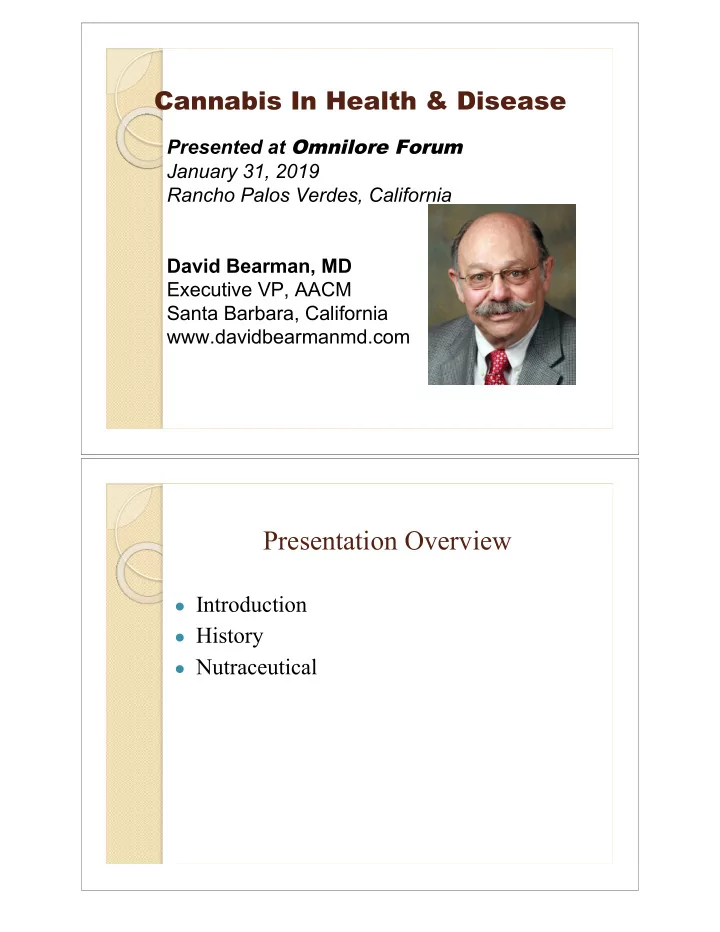
Cannabis In Health & Disease Presented at Omnilore Forum January 31, 2019 Rancho Palos Verdes, California David Bearman, MD Executive VP, AACM Santa Barbara, California www.davidbearmanmd.com Presentation Overview Introduction


slide-1
SLIDE 1

Cannabis In Health & Disease

Presented at Omnilore Forum January 31, 2019 Rancho Palos Verdes, California David Bearman, MD Executive VP, AACM Santa Barbara, California www.davidbearmanmd.com

Presentation Overview

  • Introduction
  • History
  • Nutraceutical
slide-2
SLIDE 2

Introduction

David Bearman, M.D.

  • Worked at all levels of government
  • 18 years clinical practice in Cannabinoid Medicine
  • Executive Vice President, AACM
  • Named Doctor of the Day by Wall Street Journal
  • Author—Drugs Are Not The Devil’s Tools: Greed,

Discrimination, The War on Drugs and How Medical Marijuana is Changing the Paradigm

  • Author—Demons, Discrimination, and Dollars
  • Author—Cannabis Medicine: A Guide to The Practice
  • f Cannabinoid Medicine
slide-3
SLIDE 3

This Lecture Will Address

  • History Of Medicinal Cannabis
  • Prohibition Propaganda & Folly
  • Modern Medicinal Cannabis

Medical Marijuana States

slide-4
SLIDE 4

Brief History

Shen Nung Ping Ts’oa Ching 2637 B.C.

  • Estimated date of the

first known

  • pharmacopeia. Yes, it

contained cannabis.

  • A recent Chinese

excavation provides evidence of medicinal use in 2600 B.C.

slide-5
SLIDE 5

Historical Use

  • One of many grains used in porridge or

gruel

  • Dickens made gruel sound bad but it is

nutritious

  • Beer is made from cannabis and is actually a

cousin to hops

Ancient Uses of Cannabis

  • Cannabis medical attributes were well

known in the ancient world. It was used as an analgesic, a childbirth anesthetic, for treating migraines, indigestion, and insomnia.

slide-6
SLIDE 6

Cannabis is a Nutraceutical

  • It contains:
  • 512 molecules
  • 113 cannabinoids
  • 200+ terpenes

Endocannabinoid System

  • Neurotransmitters
  • Enzymes
  • Receptors
  • Dopaminergic system
slide-7
SLIDE 7

Health Benefits

  • Antioxidant
  • Anti inflammatory
  • Anti anxiety
  • Omega-3 & -6 fatty acids
  • Stress Reduction
  • Sleep Aid
  • Anti epileptic
  • Anti proliferative
  • Treats movement disorder
  • Anti nauseate / appetite stimulant
slide-8
SLIDE 8

1839

  • Dr. William Brooke

O’Shaughnessy

  • He reintroduced cannabis into western

medicine in 1839, upon his return to England from India.

  • While in India he studied animals and

treated human patients with cannabis.

USP 1854-1941

slide-9
SLIDE 9

U.S./English 19th Century

  • 1839 O’Shaughnessy reintroduced

Cannabis to Western Medicine

  • 1854-1941 Cannabis in the USP
  • 1890 Queen Victoria- Sir Joshua Reynolds

(PMS)

  • 1898 Sir William Osler- migraine
  • Patent Medicines-Lilly, Squibb, Merck,

Parke-Davis (1870’s -1942

  • Early 1900’s 3rd or 4th most common drug

ingredient

Sir William Osler The Father of Modern Medicine

  • He wrote in the first

textbook of internal Medicine (1892) that Cannabis was the best migraine treatment

slide-10
SLIDE 10

Asthma Cigarettes

  • There were several

cannabis containing cigarettes for treatment

  • f asthma available in

the 1920s. (They included Cannadonna ,Cigares De Joy. And Grimauldi)

  • Like Advair, cannabis is

both an anti-inflammatory and a bronchodilator.

1920’S

American doctors notes millions of Rx per year contained cannabis in the 1920’s

  • L. Greensman Marijuana Recommended Collide: The Blunt Trush –

Joshua Blight and Mark Miller, Dec. 5, 2012

slide-11
SLIDE 11

University of Minnesota

  • Both my father and my uncle graduated in the

1920s from the U of M School of Pharmacy. Each, in different years ,were assigned to make tincture of cannabis.

  • My father said that they “had to be very careful

because the ALCOHOL was illegal.”

Major Pharmaceutical Companies Marketed Cannabis

  • Eli Lilly, Squibb, Merck,

Sharp and Dohme, Smith

  • Bros. all sold numerous

forms of Cannabis in the late 19th and early 20th century

slide-12
SLIDE 12

Cult of Modernism

  • Plant Based herbal medicine was in decline in the

30’s. It wasn’t modern and was not standardized.

  • Modern –
  • Telephone
  • Phonograph
  • Electric lights
  • Automobile
  • Camera
  • Movies
  • Flexner Report
  • Manufactured pharmaceuticals

Muckrakers and Patent Medicine

  • Patent medicines were a

mixed bag. Many worked. These nostrums often contained alcohol, cocaine,

  • pium and/or cannabis.
  • Others were not only

useless but could be downright dangerous. In 1903, Colliers, a mass market publication with wide circulation ran a multi-part expose on patent medicines

slide-13
SLIDE 13

Phytochemicals Go Out of Style

■ Hundreds of thousands of cannabis containing Rxs were written per year in 1920s and 30s ■ 28 OTCs contain cannabis ■ The use of herbal remedies(including cannabis) was eclipsed by the cult of modernism

  • Manufactured pharmaceuticals seen as modern
  • Cannabis was not standardized
  • Herbs =multiple compounds vs single

compound

From Popular to Pariah

  • 1897 Aspirin 1st Manufactured Pharmaceutical
  • 1902 Colliers Article
  • 1909 Sikhs Vilified By SF Chronically
  • 1910 Flexner Report
  • 1914 Hearst’s Sonora 800,000 Acre Ranch
  • 1916 Schlicten Decorticator
  • 1920s Cult 0f Modernism and
  • 1930 Anslinger named head of FBNDD
  • 1934 Did Lamont Dupont lobby Oliphant?
  • 1930s Propaganda focus on word Marijuana
slide-14
SLIDE 14

Prohibition Propaganda Lots of Propaganda

slide-15
SLIDE 15

Who Can Forget Reefer Madness Beware The Friendly Stranger

slide-16
SLIDE 16

Pulp Fiction Demonizes Cannabis Marijuana Tax Act 1937 AMA Testimony

  • Dr. William Woodward-Doctor and

attorney AMA Chief

  • Two hours testimony
  • The AMA opposed the Marijuana Tax Act
  • The AMA knew of no harm from the

medicinal use of cannabis

  • The AMA pointed out that the federal

government had no credible evidence

slide-17
SLIDE 17
  • Dr. Woodward’s Words
  • “The AMA knows of no dangers from the medical

use of cannabis”

  • He checked with The Bureau of Prisons,

Children’s Bureau, Office of Education and divisions of mental health and pharmacy in the

  • USPHS. None of them had one shred of evidence

to support Mr. Anslinger’s claims.

  • He was critical of the use of the word marijuana

because the American public was familiar with hemp and cannabis

1941 - Out of United States Pharmacopoeia

slide-18
SLIDE 18

Controlled Substances Act - 1970

  • Cannabis placed in schedule I
  • Retired CIA Directed the formation of a

commission to study drug abuse and marijuana

Nixon Marijuana Commission

Recommends legalizing recreational cannabis. Nixon rejected the recommendation.

slide-19
SLIDE 19

Nixon and Special Agent Elvis

1978 - Federal Compassionate Access Investigational New Drug Program

  • The Compassionate Investigational New

Drug program, or Compassionate IND, is a United States Federal Government-run Investigational New Drug program that allows a limited number of patients to use medical marijuana grown at the University

  • f Mississippi.
  • It is administered by the National Institute
  • n Drug Abuse. Closed to new entrants,

there are four surviving patients who were grandfathered into the program.

slide-20
SLIDE 20

1992 – Federal Compassionate Use ( IND) New Access Ends

  • Dr. Mason, acting Surgeon General, was

concerned that if too many patients were

  • n the IND program, the public might get

the idea that marijuana was actually good for you. (1)

  • 15 patients were receiving government

cannabis and another 35 approved for the program at the time the program was suspended in 1989. The program was terminated in 1992 and the 15 were grand- mothered in.

Introduction to Modern Medicinal Cannabis

slide-21
SLIDE 21

Modern Research

  • 1949 Seizures Ramsey and Davis
  • 1964 THC Structure Characterized Dr. Raphael

Mechoulam

  • 1970s & 80s Nausea & Appetite studies(NM,

CA,TX.Fl.Il)

  • 1985 Synthetic delta-9-THC (Marinol) FDA Approved
  • 1992 Endocannabinoid System
  • 1999 GW Pharmaceuticals-Grew 6 strains
  • 2000 California Marijuana Research Center est.
  • 2002 Donald Abrams, M.D. (UCSF)
  • 2005 Dr. Ware (McGill)
  • 2006 Donald Tashkin, M.D. (UCLA)
  • 2007 Donald Abrams, M.D. (UCSF)
  • 2010 Sean McAllister, Ph. D. (CPMG)

1949 - H.H. Ramsey M.D. and Jean Davis M.D.

  • The first modern study on the medicinal value
  • f cannabis. Seven subjects with intractable
  • seizures. After treatment with cannabis 5 of the

7 subjects had no or extremely few seizures.

  • They concluded: ”The cannabinols herein

reported deserve further trial in non- institutionalized epileptics.”

  • Federation Proceedings, Federation of American

Society for Experimental Biology, vol. 8, lY49, p. 284.

slide-22
SLIDE 22

Tod Mikuriya MD

  • Psychiatrist
  • Target of Federal government.
  • Read 1894 India Hemp Commission

Report

  • 1968 Selected NIMH marijuana

research grants

  • Co-author of Prop 215
  • Pioneer in marijuana movement.

1964 – Raphael Mechoulam characterizes the structure of Delta 9 THC

slide-23
SLIDE 23

Marinol – 1985

  • The AIDS Epidemic saw widespread use
  • f cannabis by HIV/AIDS sufferers.

Cannabis addressed appetite stimulation , relief of pain and depression

  • The government’s response was to

encourage the development of synthetic

  • THC. It was approved by the FDA in
  • 1985. It’s Trade name is Marinol, generic

name is dronabinol.

Cannabinoid & Cannabis

  • Marinol=1 cannabinoid
  • Cannabis=113 cannabinoids
slide-24
SLIDE 24

The Endocannabinoid System characterized circa 1992

  • Endocannabinoid system is found in the human body.
  • It is central to homeostasis.
  • It is the largest neurotransmitter in the human brain and interacts with

the dopaminergic system.

  • It is composed of:
  • RECEPTORS
  • CB1 Receptors found largely in the brain
  • LB2 Receptors found in the immune system and the periphery
  • NEUROTRANSMITTERS
  • Anandamide (AEA) – an endocannabinoid
  • 2AG -another endocannabinoid neurotransmitter
  • ENZYMES
  • FAAH -enzyme that metabolizes endocannabinoids
  • MYGYL -another enzyme for endocannabinoids

Amygdala & Nucleus Accumbens Hippocampus -

slide-25
SLIDE 25

Retrograde Inhibition Cannabis: The Plant

slide-26
SLIDE 26

Chemistry

  • Cannabis 512 chemicals
  • 113 cannabinoids (21 carbon molecule)
  • Over 200 Terpenes
  • Phenoids
  • Flavonoids

Terpenes

  • Terpenes give

cannabis its distinctive odor. There are over 200 Terpenes in

  • cannabis. They are

found extensively in citrus fruit

slide-27
SLIDE 27

Entourage Effect

  • Postulated by Mechoulam in 1999. It is the

idea that the various constituents of the plant act in concert, that the effect of the whole is greater or more effective than the sum of its parts.

  • Many cannabinoids, terpenes and flavonoids

acting together to cause a therapeutic benefit is the entourage effect

GW Pharmaceuticals - 1999

  • In 1997 House of Lords Science and

Technology Committee Report

  • In 1999 GW started doing research on

tincture of cannabis for relief of muscle spasms and neurological pain associated with Multiple Sclerosis.

slide-28
SLIDE 28

Sativex( Nabixamol)

  • A tincture of cannabis sublingual spray
  • Available in Canada since 2005.

Therapeutic Applications Of Cannabis

  • Antinauseant/Antiemetic
  • Appetite stimulant
  • Analgesic
  • Antiepileptic
  • Anti Inflammatory
  • Anxiolytic
  • Antispasmodic
  • Anti-depressant
  • Sleep Aid
  • PTSD treatment
  • ADD/ADHD treatment
slide-29
SLIDE 29

Nutraceutical Possible Benefits

  • Cancer prevention (Taschkin)
  • Heart attack health
  • Neuro-protective
  • Anti-anxiety
  • Osteoporosis

Why Such Broad Effect?

  • Largest neurotransmitter system
  • Critical for homeostasis
  • Retrograde inhibition
  • Anti inflammatory
  • Anti anxiety
slide-30
SLIDE 30

Top 6 Conditions or Symptoms

  • Pain
  • Sleep Difficulties (Insomnia)
  • Nausea
  • Arthritis & Connective Tissue Disorders
  • Migraine
  • Anxiety
  • Suppository

Other Commonly Treated Conditions

  • ADD/ADHD
  • Seizures
  • Glaucoma
  • Fibromyalgia, Restless Leg Syndrome,

Complex Reflex Sympathetic Dystrophy

  • Diabetic Peripheral Neuropathy
  • Crohn’s Disease, IBS,
  • Cyclical Vomiting Syndrome
  • Depression
  • PTSD
slide-31
SLIDE 31

Mental Health

  • Depression
  • Anxiety/Panic Attacks
  • Stress
  • OCD
  • Bipolar Disorder
  • PTSD
  • ADD/ADHD
  • Autism/Asperger's syndrome

Benefits to AIDS Patients

  • Appetite stimulant
  • Anti nauseant
  • Anti-depressant
slide-32
SLIDE 32

Benefits to Cancer Patients

  • Analgesic
  • Anti Nauseant
  • Appetite Stimulant
  • Anti Depressant
  • Anti proliferative (experimental &

anecdotal)

Benefits for ADD/ADHD

  • Effective
  • Retrograde Inhibition
  • Fewer side effects than stimulants
  • Can be used in conjunction with stimulants
slide-33
SLIDE 33

Benefits for PTSD

  • Treats and decreases anxiety
  • Helps control anger
  • Decreases nightmares
  • Symptoms possibly related to increased

dopamine transporter

Efficacy

  • History
  • Anecdotes
  • State Studies in eight states
  • GW Studies 1999 - present
  • House of Lords Report
  • IOM Report 1982 and 1999
  • CMRC Studies 2000-2010
  • 20,000 Research Studies
slide-34
SLIDE 34

Routes of Administration

  • Respiratory
  • 1-smoking
  • 2-Vaporizing
  • Sublingual
  • Oral

Safety

■ Government reports from: India/Britain(1894), U.S. (1972), Britain (1968), Canada(1973), Australia, (1978) Panama Canal Zone(1916 & 1931) ■ 1985 Delta 9 THC, FDA Approved ■ 1986-1988 FDA Chief ALJ Young’s Findings of Fact ■ 2005 Tincture of Cannabis, Health Canada Approval ■ 2006 FDA approves Phase III Sativex Clinical Trial ■ 2010 EU approves Sativex

NOTE: Sativex is a whole plant alcohol extract from two strains of cannabis in a 1:1 ratio

slide-35
SLIDE 35

Cannabis Use In Pregnancy

  • Dr. Melanie Dreher, Dean of The School of

Nursing at Rush Medical School, did her study in Jamaica in 1968.

  • This study documented that children of women

who smoked cannabis during pregnancy did better in school and reached their developmental landmarks sooner than children of women who did not smoke cannabis during pregnancy.

2005 Dr. Donald Tashkin Lung Cancer? NO!

  • He compared 1100 patients with

respiratory wellness.

  • He determined cannabis does not cause

lung cancer.

slide-36
SLIDE 36

AMA November 2009

  • Changes 2001 position that more research is

needed

  • Cannabis should be rescheduled so that more

research can be done

  • Joins over 100 health care organizations in

support of MMJ

  • Includes American College of Physicians,

American Nurse Association, American Public Health Association

Legal/States Rights

  • 1925- Linder vs. U.S. States Rights
  • 1942 -Wickert v. Filburn 10th Amendment
  • 2004- Raich v. Ashcroft- 9th Circuit
  • 2005- Gonzales v. Raich - U.S. Supreme

Court

  • 2008-2016 Boma v. Haynes State rights
  • 2014 Rohrbacha-Faut Budget Amendment
slide-37
SLIDE 37

Clinical Standards

MBC Guidelines for Giving Approval/Recommendation

  • Bonafide doctor-patient relationship
  • Good faith H&P
  • Review records
  • Plan With Objectives
  • A condition which will benefit from use of

cannabis

slide-38
SLIDE 38

Marijuana Research in the United States Studies Available

  • To date, there are over 20,000 published

studies or reviews in the scientific literature referencing the cannabis plant and its cannabinoids, nearly half of which were published within the last five years.

  • These numbers are according to a key

word search on the search engine PubMed Central, the US government repository for peer-reviewed scientific research.

slide-39
SLIDE 39

California center For Medical Cannabis Research(CMCR)

  • Founded 2000
  • Funded by the state of California
  • Located at UCSD School of Medicine
  • 18 FDA approved smoked cannabis studies
  • The center’s report to the legislature came out

in 2011

Sean McAllister,PhD.

  • He is a researcher at California Pacific

Medical Center Research Group

  • He had done research on the treatment of

mice with breast cancer with THC.

  • The study demonstrated that the THC

cured the breast cancer

  • Dr. McAllister is presently preparing to do

a human breast cancer study with a cannabinoid or cannabinoids

slide-40
SLIDE 40

Center for Medicinal Cannabis Research (CMCR)

The classification of marijuana as a Schedule I drug as well as the continuing controversy as to whether or not cannabis is of medical value are obstacles to medical progress in this area. Based on evidence currently available the Schedule I classification is not tenable; it is not accurate that cannabis has no medical value, or that information on safety is lacking.

PTSD Study By Dr. Suzanne Sisley

  • This is going on in Colorado
  • She was a long time physician in the VA

system in Arizona

  • Her study was a rare study approved by the

federal government but was blocked in Arizona by several state legislators

  • Her research is privately supported in

Colorado

slide-41
SLIDE 41

Things Are Changing 2018 Epidiolex

  • This is a high CBD GW product.
  • It was an anti seizure medication for treating

Dravet’s Syndrome

  • Approved by the FDA
  • Schedule V
slide-42
SLIDE 42

Top Needs

  • Professionalism in growing, dispensing and

prescribing

  • More research on Cancer,PTSD & Autism
  • Include ECS in medical school curriculum

Research Needs

  • Conditions
  • Cancer
  • PTSD
  • Terpenes
  • Dosage for specific conditions
  • THC CBD roles
  • Contributions of other cannabinoids
slide-43
SLIDE 43

Standards

  • Integration in California
  • All products
  • Dosage
  • Plant constituents contained
  • M.D. Standards
  • Marginalize minimalists
  • SCC and AACM standards
  • Request education on ECS and cannabis

Dispensaries

  • Need to be professional
  • Need to be regulated
  • Should be like pharmacies
  • Health spa model
slide-44
SLIDE 44

Areas to Focus On

  • Standardization – plant, labeling, product
  • Professionalism – M.D., dispensary
  • Research
  • PTSD
  • Cancer
  • Epilepsy
  • Education
  • Med School
  • CME
  • General Public

Thank you very much

David Bearman, M.D. www.davidbearmanmd.com davidbearman@cox.net 7394 Calle Real, Suite C Goleta, CA 93117 (805) 961-9988 American Academy of Cannabinoid Medicine (AACM) info.aacm@gmail.com

slide-45
SLIDE 45
  • History And Policy
slide-46
SLIDE 46

References: Demons, Discrimination, and Dollars: A Brief History of The Origins of Drug Laws; by David Bearman, M.D. Cannabis by Martin Booth Reefer Madness by Eric Schlosser Cannabinomics by Christopher Fichtner, M.D. The Pot Book, edited by Julie Holland, M.D. Cannabis and Cannabinoids by Ethan Russo, M.D. and Franjo Grotenhermen, M.D. Drugs are NOT Tools of the Devil: How Greed and Discrimination Led to Dysfunctional Drug Policy and How to Fix it, by David Bearman, M.D. Marijuana Medical Handbook; by Dale Gieringer, Ph.D., Ed Rosenthal, and Gregory T. Carter, M.D.