Presentation Outline I. Introduction A. Title ( Slide 1 ) 1. MBNA - - PDF document

presentation outline i introduction a title slide 1 1
SMART_READER_LITE
LIVE PREVIEW

Presentation Outline I. Introduction A. Title ( Slide 1 ) 1. MBNA - - PDF document

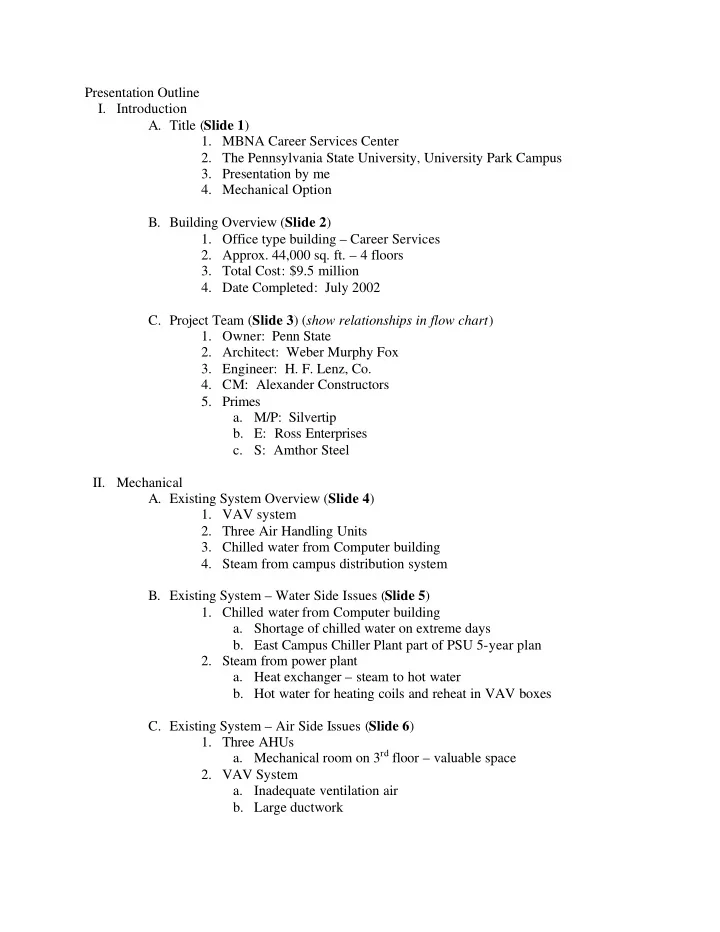
Presentation Outline I. Introduction A. Title ( Slide 1 ) 1. MBNA Career Services Center 2. The Pennsylvania State University, University Park Campus 3. Presentation by me 4. Mechanical Option B. Building Overview ( Slide 2 ) 1. Office type building


slide-1
SLIDE 1

Presentation Outline

  • I. Introduction
  • A. Title (Slide 1)
  • 1. MBNA Career Services Center
  • 2. The Pennsylvania State University, University Park Campus
  • 3. Presentation by me
  • 4. Mechanical Option
  • B. Building Overview (Slide 2)
  • 1. Office type building – Career Services
  • 2. Approx. 44,000 sq. ft. – 4 floors
  • 3. Total Cost: $9.5 million
  • 4. Date Completed: July 2002
  • C. Project Team (Slide 3) (show relationships in flow chart)
  • 1. Owner: Penn State
  • 2. Architect: Weber Murphy Fox
  • 3. Engineer: H. F. Lenz, Co.
  • 4. CM: Alexander Constructors
  • 5. Primes
  • a. M/P: Silvertip
  • b. E: Ross Enterprises
  • c. S: Amthor Steel
  • II. Mechanical
  • A. Existing System Overview (Slide 4)
  • 1. VAV system
  • 2. Three Air Handling Units
  • 3. Chilled water from Computer building
  • 4. Steam from campus distribution system
  • B. Existing System – Water Side Issues (Slide 5)
  • 1. Chilled water from Computer building
  • a. Shortage of chilled water on extreme days
  • b. East Campus Chiller Plant part of PSU 5-year plan
  • 2. Steam from power plant
  • a. Heat exchanger – steam to hot water
  • b. Hot water for heating coils and reheat in VAV boxes
  • C. Existing System – Air Side Issues (Slide 6)
  • 1. Three AHUs
  • a. Mechanical room on 3rd floor – valuable space
  • 2. VAV System
  • a. Inadequate ventilation air
  • b. Large ductwork
slide-2
SLIDE 2
  • D. Proposed System Overview (Slide 7)
  • 1. DOAS/Energy Recovery Air Handling Unit
  • a. Location - basement
  • 2. Fan Coil Unit (Parallel System)
  • a. Replace each VAV box with a FCU
  • E. Proposed System – DOAS/Energy Recovery AHU (Slides 8 & 9)
  • 1. Maximum required outdoor air – 10,905 cfm
  • 2. SEMCO Pinnacle Unit, Model PVS-18
  • a. Air Flow Capacity

1) Low: 8,000 cfm 2) Mid: 10,000 cfm 3) High: 14,000 cfm

  • 3. (show diagram of SEMCO unit in basement with clearances)
  • 4. Heating/Cooling Coil Sizes
  • 5. Efficiency of heat recovery – (diagram to show temperatures at various

locations within the unit)

  • F. Proposed System – Fan Coil Units (Slides 10 & 11)
  • 1. Heating Coil – secondary coil in FCU
  • a. Piping already exists throughout the building
  • b. No longer need hot water piping to AHU on 3rd floor
  • 2. Cooling Coil – main coil in FCU
  • a. Chilled water piping to Fan Coil Units integrated with sprinkler

piping(?)

  • b. Primarily sensible cooling to reduce/eliminate condensate
  • 3. (show diagram of components in FCU) and/or (3D drawing of FCU in

ceiling plenum with ductwork to three interview rooms)

  • 4. FCUs circulate the room air to maintain the temperature required
  • G. Proposed System – Operation Sequence/Controls (Slides 12 & 13)
  • 1. Outdoor air damper on each FCU will have 2 settings
  • a. 20% - unoccupied
  • b. 100% - occupied
  • 2. Interview Rooms/Conference rooms (intermittent occupancy)
  • a. Occupancy of rooms is based on a schedule which is put into a

program either daily or weekly

  • b. Only a section of rooms that will be used during that day will

receive the amount of OA required

  • c. All other rooms will remain on the unoccupied setting of 20%

1) Saves energy and still prevents contaminants from building up in the space

  • 3. All other spaces
  • a. Daytime – occupied – damper at 100%
  • b. Nighttime – unoccupied – damper at 20%
slide-3
SLIDE 3
  • III. Electrical (Slide 14)
  • IV. Structural (Slide 15)
  • V. Cost Comparison between VAV & DOAS/FCU (outline costs in a table) (Slide 16)
  • A. Equipment Cost
  • 1. First Cost
  • 2. Maintenance
  • B. Ductwork Cost (reduction in cost for proposed system)
  • C. Piping Cost (additional piping for chilled water to FCUs)
  • D. Electricity Cost (use $0.07/kwh for a comparison)
  • E. Structural Savings (reduction in beam sizes on 3rd floor?)
  • VI. Conclusions (Slide 17)
  • VII. Thank you (Slide 18)
  • VIII. Questions (Slide 19)