Presentation on Domestic Ferry ry Safety in Bangladesh Mohammad - - PowerPoint PPT Presentation

presentation on
SMART_READER_LITE
LIVE PREVIEW

Presentation on Domestic Ferry ry Safety in Bangladesh Mohammad - - PowerPoint PPT Presentation

Presentation on Domestic Ferry ry Safety in Bangladesh Mohammad Obaidullah Ibne Bashir CEng, FIMarEST Ship Registrar, Ship Surveyor & Examiner Department of Shipping, Bangladesh. Overview Bangladesh is a riverine country with high


slide-1
SLIDE 1

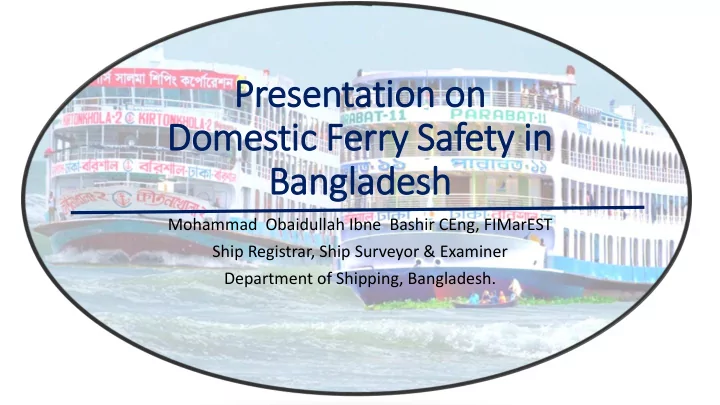
Presentation on Domestic Ferry ry Safety in Bangladesh

Mohammad Obaidullah Ibne Bashir CEng, FIMarEST Ship Registrar, Ship Surveyor & Examiner Department of Shipping, Bangladesh.
slide-2
SLIDE 2

Overview

  • Bangladesh is a riverine country with high density of population.
  • Numerous rivers move crisscrossing the country and play an important role in the

transportation of passengers and good.

  • Major Types of Inland River Communication Include:
  • Ferry Service
  • Cargo Carrier
  • Petroleum Carriers
  • Public sector do not engage much in providing these transportation (other than the

remote and isolated places where the private sector is not much interested to ply)

  • Private Sector plays an important role in the waterway transportation sector.
slide-3
SLIDE 3

Overview

  • The riverine transportation system is vital for the economy of Bangladesh.
  • While operating different types of watercraft along the riverine routes sometimes

accidents do occur which effects the human lives, the environment and properties in various forms and degree of extent .

  • The effects of accidents vary from minor injuries to fatalities and from insignificant

damage to very severe damage to the environment, property and human lives.

  • The main purpose of every accident investigation is to provide decision makers with

valid and reliable information to make better decisions to stop recurrence of the accidents.

slide-4
SLIDE 4

Overview

  • To reduce overall carbon footprint and also to reduce load on roads, Bangladesh

government attaches due priority on the waterway transportation for the carriage

  • f goods and passengers.
  • To make the waterway transportation safe and popular Department of Shipping is

committed to ensure safety of life and the vessels.

slide-5
SLIDE 5

Aim

The aim of this presentation is to analyze:

  • 1. The causes of Domestic ferry accidents in the waterways of

Bangladesh

  • 2. The remedial measures that may make the waterways safe and

secure for the passengers and the vessels.

slide-6
SLIDE 6

Waterways of Bangladesh

slide-7
SLIDE 7

Waterways of Bangladesh

  • Inland waterways plays a significant role in the lifestyle of

Bangladeshis and will remain so for a long time

  • Bangladesh’s waterways
  • stand at 24,000 km,
  • with a navigable route of
  • 5,968 km during the monsoon
  • 3,865 km in dry season.
slide-8
SLIDE 8

Waterways of Bangladesh

  • Depending on the economic value and the navigational quality of

the waterways in 1967, 12000 KM of waterways were divided into three different classes

  • The economic value was decided on the connection between

two points where from traffic was generated and navigational quality was defined by the indicated draft of a vessel with which it could safely sail through

  • However, in 1989 the inland waterways was divided into four

classes according to the Least Available Draft (LAD)

  • LAD determines the minimum depth of water a vessel can safely

negotiate

slide-9
SLIDE 9

Waterways of Bangladesh

  • It is also revealed that 2150 – 2500 KM of the total 5968 KM of

waterways are seasonal routes

  • According to existing river notices issued fortnightly by BIWTA’s

conservancy and pilotage department, 3888KM of waterways are perennially navigable.

slide-10
SLIDE 10

Waterways of Bangladesh

  • The existing waterways are shown below according to their classes:

Class Indicated Draft (m) Length (km) % Classification Criteria

I 3.6 683 11 These are major Transport Corridors where LAD of 3.6m is required to be maintained round the year II 2.1 1000 17 These link major inland ports or places of economic importance to Class I routes III 1.5 1885 32 Being seasonal in nature, it is not feasible to maintain higher LAD throughout the year IV 1.5 2400 40 These are seasonal routes where maintenance of LAD of 1.5 or more in dry season is not feasible Total 5968 100

slide-11
SLIDE 11

Different Types of Vessels in Bangladesh

  • According to the World Bank report about 745,000

country boats ply the rivers in Bangladesh of which:

  • 464,000 are used for passengers
  • 261,000 for cargo
  • Although, the figure appears to be very high the real

number for commercial purpose may be well below the figure shown here

  • As per the official count in the inland ship registry, there

are over 12,500 vessels of which

  • about 2000 passenger
  • 3000 cargo vessels
  • 95 tankers
  • 6751 fishing vessels
  • and the remaining are sand carrier, dredger, bulkhead boat etc.
  • Gross tonnage of about 0.45 million

Passenger Vessel 16% Cargo Vessel 24% Tankers 1% Fishing 54% Others 5%

slide-12
SLIDE 12

Different Types of Vessels in Bangladesh

  • In respect to passenger services there are 5 large passenger terminals with modern facilities and

6 with facilities for embarkation and disembarkation of passengers

  • There are also 133 launch stations with moderate facilities for embarkation and disembarkation
  • The kind water transports plying through the inland water ways of Bangladesh include:
  • Ferries
  • Steamers
  • Launches
  • Ships
  • Boats
  • Tug- boat
  • Oil – Tanker
  • Speed boat
  • Water-bus
  • Water ambulances etc.
slide-13
SLIDE 13

Passengers’ Movement

  • In places inaccessible by land transport like road and railways, water

transport acts as a gateway to communication with the rest of the country.

  • The facilities provided in the launch terminals are floating steel

pontoons of different sizes.

  • These pontoons are connected to the shore by a wooden jetty and

gangway.

  • The pontoons are used for berthing of vessels, embarkation and

disembarkation of passengers and loading and unloading of cargoes.

slide-14
SLIDE 14

Passengers’ Movement

  • Statistics show that around more than 3 lacs

passengers move through the water ways on regular basis using facilities available at different terminals and ghats.

  • Regular movement of passengers from different

ports are shown below:

  • Dhaka port: 50,000
  • Borishal port: 30,000
  • Narayangonj port: 10,000
  • Bhola port: 5,000
  • Aricha port: 10,000
  • Mawa port: 15,000
  • Other ports: 1, 80,000
  • During the period of different religious festivals and

long weekends the movement of passengers’ increases almost 5 times than normal.

Bhola 2% Dhaka 17% Aricha 3% Borishal 10% Narayangonj 3% Others 60% Mawa 5%

slide-15
SLIDE 15

Problems Encountered by Passengers

  • During the movement of passengers, there are some common problems

usually faced in terminals are:

  • Harassment while getting up and down (in the ferries, ships).
  • Small stair system.
  • Lack of toilet, wash room facilities .
  • Lack of sufficient security guards.
  • Over all, lack of modern equipment in the ports.
  • Lack of facilities for Handicapped personnel.
  • In addition to the problems faced in the terminals, passengers also

sometimes faces problems onboard. These are mainly related to:

  • Inadequate recreation facilities.
  • Shortage of accommodation/ spaces onboard if the ship is overloaded.
  • Lack of personnel safety equipment in case of overloading.
slide-16
SLIDE 16

Solution to the Problems

Problems faced by the passengers have direct relation with the safety of the passengers and the safety of the vessels. To overcome the problems measures are taken by BIWTA and the Department of shipping

  • In all the terminals and Ghats adequate spaces have been created such as waiting

rooms with toilets and washroom facilities

  • In the larger terminals large size LED screens have been placed to show the timetable
  • f different passenger launches for different routes
  • These screens are also used to show video clips on safety of passengers and how to

use the lifesaving appliances in case of need

  • To maintain orderly situation at the terminals and also to maintain safety different

measures are taken. Some of those are:

  • Ensure skillful management in handling the situation.
  • Adequate number of security personnel are employed to maintain law and order situation at the

terminal

  • Ensure passengers safety and security through compliance of safety measures and monitoring by

Department of Shipping officials

  • Ensure sufficient lightening at night
  • Maintaining the timetable for the departure of the passenger launches
slide-17
SLIDE 17

Accidents and Casualties

There are one storied, two storied and three storied motor launches which ply on different destinations daily.

  • Motor launches travelling to near destinations around capital city are smaller in

size and they make more than one round trip throughout the day

  • Large motor launches going to distant locations have specific time schedules

With the increase in population and the growing economy of the country, the waterways are getting congested despite the fact that the inland waterways are not expanding, Therefore, problems relating to maritime safety are emerging with new dimensions every day.

slide-18
SLIDE 18

Accidents and Casualties

  • In past few years number of launch accidents killed several hundred

people in Bangladesh

  • In response to this, government took some remedial measures to

reduce the number of accidents

  • Statistics of accidents from 1991 till 2018:
slide-19
SLIDE 19

Accidents and Casualties

20 40 60 80 100 120 140 160 180 200 1991- 1995 1996- 2000 2001- 2005 2006- 2010 2011- 2015 2016- 2018 95 55 133 182 89 54

Number of Accidents (Total)

20 40 60 80 100 120 1991-1995 1996-2000 2001-2005 2006-2010 2011-2015 2016-2018 58 25 67 38 22 14 10 7 22 26 38 32 27 23 44 118 29 8

Number of Accidents by Category

Launch Cargo Others

Statistics of accidents from 1991 till 2018

slide-20
SLIDE 20

Accidents and Casualties

200 400 600 800 1000 1200 1991-1995 1996-2000 2001-2005 2006-2010 2011-2015 2016-2018 550 797 1169 533 502 82 129 182 55 110 4 3 60 118 24 115 95 7

Number of Casualties

Dead Injured Missing

slide-21
SLIDE 21

The Causes of Accidents in the Passenger Vessels

In the waterways of Bangladesh sometimes accident occurs and after each of the accidents investigations are conducted. Actions are taken on the recommendation

  • f the investigation Committee.

The general reasons of inland accidents are:

  • Overloading
  • Bad weather
  • Human Error (lack of skill, wrong maneuvering, lack of awareness of the

crews)

  • Poor management of river route and inland port
  • Lack of awareness of the passengers
  • Lack of navigability and absence of navigational aids
  • Unauthorized ship building and improper survey
  • Plying without survey and registration certificate
  • Unawareness of the owners and their negligence in vessel maintenance
slide-22
SLIDE 22

Analysis of Accidents

Comparison between Passenger Vessel accidents and overall accidents

58 25 67 38 22 14 95 55 133 182 89 54 1991-1995 1996-2000 2001-2005 2006-2010 2011-2015 2016-2018

Passenger Vessels Vs Overall Accidents

Passenger Vessel Accidents Overall accidents

slide-23
SLIDE 23

Analysis of Accidents

  • Overall marine vessel accidents and the number of passenger

vessel accidents from 1991 to 2018 have been investigated.

  • From the figure above it has been observed that the number of

passenger vessel accidents is in a decreasing trend with respect to the overall marine vessel accidents as time goes on.

  • From 1991 to 2018, total number of passenger vessel accident is

224 where overall marine vessel accident is 608 which are about 36.84% of total marine accidents.

  • In the marine accidents from 1991 to 2018 total death was 3633.

Out of this number death from launch accident was 1781.

slide-24
SLIDE 24

Month wise Distribution of Accidents

16 15 24 31 35 16 12 15 21 12 13 14 5 10 15 20 25 30 35 40 Jan Feb Mar Apr May Jun Jul Aug Sep Oct Nov Dec

slide-25
SLIDE 25

Causes of Passenger Vessel Accidents

  • Marine accidents that have occurred could have been minimized by

carrying out risk assessment.

  • Taking into account of all those accidents happen in Bangladesh may

be classified into five types or categories namely

  • Collision
  • Overloading
  • Inclement weather
  • Fire and explosion
  • Bottom Damage

Collission 43% Overloading 25% Inclement Weather 23% Fire and Explosion 6% Bottom Damage 3%

slide-26
SLIDE 26

Collision

  • It appears that the many of the vessels plying the rivers

do not have fitness certificates or route permits

  • During the monsoon, the width of the waterways

increases to several kilometers but Navigable channel is still generally narrow, shallow and meandering

  • Many of the passenger vessel operators do not have a

license; means that they are unskilled

  • Many of them do not have proper knowledge on

Convention on the International Regulations for Preventing Collisions at Sea (COLREG) and lacks training

  • The inexperienced operators try to go faster to prove

that they can arrive at the appointed destination early and in speeding they try to overtake other vessels

  • Thus collision is the result of this reckless driving in the

rivers of Bangladesh

slide-27
SLIDE 27

Overloading

  • Bangladesh is a highly populated country and the

available transports are always in short of supply.

  • To make matters worse, the passenger vessel
  • wners, in their quest for maximum profit, tend to
  • verload by doubling or tripling the actual carrying

capacity of their vessels which causes the vessel to become unstable

  • If a vessel inclines up to a certain angle (angle of

vanishing stability), then it will not be able to return

  • f its upright condition thus it inclines more and

loses its stability and capsize

slide-28
SLIDE 28

In Inclement Weather

  • Inclement weather is one of the principal causes of marine accidents
  • From June to October weather conditions are often very unsettled over the Bay of
  • Bengal. Cyclones, gusty winds and heavy rainfalls are the usual phenomena at this

time of the year

  • In case of inclement weather, strong wind creates pressure on lateral area of

superstructure or lateral area of the vessel exposed to the weather, which tends to incline the vessel

  • For inclining, the vessel has to overcome the resistance of water exerted on the

underwater volume

  • Thus, the ratio of the underwater volume to lateral area of superstructure plays a

substantial role in the stability of passenger vessel

  • Passenger vessels’ stability under wind pressure largely depends on wind lever.
  • As per inland shipping stability rules, passenger vessels are not allowed to ply at a

wind speed more than 10m/s

  • Several accidents have been happened due to inclement weather when the wind

pressure was more than 0.0322 t/m2 or wind speed more than 10m/s

slide-29
SLIDE 29

Fire and explosion

  • Fire explosion is another reason which causes marine accidents in

Bangladesh

  • Most of the passenger Vessels do not follow Structural fire protection

plan and fire control plan. So the correct insulation is not placed in the right place

  • In machinery space and galley where fire can occur most probably, A-

60 insulation is mandatory

  • In some cases Life Saving Appliances are not sufficient in the vessels

and means of escape are not defined

  • Lacking of following SOLAS (Safety of Life at Sea) rules causes fire and

explosion in passenger vessels

slide-30
SLIDE 30

Bottom Damage

  • Most of the Inland vessels in Bangladesh do not

follow common structural rules when building new vessels

  • Most vessels do not have preliminary longitudinal

strength calculation

  • So, they do not meet minimum still water

bending moment (Hogging/ Sagging) and minimum hull section modulus which causes bottom rapture

slide-31
SLIDE 31

Measures Taken to Reduce Accidents

From the accident reports the major causes of the accidents and the recommendations for remedial measures are analyzed. The general recommendation to reduce the accidents can be summarized as follows:

  • Monitoring and supervising the water craft from its construction till it enters

into operation

  • Checking the Design of each of the vessel before construction
  • Prohibiting Sunken Deck vessels
  • Installing solid ballast on the bottom of the vessel to ensure its stability
  • Arranging special training for the master and drivers
  • Running awareness building programme for the crew and the passengers
  • Modernizing the design of the vessels
  • Making ships database
  • Operating regular mobile court to take punitive measures against the wrong

doers,

slide-32
SLIDE 32

Measures Taken to Reduce Accidents

Additionally to improve the navigability of the water way and to make those safe following steps are also taken on a regular basis:

  • Dredging rivers regularly to save the navigability of the waterways
  • Establishing channel marking buoys, beacon lights at different positions of the

waterways

  • Stopping Sunken Deck vessels during unfavorable weather, extreme

current/wave, foggy environment and gradually removing those from the service

  • Preventing overloading of passengers and goods
  • Ensuring the fitness of the vessels
  • Initiatives are also taken to install the Vessel Traffic Management System (VTMS)

and Traffic Separation Scheme

  • With all these measures the number of accidents have been reduced

significantly and in last three years no passenger launch has sunk

slide-33
SLIDE 33

Conclusion

  • Bangladesh being an over populated country has always growing demand for

transport

  • The private sector dominates the inland water transport sector both for goods

and passengers

  • Riverine transportation services are popular in the country and availed by all

classes of people

  • Among many causes, collision, overloading, inclement weather, fire and

explosion and bottom damage have been identified as the major reasons of accidents

  • It is revealed that training and education of the ship’s crew and aids to

navigation are of prime importance to address the causes of accidents

  • To improve the overall safety and security in the waterways of Bangladesh,

cooperation from the development partners are always welcome

slide-34
SLIDE 34

Conclusion

  • To improve the overall safety and security in the waterways of

Bangladesh, cooperation from the development partners are always welcome.

  • This cooperation may be in the field of training and education of the

crew and developing the waterways and monitoring system.

slide-35
SLIDE 35

Thank You