PRESENTATION ON CIVIL LIBERTIES & CIVIL RIGHTS (100 Points) - - PDF document

presentation on civil liberties civil rights 100 points
SMART_READER_LITE
LIVE PREVIEW

PRESENTATION ON CIVIL LIBERTIES & CIVIL RIGHTS (100 Points) - - PDF document

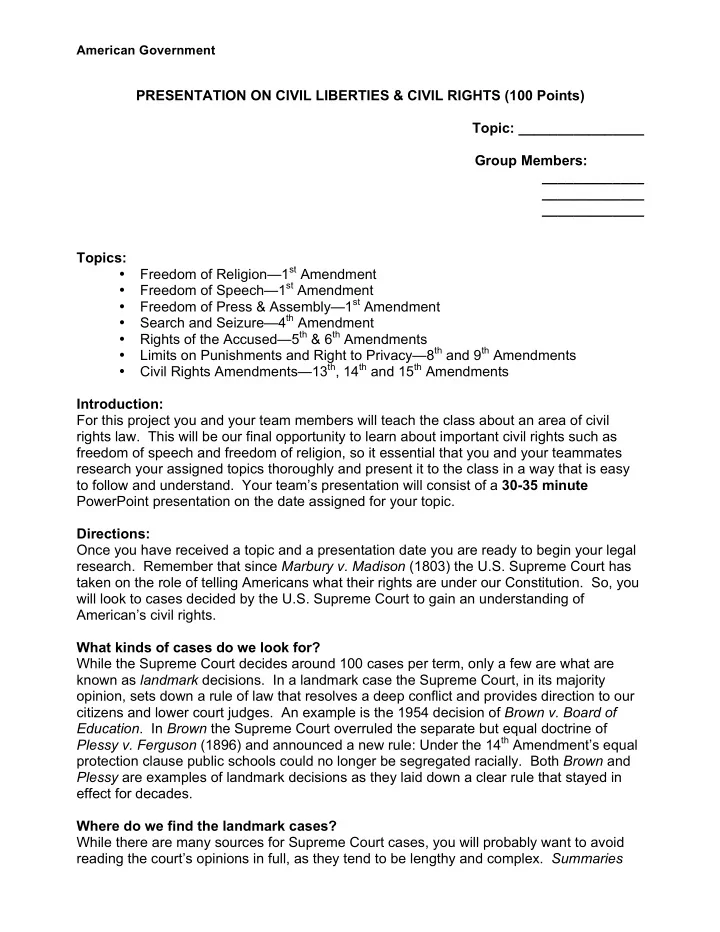
American Government Bayles S 06 PRESENTATION ON CIVIL LIBERTIES & CIVIL RIGHTS (100 Points) Topic: ________________ Group Members: _____________ _____________ _____________ Topics: Freedom of Religion1 st Amendment Freedom


slide-1
SLIDE 1

American Government Bayles S ’06

PRESENTATION ON CIVIL LIBERTIES & CIVIL RIGHTS (100 Points) Topic: ________________ Group Members: _____________ _____________ _____________ Topics:

  • Freedom of Religion—1st Amendment
  • Freedom of Speech—1st Amendment
  • Freedom of Press & Assembly—1st Amendment
  • Search and Seizure—4th Amendment
  • Rights of the Accused—5th & 6th Amendments
  • Limits on Punishments and Right to Privacy—8th and 9th Amendments
  • Civil Rights Amendments—13th, 14th and 15th Amendments

Introduction: For this project you and your team members will teach the class about an area of civil rights law. This will be our final opportunity to learn about important civil rights such as freedom of speech and freedom of religion, so it essential that you and your teammates research your assigned topics thoroughly and present it to the class in a way that is easy to follow and understand. Your team’s presentation will consist of a 30-35 minute PowerPoint presentation on the date assigned for your topic. Directions: Once you have received a topic and a presentation date you are ready to begin your legal

  • research. Remember that since Marbury v. Madison (1803) the U.S. Supreme Court has

taken on the role of telling Americans what their rights are under our Constitution. So, you will look to cases decided by the U.S. Supreme Court to gain an understanding of American’s civil rights. What kinds of cases do we look for? While the Supreme Court decides around 100 cases per term, only a few are what are known as landmark decisions. In a landmark case the Supreme Court, in its majority

  • pinion, sets down a rule of law that resolves a deep conflict and provides direction to our

citizens and lower court judges. An example is the 1954 decision of Brown v. Board of

  • Education. In Brown the Supreme Court overruled the separate but equal doctrine of

Plessy v. Ferguson (1896) and announced a new rule: Under the 14th Amendment’s equal protection clause public schools could no longer be segregated racially. Both Brown and Plessy are examples of landmark decisions as they laid down a clear rule that stayed in effect for decades. Where do we find the landmark cases? While there are many sources for Supreme Court cases, you will probably want to avoid reading the court’s opinions in full, as they tend to be lengthy and complex. Summaries

slide-2
SLIDE 2

American Government Bayles S ’06

and abstracts of cases are much easier to understand. You will receive a handout that gives you background on your topic, along with references to leading case decisions. You can find much that you will need on the Internet. The following sites should be helpful: http://www.oyez.org/oyez/frontpage http://www.findlaw.com/ http://www.findlaw.com/casecode/supreme.html (for Supreme Court cases) http://www.billofrightsinstitute.org/page.aspx?pid=471 Of course, you are not limited to these sites. It is important that you create new slides and not reuse previously existing work. Requirements:

  • Work cooperatively as a group, dividing up research, PowerPoint preparation, and
  • ther tasks equitably and efficiently
  • Each and every member of the group is responsible for the entire

presentation (no exceptions, no excuses).

  • Prepare a PowerPoint presentation for an entire class period that demonstrates the

U.S. Supreme Court’s interpretation of the Civil Liberty or Civil Right over time

  • Use the suggested web sites and handouts, and then conduct additional research
  • Create a Title Page slide that includes
  • Your topic
  • Full names of all group members
  • Name of this class and your class period
  • Your teacher’s name
  • The date of your presentation
  • Prepare a Time Line slide for your presentation
  • Must contain all landmark cases and distinctive phases of the law showing

how the courts have interpreted the amendment(s)

  • Prepare background slides
  • Include relevant material from your textbook (the index is a great help)
  • Define all unfamiliar terms that will aid your audience’s understanding of your

topic

  • Create Case Slides
  • Title of Case (Last names only)
  • Year of Case Decision (do not include day or month)
  • Key facts of the case (in your own words)
  • Question decided by the court or the conflict that the case resolved
  • The Court’s decision
  • Reason for the court’s decision
  • 30 words per case slide, maximum (see Mrs. Wiens for any exceptions)
  • Conclusion slide
  • Summarize key ideas
  • Bibliography; sources
slide-3
SLIDE 3

American Government Bayles S ’06

NOTE: It is essential that your team practice prior to your presentation. Teams that practice make smoother, easier-to-understand presentations. Teams who “wing it” score poorly and invariably stand before the class reading PowerPoint slides. The “wing it” approach is not acceptable, and if it occurs likely will result in a make up assignment. Important: You MUST provide a CD-R copy to Mrs. Wiens no later than 8 a.m. of your

  • presentation. The day before is even better. Due to the unreliability of network

connections, you may not run your PowerPoint presentation from the school server

  • r other storage method. Mrs. Wiens will be happy to furnish a blank CD-R on request.

STUDENT PERFORMANCE GUARANTEE YOU ARE RESPONSIBLE TO PRESENT ON THE DATE ASSIGNED. UNDER NO CIRCUMSTANCES SIGN UP FOR A DATE ON WHICH YOU EXPECT TO BE ABSENT. TEAMS MAY NOT SWITCH DATES WITHOUT FIRST OBTAINING: (1) THE WRITTEN APPROVAL OF ALL AFFECTED TEAM MEMBERS; AND (2) THE WRITTEN APPROVAL OF MRS WIENS.

slide-4
SLIDE 4

American Government Bayles S ’06

American Government Civil Rights PowerPoint My team’s assigned Amendment/Topic is: __________________________. My research responsibilities to my team are: ______________________________________________________________. My team will present to the class on: ______________________________. See the following pages for required cases. These are all the landmark Cases for my topic(s) that I will use:

  • Example: Miranda v. Arizona, 384 U.S. 436 (1966)

___________________ v. ____________________ , ____ U.S. _____ ( ). ___________________ v. ____________________ , ____ U.S. _____ ( ). ___________________ v. ____________________ , ____ U.S. _____ ( ). ___________________ v. ____________________ , ____ U.S. _____ ( ). ___________________ v. ____________________ , ____ U.S. _____ ( ). ___________________ v. ____________________ , ____ U.S. _____ ( ). ___________________ v. ____________________ , ____ U.S. _____ ( ). ___________________ v. ____________________ , ____ U.S. _____ ( ). ___________________ v. ____________________ , ____ U.S. _____ ( ). ___________________ v. ____________________ , ____ U.S. _____ ( ). ___________________ v. ____________________ , ____ U.S. _____ ( ). ___________________ v. ____________________ , ____ U.S. _____ ( ). ___________________ v. ____________________ , ____ U.S. _____ ( ).

___________________ v. ____________________ , ____ U.S. _____ ( ).

___________________ v. ____________________ , ____ U.S. _____ ( ). ___________________ v. ____________________ , ____ U.S. _____ ( ). ___________________ v. ____________________ , ____ U.S. _____ ( ). ___________________ v. ____________________ , ____ U.S. _____ ( ). ___________________ v. ____________________ , ____ U.S. _____ ( ). ___________________ v. ____________________ , ____ U.S. _____ ( ). ___________________ v. ____________________ , ____ U.S. _____ ( ). ___________________ v. ____________________ , ____ U.S. _____ ( ).

slide-5
SLIDE 5

American Government Bayles S ’06

Know Your Rights – Required Supreme Court Cases

  • Instructions. During presentations you will be presented with landmark decisions on each
  • topic. These United States Supreme Court decisions carry great importance. Listen

carefully to each presentation and identify the titles of each case below.

1st Amendment: Freedom of Religion

There are two clauses in the First Amendment regarding religion: The Free Exercise Clause and the Establishment Clause.

  • A. Free Exercise Cases:
  • 1. The case where the Supreme Court decided that religious freedom does not include the

right to practice polygamy. _________________________________________________

  • 2. Two cases where the Supreme Court decided if a public school student cannot be

punished for refusing to pledge allegiance to our flag. _________________________________________________ _________________________________________________

  • 3. The case where the Supreme Court decided that Amish parents could not be punished

for refusing to send their children to public school. _________________________________________________

  • 4. The case where the Supreme Court decided that practitioners of the Afro-Caribbean

religion of Santería could not be punished for engaging in animal sacrifices. _________________________________________________

  • 5. The case where the Supreme Court decided that a U.S. Army soldier could be

prohibited from wearing a yarmulke under his uniform hat. _________________________________________________

  • B. Establishment Clause Cases
  • 1. The case where the Supreme Court decided that a state could reimburse parents who

paid bus fare for their children to travel to religious schools. _________________________________________________

  • 2. The case where the Supreme Court decided that New York public school teachers could

not have their students recite a state-composed prayer as part of the school day. _________________________________________________

  • 3. The case where the Supreme Court decided that a state law that barred the teaching of

evolution in public school was unconstitutional. _________________________________________________

slide-6
SLIDE 6

American Government Bayles S ’06

  • 4. Two 1980s cases where the Supreme Court had to decide whether displaying religious

symbols (nativity scene, menorah, Christmas tree) on public property violated the Establishment Clause. _________________________________________________ _________________________________________________

  • 5. Two cases where the Supreme Court had to decide whether the Ten Commandments

could be displayed on public property. _________________________________________________ _________________________________________________

1st Amendment: Freedom of Speech

  • 1. The case where the Supreme Court first used the “clear and present danger test” to

decide if a person’s speech cold be punished. _________________________________________________

  • 2. The case where the Supreme Court for the first time ruled that the First Amendment’s

freedom of speech guarantee applied to the states. _________________________________________________

  • 3. The case where the Supreme Court first decided that students possessed free speech

rights while attending public school. _________________________________________________

  • 4. The case where the Supreme Court ruled that political candidates have a free speech

right to donate unlimited amounts of their money to their campaign. Then The case upholding the right of corporations to make independent political contributions. _________________________________________________ _________________________________________________

  • 5. The case where the Supreme Court ruled that freedom of speech does not apply to

fighting words. _________________________________________________

  • 6. The case where the Supreme Court ruled that speech could be restricted only in the

event that it was likely to produce a clear and present danger. _________________________________________________

slide-7
SLIDE 7

American Government Bayles S ’06

  • 7. The case where the Supreme Court ruled that speech that merely advocates violence is

protected so long as it does not incite imminent lawless action. _________________________________________________

First Amendment: Freedom of Press

  • 1. The 1930s case where the Supreme Court decided if a state court could issue a prior

restraint without violating the First Amendment’s free press guarantee. _________________________________________________

  • 2. The case where the Supreme Court decided that public figures are subject to different

rules than ordinary persons when suing for injuries caused by published falsehoods. _________________________________________________

  • 3. The case where the Supreme Court decided that a newspaper could legally publish

stolen classified documents even if the documents caused embarrassment to the government. _________________________________________________

  • 4. The 1970s Supreme Court case that established a three-part test to determine whether

such materials are obscene and therefore not protected by the First Amendment’s free press guarantee. _________________________________________________

  • 5. The case where the Supreme Court decided whether student-run newspapers are

entitled to the same free press protections as ordinary newspapers. _________________________________________________

slide-8
SLIDE 8

American Government Bayles S ’06

First Amendment: Freedom of Assembly

  • 1. The case where the Supreme Court decided that a state could not force a private civil

rights group to turn over its membership list. _________________________________________________

  • 2. The case where the Supreme Court decided that a private group could not be forced to

admit homosexuals if their values differed markedly from its own. _________________________________________________

  • 3. The case where the Supreme Court decided that persons had a general right to

demonstrate peacefully on public streets and sidewalks in South Carolina. _________________________________________________

  • 4. The case where the Supreme Court decided that governments must treat all groups the

same, even the KKK, and cannot discriminate on the basis of a group’s ideas or beliefs. _________________________________________________

  • 5. The case where the Supreme Court said it was lawful to teach about the forcible
  • verthrow of government whereas it is unlawful to advocate for the active, forcible
  • verthrow of government.

_________________________________________________

Fourth Amendment: Freedom from Unreasonable Searches and Seizures

  • 1. The case where the Supreme Court decided for the first time that illegally seized

evidence was subject to the exclusionary rule. _________________________________________________

  • 2. The case where the Supreme Court decided for the first time that the 4th Amendment’s

exclusionary rule also applied to states. _________________________________________________

  • 3. The 1920s case where the Supreme Court first decided that automobiles present an

exception to the Fourth Amendment’s search warrant requirement. _________________________________________________

  • 4. The case where the Supreme Court first decided when a police officer has the authority

to pat down a suspect in a search for illegal weapons. _________________________________________________

slide-9
SLIDE 9

American Government Bayles S ’06

  • 5. The case where the Supreme Court decided that lawfully present police officers may

seize obvious contraband when it is in plain view even if they do not have a search warrant. _________________________________________________ Important: Generally speaking, there are several exceptions to the search warrant

  • requirement. Write four Supreme Court decisions that explain some of these exceptions.

http://en.wikipedia.org/wiki/Fourth_Amendment_to_the_United_States_Constitution#Excep tions_to_the_warrant_requirement #1. ____________________________ vs. _________________________ Exception:________________________________________________________ Explanation:______________________________________________________________ ________________________________________________________ #2. ____________________________ vs. _________________________ Exception:________________________________________________________ Explanation:______________________________________________________________ ________________________________________________________ #3. ____________________________ vs. _________________________ Exception:________________________________________________________ Explanation:______________________________________________________________ ________________________________________________________ #4. ____________________________ vs. _________________________ Exception:________________________________________________________ Explanation:______________________________________________________________ ________________________________________________________________________ ________________________________________________

slide-10
SLIDE 10

American Government Bayles S ’06

Fifth & Sixth Amendments: Rights of Persons Accused of Crimes

  • 1. The 1964 case where the Supreme Court decided that a suspect in police custody must

be allowed to speak with his lawyer. _________________________________________________ 2 The 1968 case where the Supreme Court decided that persons accused of a felony must be given the right to a jury trial. _________________________________________________

  • 3. The 1989 case where the Supreme Court decided that an accused person’s right to

confront witness is not absolute. _________________________________________________

  • 4. The 1966 case where the Supreme Court decided that a confession obtained before a

person is advised of his right to counsel and against self-incrimination may not be used at trial. _________________________________________________

  • 5. The 1937 case (since reversed) where the Supreme Court ruled that the double

jeopardy guarantee is not a fundamental right. _________________________________________________

  • 6. The 1976 case where the Supreme Court decided that a person accused of a crime is

entitled to a public trial, including the presence of the press. _________________________________________________

8th Amendment: Cruel and Unusual Punishment

  • 1. The two 1970s cases where the Supreme Court clarified how the death penalty may be

carried out without violating the 8th and 14th amendments. _________________________________________________ _________________________________________________

  • 2. The 1977 case where the Supreme Court decided if students in public schools could be

subjected to corporal punishment.

slide-11
SLIDE 11

American Government Bayles S ’06

_________________________________________________

  • 3. The 2008 case where the Supreme Court decided if the death penalty could be imposed

for a rape conviction. _________________________________________________

  • 4. The first case where the Supreme Court decided if a person could be executed if they

were under 18 when they committed the crime. Then The case where the Supreme Court reversed its decision. Hint: It was a Missouri case. _________________________________________________ _________________________________________________

  • 5. The 1976 case where the Supreme Court decided a state could not require a jury to

impose the death penalty in certain cases. _________________________________________________

  • 6. The 2002 case where the Supreme Court decided that a mentally retarded murderer

could not be given the death penalty. _________________________________________________

9th Amendment: Right of Privacy

  • 1. The 1965 cases where the Supreme Court decided if states could limit a married

person’s access to birth control. _________________________________________________

  • 2. The case where the Supreme Court first decided that women have a right to obtain an

abortion. _________________________________________________

  • 3. The case where the Supreme Court ruled that a state’s requirement that a woman
  • btain her husband’s consent before having an abortion presented an undue burden.

_________________________________________________

slide-12
SLIDE 12

American Government Bayles S ’06

  • 4. Find 2003 case where the Supreme Court decided that adults have a right to engage in

private same-sex conduct. _________________________________________________

  • 5. The 1997 case where the Supreme Court decided if a state could legalize physician-

assisted suicide. _________________________________________________

slide-13
SLIDE 13

American Government Bayles S ’06

Civil Rights PPT Project Grading Sheet

Class Period: ______ Date: __________________ Topic: Individual Comments

  • 1. _______________________
  • 2. _______________________
  • 3. ________________________

PPT submitted to Mr. Wiens in advance of class? Conclusion slide? Title slide? Each team member knowledgeable about entire presentation? Timeline? Case slides with Q & A format? Clear evidence of practice?

slide-14
SLIDE 14

American Government Bayles S ’06

CIVIL RIGHTS PPT Outstanding Good Satisfactory Needs Improvement Content (30) Covers topic in- depth with relevant definitions, incorporation process, landmark cases, laws and historical events. Subject knowledge is excellent. _______________ _______________ _______________ Includes essential knowledge about the topic, including nearly all landmark

  • cases. Subject

knowledge appears to be good, but there are factual errors or omissions _______________ _______________ _______________ Includes essential information about the topic but there are significant factual errors and a significant number

  • f landmark

decisions are

  • mitted.

_______________ _______________ _______________ Content is minimal OR there are 5 or more factual errors

  • r omissions of

landmark cases. _______________ _______________ _______________ Organization (10) Content is well-

  • rganized using

headings or bulleted lists to group related

  • material. Slides

feature Q & A format. _______________ _______________ Uses headings or bulleted lists to

  • rganize, but the
  • verall organization
  • f topics appears

flawed. _______________ _______________ _______________ Content is logically

  • rganized for the

most part. _______________ _______________ _______________ There was no clear

  • r logical
  • rganizational

structure, just a grouping of facts. _______________ _______________ _______________ PPT Design (10) Excellent use of fonts, color, graphics, effects,

  • etc. to enhance the

presentation. _______________ _______________ _______________ Good use of fonts, color, graphics, effects, etc. to enhance to presentation. _______________ _______________ _______________ Some use of font, color, graphics, effects, etc. but at times these detract from the content. _______________ _______________ _______________ Use of font, color, graphics, effects

  • etc. but these often

distract from the presentation. _______________ _______________ _______________ Followed Assignment Directions (10) All requirements are met and exceeded (title slide, timeline, conclusion slide, running time. _______________ All assigned requirements are met. _______________ _______________ _______________ One assigned requirement is not completely met. _______________ _______________ _______________ More than one assigned requirement is not completely met. _______________ _______________ _______________ Presentation (30) Clear evidence of rehearsal with clear explanations, avoidance of slide reading, equitable division of speaking duties, and seriousness of purpose. _______________ _______________ Did not succeed in

  • ne of the key

Presentation criteria: _______________ _______________ _______________ _______________ Did not succeed in two of the key presentation criteria: _______________ _______________ _______________ _______________ _______________ _______________ Did not succeed in three of the key presentation criteria: _______________ _______________ _______________ _______________ _______________ _______________ Mechanics (10) No misspellings, grammatical errors

  • r incorrect case

information. Three or fewer misspellings and/or mechanical errors. Four misspellings and/or grammatical errors. More than 4 errors in spelling or grammar.