
SLIDE 1
PRESENTATION OF THE WORLD HABITAT AWARDS 2013/14 WORLD URBAN FORUM 7
MEDELLÍN, COLOMBIA
PRESENTATION OF THE WORLD HABITAT AWARDS 2013/14 WORLD URBAN FORUM - - PDF document
PRESENTATION OF THE WORLD HABITAT AWARDS 2013/14 WORLD URBAN FORUM 7 MEDELLN, COLOMBIA Contents 04 Message to the World Urban Forum Mr Ban-Ki Moon, Secretary-General, United Nations 06 Equitable societies Dr Joan Clos, Executive
MEDELLÍN, COLOMBIA
04 Message to the World Urban Forum
Mr Ban-Ki Moon, Secretary-General, United Nations
06 Equitable societies
Dr Joan Clos, Executive Director, UN-Habitat
08 The World Habitat Awards
Mr Geoff Payne, Trustee, Building and Social Housing Foundation
12 World Habitat Awards 2013/14: Winning Projects
Hebron Old City Rehabilitation Programme, Palestine The 100,000 Homes Campaign, USA
20 2013 Habitat Scroll of Honour Awards 22 World Habitat Award 2013/14 Finalists 26 Sources of Further Information 27 World Habitat Awards: An Invitation to Enter
03
The 2013/14 World Habitat Awards for innovative and sustainable housing solutions were presented at the closing ceremony of the World Urban Forum 7 in Medellίn, Colombia,
The World Urban Forum (WUF) is organised biennially by the United Nations Human Settlements Programme (UN-Habitat), bringing together a wide range of urban development actors in
smarter and more inclusive. The Seventh session of the World Urban Forum was hosted by the Government of Colombia and the City of Medellίn, in collaboration with UN-Habitat. The theme of the World Urban Forum 7 was ‘Transforming Cities Today for Equitable Societies Tomorrow’, highlighting the role of urban policy in redistributing resources and calling for equity to be embedded in urban development strategies. Discussions from this year’s event will also underpin the development of the United Nations Conference on Housing and Sustainable Urban Development, Habitat III in 2016.
‘Transforming Cities Today for Equitable Societies Tomorrow’
04
05
I am pleased to send greetings to the Seventh session of the World Urban Forum, and I thank the Government of Colombia and the City of Medellίn for hosting. Our world is increasingly
development - equitable social progress, inclusive economic growth and sound environmental stewardship. But the challenges remain
rising urban inequality. All over the world cities and towns are divided along social, cultural and economic
that the urban environment can and should offer. We need inclusive development to eradicate extreme poverty. This is emerging as a central theme of the Post-2015 development agenda. It should be your focus this week and as you work towards Habitat III in 2016. We need a new urban agenda that leaves no-one behind. I count on your expertise and commitment. Let us plan and manage our towns and cities so they provide the foundation for global, durable and sustainable development.
Mr Ban Ki-Moon, Secretary-General, United Nations
Main picture: Medellίn, host of the World Urban Forum 7 Inset picture: Mr Ban Ki-Moon, Secretary-General, United Nations
06
We gather this week in the Colombian city of Medellίn for the Seventh session of the World Urban Forum. This year’s theme, Urban Equity in Development – Cities for Life, represents the urgent call for equity for all as we work towards improving our cities. Inequity has become a universal concern. Differentials in access to
consumption, information and technology are the norm, not the exception. For the majority
are greater today than they were a generation ago. Unequal cities have difficulties in optimising the urban advantage, and translating it into tangible benefits in social, economic and political aspects for all. Therefore, we must integrate urban equity in its different dimensions into the development agenda. This also includes looking at equality as a key human right
ensure sustainable development.
Dr Joan Clos, Executive Director, UN-Habitat
07
This World Urban Forum is the beginning of the journey towards the United Nations Conference on Housing and Sustainable Urban Development, Habitat III. Your contribution to the discussions
an important role in laying the groundwork for the decisions to be taken in 2016 on what
To do this we need a new Global Urban Agenda. This agenda requires robust urban planning that focuses on public space and takes into account the needs of all
become places of economic growth, socially inclusive and environmentally sustainable. Medellín provides us with a living example of a city in transition; a city that has faced the challenges that lie before it and, in addressing them, has created opportunities to re-shape its future for the better.
Main picture: Medellín, Colombia Inset picture: Dr Joan Clos, Executive Director, UN-Habitat
08
Mr Geoff Payne, Trustee, Building and Social Housing Foundation
The annual World Habitat Awards competition was established in 1985 by the Building and Social Housing Foundation (BSHF) to identify innovative, sustainable and scalable housing solutions
ensure that the approaches developed in the winning projects are widely shared, by
activities as well as publishing and disseminating a range of information. The two winning projects this year both work, in very different ways, with local communities to provide long- term, sustainable housing solutions. The Hebron Old City Rehabilitation Programme was established to revitalise the Old City of Hebron. The programme focuses on several areas including the careful renovation of housing and
infrastructure and improvement of public spaces, coupled with efforts to stimulate local economic development and the provision of legal assistance. The 100,000 Homes Campaign has worked to permanently house 100,000 of the most vulnerable homeless individuals by July 2014. Through advocating the ‘Street to Home’ methodology, and developing a range of innovative tools, the Campaign aims to bring about fundamental changes to the way chronic homelessness is tackled in the
participating communities to commit to closely monitored goals. These two programmes have contributed to the safe housing
and families, along with the provision of wider support
World Habitat Awards will provide a new platform for them to share their knowledge and experiences.
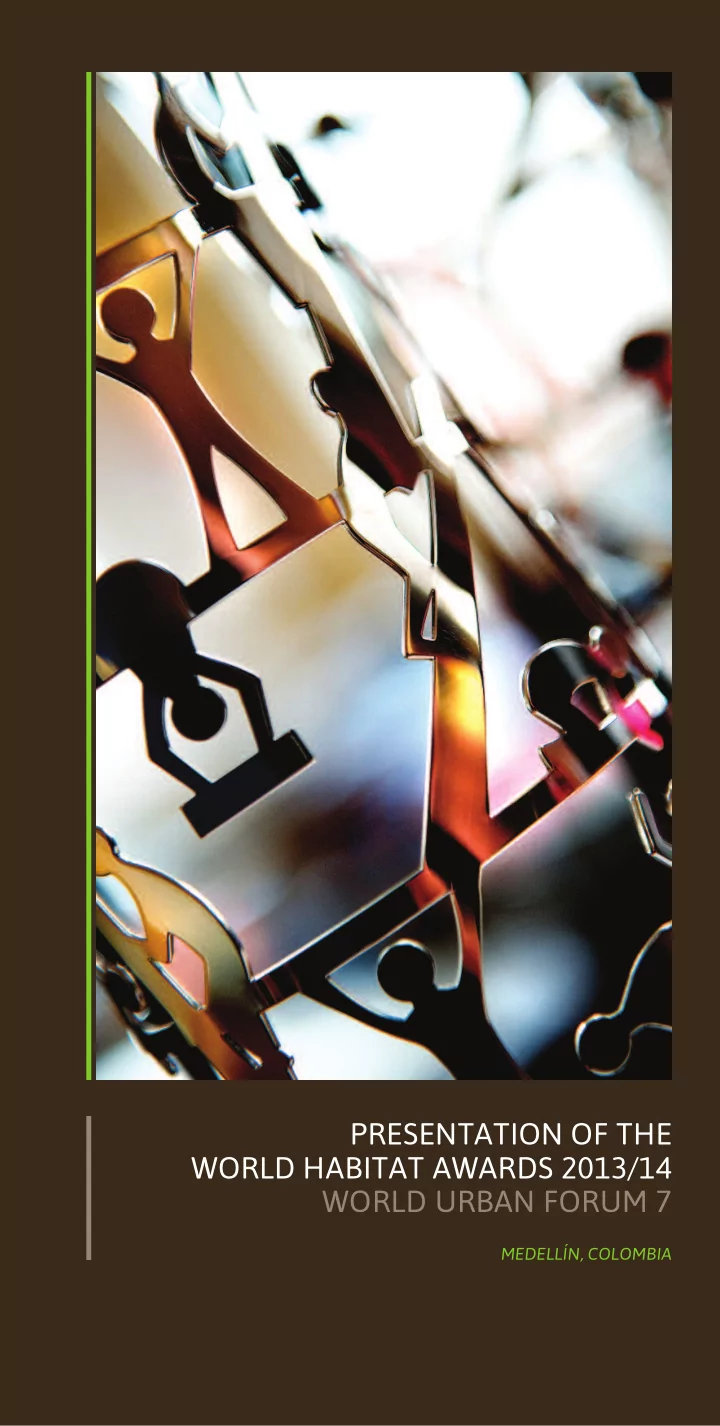
Main picture: World Habitat Awards trophy Inset picture: Mr Geoff Payne, Trustee, Building and Social Housing Foundation
09
Dr Joan Clos, Under-Secretary-General of the United Nations and Executive Director of UN-Habitat, presented a World Habitat Award trophy to each of the two winners. The World Habitat Awards trophies are crafted in solid silver and contain the symbol of the International Year of Shelter for the
Kate Thorley and crafted by Andrew Macgowan.
10
Mr Emad Hamdan receives the World Habitat Award trophy
City Rehabilitation Programme from Dr. Joan Clos, Under-Secretary-General
Executive Director of UN- Habitat. Ms Rosanne Haggerty receives the World Habitat Award trophy on behalf of the 100,000 Homes Campaign from Dr. Joan Clos, Under- Secretary-General of the United Nations and Executive Director of UN-Habitat.
11
12
WORLD HABITAT AWARD 2013/14 WINNer
The Project The Hebron Old City Rehabilitation Programme was initiated by the Hebron Rehabilitation Committee (HRC). HRC was established as a semi- governmental organisation in 1996 by a presidential declaration from former Palestinian leader Yasser
re-population of the deteriorated Old City of Hebron, preserve cultural heritage, support local economic development and provide affordable housing. The HRC offices are located within the Old City, in an area which is currently under Israeli military
project include the securing of decent housing, infrastructure and services, the stimulation of economic activity, and the provision of legal assistance to protect the residents' rights. The programme has ensured the continuous use and maintenance of historic buildings and urban spaces that had previously been abandoned. Over 1,000 housing units have been renovated and are now inhabited by approximately 6,000 people. History Hebron is one of the oldest cities in the world, having been continuously inhabited for over 5,000 years. Its historic centre is characterised by the density of its architectural fabric, narrow, winding streets and stone masonry structures of significant heritage value. Following the Israeli
the area was progressively abandoned and over time the physical condition
difficulties with Israeli settlers and tight restrictions on the movement of residents, together with increasing economic problems, caused most residents to leave the area, leaving
marginalised and unable to afford to live elsewhere. By 1995, approximately 9,500 Palestinian residents had left, with less than 400 remaining. The economic life of the Old City was also severely affected, with the closure of 77 per cent of its shops and commercial activities. The Hebron Old City Rehabilitation Programme involves the restoration and reuse of historic buildings in Hebron’s Old City for housing purposes, combined with improvements to public spaces, urban infrastructure and services, social and legal assistance and measures to stimulate job creation and develop the local economy.
13
Main picture: Hebron Old City, Inset picture: Hebron Old City
The programme focuses on the following key areas: Housing Through a sensitive rehabilitation and restoration process using traditional techniques and materials,
renovated and are now inhabited by approximately 6,000 people (78 per cent of whom are tenants and 22 per cent of whom are owner occupiers). Large residential properties
extended families of 20 or more people have been converted into smaller apartments to adapt to current cultural and household
employed and locally produced materials are used wherever possible. Infrastructure and services Social assistance, education and health care is provided to low- income families free of charge and a community centre, children’s playgrounds and public gardens have been established. Infrastructure upgrading has included a new sewerage network, water and electricity supply, improvement of paved areas, sidewalks and stairs, planting of trees, handrail installation and street lighting. Public spaces, formerly used as dumping grounds, have been reclaimed. Social development The programme has increasingly focused on social development and enhanced the role of residents in the revitalisation process through the implementation of several awareness programs and activities. Economic development The programme has increasingly focused its work on reviving local economic activity and creating jobs in and around the Old City in an effort to reduce poverty and
restored and various activities have been organised to encourage tourism. A vocational training school was established in 2009 in partnership with the Spanish government. Human rights With funding from the Norwegian government, HRC has established a comprehensive programme aiming at the protection of Old City residents from human rights violations, including arbitrary arrests, physical abuse, damage to property, expropriation of houses and land, closing of streets and business to Palestinians and preventing the rehabilitation of buildings in the Old
HRC hopes to create an environment
towards the safety of the community and prevent future depopulation.
14 Covering costs Funding for the programme has been
including the Palestinian National Authority, other government sources and international multi- and bi-lateral donors including many European
the programme in 1996, more than US$32 million has been received from over 20 donors in 16 countries to cover the costs of the programme. The average cost per unit for housing rehabilitation is US$26,000. Ongoing operating costs of the programme are met through a combination of grants from national and international donors, other revenues and in-kind donations, totalling approximately US$2.7 million per year. Funding to the amount of US$600,000 was provided by Spanish Agency for International Development Cooperation (AECID) for the establishment of a vocational training school in 2009. Impact More than 6,000 people are now living in the Old City, ensuring the continuous use and maintenance of historical buildings and urban spaces that had previously been abandoned. The more than tenfold increase in the number of people living within the rehabilitation programme area has been the most important indicator of the success of the
rehabilitation of infrastructure, services and public spaces has significantly improved the living conditions in the Old City. The legal unit of HRC has assisted shop owners and families in getting back properties that had been closed down or expropriated through a ruling in the Israeli Supreme Court. Rulings such as this have protected the rights of the Palestinians. Over 160 shop owners have reopened their shops and 207 permanent jobs have been created to date.
WORLD HABITAT AWARD 2013/14 WINNer
15
Main picture: Hebron Old City, Inset picture left: Hebron Old City, Inset picture middle: Hebron Old City, Inset picture right: Hebron Old City
Social sustainability A range of social development initiatives have been established to facilitate greater community cooperation, including setting up a community centre, outreach activities, school trips to the Old City and special activities for young
the programme has been the reintegration of the Old City into the social fabric of Hebron as previously decayed areas separating the two parts of the city have been restored, fostering movement between them. The improvements to basic infrastructure and services, particularly in terms of the availability of safe drinking water and sanitation, in the area have a positive effect on residents’ health. The legal assistance provided by HRC helps to protect residents against human rights violations and seeks to create an environment of greater accountability by the military forces and settler groups within the Old City. HRC works to address the urgent housing needs of the most marginalised in Hebron, seeking to reduce existing social inequalities. The rehabilitation programme has a number of initiatives that target specific groups including, for example, vocational training activities for women, activities with disabled persons and income- generating activities for refugees. Residents are involved in the planning stages of the programme and in wider decisions affecting the
activities and the work of the human rights unit encourage residents to take a more active role in society. For further details about the Hebron Old City Rehabilitation Programme, please see the contact details on page 26 or visit the World Habitat Awards website at www.worldhabitatawards.org.
16 The Project Community Solutions’ (CS) 100,000 Homes Campaign aims to build a national grassroots movement and help over 200 communities find and permanently house 100,000 of the most long-term and vulnerable people experiencing homelessness in the USA by 2014. The Campaign achieves its aims by advocating and transferring the proven ‘Street to Home’ method pioneered in New York to communities elsewhere. A network
committed to this work at the local
implementation teams in over 200 participating communities. The Campaign started in July 2010 and was scheduled to end in July 2014. In June 2014, ahead of schedule, the Campaign achieved its goal with 100,000 homeless persons now permanently housed by 190 enrolled communities. The objective is to change the way that communities respond to homelessness and to shift efforts away from emergency responses to long-term solutions. As a result of the Campaign, long-term and medically vulnerable homeless people have been permanently housed and hospital costs have been vastly reduced, as has return to jail. As well as increasing levels of income and employment, significant changes are also taking place at policy level. Homelessness in the USA Around 650,000 people are homeless in the USA on any given night, and from 1.5 to 2 million over the course
is short-term, but for roughly 100,000 people it becomes chronic. They have complex needs that prolong homelessness and make them dependent on costly government services that fail to deliver lasting or cost effective results. The 17 per cent chronically homeless consume over half of the resources dedicated to
homelessness seriously affects health; the average lifespan of a chronically homeless person is 25 years less than that of the average
come first-serve basis, rather than targeting those most in need.
WORLD HABITAT AWARD 2013/14 WINNer
17 Developing the tools and building a popular movement The Campaign employs an innovative process of movement building and quality improvement methods to create two significant changes at the community level: a registry of all homeless persons and a plan to move 2.5 per cent of the chronic and vulnerable homeless population into permanent housing each month. In this context, a community is a multi-faceted term defined locally, encompassing a definition of space, but also of participating organisations and resources. To do this CS recruits prioritised communities into the movement; the number of communities continues to
local sectors as possible. Free training is provided in Registry Week Boot Camps comprising a two-day
Campaign and the variety of resources available. Following this the community organises a Registry Week in which hundreds of volunteers canvas the streets between 04.00am and 06.00am for three consecutive mornings to survey each person sleeping outside using the Vulnerability Index, a tool created by Community Solutions. This creates a by-name and by- photograph registry of all homeless persons, ranked by risk of premature
data-driven negotiations about housing and support systems. The needs of individual homeless people are matched with housing
employment support, as well as Critical Time Intervention support to enable them to maintain their independence in their own home. Enrolled communities across the USA have found innovative ways to line up housing and services, and of discovering resources they had so far not tapped into. The Campaign has a national network of like-minded communities and mentors to find new ways to secure units, funding and support. Each community receives a monthly progress report that compares their progress against standard benchmarks. The Campaign has a full-time director of strategic partnerships based in Washington D.C. who connects the grassroots work with high level officials and organisations. This person works closely with several central government departments and over two dozen strategic partners with whom CS synchronises efforts to move vulnerable homeless persons into permanent housing. The work of the Campaign has influenced many policy changes across different jurisdictions, helping to streamline and improve the process of housing the homeless in a more permanent way.
18 Covering costs The cost of the Campaign is US$1.5 million per year, funded mostly by foundations and corporations. From 2013, CS received more significant funding from the federal government and from a national veterans’ advocacy project, but much of the Campaign’s costs will still be funded from philanthropic contributions. No capital investment was required to launch or operate the Campaign. There currently is no cost to the participating communities. Following the conclusion of the Campaign, CS plans to continue many of the consultancy services to communities for a fee. Sixty per cent of income in 2015 is projected to come from fees for turning real estate into housing for homeless persons with donations and government grants contributing 20 per cent each. In addition impact evaluations show significant savings, especially from reduced
being demonstrated to policy makers with a view to securing longer term system change and realignment of funding to pay for housing. Impact and innovation Over 95,000 long-term and medically vulnerable homeless people have been permanently housed as of June
strategies that have a proven retention rate of 85 per cent; one survey showed an actual retention of 90 per cent after one year in housing. Levels of income and employment
tools are effective, such as the Rapid Results Housing Placement Boot Camp which has already helped registered communities to double their placement rate. Some communities reduced the time it takes to move veterans into housing by 75 per cent, while other communities improved their targeting of chronically homeless
rolled out to 40 communities focusing on non-veterans in 2013. Rapid results teams also report changes in mind-set, behaviours and processes that carry the effect beyond their lifespan. These include unprecedented levels of collaboration between and across agencies and not-for-profit
‘one stop shops’ for housing solutions and greater delegation to front-line staff.
WORLD HABITAT AWARD 2013/14 WINNer
19 Scaling up and transfer The Campaign is a scaling-up process in itself, taking a proven approach developed in New York, to the USA as a whole and beyond. The Campaign team attempts to accept as many invitations as possible to visit external organisations in the USA and abroad to discuss and advocate the Campaign’s methodology. The Campaign now works on a regular basis with over 200 local coalitions across the USA. The Campaign is continuing to spread in influence across the United States, and overseas transfer is imminent with plans to export the model to Ireland, Australia and Canada. For further details about the 100,000 Homes Campaign, please see the contact details on page 26 or visit the World Habitat Awards website at www.worldhabitatawards.org
20
The Habitat Scroll of Honour Award was launched by the United Nations Human Settlements Programme (UN-Habitat) in 1989. The aim of this prestigious human settlements award is to acknowledge individuals and institutions which have made
various fields such as shelter provision, highlighting the plight of the homeless, leadership in post-conflict reconstruction, and developing and improving human settlements and the quality of urban life. Presented by Dr Joan Clos, Under-Secretary-General
Executive Director of UN-Habitat; Mr Luis Felipe Henao, Minister of Housing, City and Territory of Colombia; Mr Sergio Fajardo, Governor
Gaviria, Mayor of Medellín, the 2013 Habitat Scrolls of Honour were awarded to:
21 > UPP Social Programme
(Municipality of Rio de Janeiro), Brazil For advancing the promotion
development in the favelas of Rio de Janeiro
> People’s Government of
Shouguang City, China For improvements in infrastructure, transport and traffic systems
> Ministry of Urban
Development, Housing and Construction, Ethiopia For its groundbreaking Cobblestone - Youth Job Creation Initiative
> Suwon City, Republic of
Korea For its citizen-initiated governance and participatory urban planning and budgeting
> Community Led
Infrastructure Funding Facility (CLIFF), United Kingdom For enabling organisations
greater resources
> An additional Scroll of
Honour was announced at WUF7 for Diane Diacon, Former Director of BSHF for her outstanding efforts and commitment to promoting housing policy and practice. Diane’s award will be presented to her at a later date.
22
Community Management of Urban Infrastructure Argentina Fundación Pro Vivienda Social is working in 18 marginalised neighbourhoods in Greater Buenos Aires to promote social inclusion by empowering communities, improving housing conditions and connecting people to basic services. The project promotes social inclusion and community-led development through a participatory model that relies
residents, companies, banks and governments. Community trusts and innovative finance mechanisms are used to manage resources and deliver the project, using housing as a mobilising agent through which the community gets together to combine savings and resources. A pro-poor business model has been established and over 4,500 families have been connected to the natural gas network. The Struggle for Housing in Central Areas Brazil This community-led project aims to provide decent, affordable housing for low- income families living in inadequate, overcrowded conditions in the city centre of Santos, addressing the issues
displacement and working towards ensuring the right to adequate housing and the right to the city for all. The Association of Tenements in Central Areas has become a national example of a grassroots group working together to regenerate the
directly benefiting 800 residents and has succeeded in influencing public policy. Many other similar groups in Brazil have learned from the experience through direct exchanges and training.
23
Cooperative Programme for the Development of Urban Neighbourhoods Cameroon Since 2006, Actions Solidaires de Soutien aux Organisations et d'Appui aux Libertés (ASSOAL) has been working with the National Network of the Inhabitants of Cameroon to develop new ways of improving access to affordable housing in Cameroon and influence national policy. Pilot interventions including participatory budgeting and the setting up of housing cooperatives have been carried out to demonstrate the validity of these approaches. The programme addresses issues of access to property
neighbourhood improvement through inclusive and democratic processes. ASSOAL runs a range of dissemination and knowledge-sharing activities, working to create a culture of citizen participation and empower the urban poor to positively shape their living environment. CCOC Beaver Barracks Redevelopment Canada The Centretown Citizens Ottawa Corporation (CCOC) aims to facilitate the development of mixed income communities that are appropriately designed and managed and built on a scale that ensures integration within the neighbourhood. Built to a high environmental standard on a brownfield site, the Beaver Barracks project works with tenants to promote a sustainable lifestyle and includes geothermal heating and cooling, a green roof, tenant-run gardens and a high performance building envelope, including triple glazed windows. The development comprises 254 apartments in five buildings,
below-market and deeply subsidised rents for people on a range of incomes.
24
Milton Park Community Canada Milton Park is one of the
Montreal, located on prime land in the city centre. In the 1970s, the area was targeted for regeneration which would have led to gentrification and made it unaffordable for
the community mobilised to find a long-term solution and avoid evictions, resulting in the creation of the Milton Park Community. The buildings and land were bought and organised into a condominium structure governed by a Declaration of Co-Ownership involving 25 members made up of cooperatives and non-profit housing corporations. This ensured permanent affordability for residents and created the largest renovated cooperative housing structure in North America. Renewable Energy for Farmers China Since 2007, the NGO Initiative Développement has been working in the Guizhou and Yunnan provinces of China retrofitting rural farms with biodigesters connected to a new toilet and animal pen which enables households to have access to biogas, a clean and renewable energy source. Through the Gold Standard certification scheme, the project has guaranteed funding until 2020 from carbon credit sales to ensure the maintenance and long term use of the biodigesters and continued training provision to
partnership with government agencies, the project is significantly scaling up the approach, with the aim of reaching 1.7 million households by 2020.
25
30 Years of Planning Continuity in Freiburg Germany Continuity of an integrated planning approach over the last 30 years has led to the development of Freiburg as a leading exemplar of sustainable living in a compact car-lite city. Two urban extensions – Vauban and Rieselfeld – provide homes for 17,500 people and have been developed using low carbon technologies, self-build and with excellent mass transit systems. A key success factor in Freiburg’s approach has been its focus on citizen participation and active
established the Freiburg Charter with a set of 12 principles for sustainable urban planning and
model has spread to cities in neighbouring countries, as well as further afield. Alliances for Building Capacities and Options for the Urban Poor India The Odisha Alliance works in 225 informal settlements, benefiting the bottom 30 per cent of the economic pyramid
focuses on the community-led development of model houses that are affordable and adapted to local needs, as a basis for negotiating with government actors. These houses act as ‘precedents’, demonstrating that slum dwellers can be the agents of their own development, whilst providing affordable housing solutions that can be scaled up. The Alliance also works as the agency for city scale urban poor surveys and planning and community-led GPS mapping, with 70 per cent of the work carried out by slum residents.
26
Building and Social Housing Foundation Mr David Ireland Director Building and Social Housing Foundation Memorial Square Coalville Leicestershire LE67 3TU UNITED KINGDOM Tel +44 (0)1530 510444 bshf@bshf.org www.bshf.org www.worldhabitatawards.org Hebron Old City Rehabilitation Programme Mr Emad Hamdan General Director Hebron Rehabilitation Committee Hebron Old City Al-Dweik Palace P.O. Box 321 West Bank PALESTINE Tel +972 2 222 6993 hebronhrc@gmail.com hebronc@hebronet.org www.hebronrc.org The 100,000 Homes Campaign Ms Rebecca Kanis Director of the 100,000 Homes Campaign Community Solutions 125 Maiden Lane Suite 16C New York NY 10038 USA Tel +1 646 797 4370 info@cmtysolutions.org www.cmtysolutions.org www.100khomes.org United Nations Human Settlements Programme (UN-Habitat) Ms Ana Moreno Spokesperson & Chief, Advocacy, Outreach and Communications UN-Habitat PO Box 30030 GPO Nairobi, 00100 KENYA Tel +254 20 762 3065 ana.moreno@unhabitat.org www.unhabitat.org
The World Habitat Awards were established in 1985 by the Building and Social Housing Foundation as part of its contribution to the United Nations International Year of Shelter for the Homeless. This annual international competition recognises innovative, sustainable and scalable solutions to key housing challenges in the global South as well as the North. Every year an award of £10,000 is presented to each of the two winners at the World Urban Forum (even years) and UN-Habitat Governing Council (odd years). HOUSING SOLUTIONS The guiding principles of the World Habitat Awards are innovation, sustainability and transfer, and practices are sought that approach housing from a broad perspective, acknowledging the many factors that have an impact on the way that people live. The competition is open to any individual, organisation or government agency that has an innovative and sustainable housing solution in any country of the world. More than one entry can be made by the same individual or
ENTRY PROCEDURE Initial submissions to the Awards need only comprise a concise description of the key aspects of the initiative, accompanied by images, and may be submitted in English, Spanish or French. Please note that entries should relate to housing projects and processes that are either completed or in progress. Those that are at design stage
development cannot be considered. For further information and an online application form please visit www.worldhabitatawards.org
Building and Social Housing Foundation Memorial Square Coalville Leicestershire LE67 3TU United Kingdom Tel +44 (0)1530 510 444 Fax +44 (0)1530 510 332 Email bshf@bshf.org Web www.bshf.org www.worldhabitatawards.org /worldhabitatawards @bshf; @bshf_wha The Building and Social Housing Foundation (BSHF) is an independent research organisation that promotes sustainable development and innovation in housing through collaborative research and knowledge transfer. Established in 1976, BSHF works both in the UK and internationally to identify innovative housing solutions and to foster the exchange of information and good practice. BSHF is committed to promoting housing policy and practice that is people-centred and environmentally
has practical relevance and addresses a range of current housing issues worldwide. Charity Number 270987 ISBN 978-1-901742-51-0 PRICE £10.00