Presentation for Meeting of the Gateway Cities Planning Directors - - PowerPoint PPT Presentation

presentation for meeting of the gateway cities planning
SMART_READER_LITE
LIVE PREVIEW

Presentation for Meeting of the Gateway Cities Planning Directors - - PowerPoint PPT Presentation

Presentation for Meeting of the Gateway Cities Planning Directors April 13, 2016 Carrie Metzgar CivicSpark Americorps Fellow 1 What is ? A Governors fellowship program dedicated to building capacity for local governments to address

slide-1
SLIDE 1

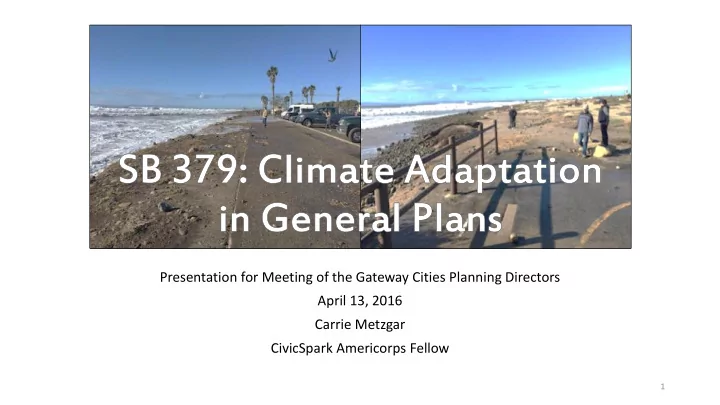
Presentation for Meeting of the Gateway Cities Planning Directors April 13, 2016 Carrie Metzgar CivicSpark Americorps Fellow

1

slide-2
SLIDE 2

What is

A Governor’s fellowship program dedicated to building capacity for local governments to address climate change in California.

?

2

slide-3
SLIDE 3

Fellowship Projects

City of Long Beach Alliance of Regional Collaboratives for Climate Adaptation (ARCCA)

3

slide-4
SLIDE 4

Climate Adaptation vs. . Mitigation

Adaptation:

Actions that minimize or prevent the negative impacts of climate change

Mitigation:

Actions that reduce the emissions that contribute to climate change

4

Source: DNV-GL

slide-5
SLIDE 5

Potential Climate Change Im Impacts

5

slide-6
SLIDE 6

What does this mean for the Gateway Cities?

Transportation Air Quality Housing Economic Development Extreme heat

Road surface expansion, pavement buckling, railroad track buckling Increased allergens, aggravated respiratory and asthma complications Deterioration of housing, increased temperatures in homes, increased cost in energy bills Loss of population due to residents moving to more cooler locations, challenges for

  • utdoor work

Drought/ water resources

Fuel supply at threat Increased smog, dust Restrictions on water usages in homes Food services may lose business due to dependency on agriculture

Sea level rise and coastal flooding

Flooding of roadways, disruption of transit services, damage to infrastructure Toxic runoff Damages to homes, potential displacement of residents in extreme cases Can cause strain on students and workers who are unable to get to school or work

6

slide-7
SLIDE 7

7

slide-8
SLIDE 8

In Introducing SB 379: Helping our cit ities pla lan to adapt

What does SB 379 require? Requires the safety elements of general plans to be reviewed and updated to include climate adaptation and resiliency strategies. What is SB 379? It is a piece of the State's overall adaptation strategy, putting the focus on local agencies to plan for a resilient future.

8

slide-9
SLIDE 9

3 Key Components for Compliance

In order to comply with SB 379, the safety element must include the following components: #1 ASSESS: Vulnerability Assessment #2 DEVELOP: Set of Adaptation and Resilience Goals and Policies #3 IMPLEMENT: Set of Feasible Implementation Measures

9

slide-10
SLIDE 10

#1 ASSESS: Vulnerability Assessment

  • Conduct a vulnerability assessment to identify risks to climate

change in local jurisdictions.

Vulnerability

Sensitivity

Adaptive Capacity

Exposure

10

Source: California Environmental Health Tracking Program

slide-11
SLIDE 11

#2 DEVELOP: Set of f Adaptation and Resilience Goals and Poli licies

  • Create a set of adaptation and resilience goals, policies, and objectives

based on information identified in the vulnerability assessment.

Example Adaptation Goals and Objectives:

  • Increase the city’s urban tree canopy to reduce air

pollution and impacts of extreme heat.

  • Enhance emergency preparedness for residents in

vulnerable neighborhoods during extreme climate events.

  • Collaborate with nearby jurisdictions to raise

awareness about climate change impacts.

11

slide-12
SLIDE 12

#3 IM IMPLEMENT: Set of f Feasible Im Implementation Measures

  • Create a set of feasible implementation measures designed to

carry out the adaptation goals.

Example Implementation Measures:

  • Develop a city tree planting program with a target

number of trees to plant.

  • Designate specific public facilities as ‘safe zones’ for

residents to go to during extreme events.

  • Join a regional climate change working group in

which the city can engage in ongoing dialogue about climate change.

12

slide-13
SLIDE 13

Im Important Dates!

JANUARY 1, 2017

  • If a city currently has an adopted Local Hazard

Mitigation Plan (LHMP), then upon the next revision of the LHMP, cities must also include climate adaptation into the safety element of the general plan. JANUARY 1, 2022

  • If a city currently has not yet adopted a LHMP,

then the safety element of the general plan must be updated to address climate adaptation by January 1, 2022.

Yes, LHMP No, LHMP

13

slide-14
SLIDE 14

“All of f th this in information is is great, but what do I do next?”

Will have checklist for SB 379 compliance!

14

slide-15
SLIDE 15

Thank you! Questions?

Carrie Metzgar CivicSpark Americorps Fellow cmetzgar@civicspark.lgc.org

15