
SLIDE 1
Presentation by Steve Harvey
www.blogger.com.au
1
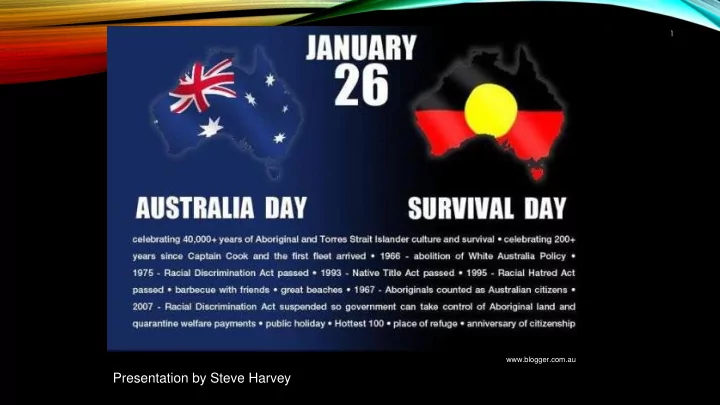
Presentation by Steve Harvey WARNING 2 Aboriginal and Torres - - PowerPoint PPT Presentation
1 www.blogger.com.au Presentation by Steve Harvey WARNING 2 Aboriginal and Torres Strait Islander [viewers, listeners, readers] are advised that the following PowerPoint presentation may contain images and voices of people who have died.
Presentation by Steve Harvey
www.blogger.com.au
1
2
3
4
format.
Australia.
every year?
that it is our job as educators to teach this history of events regardless of these differing opinions. We need to look at all the facts .
and “ultimately, if emotional issues are ignored, then far from learning to deal with difficult issues rationally students may simply come to see school history as irrelevant to their own concerns and students are, after all, entitled to their own emotions” (Barton & McCully, 2007, p. 19).
Celebrating Country In Australia
Image : ABC, 2015
5
Image :http://www.creativespirits.info/aboriginalculture/history/australia-day-invasion-day
Their Worlds Might Touch But Their Views Can Be Worlds Apart
6
7
citizens to take part in reasoned discussions with those whose opinions differ from their own, then surely it is our job as educators to develop this ability in our students”
(Barton & McCully, 2007).
Mark Saddler’s artwork depicts all people working together as a nation.
Image source: http//www.dailyadvertiser.com.au
The Meaning Of Australia Day For Aboriginal People
is a commemoration of a deep loss of their sovereign rights to live on their land that has a history and culture that is 40,000 years old.
Sovereignty Day’. The latter name reflects that all Aboriginal nations are sovereign and should be united in the continuous fight for their rights”(Creativespirit.info).
expense of one race over another, worse still it is at the expense of the original custodians of the land, the Aboriginal and Torres Strait Islanders people. Source: http://www.creativespirits.info/aboriginalculture/history/australia-day-invasion-dayTTt
8
How Do You Celebrate Australia Day?
settlement in Australia is not a cause for celebration for all citizens. Indigenous Australians often feel that the celebrations on Australia Day exclude them and their culture, which was thriving for thousands of years before the arrival of the First Fleet.
Image source: www.theage.com.au Image source: http://www.bookofdaystales.com
9
a national holiday on 26 January is a recent one. Not until 1935 did all the Australian states and territories use that name to mark that date. Not until 1994 did they begin to celebrate Australia Day consistently as a public holiday on that date.
Image: www.abc.net.au
10
The Australia Day Council explains the day as follows: On Australia Day we come together as a nation to celebrate what's great about Australia and being
achieved and what we can be proud of in our great nation. It's the day for us to re-commit to making Australia an even better place for the future.
Image: www.abc.net.au
https://www.youtube.com/watch?v=AFyIPuMNSyk
all Australians through a focus on participation, meaning and recognition across our events, programs and activities for Australia Day. Australia Day is a day for all Australians to come together to celebrate what they love about being Australian and what they are proud of. In 2015, 65% of Australians actively participated in Australia Day in some way. The traditions and activities we participate in for Australia Day might be different, but we are all united on 26 January in reflecting
Australian Day 2015 Celebrate Your Way
11
First Fleet of 11 convict ships from Great Britain arrived and the raising of the Union Jack by Captain Arthur Phillip at Sydney Cove. The date was 26th January 1788.
Arthur Phillip, by William Sherwin, 1789 Image source: National Library of Australia, 9846227 Image source: www.migrationheritage.nsw.gov.au
12
Image source: www.dailytelegraphy.com.au
Image source: http://www.convictcreations.com
Australia Day “We must be the only country in the world that marks its national day not by celebrating its identity, but by questioning it.” Ken Boundy
Australian a descendent of a convict?
day as all it celebrates is the anniversary of the British to establish the penal colony of New South Wales?
the invasion of Australia and the dispossession of the Aborigines?
celebrating all people and multiculturalism and immigration, culture rather than settlement or
to embrace all. (Extract taken from Tony Abbott’s
2015 Australian Day speech)
13
https://www.youtube.com/watch?v=60k739mhtkw
https://www.youtube.com/watch?v=2QB7zFFjkKA
14
I Am, You Are Australian
we are?
https://www.youtube.com/watch?v=7c6FjsRALd4
Always was, always will be Aboriginal land: Rallies across Australia on Survival Day 2015
www.sbs.com.au https://www.youtube.com/watch?v=6afxjhdw_oc
Australia Day/Invasion Day - Lest We Forget 1788 Captain Cook’s cottage graffitied in 2014 Just prior to Australia Day Two Very Different Ways to Express Your Opinions On Australia Day / Invasion Day
across?
15
https://www.youtube.com/watch?v=Lh2M2cpxNX4
16
the rich and impressive cultures of our country — and constitutional recognition is part of achieving that,” (Adam Goodes, spoke about recognising Aboriginal people in the constitution at an event in Sydney 2014).
How do other Countries celebrate their National Day?
independence from Portugal. Chile, celebrates its independence from Spain on the 18th September. Mexico celebrates it independence from Spain on the 16th September. Other countries include: Netherlands, Greece, Poland, Israel, India, Burma, South Korea, and a significant number of other countries.
Great Britain in 1947. The country celebrates with flag-hoisting, parades, patriotic songs and kite flying. In Delhi, the Prime Minister delivers a speech at Red Fort, a 17th Century complex that housed the Mughal emperors, who were exiled during British rule.
Other countries such as South Africa celebrate its independence from Great Britain on the 31st of May 1910 but the country celebrates the 27th April the day in 1994 when the first democratic, non-racial elections were held. South Africans commemorate the restoration of dignity and human rights after a period of apartheid.
Great Britain has neither a national day or an independence day.
17
PAUL KEATING’S THE REDFERN STATEMENT: 10TH DECEMBER 1992 IN COMPARISON TO DR MARTIN LUTHER KING JR’S I HAVE A DREAM SPEECH: 28TH AUGUST 1963
the location of where the statement was made was this Government tactics?
18
https://www.youtube.com/watch?v=hhqAFLud228 https://www.youtube.com/watch?v=3vDWWy4CMhE
coming lessons and look at the importance they both have in civil rights issues.
https://www.youtube.com/watch?v=NM39rnBTBFc
BBQ at Richie Benaud’s House
19
true representation of Australia Day ?
20
individually
be placed in box folded in half. Teacher will pick six students at random and student will then come to front of class and give their answers, views and beliefs of what Australia Day means to them.
to answer the following questions with there will be four groups.
teacher picks one and then that group comes up and give their answers to the class
writing students’ answers on the white board.
Australia Day “We must be the only country in the world that marks its national day not by celebrating its identity, but by questioning it”. (Ken Boundy)
January, would this have been a good time to have done so?
21
22
a set topic subject.
collaboration of ideas and thoughts from fellow peers, through debate, discussion, presentations and by critically reflecting on presented information, such as this power point presentation.
discussions, it further informs students of past and present controversial issues.
deal with them in a rational way by having dignity, respect, empathy and social justice towards others and wellbeing of others.
The Australian Curriculum History: 5.2 : Historical knowledge and understanding Historical empathy and moral judgement: The capacity into the world of the past with an informed imagination and ethical
meaningful historical accounts involve explicit or implicit moral judgement, and historians require an awareness of their own values and the impact of these values n their historical understanding English: ACLELA1564: Content description Year 10 – “Understand how language used can have inclusive and exclusive social effects and can empower or disempower people” General Capabilities: ACDSEH104 Year 10 Ethical understanding: Students understanding ethical concepts and issues: Explore ethical concepts in context. Reasoning in decision making and actions: Consider consequences. Exploring values, rights and responsibilities: Examine values, explore rights and responsibilities, consider points of view. Intercultural understanding: Students to investigate culture and culture identity. Explore and compare cultural knowledge, beliefs and practices. Critical and Creative thinking: Students to identify and clarify information and ideas. Organise and process information. ACARA: Cross-Curriculum priorities: The Aboriginal and Torres Strait Islander histories and cultures priority provides the opportunities for all young Australians to gain a deeper understanding and appreciation of Aboriginal and Torres Strait Islander histories and cultures, deep knowledge traditions and holistic world views.
23
REFERENCES
Adam Goodes inspires-This is my Australia. (2014). Retrieved from https://www.youtube.com/watch?v=Lh2M2cpxNX4 Australian Curriculum and Assessment Authority. (2015). Cross-Curriculum priority areas. Retrieved from http://www.acara.edu.au/curriculum/cross-curriculum-priorities.html Australian Curriculum and Assessment Authority. (2015). Foundation to Year 10 Curriculum: English. Retrieved from http://www.australiancurriculum.edu.au/generalcapacities/pdf/overview Australian Curriculum and Assessment Authority. (2015). English (version 8.1). Australia: ACARA. Retrieved from http://www.acra.au Australian Curriculum and Assessment Authority. (2015). Foundation to Year 10 Curriculum: History. Retrieved from http://www.australiancurriculum.edu.au/generalcapabilities/pdf/overview Australian Curriculum and Assessment Authority. (2015). History (version 8.1). Australia: ACARA. Retrieved from http://www.acra.au Australia Day. (2011). TVC-Celebrate today and live it again tomorrow. Retrieved from https://www.youtube.com/watch?v=2QB7zFFjkKA Australia Day Council (2015) Australia Day History. Retrieved from http://www.australiaday.org.au/austral-day/history/ Australia Day/Invasion Day-Least we forget 1788. (2015). Retrieved from https://www.youtube.com/watch?v=6afxjhdw_oc Australian Government Department of the Prime Minister and Government. Indigenous Affairs. Retrieved from www.indigenous.gov.au/culture-and-capability Barton, K & McCully, A. (2007). Teaching Controversial Issues… where controversial issues really matter: Teaching History, 127 June. BBq at Richie Benaud’s House. (2015). Retrieved from https://www.youtube.com/watch?v=NM39rnBTBFc Convict Creations. (2015). The True Meaning of Australia Day. Retrieved from http://www.convictcreations.com/culture/traditions.htm Creative Spirits. (2015). Australia Day – Invasion Day. Retrieved from http://www.creativespirits.info/aboriginalculture/history/Australia-day-invasion-day Creative Spirits. (2015). Aboriginal Languages – Australian Indigenous Language (verbal, non verbal). 24
REFERENCES
25 Gebhardt, p. (2013). A National Day of Shame. (2013, January 2013). The Sydney Morning Herald. Retrieved from http://www.smh.com.au/federal-politics/society-and-culture/a-national-day-of-shame-20130123-2d7b3.html Hogue, C. (2005). Does Australia have a National Identity. Retrieved from https://cpd.org.au/2005/07/does-australia-have-a-national-identity/ Keating, P. (1992). The Redfern Address-Australian Labor Party. Retrieved from https://www.youtube.com/watch?v=hhqAFLud228 Luther, M, K., Jr, (1963). I have a dream speech. Retrieved from https://www.youtube.com/watch?v=3vDWWy4CMhE McDonald, S. (2014). Aboriginal Councillor Dominic Wy Kanak wants the First Fleet settlement in Sydney recognised as an ‘invasion. Retrieved from http://www.dailytelegraph.com.au/newslocal/city-east/aboriginal-councillor-dominic-wy-kank-wants-the-first-fleet-settlement-in-sydney-recognised-as-an-invasion… NIT News, (2015). Always was, always will be Aboriginal land: Rallies across Australia on Survival Day 2015. Retrieved from
https://www.youtube.com/watch?v=7c6FjsRALd4 Saddler, M. (2015). What is the meaning of Australia Day? The Daily Advertiser. Retrieved from http://www.dailyadvertiser.com.au/story/3209807/what-is-meaning-of-australia-day/ SBS News, (2014). ‘Invasion Day” debate resurfaces. SBS News. Retrieved from https://www.sbs.com.au/news/article/2014/01/24/invasion-day-debate-resurfaces Smith, D. (2015). The truth is January 26 should be First Fleet Day, not Australia Day. The Age. Retrieved from http://www.theage.com.au/comment/the-truth-is-January-26-should-be-first-fleet-day-not-Australia-day-20150123-12xb0x.html