Presentation by Dr. Padraig Walsh, CEO of QQI at ETBI Annual - - PDF document

presentation by dr padraig walsh ceo of qqi at etbi
SMART_READER_LITE
LIVE PREVIEW

Presentation by Dr. Padraig Walsh, CEO of QQI at ETBI Annual - - PDF document

Presentation by Dr. Padraig Walsh, CEO of QQI at ETBI Annual Conference Killashee House Hotel 26 September 2018 Who is responsible for quality in FET? Introduction QQIs answer to this question is explicated, I believe, in the values statement


slide-1
SLIDE 1

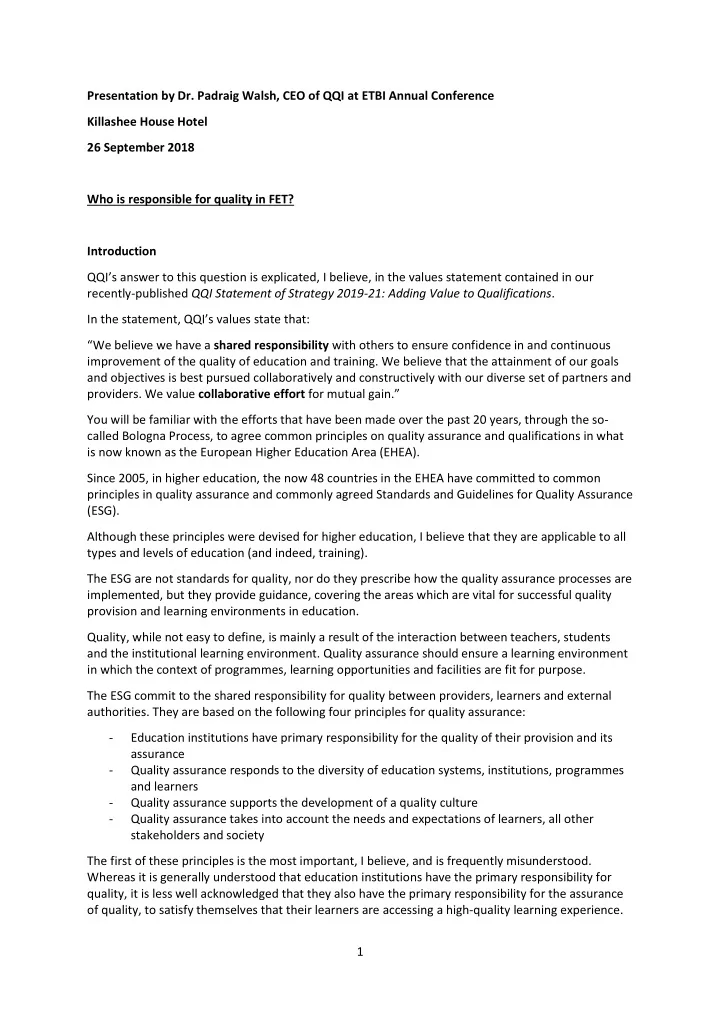
1 Presentation by Dr. Padraig Walsh, CEO of QQI at ETBI Annual Conference Killashee House Hotel 26 September 2018 Who is responsible for quality in FET? Introduction QQI’s answer to this question is explicated, I believe, in the values statement contained in our recently-published QQI Statement of Strategy 2019-21: Adding Value to Qualifications. In the statement, QQI’s values state that: “We believe we have a shared responsibility with others to ensure confidence in and continuous improvement of the quality of education and training. We believe that the attainment of our goals and objectives is best pursued collaboratively and constructively with our diverse set of partners and

  • providers. We value collaborative effort for mutual gain.”

You will be familiar with the efforts that have been made over the past 20 years, through the so- called Bologna Process, to agree common principles on quality assurance and qualifications in what is now known as the European Higher Education Area (EHEA). Since 2005, in higher education, the now 48 countries in the EHEA have committed to common principles in quality assurance and commonly agreed Standards and Guidelines for Quality Assurance (ESG). Although these principles were devised for higher education, I believe that they are applicable to all types and levels of education (and indeed, training). The ESG are not standards for quality, nor do they prescribe how the quality assurance processes are implemented, but they provide guidance, covering the areas which are vital for successful quality provision and learning environments in education. Quality, while not easy to define, is mainly a result of the interaction between teachers, students and the institutional learning environment. Quality assurance should ensure a learning environment in which the context of programmes, learning opportunities and facilities are fit for purpose. The ESG commit to the shared responsibility for quality between providers, learners and external

  • authorities. They are based on the following four principles for quality assurance:
  • Education institutions have primary responsibility for the quality of their provision and its

assurance

  • Quality assurance responds to the diversity of education systems, institutions, programmes

and learners

  • Quality assurance supports the development of a quality culture
  • Quality assurance takes into account the needs and expectations of learners, all other

stakeholders and society The first of these principles is the most important, I believe, and is frequently misunderstood. Whereas it is generally understood that education institutions have the primary responsibility for quality, it is less well acknowledged that they also have the primary responsibility for the assurance

  • f quality, to satisfy themselves that their learners are accessing a high-quality learning experience.
slide-2
SLIDE 2

2 The role of external quality assurance agencies like QQI is largely to ensure that the internal quality assurance systems put in place by providers, such as the Education and Training Boards, are

  • effective. Our role in FET is to evaluate how seriously the ETBs are taking their responsibility for

quality and its assurance, to publicly report on our findings, to commend good practice where we find it and to make recommendations for improvement where deficiencies are found. Quality Assurance in Further Education – current state QQI’s responsibility begins with the issuing of statutory quality assurance guidelines to providers of education and training and providers should, when developing their own quality assurance procedures, take account of these guidelines. In 2016, QQI, following consultation with stakeholders, developed and published core QA guidelines that apply to all providers of education and training. This decision came about because we believe that there are certain core principles that apply to all types of education and training, be it general, vocational or higher. This reflects a growing trend internationally to a more unified approach to tertiary or post-secondary education in countries like Australia, New Zealand, Scotland and Wales. Indeed, developments in Ireland such as the establishment of QQI, the widening of Apprenticeship provision across Levels 5-9 (and possibly 10) of the NFQ, the structural changes in the Department of Education and Skills that now house Further and Higher Education under a single Assistant Secretary. More recently, I have been asked to assist the Welsh government in their development of a post- compulsory Education and Training Commission following the recommendations in the Hazelkorn

  • report. The Welsh has been positively influenced by QQI’s approach of issuing core QA Guidelines for

all education and training providers. As you know, we have supplemented the core QA guidelines with additional sector-specific and topic-specific guidelines that are appropriate to the scope of a provider’s provision. For the ETBs, this involves engaging with guidelines specifically developed for the ETB sector but also guidelines for providers of national apprenticeship programmes. ETBs are aware that the quality assurance procedures must be comprehensive and cover all education, training and related services provided by ETBs, regardless of whether these lead to QQI awards or awards of other awarding bodies or indeed lead to no award. Initial quality dialogue meetings between QQI and ETBs A senior team from QQI, including myself, the Head of Access and Lifelong Learning, Andrina Wafer and other colleagues visited the 16 ETBs over the period 7 November – 8 December 2017. At the meetings, the QQI team met with the relevant Chief Executive and Further Education and Training Director and their teams which typically included Training Centre Managers and Officers, Principals/Vice-Principals of Further Education Colleges, VTOS and Youthreach co-ordinators and Adult Education Officers. The ‘dialogue’ meetings were so-called as they allowed an ETB to present the new FET management teams and the new governance systems that were being put in place. The presentations confirmed to QQI that ETBs were very much taking on board the importance of quality assurance being ‘ETB-

  • wned and ETB-led’. There was a strong sense that ETBs were assuming corporate responsibility for

quality assurance over the range of their further education and training provision, be it delivered through PLC, VTOS, Youthreach, Adult and Community Education or training centres.

slide-3
SLIDE 3

3 In all the dialogue meetings, QQI emphasised the necessity for ETBs to have regard to the relevant QQI quality assurance guidelines when devising their own procedures and the prompt and visible publication of quality assurance policies and procedures on each ETB website. In addition, QQI stressed the importance of the publication of all relevant ETB-organised quality evaluation reports through links on the ETB’s website as an essential component to promote transparency and support public confidence for all stakeholders. QQI emphasised the importance of this set of dialogue meetings in maintaining contact with each ETB as this is the level at which the regulatory relationship with QQI exists. QQI is highly dependent

  • n colleagues in each ETB to disseminate key communications relating to quality assurance and the

work of QQI across the organisation in an effective manner. As a product of amalgamation itself, QQI fully recognises the challenge of integrating the quality systems of the former vocational education committees and FÁS training centres into a single quality assurance system. CDETB, the largest ETB, has a staff of approximately 3,500 providing courses for almost 23,000 full-time and 30,000 part-time learners each year across the City of Dublin. CDETB currently operates 16 Colleges of Further Education, 2 Training Centres, an Adult Education Service that operates in 5 separate areas across the city, 10 Youthreach Centres and Education and Training facilities in 7 prisons. The challenge for CDETB was to move from 22 separate legacy quality assurance agreements in 2014 down to 4 agreements in 2018 covering FE colleges, Youthreach, Adult/Prison Education and Training. Over time, the aim for CDETB is to move even more towards a unified total quality assurance management framework. This is illustrated in the QA section on the CDETB website. This total QA management framework will take time and will require, I believe, changes in the administrative structures of ETBs. The appointment of FET Directors in each ETB has been a great

  • beginning. This has allowed the development of a peer group who interact with each other and with

bodies like QQI. This has been accompanied, in some cases, with the appointment of quality assurance

  • fficers in ETBs. The professionalisation of these roles is essential, I believe, to the development of a

sustainable quality system across ETBs and the wider FET sector. When I studied Engineering in UCD, in the late 1970s, the Department consisted of a team of academics and a single school secretary running a single undergraduate programme. There was no Erasmus programme, no choice or electives until final year and no structured mechanism for student feedback and no public reporting of anything. The development and maintenance of modular and semesterised programmes has required the introduction of a professional administrative cadre in higher education. The HEA performance framework report in 2014 indicates that 53% of staff in the university sector are classed as administrative, this falls to 31% in the Institue of Technology sector. It is considerably lower again in the ETB sector, yet the development, compliance and reporting responsibilities of the ETBs is now commensurate with that for higher education. Think of FOI, GDPR, Data Analytics, FARR, Institutional Quality Reporting and Strategic Dialogue. This shouldn’t have to mean greater diversion of teachers from frontline teaching, as the current burden of administrative work is already doing this but a move toward a more balanced mix of administrative and teaching staff across the sector. I am aware that this requires a rebalancing of the current staff allocation model across the sector, but I believe this is essential if we are to develop a high-quality, flexible, responsive FET system. One of the primary differences between the school and FE/ETB sector is in the ability of individual teachers to input into programme development. The move from a series of prescriptive QQI award specifications in CAS to the more provider-led role in programme development envisaged by the new QQI validation policy brings with it certain challenges. The national credibility of programmes and their associated awards requires levels of comparability between similar programmes delivered in different locations or settings.

slide-4
SLIDE 4

4 This should not take away from the ability of providers and individual teachers to adjust and modify programmes but essentially the responsibility in the new validation system must lie more on the provider developing a programme of education and training. For this to work optimally, sufficient space must be available to disciplinary experts to engage in the programme development process. It is likely that adjustments to the current staffing model will have to take place both to support such programme development and the required administrative support. The recently published QQI Statement of Strategy, informed by the views of our stakeholders, describes a key priority as being ‘to maintain, develop and promote the (National) Framework (of Qualifications) as the central feature of a flexible, responsive system for quality-assured qualifications in Ireland”. The Statement further commits QQI to “streamline our system of standards and awards to permit providers to deliver flexible, responsive and nationally-benchmarked programmes of education and training leading to our awards”. This necessitates that an appropriate balance between central support from ETBI, QQI, SOLAS and the DES and the relative levels of autonomy of individual ETBs. Recent Developments: Apprenticeship One of the exciting new areas for the Education and Training Board has been the challenge of developing new apprenticeship programmes. It is worthwhile setting out the nature of this

  • challenge. An ETB, itself a relatively new entity is acting as a co-ordinating provider, along with other

ETBs, as part of a consortium, involving multiple industry partners to develop a new programme, without established awards, to operate nationally while being delivered locally. They are doing this in the context of a new QQI quality assurance guidelines new QQI validation policy, with different criteria, involving the use of panels and site visits. To some extent, this involves competition, between individual ETBs to lead national programmes and further competition in a crowded space with higher education institutions. The development time from ‘approval of concept’ to submission of application to QQI has taken too long, for ETBs, for QQI, for SOLAS and the Minister. However, at this stage, we have validated ETB- led apprenticeships in Culinary Arts, Property Services, Butchery and Original Equipment Manufacturing from ETBs in Kerry, City of Dublin, Cavan-Monaghan and Mayo-Sligo-Leitrim

  • respectively. Many of these ETBs are involved in developing further apprenticeships but now in the

knowledge that there is a clear path to the summit. QQI is pleased with the way these programmes are developing and we acknowledge the challenge that this has been for providers. We have had a few bumps along the way, in the challenge of writing module and programme learning outcomes, and the volume of submissions required to document programmes. I know everybody in the development of new Apprenticeships recognises that we serve nobody well by trying to cut corners or by trying to lower the bar. However, QQI has had to recognise that we are in a developmental phase and that providers need assistance and support in developing programmes and in understanding new language and that we may have to operate close to the edge

  • f our comfort zone in balancing the roles of advice and examination.

The new validation process has also been one of learning for QQI. We recognise that a process of compliance with each sub-criterion of validation may have focussed the applicants and panel evaluators and chairs too much on the detail and not allowed people to stand back and answer the fundamental question ‘does this look like a high-quality programme?’ We have learned from this and are committed to briefing our panels, chairs and applicants on the lessons learned from the process so far.

slide-5
SLIDE 5

5 We are also ensuring that the panels include, in so far as possible, people with a background in FET. The best lessons to be learned are from those who have gone through the process. For ETB wishing to get involved in leading consortia in Apprenticeship development, the most valuable help will come, I believe, from those that have already undergone the process successfully and who are in the best position to aid in developing programmes and in documenting them in a manner that leads to their successful validation. While all programmes require disciplinary knowledge, writing learning

  • utcomes and clearly documenting a programme are largely generic, transferrable skills.

I was very struck, at a meeting this summer, by a reminder to me from a FET Director that ETBs are doing ‘validation, while wearing L-plates’. However, at this point, four of the ETBs have successfully piloted programmes through validation and have now deservedly earned their right to a full driver’s licence. Recent developments in QQI Monitoring As a complement to the internal verification and external authentication elements of assessment moderation described previously, QQI data monitoring also has a role to play. Most QQI monitoring is routine and desk-based, although there are provisions for direct interventions on foot of complaints

  • r concerns identified through the QQI policy on monitoring.

QQI now sends annual grading reports to all its FET providers with directions that it is to be used for both review of internal consistency in grading and for benchmarking against national comparators. These reports have proved very useful in identifying which fields of learning and forms of assessment show the greatest levels of variability in grading. It was evident during the Dialogue Meetings between QQI and the ETBs in 2017 that the provision of the above data was being carefully considered by the ETBs as part of their own internal quality assurance systems. Towards Institutional Review Following the approval by QQI of the QA procedures for the ETBs in April and June 2018, the next step is an external review of the effectiveness of quality assurance procedures in the 16 Education and Training Boards. This will follow the well-established practice of a self-evaluation report (this time at the wider ETB-level, rather than just the product of the executive), a visit by the expert panel and a public report containing commendations and recommendations for improvement. The intention is to conduct an omnibus review of all 16 ETBs in 2020. This will be an opportunity to see the progress being made towards an integrated quality system within each ETB. Over the next number of months, we hope to develop the methodology for the review. As part of our statutory consultation process, we will develop this, in consultation with the providers, the ETBs themselves and with SOLAS, as the funding body and will provide an opportunity for wider stakeholders, such as learner representative bodies and advocates, to input into the process. This process, we hope, will allow us to answer the important questions. Do the ETBs have robust quality assurance procedures in place for their education and training provision and more importantly, are they providing transparent public information about how effective these procedures are in demonstrating that learners are receiving a high-quality learning experience? Quality Enhancement QQI also has a role in supporting providers in enhancing quality. In November 2018, QQI is

  • rganising separate consultation events in relation to assessment in further and higher Education.

These consultations are being held in the context of QQI’s green paper on Assessment that was

slide-6
SLIDE 6

6 issued earlier in the year. The further education event on 13th November in the Alex Hotel is being jointly hosted by QQI and Education and Training Board Ireland (ETBI). The status of Further Education and Training It is useful to remind ourselves of where we have come from with FET. It took until the establishment of SOLAS in 2013 for Ireland to produce a national Further Education and Training Strategy in 2014. What did the mid-term review of the FET strategy by Prospectus tell us? Consider the following extracts. “The credibility of the FET Sector will ultimately be judged by its ability to compete in the educational ecosystem for a limited cohort of learners and evidence to all stakeholders the real- world benefits of attaining a FET qualification.” “The improved standing of FET will be driven by (these outcomes) if the value of the sector can be seen by progression of valued up-skilling” “If the FET sector is to realise its ambition of adopting a whole-system approach, a further important consideration for the Department in establishing a clear policy position, is defining how the FET sector can develop and align with the higher education sector in a way that ensures more seamless transitions for learners.” “(Ireland needs to) develop a fully integrated tertiary education model focused on student learner/career pathways, which builds on the existing relationship between Further Education and Training and Higher Education and includes all learners on the educational continuum”. There are some strong lessons in there for all of us. Lessons from elsewhere I am often asked, frequently by our own Department of Education, when talking about quality. ‘Where are the exemplars? Who is doing this well?’. In many cases, I can answer that Ireland is one

  • f the strongest performers internationally in quality and its assurance.

The embeddedness of our national framework for qualifications, where a taxi driver will tell you that their son or daughter is doing the level 6 or level 8 course, is something that is envied elsewhere. We have a good quality assurance system, with strong levels of autonomy, most particularly in further and higher education. There are, however, countries that do education better than us and we can certainly learn lessons from them but that may involve making hard choices and we may have to be prepared to wait a long time before our efforts to improve come to fruition and we are not particularly good at waiting. Ireland’s problem, in mathematical terms, is not the periodicity of our economic and other cycles, but their amplitude. Witness our struggle with the housing crisis, where we have cycled from ‘ghost estates’ to homelessness in less than a decade. Our peaks and troughs are too big and we need to find ways of modulating that. I am not sure that yesterday’s headline from the ESRI that the Irish economy is going to grow by 9% in 2018 is particularly welcome.

slide-7
SLIDE 7

7 When asked about exemplars in education, I frequently return to a 2010 OECD report commissioned by the United States entitled ‘Strong performers and successful reformers in education: lesson from PISA for the United States’. Although this relates to secondary education, I believe it applies to education generally. The case study for Finland is entitled: ‘slow and steady reform for consistently high results’. The summary paragraph encapsulates Finland’s success well and I quote: ‘Finland is one of the world’s leaders in the academic performance of its secondary school students. This performance is also remarkably consistent across schools. Finnish schools seem to serve all students well, regardless of family background, socio-economic status or ability. The factors behind this success include political consensus to educate all children in a common school system; an expectation that all children can achieve at high levels, regardless of family background or regional circumstance; single minded pursuit of teaching excellence; collective school responsibility for learners who are struggling; modest financial resources that are tightly focussed on the classroom and a climate of trust between educators and the community’. It is worth reflecting on the above, in an Irish context. While we would love consistently high results, we have a poor appetite for slow and steady reform. We would like, I think, to have an education and training system that is remarkably consistent, and that serves all students well. We would do well to consider the consensus that would be required to achieve such consistency. The Finnish example chimes well, I believe, with the concept of the primary responsibility for quality lying with the provider and the individual teacher and we could do well to reflect on the Finnish lesson of ‘single-minded pursuit of teaching excellence, collective responsibility, modest financial resources that are tightly focussed on the classroom and a climate of trust between educators and the community’. Thank you. Dr Padraig Walsh