Presentation av examensarbeten Torsdag 8 Jun i , tid: 8 15 Masters - - PowerPoint PPT Presentation

presentation av examensarbeten
SMART_READER_LITE
LIVE PREVIEW

Presentation av examensarbeten Torsdag 8 Jun i , tid: 8 15 Masters - - PowerPoint PPT Presentation

Vlkomna till rets gemensamma redovisning av examensarbeten. Avdelningen fr konstruktionsteknik p Chalmers utexaminerar ett relativt stort antal examensarbeten varje r. Mnga av dessa r initierade av och genomfrs hos olika aktrer


slide-1
SLIDE 1

DIVISION OF STRUCTURAL ENGINEERING Chalmers University of Technology Välkomna till årets gemensamma redovisning av examensarbeten.

Avdelningen för konstruktionsteknik på Chalmers utexaminerar ett relativt stort antal examensarbeten varje år. Många av dessa är initierade av och genomförs hos olika aktörer i näringslivet. Andra har en stark anknytning till de forskningsprojekt som bedrivs av forskargrupperna på avdelningen. Som ett led i vår strävan för ett starkare samarbete till industrin och en effektivare kunskaps- och erfarenhetsöverföring anordnar vi tillsammans med Konstruktionscentrum på Chalmers en workshop där examensarbeten genomförda under våren 2017 presenteras. Vi hoppas att Ni på det sättet får bättre möjlighet att närvara vid redovisningarna för att ta del av presentationerna och bidra till diskussionen. Mycket välkomna! Chalmers kartor, http://maps.chalmers.se/, sök efter EB/EC/EE/EF hörsal

Presentation av examensarbeten

Torsdag 8 Juni, tid: 8‐15

slide-2
SLIDE 2

Master’s thesis seminars - June, 8th 2017 Session 1, 08:00-09:00

Room EB Room EC Modelling composite beams with partial composite action Validation of beam element models using FEM in composite beams with partial composite action Abstract: In 2015, the Department of Civil and Environmental Engineering at UPC (Barcelona) developed a 2D model based on 1D beam elements for a simplified analysis

  • f composite beams with partial composite action. The proposed model overcomes the

problems that existing analytical theories in the literature or complex FEM analysis present, such as lack of intuitiveness, limited applicability, little versatility, and hard modelling process. Thus, this thesis aims at validating the accuracy and applicability of the reduced model developed at UPC by means of FEM (ABAQUS) for different types of structure such as simply supported, continuous and variable-depth beams. Students Ricard Caus Opponents Adem Hasi Supervisors Fredrik Larsson (Chalmers, Dept. of Applied Mechanics) Examiner Fredrik Larsson Material characterisation of weld toe region using Digital Image Correlation Abstract: The aim of the thesis project is to investigate the local material properties at the weld toe of a welded joint, using digital image correlation (DIC) in order to obtain the true stress field over the investigated area. The real stress-strain curves of the three material regions at the weld toe, namely, the weld material, base material and heat affected zone are

  • btained by means of material calibration by using an optimization function in Matlab,

combined with the structural analysis capability of Abaqus. Students Andrea Dező Opponents Fabio Lozano & Josef Makdesi Supervisors Mohammad Al-Emrani, Mathias Flansbjer (SP) Examiner Mohammad Al-Emrani Room EE Room EF Repair of submerged concrete piles with FRP composites Abstract: Deterioration of concrete piles in marine structures due to harsh environmental conditions has highlighted the need of continuous maintenance and renewal of such

  • structures. To repair these structures a relatively new and emerging repair method is to wrap

the piles with fibre reinforced polymer (FRP) materials. The aim of this thesis is to investigate the feasibility of FRP repair method for submerged piles. The methods used are: a literature review an interviews with experts in the field, accelerated long-term durability tests focusing on corrosion and a case study to compare costs between FRP and traditional repair methods. Students Johan Röös & August Uddmyr Opponents Per Ahlgren & Joacim Edwijn Supervisors Valbona Mara (ÅF), Reza Haghani Dogaheh Examiner Reza Haghani Dogaheh Dynamic bridge-train interaction in high-speed railway design An evaluation of comfort criteria regulations and analysis methods according to Eurocode Abstract: High speed railway is being introduced in Sweden through the East Link Project. When it comes to vehicle comfort due to vertical accelerations two analysis methods are proposed in Eurocode. The first is a simplified analysis based on the static load model LM71 and the second approach is a dynamic vehicle bridge interaction model. This thesis compares these two methods using a finite element approach with analysis in MATLAB and ABAQUS. Results indicate that the simplified method might underestimate the real behaviour of the train. Students Axel Kristensson & Michael Engberg Opponents Josefin Panarelli & Angelica Henriksson Supervisors Peter Möller (Chalmers), Magnus Bäckström (COWI), Niclas Karlsson (COWI) and Marcus Hjelm (COWI) Examiner Joosef Leppänen
slide-3
SLIDE 3

Master’s thesis seminars - June, 8th 2017 Session 2, 09:00-10:00

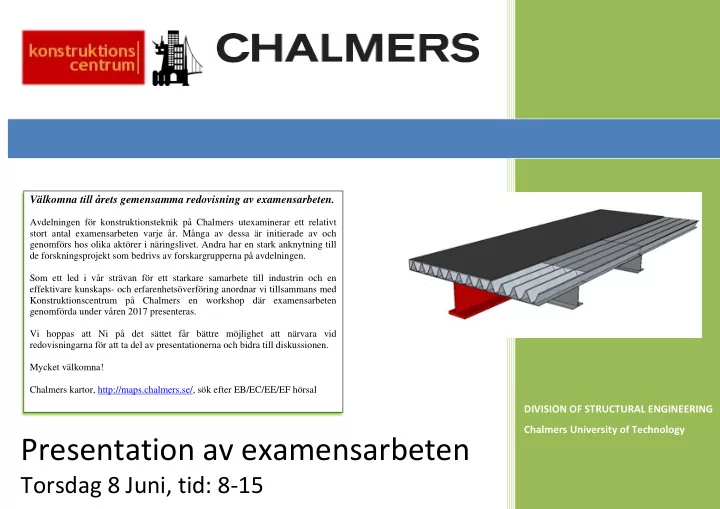
Room EB Room EC Shear Capacity of Corroded RC Structures A study based on detailed 3D FE analyses Abstract: One of the main reasons for deterioration of RC structures is the corrosion of steel reinforcement. The aim of this study is to deepen the understanding of the effects of corrosion on shear response of RC structures. Therefore detailed 3D FE analysis was used to investigate the shear behaviour of RC beams subjected to different corrosion levels and loaded in a four-point bending test set-up. The FE model includes a bond and corrosion model to describe the interaction between concrete and reinforcement and is verified against experimental beam tests. A parametric study was made and indicated that corrosion may result in more shear cracks with a smaller angle within the shear span. Students David Bergqvist & David Wallertz Opponents Hossein Tahershamsi Supervisors Kamyab Zandi & Mattias Blomfors Examiner Kamyab Zandi FE-modelling of steel sandwich elements under patch loading Simulation of the structural response with 2D FE-models Abstract: To validate the usage of corrugated steel sandwich elements for bridge applications, the fatigue capacity of the structure can conveniently be checked through FE-modelling. Complicated geometry and influence of welds make the modelling process an unreasonably time-consuming and challenging process. Therefore, an approach to reduce the complexity of the FE-model was proposed and a validation of the response was attempted for several sandwich element plates. A study was performed by comparing global and local response under patch loading. Students Alfred Ro & Jon Difs Opponents Fredrik Bengtsson Supervisors Peter Nilsson (WSP, Chalmers) Examiner Mohammad Al-Emrani Room EE Room EF Parametric analysis and optimisation of FRP pedestrian bridges Optimisation of hybrid fibre compositions and fibre angles in serviceability limit state Abstract: FRP bridges come in many different sizes and shapes, and often involve complex

  • geometry. This, combined with anisotropic material behaviour, means building a structural

model of the bridge becomes time consuming. In this thesis we have looked into the advantages of using parametric modelling for analysing and optimising existing or proposed FRP pedestrian bridges. Results show that there are considerable performance gains to be made with all of the suggested optimisation methods and we see a clear advantage in using parametric analysis for pedestrian FRP bridges in terms modelling time and flexibility. Students Jimmie Andersson & Gustav Good Opponents Sara Almstedt & Puria Safari Supervisors Georgi Nedev (Ramböll), Erik Olsson (Chalmers) Examiner Reza Haghani Dogaheh Stress-Ribbon Timber Roof Structures Abstract: The stress ribbon system has the shape of a freely hanging cable but with inherent bending stiffness. Two different numerical analysis software are investigated to find a tool to implement for design of stress ribbon structures. Snow- and wind loads are discussed to find realistic load cases that are applied on the structure. The relation between cross-section and span length of a stress ribbon structure makes it sensible to asymmetrical loads that consequently create large deformations. Student David Gustafsson & Martin Ingvarsson Opponents Marcus Ahlström & Carl Holmquist Supervisors Samuel Hofverberg (WSP) & Alexander Sehlström (WSP, Chalmers) Examiner Joosef Leppänen

slide-4
SLIDE 4

Master’s thesis seminars - June, 8th 2017 Session 3, 10:00-11:00

Room EB Room EC FE-modelling of a tied arch bridge with regard to restraining forces A comparison of modelling techniques Abstract: In tied arch bridges restraining forces may arise in the transversal beams due to movements of adjacent structural parts. The magnitude of such forces depends partly on the stiffness of the transversal beams, resulting in difficulties when designing. The impact of modelling techniques regarding the restraining forces is investigated using three various levels of complexity; beam grillage, deck as shell elements and only shell elements. The results show that the beam grillage model is conservative. The presentation of the study will include a recommendation of the suitable detail level when designing tied arch bridges. Students Frida Gustavsson & Sofia Jorholm Opponents Joel Eriksson & Adam Jonsson Supervisors Emanuel Trolin (Norconsult), Ignasi Fernandez Perez Examiner Ignasi Fernandez Perez Verification and optimisation of the initial bow imperfection for buckling of steel members - Flexural buckling of columns and beam-columns Abstract: The research on buckling of steel members are an ever present field of study, this thesis is evaluating the accuracy of the calculation method using initial bow

  • imperfections. The aim is to analyse and compare this method with other well established

methods for columns and beam-columns only considering flexural buckling. And in case

  • f deviations the goal is to develop the value and/or formula for the initial bow

imperfection. For columns subjected to only a compressive force the analysis shows results on the safe side and the optimisation of the initial imperfection shows positive results. For beam- columns the results are much more on the unsafe side. Students Angelica Henriksson & Josefin Panarelli Opponents Axel Kristensson & Michael Engberg Supervisors Rasmus Sylvén (VBK) & Mohammad Al-Emrani Examiner Mohammad Al-Emrani Room EE Room EF Flexural strengthening of concrete structures with prestressed Fiber reinforced polymer (FRP) composite Abstract: By prestressing CFRP and externally bond it to a RC structure the behavior can be increased due to cracks closing up and an increase in the ultimate strength. Results from FEA shows that crack-width can be reduced if the prestressing level in the CFRP is within a certain range. Prestressing with too high force will cause the concrete to crack on the top side and reduce the ductility of the beam. The optimal prestressing force will be between 34,24 - 38,05 % utilization of the CFRP. Student Per Ahlgren & Joacim Edwijn Opponents Johan Röös & August Uddmyr Supervisors Jincheng Yang (Chalmers), Valbona Mara (ÅF) Examiner Reza Haghani Dogaheh Plastic Deformation Capacity of Concrete Beams Subjected to a Drop-weight Impact and Static Loading Abstract: The dynamic behaviour of simply supported reinforced concrete beams was evaluated through an experimental study consisting of a drop-weight impact falling from different heights. Static tests were subsequently performed in order to examine the post- impact behaviour. An increase of the post-impact deformation capacity was observed in the specimens subjected to a larger impact energy. The test results were compared with predictions based on different numerical models, including 2DOF and FEA in LS-Dyna with hexahedron and tetrahedron solid elements. High correspondence was found, although the numerical models tend to overestimate the maximum deformation. Students Fabio Lozano & Josef Makdesi Opponents Andrea Dezo Supervisors Morgan Johansson (Norconsult, Chalmers) Mathias Flansbjer (SP, Chalmers) Examiner Joosef Leppänen

slide-5
SLIDE 5

Master’s thesis seminars - June, 8th 2017 Session 4, 11:00-12:00

Room EB Room EC Assessment and comparative study of design method for onshore wind power plant foundations Abstract: With increasing demand for renewable energy the amount of wind power plants has grown steadily. At the company WSP there has been a wish to investigate and increase the knowledge about design process of wind power plant foundations. The objective of the thesis was to; investigate the influence of the height of the tower, how a decreased design life from 50 to 20 years affects the design and what impact different norms might have. The study showed a clear relation between the height of the tower and the design forces, a moderate correlation between the height and dimensions. Furthermore, the reduced design life and the use of different had little influence on the final design. Student Marcus Ahlström & Carl Holmqvist Opponents David Gustafsson & Martin Ingvarsson Supervisors Alexandre Mathern (Chalmers), Erik Gustavsson (WSP) Examiner Rasmus Rempling Structural analysis and optimal design of an innovative bio-composite sandwich element as floor system for multi-storey timber buildings Abstract: The scope of the thesis is to reduce the height of apartment dividing floors with the main goal to include an additional floor to the same height of the building. Optimal design of a sandwich bio-composite plate with a corrugated core is conducted in this study. The effect of directional material properties of different timber laminated composite constituents and shear deformations are incorporated into the analyses to gain the maximum efficiency of the optimal results. The results show that in terms of structural behaviour it is possible to significantly reduce the height of the floors with the proposed design in comparison with existing similar floors in the market. Student Kajsa Fröjd & Andreas Hellström Opponents Simon Kastari & Rebecka Eliasson Supervisors Rasoul Atashipour Examiner Rasoul Atashipour Room EE Room EF Design methodology for evaluation of global stability in structural systems Abstract: When choosing a structural system for a building it is important to consider stability issues. These stability effects include overturning, sliding, accidental action, dynamic effects and global buckling effects. The aim of this thesis is cover the issues of global stability to ensure safe structures in the future due their increase in slenderness. The main intent is to present methods that a general contractor can use to evaluate global stability in buildings. The thesis displays methods for evaluating global stability, but focuses on methods of evaluating global buckling stability. Students AbdulRaheem Alsofi & Andreas Grahn Opponents Priyanka Das Supervisors Carl Jonsson, Carl Larsson (Skanska Teknik), Karl-Gunnar Olsson (Chalmers) Examiner Filip Nilenius Calculation of vibrations in structures in the early design phase A study regarding prediction of comfort disturbing vibrations in building Abstract: Performing dynamic analyses to predict vibrations in a building, due to e.g. nearby traffic, may require advanced calculations. This master’s thesis aims to investigate how the dynamical response of buildings can be analysed in a simplified manner. A program, using methods common in earthquake engineering in combination with comfort weighting of vibrations, is developed. Analyses are performed and the results are compared to results from a general FE program. The comparisons show that the results differ but the program still indicates if the dynamic responses are potentially critical or not. Students Linnea Fagerström & Philip Lindorsson Opponents Alexander Nyberg & Gustav Söderlund Supervisors Mattias Carlsson (ÅF Infrastructure), Morgan Johansson Examiner Morgan Johansson & Peter Folkow

slide-6
SLIDE 6

Master’s thesis seminars - June, 8th 2017 Session 5, 13:00-14:00

Room EB Room EC 3D-scanning of naturally corroded steel bars Abstract: The present study focus on the effect of corrosion of steel reinforcement in reinforced concrete (RC) structures. For a specific length, it is possible to identify a critical cross-section (CCS), which attain the highest loss of area. This thesis focus on this CCS and how the different characterizing parameters of the same can be described from the measured average corrosion level of a specific bar length. To cover this the average corrosion level of each specific bar was obtained by 3D scanning and variables like pit depth, pit length, pit width and corroded perimeter were measured by combined physical and numerical post processing of that techniques. Finally, relations between all the measured parameters to the average corrosion level were obtained, hence possible predictions of the CCS from estimated average corrosion level of a specific bar length could be described. Student Priyanka Das Opponents Abdul Raheem Alsofi & Andreas Grahn Supervisors Ignasi Fernandez Perez Examiner Ignasi Fernandez Perez Information flow in construction projects in terms of new employees' ability to handle Abstract: There is a need to increase the productivity of newly employed engineers in the construction industry within large construction organizations with focus on information- handling and the existing communication pattern. Therefore the objective of this thesis has been to find hinders and obstacles causing the long period of time required for employees to perform on the highest level starting with a study on what educations new employees are given and identifying wastes according to the lean theory. The result shows a difference between how matters are observed from the leadership and the engineers working on a project alongside different kind of wastes in conjunction with information-handling. Students Adem Hasi Opponents Ricard Caus Elias Supervisors Mikael Johansson (Construction Management, Chalmers) Examiner Mikael Johansson Room EE Room EF Automation of the dimensioning of glass and production of glass drawings Abstract: Dimensioning is done for a huge amount of glass pieces every year at Skandinaviska Glassystem, and drawings needs to be created for every piece separately. This is currently done with a lot of manual work using design rules and other guidelines. The manual work associated with the dimensioning is extensive, tedious and time consuming and therefore also expensive. The objective of this thesis is to look at how this process can be made more effective. A set of tools/small programs was developed to automate the process. By dividing the automation into several smaller parts the solution has become flexible and suitable for future changes and further development. Students Martin Nygren Opponents Gustav Good & Jimmie Andersson Supervisors Jakob Brusewitz (Skandinaviska Glassystem) & Filip Nilenius Examiner Filip Nilenius Wind-Induced Acceleration in High-Rise Buildings An investigation on the dynamic effects due to deep foundations Abstract: Several new high-rise buildings are being planned in Gothenburg, where deep pile foundation is necessary. When designing such structures, it’s important to consider the horizontal acceleration in serviceability limit state. The available design codes are based on fixed support conditions, which doesn’t correspond to the situation of a deep foundation. Using an analytical model, this thesis investigates the effects on horizontal acceleration due to such boundary conditions. The study showed that the Swedish national annex is conservative, and the estimated acceleration can be reduced by more extensive dynamic analysis. Students Alexander Nyberg & Gustav Söderlund Opponents Linnea Fagerström & Philip Lindorsson Supervisors Björn Walhelm (Integra Engineering AB), Morgan Johansson Examiner Morgan Johansson

slide-7
SLIDE 7

Master’s thesis seminars - June, 8th 2017 Session 6, 14:00-15:00

Room EB Room EC Effect of Leaching on Compressive Strength Abstract: Cementitious materials that are in contact with soft water will eventually be leached resulting in increased porosity and reduced strength. One situation where this could have an impact is when cement strength is determined in laboratories. This project investigates the influence of the curing water during compressive strength tests of cement prisms. The result of the study showed a strength reduction for prisms stored in water with low pH and ion concentration. The effect was larger for specimens with slow hydration. The leached depth was estimated to around 0.5 mm. Students Fredrik Bengtsson Opponents Jon Difs & Alfred Ro Supervisors Ingemar Löfgren, Filip Nilenius, Helén Jansson Examiner Ingemar Löfgren No presentation in this lecture hall You are most welcome to the other rooms! Room EE Room EF Finite Element Model Evaluation using Factorial Design Simulation of Chloride Diffusion in 3D Heterogeneous Concrete Abstract: Concrete structures should be capable of withstanding the conditions throughout the serviceability of the structure. Due to the exposure of the external agents arising from the environment e.g. chloride ions, concrete structures will gradually deteriorate. Modelling of chloride ingress is highly preferable as a mean for assessing and predicting the behaviour of existing concrete structures, such as bridges. The behaviour of such models, nevertheless, need to be evaluated as a prediction tool in order to optimise cost and time of experimental studies. The general aim is to perform a statistical method called "factorial design" on sets of outputs taken from the model. The obtained results are used to observe the main effects and interactions of different factors. Two different cases of chloride transport are investigated: stationary and transient diffusion. The analysis of stationary case shows a proper relation between aggregate content and Interfacial Transition Zone (ITZ)

  • diffusivity. There is also an ongoing investigation on the transient model.

Students Hossein Tahershamsi Opponents David Bergqvist & David Wallertz Supervisors Filip Nilenius Examiner Filip Nilenius Modelling techniques for post tensioned concrete slab bridges Abstract: The post-tensioning in a concrete slab bridge has effects primarily parallel but also perpendicular to the tendons. It is important that a numerical model captures these effects and the choice of modelling technique is therefore crucial. In Eurocode, there is a requirement that concrete close to tendons should not be in tension. However, it is not clear for which direction the requirement is valid; causing a problem since it is impractical for stresses developing perpendicular to the tendons. Equally important, the assumption for cracked or uncracked concrete influences the results and the choice of modeling technique. Students Joel Eriksson & Adam Jonsson Opponents Sofia Jorholm & Frida Gustavsson Supervisors Ginko Georgiev (Norconsult), Morgan Johansson (Norconsult, Chalmers) Examiner Morgan Johansson