Presentation 7.3b: Multiple linear re- gression Murray Logan - - PDF document

presentation 7 3b multiple linear re gression
SMART_READER_LITE
LIVE PREVIEW

Presentation 7.3b: Multiple linear re- gression Murray Logan - - PDF document

-1- Presentation 7.3b: Multiple linear re- gression Murray Logan August 9, 2016 Table of contents 1 Theory 1 2 Worked Examples 3 0.1. Preparations 0.1.1. Packages library(ggplot2) library(car) library(GGally) library(rstan)


slide-1
SLIDE 1
  • 1-

Presentation 7.3b: Multiple linear re- gression

Murray Logan

August 9, 2016

Table of contents

1 Theory 1 2 Worked Examples 3

0.1. Preparations

0.1.1. Packages

library(ggplot2) library(car) library(GGally) library(rstan) library(brms) library(coda) library(dplyr) library(gridExtra)

0.1.2. Data

www.flutterbys.com.au/stats/downloads/data/loyn.csv www.flutterbys.com.au/stats/downloads/data/paruelo.csv

  • 1. Theory

1.1. Multiple Linear Regression

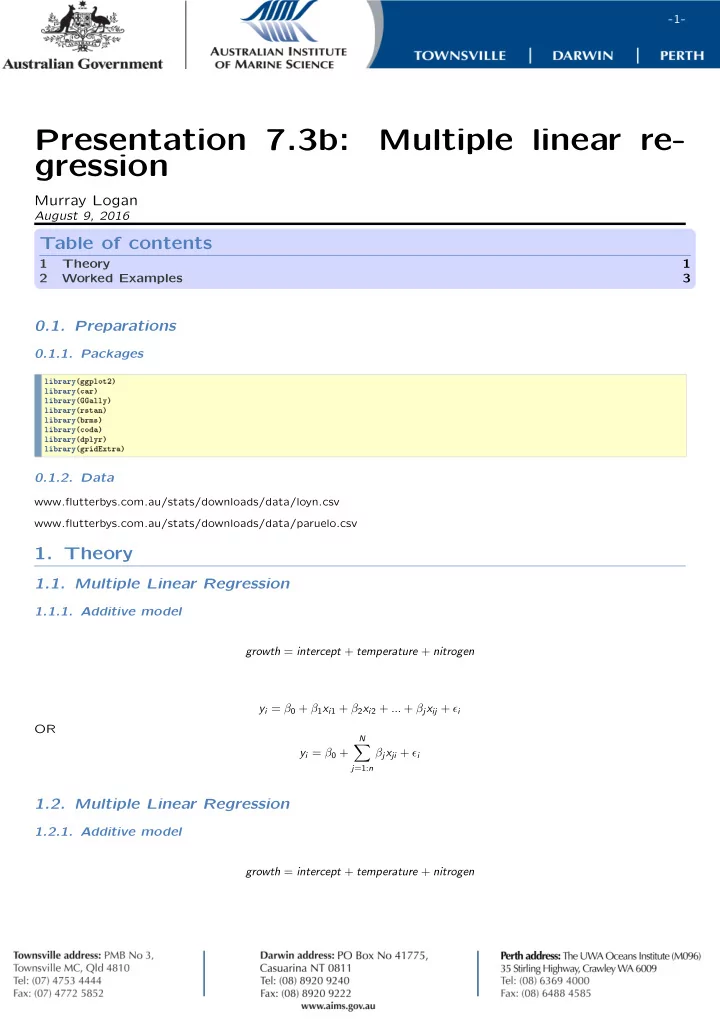
1.1.1. Additive model growth = intercept + temperature + nitrogen yi = β0 + β1xi1 + β2xi2 + ... + βjxij + ϵi OR yi = β0 +

N

j=1:n

βjxji + ϵi

1.2. Multiple Linear Regression

1.2.1. Additive model growth = intercept + temperature + nitrogen

slide-2
SLIDE 2
  • 2-

yi = β0 + β1xi1 + β2xi2 + ... + βjxij + ϵi

  • effect of one predictor holding the other(s) constant

1.3. Multiple Linear Regression

1.3.1. Additive model growth = intercept + temperature + nitrogen yi = β0 + β1xi1 + β2xi2 + ... + βjxij + ϵi Y X1 X2 3 22.7 0.9 2.5 23.7 0.5 6 25.7 0.6 5.5 29.1 0.7 9 22 0.8 8.6 29 1.3 12 29.4 1

1.4. Multiple Linear Regression

1.4.1. Multiplicative model growth = intercept + temp + nitro + temp × nitro yi = β0 + β1xi1 + β2xi2 + β3xi1xi2 + ... + ϵi

1.5. Assumtions

  • normality, homogeneity of variance, linearity
  • (multi)collinearity
slide-3
SLIDE 3
  • 3-

1.6. Multiple Linear Regression

1.6.1. Variance inflation var.inf = 1 1 − R2 Collinear when var.inf >= 5 Some prefer > 3

  • 2. Worked Examples

2.1. Worked examples

loyn <- read.csv('../data/loyn.csv', strip.white=T) head(loyn)

ABUND AREA YR.ISOL DIST LDIST GRAZE ALT 1 5.3 0.1 1968 39 39 2 160 2 2.0 0.5 1920 234 234 5 60 3 1.5 0.5 1900 104 311 5 140 4 17.1 1.0 1966 66 66 3 160 5 13.8 1.0 1918 246 246 5 140 6 14.1 1.0 1965 234 285 3 130

2.2. Worked Examples

Question: what effects do fragmentation variables have on the abundance of forest birds Linear model: Abundi ∼ N(µ, σ2) µ = β0 +

N

j=1:n

βjXji β0, βj ∼ N(0, 1000) σ ∼ Cauchy(0, 5)

slide-4
SLIDE 4
  • 4-

2.3. Worked Examples

paruelo <- read.csv('../data/paruelo.csv', strip.white=T) head(paruelo)

C3 LAT LONG MAP MAT JJAMAP DJFMAP 1 0.65 46.40 119.55 199 12.4 0.12 0.45 2 0.65 47.32 114.27 469 7.5 0.24 0.29 3 0.76 45.78 110.78 536 7.2 0.24 0.20 4 0.75 43.95 101.87 476 8.2 0.35 0.15 5 0.33 46.90 102.82 484 4.8 0.40 0.14 6 0.03 38.87 99.38 623 12.0 0.40 0.11

2.4. Worked Examples

Question: what effects do fragmentation geographical variables have on the abundance of C3 grasses Linear model: √ C3i ∼ N(µ, σ2) µ = β0 +

N

j=1:n

βjXji β0, βj ∼ N(0, 1000) σ ∼ Cauchy(0, 5)