
SLIDE 1
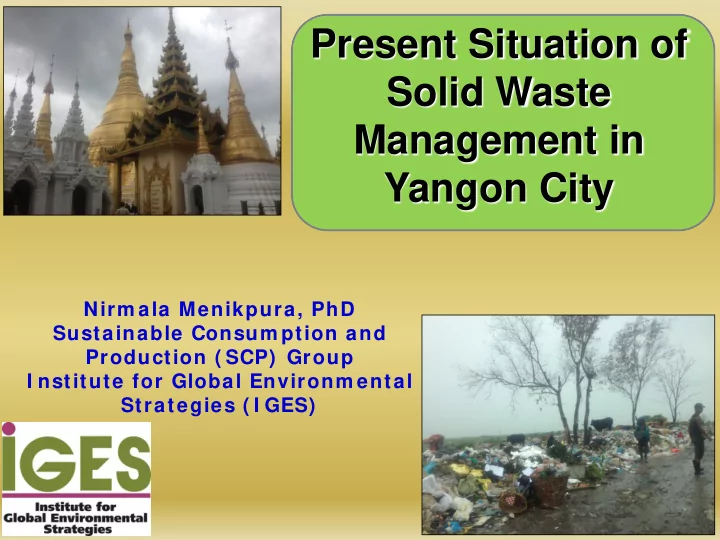
Present Situation of Solid Waste Management in Yangon City
1
Nirm ala Menikpura, PhD Sustainable Consum ption and Production ( SCP) Group I nstitute for Global Environm ental Strategies ( I GES)
Present Situation of Solid Waste Management in Yangon City Nirm - - PowerPoint PPT Presentation
Present Situation of Solid Waste Management in Yangon City Nirm ala Menikpura, PhD Sustainable Consum ption and Production ( SCP) Group I nstitute for Global Environm ental Strategies ( I GES) 1 General background of Yangon City
1
Nirm ala Menikpura, PhD Sustainable Consum ption and Production ( SCP) Group I nstitute for Global Environm ental Strategies ( I GES)
Administrative boundary of Yangon City Development Committee
Source : YCDC
2
Daily Managem ent
sites Pollution Control ( progressing)
3
0 .0 5 0 .1 0 .1 5 0 .2 0 .2 5 0 .3 0 .3 5 0 .4 2001-2002 2003-2004 2006-2007 2010-2011 2011-2012
1540 tonnes/ day 169 0 tonnes/ day kg/ capita/ day
Total waste generation - 1,690 toness/ day Total waste collection - 1,550 tonnes/ day The remaining 140 tonnes share the recycling and illegal dumping More than 75% of waste is organic
Organic waste , 76% Paper & textile 0.1% Plastic 10 %
10 %
4
5
Satellite TSP 300 Kyat per day Old suburbs-3 0 0 kyat per m onth/ household Sub-Urban - 4 5 0 kyat per m onth/ household Central Business District - ( 6 0 0 ) kyat per m onth/ household
Charges from commercial
centers, hotels etc. are based on sizes, kind of facilities, waste types and
Picture by YCDC
By Trucks
Pictures by YCDC
6
By carts
Pictures by YCDC
7
There are 13 kinds of trucks are used for waste transportation No. of trucks available 297 and capacity of trucks varies 2-8 tonnes/ trip Many trucks are too old and often, vehicle breakdown do happen.
8
Pictures by YCDC
9
1 7 2
Htain Bin Hlaw Gar Htaw e Chaung Da La 3 0 Km 2 6 Km 3 Kyi Su 4 5 6 Shwe Pyi Thar
PCDC is planning to implement a landfill gas-to-energy recovery plant to replace this open dumpsite Future This is the biggest open dumpsite in YCDC 847 tonnes of incoming waste is disposed per day
10
This is the second biggest open dumpsite 612 tonnes of incoming waste is disposed per day YCDC is considering installation of incineration plant (with electricity recovery) Future
11
Dum psite at Shw e Pyi Thar
Disposal capacity – 5 0 tonnes/ day
Dum psite at Hlaw Ger
Disposal capacity 2 5 tonnes/ day
YCDC is considering installation of small incineration (without electricity production) plants to replace these dumpsites . Future
12
YCDC has estimated that 86 tonnes/ day generated waste is recycling Valuable recyclables are stored at household level and sell to the nearby junkshops YCDC is also running a small-scale plastic recycling plant and green and blue plastics bag is produced using the waste plastic.
Plastic recycling activities at YCDC Composition of recyclables in Yangon
13
I GES GHG calculation tool was used to estimate the climate impacts from current waste management in Yangon
Emission of CH4 from open dumping 22.88 kg of CH4/ tonne Direct GHG emission from mixed waste open dumping 480.48 kg of CO2-eq/ tonne of mix waste GHG emission from open dumping from monthly disposed waste 2 2 ,3 4 2 Tonnes of CO2-eq/ month
0.5 1 1.5 2 2.5 3 3.5 4 1 2 3 4 5 6 7 8 9 10 11 12 13 14 15 16 17 18 19 20 21 22 23 24 25 26 27 28 29 30 31 32 33 34 35 36 37 38 39 40 CH4 generation ( Gg from m onthly disposed w aste) Year ( after disposal)
GHG em issions from open dum ping YCDC uses 128,704 L diesel and 900 L of gasoline for waste transportation
GHG emissions from transportation 7.51 kg of CO2-eq/ tonne of waste Monthly GHG emission from transportation 3 4 9 tonnes of CO2-eq/ month
GHG em issions from W aste Transportation
14
Direct GHG emissions from recycling
866.42 kg of CO2-eq/ tonne of mixed recyclables
Avoided GHG emissions from recycling via materials recovery
2646.79 kg of CO2-eq/ tonne of mixed recyclables
Net GHG emissions from recycling (life cycle perspective)
kg of CO2-eq/ tonne of mixed recyclables
Monthly total GHG reduction from recycling
Tonnes of CO2-eq/ m onth
GHG emissions from recycling activities in Yangon
349 22,342
18,098
5000 10000 15000 20000 25000
GHG emissions from transportation GHG emissions from
GHG reduction from recycling Overall GHG emissions from waste management Tonnes of CO2 -eq.m onth
Overall GHG em ission from w aste m anagem ent in Yangon
15
Landfill gas-to-energy recovery and incineration would be the two major technologies in the intended waste management system in Yangon Our suggestions to im prove the clim ate benefits and other co-benefits from w aste m anagem ent Careful planning is very important in the designing phase to avoid the failure that may happen after the implementation Improving the efficiency of the landfill gas recovery is the key to mitigate
continues, and extending the duration of gas recovery project to cover the peak production period of methane Composition and the moisture content of the waste can be greatly effected on the efficiency of the incineration plant. Pre-treatment would be necessary to reduce the moisture content waste prior to combustion Despite all the waste-to-energy technologies, development of proper recycling scheme in Yangon would contribute for significant GHG reduction and then to attain the target of low carbon city
16
17
Nirm ala Menikpura, PhD Sustainable Consum ption and Production ( SCP) group, I nstitute for Global Environm ental Strategies ( I GES) Em ail: m enikpura@iges.or.jp
18