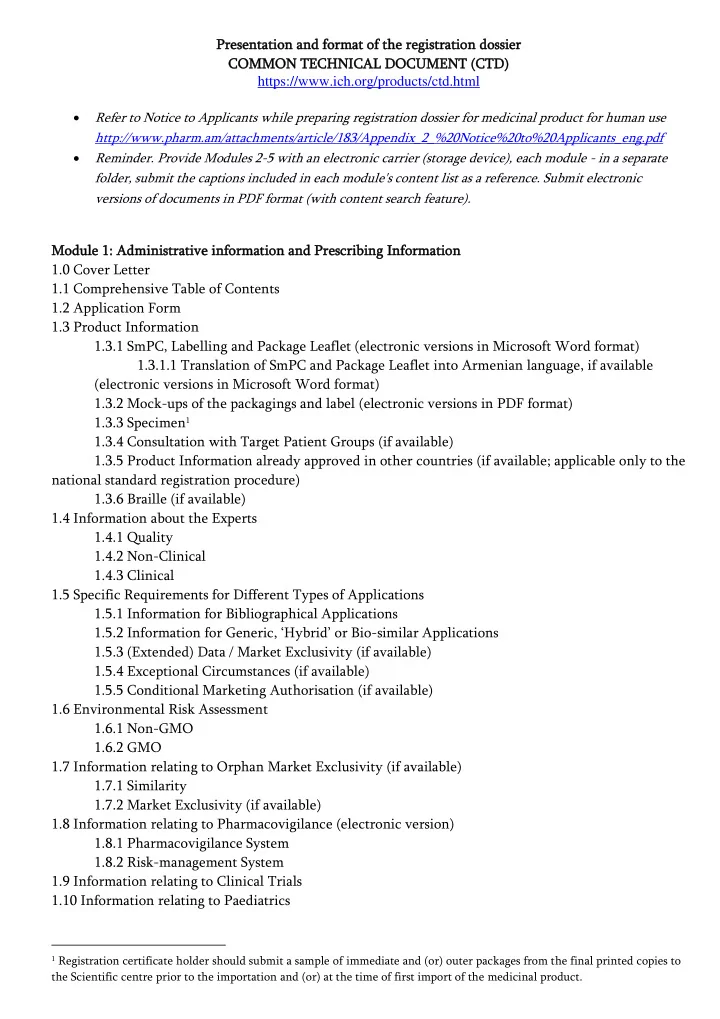
SLIDE 1 Presen Presentat tation
and fo form rmat at of
the regi registra strati tion
doss ssier er COMM MMON T TECHNICAL HNICAL DOCUME UMENT (CTD) https://www.ich.org/products/ctd.html
Refer to Notice to Applicants while preparing registration dossier for medicinal product for human use http://www.pharm.am/attachments/article/183/Appendix_2_%20Notice%20to%20Applicants_eng.pdf
- Reminder. Provide Modules 2-5 with an electronic carrier (storage device), each module - in a separate
folder, submit the captions included in each module's content list as a reference. Submit electronic versions of documents in PDF format (with content search feature).
Mo Modul dule 1: Ad e 1: Admi ministra strati tive ve info form rmatio ation and and Pres Prescribin ribing I Info form rmatio ation 1.0 Cover Letter 1.1 Comprehensive Table of Contents 1.2 Application Form 1.3 Product Information 1.3.1 SmPC, Labelling and Package Leaflet (electronic versions in Microsoft Word format) 1.3.1.1 Translation of SmPC and Package Leaflet into Armenian language, if available (electronic versions in Microsoft Word format) 1.3.2 Mock-ups of the packagings and label (electronic versions in PDF format) 1.3.3 Specimen1 1.3.4 Consultation with Target Patient Groups (if available) 1.3.5 Product Information already approved in other countries (if available; applicable only to the national standard registration procedure) 1.3.6 Braille (if available) 1.4 Information about the Experts 1.4.1 Quality 1.4.2 Non-Clinical 1.4.3 Clinical 1.5 Specific Requirements for Different Types of Applications 1.5.1 Information for Bibliographical Applications 1.5.2 Information for Generic, ‘Hybrid’ or Bio-similar Applications 1.5.3 (Extended) Data / Market Exclusivity (if available) 1.5.4 Exceptional Circumstances (if available) 1.5.5 Conditional Marketing Authorisation (if available) 1.6 Environmental Risk Assessment 1.6.1 Non-GMO 1.6.2 GMO 1.7 Information relating to Orphan Market Exclusivity (if available) 1.7.1 Similarity 1.7.2 Market Exclusivity (if available) 1.8 Information relating to Pharmacovigilance (electronic version) 1.8.1 Pharmacovigilance System 1.8.2 Risk-management System 1.9 Information relating to Clinical Trials 1.10 Information relating to Paediatrics
1 Registration certificate holder should submit a sample of immediate and (or) outer packages from the final printed copies to
the Scientific centre prior to the importation and (or) at the time of first import of the medicinal product.
SLIDE 2 Additional Data Additional Data 1.11 Manufacturing Authorisations (including all appendices) for all manufacturing sites involved in the manufacturing process of the medicinal product and the active substances issued by the competent authority of country of origin (duly certified copy2). 1.12 GMP certificates or other proof of GMP compliance or EudraGMP documents or inspection reports for all manufacturing sites involved in the manufacturing process of the medicinal product and the active substance issued by the competent authority of country of origin (duly certified copy). 1.13 Marketing Authorisation (Registration certificate) or Certificate of Pharmaceutical Product (CPP – WHO format) issued by the competent authority of the country of Applicant (Marketing authorization holder) (original or duly certified copy). 1.14 Worldwide registration status (if available): Copies of Marketing Authorisations or tabular listing of authorizations by specifying marketing authorization number, date of authorization, country, trade name and etc. 1.15 Letter(s) of access to Active Master File(s) or copy of Ph. Eur. Certificate(s) of suitability. Ph. Eur. Certificate(s) of suitability for TSE. 1.16 Copy of written confirmation from the manufacturer of the active substance to inform the applicant in case of modification of the manufacturing process or specifications. 1.17 Written consent(s) of the competent authorities regarding GMO release in the environment (if available). 1.18 Copy of certificate for a Vaccine Antigen Master File (VAMF) issued by the competent authority of country of origin (if available). 1.19 Copy of certificate for a Plasma Master File (PMF) issued by the competent authority of country of
1.20 Assessment report of the reference competent authority3 (applicable only for the simplified national registration procedure). Documents appended to the report – specifications, original SmPC and Package Leaflet and their translated4 versions (if not in English language) should be included in appropriate sections of the registration dossier. Modul Module 2 e 2 Sum Summa marie ries 2.1CTD Table of Contents (Module 2 – 5) 2.2 CTD Introduction 2.3 Quality Overall Summary – Introduction 2.3.S Quality Overall Summary – Drug Substance 2.3.S.1 General Information 2.3.S.2 Manufacture 2.3.S.3 Characterisation 2.3.S.4 Control of Drug Substance 2.3.S.5 Reference Standards or Materials 2.3.S.6 Container Closure System 2.3.S.7 Stability 2.3.P Quality Overall Summary – Drug Product 2.3.P.1 Description and Composition of the Drug Product 2.3.P.2 Pharmaceutical Development
2 Duly certified copy - a notarized copy of the document and, in the case of the Member States of the Hague Convention, also
approved by the Apostille.
3 Reference competent authority – ICH member states medicines regulatory authority and, in the case of pre-qualification,
WHO.
4 It is necessary to submit notarized translations and, in the case of the Member States of the Hague Convention, also
approved by the Apostille.
SLIDE 3
2.3.P.3 Manufacture 2.3.P.4 Control of Excipients 2.3.P.5 Control of Drug Product 2.3.P.6 Reference Standards or Materials 2.3.P.7 Container Closure System 2.3.P.8 Stability 2.3.A Quality Overall Summary – Appendices 2.3.A.1 Facilities and Equipment 2.3.A.2 Adventitious Agents Safety Evaluation 2.3.A.3 Excipients 2.3.R Quality Overall Summary – additional Information 2.4 Nonclinical Overview 2.5 Clinical Overview 2.5.1 Product Development Rationale 2.5.2 Overview of Biopharmaceutics 2.5.3 Overview of Clinical Pharmacology 2.5.4 Overview of Efficacy 2.5.5 Overview of Safety 2.5.6 Benefits and Risks Conclusions 2.5.7 Literature References 2.6 Nonclinical Written and Tabulated Summaries 2.6.1 Introduction 2.6.2 Pharmacology Written Summary 2.6.2.1 Brief Summary 2.6.2.2 Primary Pharmacodynamics 2.6.2.3 Secondary Pharmacodynamics 2.6.2.4 Safety Pharmacology 2.6.2.5 Pharmacodynamic Drug Interactions 2.6.2.6 Discussion and Conclusions 2.6.2.7 Tables and Figures 2.6.3 Pharmacology Tabulated Summary 2.6.3.1 Pharmacology: Overview 2.6.3.2 Primary Pharmacodynamics5 2.6.3.3 Secondary Pharmacodynamics5 2.6.3.4 Safety Pharmacology 2.6.3.5 Pharmacodynamic Drug Interactions5 2.6.4 Pharmacokinetics Written Summary 2.6.4.1 Brief Summary 2.6.4.2 Methods of Analysis 2.6.4.3 Absorption 2.6.4.4 Distribution 2.6.4.5 Metabolism 2.6.4.6 Excretion 2.6.4.7 Pharmacokinetic Drug Interactions 2.6.4.8 Other Pharmacokinetic Studies 2.6.4.9 Discussion and Conclusions 2.6.4.10 Tables and Figures 2.6.5 Pharmacokinetics Tabulated Summary 2.6.5.1 Pharmacokinetics: Overview 2.6.5.2 Analytical Methods and Validation Reports5 2.6.5.3 Pharmacokinetics: Absorption After a Single Dose 2.6.5.4 Pharmacokinetics: Absorption after Repeated Doses 2.6.5.5 Pharmacokinetics: Organ Distribution 2.6.5.6 Pharmacokinetics: Plasma Protein Binding
5 Tabulated Summary is optional. It is preferable to include text tables and figures with the Nonclinical Written Summary․
SLIDE 4
2.6.5.7 Pharmacokinetics: Study in Pregnant or Nursing Animals 2.6.5.8 Pharmacokinetics: Other Distribution Study 2.6.5.9 Pharmacokinetics: Metabolism In Vivo 2.6.5.10 Pharmacokinetics: Metabolism In Vitro 2.6.5.11 Pharmacokinetics: Possible Metabolic Pathways 2.6.5.12 Pharmacokinetics: Induction/Inhibition of Drug-Metabolizing Enzymes 2.6.5.13 Pharmacokinetics: Excretion 2.6.5.14 Pharmacokinetics: Excretion into Bile 2.6.5.15 Pharmacokinetics: Drug-Drug Interactions 2.6.5.16 Pharmacokinetics: Other 2.6.6 Toxicology Written Summary 2.6.6.1 Brief Summary 2.6.6.2 Single-Dose Toxicity 2.6.6.3 Repeat-Dose Toxicity (including supportive toxicokinetics evaluation) 2.6.6.4 Genotoxicity 2.6.6.5 Carcinogenicity (including supportive toxicokinetics evaluations) 2.6.6.6 Reproductive and Developmental Toxicity (including range-finding studies and supportive toxicokinetics evaluations) 2.6.6.7 Local Tolerance 2.6.6.8 Other Toxicity Studies (if available) 2.6.6.9 Discussion and Conclusions 2.6.6.10 Tables and Figures 2.6.7 Toxicology Tabulated Summary 2.6.7.1 Toxicology: Overview 2.6.7.2 Toxicokinetics: Overview of Toxicokinetics Studies 2.6.7.3 Toxicokinetics: Overview of Toxicokinetics Data 2.6.7.4 Toxicology: Drug Substance 2.6.7.5 Single-Dose Toxicity 2.6.7.6 Repeat-Dose Toxicity: Non-pivotal Studies 2.6.7.7 Repeat-Dose Toxicity: Pivotal Studies 2.6.7.8 Genotoxicity: In Vitro 2.6.7.9 Genotoxicity: In Vivo 2.6.7.10 Carcinogenicity 2.6.7.11 Reproductive and Developmental Toxicity: Non-pivotal Studies 2.6.7.12 Reproductive and Developmental Toxicity: Fertility and Early Embryonic Development to Implantation (Pivotal) 2.6.7.13 Reproductive and Developmental Toxicity: Effects on Embryofetal Development (Pivotal) 2.6.7.14 Reproductive and Developmental Toxicity: Effects on Pre- and Postnatal Development, Including Maternal Function (Pivotal) 2.6.7.15 Studies in Juvenile Animals6 2.6.7.16 Local Tolerance 2.6.7.17 Other Toxicity Studies 2.7 Clinical Summaries 2.7.1 Summary of Biopharmaceutic and Associated Analytical Methods 2.7.1.1 Background and Overview 2.7.1.2 Summary of Results of Individual Studies 2.7.1.3 Comparison and Analyses of Results Across Studies 2.7.1.4 Appendix 2.7.2 Summary of Clinical Pharmacology Studies 2.7.2.1 Background and Overview 2.7.2.2 Summary of Results of Individual Studies 2.7.2.3 Comparison and Analyses of Results Across Studies
6 When a juvenile animal study has been conducted, it should be tabulated using the template appropriate for the type of study and
located in Section 2.6.7.15․
SLIDE 5
2.7.2.4 Special Studies 2.7.2.5 Appendix 2.7.3 Summary of Clinical Efficacy 2.7.3.1 Background and Overview of Clinical Efficacy 2.7.3.2 Summary of Results of Individual Studies 2.7.3.3 Comparison and Analyses of Results Across Studies 2.7.3.3.1 Study Populations 2.7.3.3.2 Comparison of Efficacy Results of all Studies 2.7.3.3.3 Comparison of Results in Sub-populations 2.7.3.4 Analysis of Clinical Information Relevant to Dosing Recommendations 2.7.3.5 Persistence of Efficacy and/or Tolerance Effects 2.7.3.6 Appendix 2.7.4 Summary of Safety 2.7.4.1 Exposure to the Drug 2.7.4.1.1 Overall Safety Evaluation Plan and Narratives of Safety Studies 2.7.4.1.2 Overall Extent of Exposure 2.7.4.1.3 Demographic and Other Characteristics of Study Population 2.7.4.2 Adverse Events 2.7.4.2.1 Analysis of Adverse Events 2.7.4.2.2 Narratives 2.7.4.3 Clinical Laboratory Evaluations 2.7.4.4 Vital Signs, Physical Findings, and Other Observations Related to Safety 2.7.4.5 Safety in Special Groups and Situations 2.7.4.5.1 Intrinsic Factors 2.7.4.5.2 Extrinsic Factors 2.7.4.5.3 Drug Interactions 2.7.4.5.4 Use in Pregnancy and Lactation 2.7.4.5.5 Overdose 2.7.4.5.6 Drug Abuse 2.7.4.5.7 Withdrawal and Rebound 2.7.4.5.8 Effects on Ability to Drive or Operate Machinery or Impairment of Mental Ability 2.7.4.6 Post-marketing Data 2.7.4.7 Appendix 2.7.5 References 2.7.6 Synopses of Individual Studies Modul Module 3 Q e 3 Qua uality ty 3.1 Table of Content 3.2 Body of Data 3.2.S Drug Substance 3.2.S.1 General Information 3.2.S.1.1 Nomenclature 3.2.S.1.2 Structure 3.2.S.1.3 General Properties 3.2.S.2 Manufacture 3.2.S.2.1 Manufacturer(s) 3.2.S.2.2 Description of Manufacturing Process and Process Controls 3.2.S.2.3 Control of Materials 3.2.S.2.4 Controls of Critical Steps and Intermediates 3.2.S.2.5 Process Validation and/or Evaluation 3.2.S.2.6 Manufacturing Process Development 3.2.S.3 Characterisation
SLIDE 6
3.2.S.3.1 Elucidation of Structure and Other Characteristics 3.2.S.3.2 Impurities 3.2.S.4 Control of Drug Substance 3.2.S.4.1 Specification 3.2.S.4.2 Analytical Procedures 3.2.S.4.3 Validation of Analytical Procedures 3.2.S.4.4 Batch Analyses 3.2.S.4.5 Justification of Specification 3.2.S.5 Reference Standards or Materials 3.2.S.6 Container Closure System 3.2.S.7 Stability 3.2.S.7.1 Stability Summary and Conclusions 3.2.S.7.2 Post-approval Stability Protocol and Stability Commitment 3.2.S.7.3 Stability Data 3.2.P Drug Product 3.2.P.1 Description and Composition of the Drug Product 3.2.P.2 Pharmaceutical Development 3.2.P.2.1 Components of the Drug Product 3.2.P.2.1.1. Drug Substance 3.2.P.2.1.2. Excipients 3.2.P.2.2 Drug Product 3.2.P.2.2.1. Formulation Development 3.2.P.2.2.2 Overages 3.2.P.2.2.3 Physicochemical and Biological Properties 3.2.P.2.3 Manufacturing Process Development 3.2.P.2.4 Container Closure System 3.2.P.2.5 Microbiological Attributes 3.2.P.2.6 Compatibility 3.2.P.3 Manufacture 3.2.P.3.1 Manufacturer(s) 3.2.P.3.2 Batch Formula 3.2.P.3.3 Description of Manufacturing Process and Process Controls 3.2.P.3.4 Controls of Critical Steps and Intermediates 3.2.P.3.5 Process Validation and/or Evaluation 3.2.P.4 Control of Excipients 3.2.P.4.1 Specifications 3.2.P.4.2 Analytical Procedures 3.2.P.4.3 Validation of Analytical Procedures 3.2.P.4.4 Justification of Specifications 3.2.P.4.5 Excipients of Human or Animal Origin 3.2.P.4.6 Novel Excipients 3.2.P.5 Control of Drug Product 3.2.P.5.1 Specification(s) 3.2.P.5.2 Analytical Procedures 3.2.P.5.3 Validation of Analytical Procedures 3.2.P.5.4 Batch Analyses 3.2.P.5.5 Characterisation of Impurities 3.2.P.5.6 Justification of Specifications 3.2.P.6 Reference Standards or Materials
SLIDE 7 3.2.P.7 Container Closure System 3.2.P.8 Stability 3.2.P.8.1 Stability Summary and Conclusion 3.2.P.8.2 Post-approval Stability Protocol and Stability Commitment 3.2.P.8.3 Stability Data 3.2.A Appendices 3.2.A.1 Facilities and Equipment 3.2.A.2 Adventitious Agents Safety Evaluation (name, dosage form, manufacturer) 3.2.A.3 Excipients 3.2.R Regional information 3.3 Literature References Modul Module 4 N e 4 Non
al Study udy Rep Report rts 4.1 Table of Content 4.2 Study Reports 4.2.1 Pharmacology 4.2.1.1 Primary Pharmacodynamics 4.2.1.2 Secondary Pharmacodynamics 4.2.1.3 Safety Pharmacology 4.2.1.4 Pharmacodynamic Drug Interactions 4.2.2 Pharmacokinetics 4.2.2.1 Analytical Methods and Validation Reports 4.2.2.2 Absorption 4.2.2.3 Distribution 4.2.2.4 Metabolism 4.2.2.5 Excretion 4.2.2.6 Pharmacokinetic Drug Interactions (nonclinical) 4.2.2.7 Other Pharmacokinetic Studies 4.2.3 Toxicology 4.2.3.1 Single-Dose Toxicity (in order by species, by route) 4.2.3.2 Repeat-Dose Toxicity (in order by species, by route, by duration, including supportive toxicokinetics evaluations) 4.2.3.3 Genotoxicity 4.2.3.3.1 In vitro 4.2.3.3.2 In vivo (including supportive toxicokinetics evaluations) 4.2.3.4 Carcinogenicity (including supportive toxicokinetics evaluations) 4.2.3.4.1 Long-term studies (in order by species, including range-finding studies that cannot be appropriately included under repeat-dose toxicity or pharmacokinetics) 4.2.3.4.2 Short- or medium-term studies (including range-finding studies that cannot be appropriately included under repeat-dose toxicity or pharmacokinetics) 4.2.3.4.3 Other studies 4.2.3.5 Reproductive and Developmental Toxicity (including range-finding studies and supportive toxicokinetics evaluations) (If modified study designs are used, the following sub- headings should be modified accordingly.) 4.2.3.5.1 Fertility and early embryonic development 4.2.3.5.2 Embryo-fetal development 4.2.3.5.3 Prenatal and postnatal development, including maternal function
SLIDE 8
4.2.3.5.4 Studies in which the offspring (juvenile animals) are dosed and/or further evaluated 4.2.3.6 Local Tolerance 4.2.3.7 Other Toxicity Studies (if available) 4.2.3.7.1 Antigenicity 4.2.3.7.2 Immunotoxicity 4.2.3.7.3 Mechanistic studies (if not included elsewhere) 4.2.3.7.4 Dependence 4.2.3.7.5 Metabolites 4.2.3.7.6 Impurities 4.2.3.7.7 Other 4.3 Literature References Modul Module 5 e 5 Clinical Study Report al Study Report 5.1 Table of Contents 5.2 Tabular Listing of All Clinical Studies 5.3 Clinical Study Reports 5.3.1 Reports of Biopharmaceutic Studies 5.3.1.1 Bioavailability (BA) Study Reports 5.3.1.2 Comparative BA and Bioequivalence (BE) Study Reports 5.3.1.3 In Vitro – In Vivo Correlation Study Reports 5.3.1.4 Reports of Bioanalytical and Analytical Methods For Human Studies 5.3.2 Reports of Studies Pertinent to Pharmacokinetics Using Human Biomaterials 5.3.2.1 Plasma Protein Binding Study Reports 5.3.2.2 Reports of Hepatic Metabolism and Drug Interaction Studies 5.3.2.3 Reports of Studies Using Other Human Biomaterials 5.3.3 Reports of Human Pharmacokinetic (PK) Studies 5.3.3.1 Healthy Subject PK and Initial Tolerability Study Reports 5.3.3.2 Patient PK and Initial Tolerability Study Reports 5.3.3.3 Intrinsic Factor PK Study Reports 5.3.3.4 Extrinsic Factor PK Study Reports 5.3.3.5 Population PK Study Reports 5.3.4 Reports of Human Pharmacodynamic (PD) Studies 5.3.4.1 Healthy Subject PD and PK/PD Study Reports 5.3.4.2 Patient PD and PK/PD Study Reports 5.3.5 Reports of Efficacy and Safety Studies 5.3.5.1 Study Reports of Controlled Clinical Studies Pertinent to the Claimed Indication 5.3.5.2 Study Reports of Uncontrolled Clinical Studies 5.3.5.3 Reports of Analyses of Data from More than One Study 5.3.5.4 Other Study Reports 5.3.6 Reports օf Post-marketing Experience 5.3.7 Case Report Forms and Individual Patient Listings 5.4 Literature References