SLIDE 1
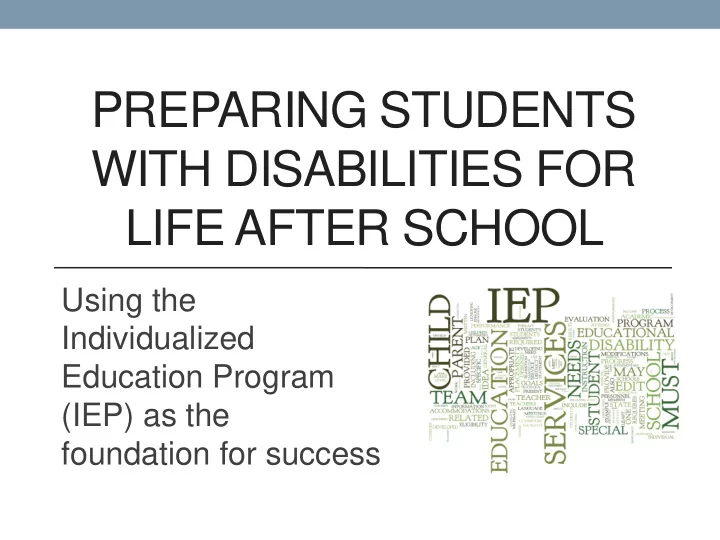
PREPARING STUDENTS WITH DISABILITIES FOR LIFE AFTER SCHOOL
Using the Individualized Education Program (IEP) as the foundation for success
SLIDE 2
PUBLIC INTEREST LAW CENTER
The Public Interest Law Center uses high- impact legal strategies to advance the civil, social, and economic rights of communities in the Philadelphia region facing discrimination, inequality, and poverty. We use litigation, community education, advocacy, and organizing to secure their access to fundamental resources and services.
SLIDE 3 Objectives
- Identify who designs the Individualized
Education Program (IEP)
- Identify appropriate transition assessments
- Give examples of transition services related
to post secondary education, independent living, and employment
SLIDE 4 Brief Overview of the Individuals with Disabilities Education Act (IDEA)
- The IDEA is a federal law that provides
students with disabilities the right to receive an education to meet their unique needs
- STUDENTS CAN BE COVERED BY THE
IDEA UNTIL AGE 21
- The main tool used to fulfill the purpose of
the IDEA is a student’s Individualized Education Program (IEP)
SLIDE 5 Brief Overview of the Individualized Education Program (IEP)
- An IEP is a written statement for each child
with a disability that includes
- Present level of academic performance and
functional achievement
- Measurable annual goals
- specific services to be offered
- Must be reviewed on a yearly basis
REMEMBER THE IEP IS A BINDING
LEGAL DOCUMENT
SLIDE 6 Members of the IEP Team
- The student
- The student’s family member
- One regular education teacher
- One special education teacher
- A member of the school district with the
authority to agree to provide services and who has the knowledge of what services are available
ANYONE ELSE THE FAMILY WANTS TO
INCLUDE
SLIDE 7 Transition Planning as Part the IEP
- Transition planning is the process in which
the IEP team sets goals for the student’s life AFTER HIGH SCHOOL
- In Pennsylvania, transition planning must
begin the year the student turns 14
- The IEP must include measurable post
school goals and transition services in addition to annual IEP goals
SLIDE 8
Creating Post School Goals
THE STUDENT MUST BE INVITED TO EVERY MEETING WHERE TRANSITION IS BEING DISCUSSED
Independent Living Employment Post Secondary Education
SLIDE 9 Age Appropriate Transition Assessments
- Post school goals must be based upon age
appropriate transition assessments
- CASEY-Life Skills Assessment
- http://lifeskills.casey.org/
- Transition Success Assessment
- https://ou.edu/content/dam/Education/docume
nts/TSA%20Professional.pdf
- Brigance Transition Inventory
- O'Net Online
- Naviance
SLIDE 10 Examples of Inappropriate Assessments
- An assessment report that just
summarizes the data because it should provide much more than that, such as goals and recommendations
- One interest checklist, survey, piece of
paper, or assessment measure
- Ask for a copy of the results of the
transition assessment
SLIDE 11 Examples of Post School Goals
GOOD
- After graduation, Paulo will work 20
plus hours a week at the local grocery store and be provided temporary supports through Vocational Rehabilitation BAD
- Paulo will be referred to Vocational
Rehabilitation for assistance with job placement
SLIDE 12 Your Turn
- After graduation, Jamarreo wants a new
less visible hearing aid
- After graduation, Alex will enroll at Kings
College and take a business math class to improve his work related math skills and to advance his career in business
SLIDE 13 Effective Annual IEP Goals
KEEP THE POST SCHOOL GOALS IN MIND
- Given a task instruction and a task analysis for
bagging groceries, Paulo will demonstrate the steps in the task analysis with 80% accuracy and no more than one verbal prompt weekly by (specific date)
SLIDE 14 Effective Annual IEP Goals
KEEP THE POST SCHOOL GOALS IN MIND
- Given direct instruction in the high school
Business Math course and guided practice, Alex will (a) use a calculator, and (b) create spreadsheets using money management software with 85% accuracy throughout the Spring semester of this IEP
SLIDE 15 Transition Services
- “A coordinate set of activities” designed “to
facilitate the child’s movement from school to post-school activities,” including further education, independent living and employment
- pattan.netwebsite.s3.amazonaws.com/images
/2017/05/23/Ann_IEP_Revised052417.pdf
- The school district can partner with other
agencies and organizations to provide these services
SLIDE 16 Examples of Transition Services Related to Post-Secondary Education
- Purchasing assistive technology and
training the student on how to use it
- Enrolling in courses while still in high
school that align with the student’s post- secondary interests
- Visiting college campuses or trade schools
SLIDE 17 Accommodations In College
- Unlike high school, students don’t
automatically qualify for accommodations
- Must “self identify” as a person with a
disability
- Present current documentation from a
licensed professional
- Student’s IEP is NOT sufficient
SLIDE 18 Examples of Transition Services Related to Independent Living
- Classes on cooking and financial literacy/budgeting
- Driver’s education and/or travel training
- Self advocacy particularly around the student’s
disabilities and the type of support the student will need
Applying for Social Security Disability Benefits Applying for PA’s Intellectual Disability System Applying for Bureau of Autism Services
SLIDE 19 Waivers
The Pennsylvania Department of Human Services (PA DHS) offers several types of waivers, which allow people with disabilities to receive a variety of services in their homes and communities.
- Consolidated Waiver
- Person/Family Directed Support Waiver
SLIDE 20 Examples of Transition Services Related to Employment
- Job shadowing
- Work-based learning experiences
- Attendance at job/career fairs
- Vocational assessments
SLIDE 21 The Role of State Agencies
The Office of Vocational Rehabilitation
(OVR)
OVR provides vocational rehabilitation services to help persons with disabilities prepare for, obtain, or maintain employment 717-787-5279 www.dli.state.pa.us http://transition-guide- admin.s3.amazonaws.com/files/2012/07/17/VocRehab.pdf
SLIDE 22 Work Experience for High School Students with Disabilities Act
- PA law that was passed on May 17, 2016
- REQUIRES collaboration between Office of
Vocational Rehabilitation (OVR) and school districts to develop IEP’s that include job skills training when appropriate
- The Act encourages OVR counselors to participate
in IEP meetings when they are invited
SLIDE 23 The Key for Successful Collaboration
- Service providers must understand a client’s
transition goals and ensure that all plans are aligned and include the services to achieve these goals
Individual Education Program (IEP) through the
client’s school
Individual Support Plan (ISP) through the Bureau
- f Autism Services or Intellectual Disability
System
Individual Plan for Employment (IPE) through the
Office of Vocational Rehabilitation
SLIDE 24 Tips For Effective Transition Plans
KEEP THE END GOAL IN MIND For each transition service include:
Service/ Activity Location Frequency Projected Start Date Duration Person/Agency Responsible
Where the child will complete the service Be specific – don’t just write “as needed”
SLIDE 25 High School Past Age 18
- Remember students who receive special
education services can stay in school and continue to receive services until 21
- Graduation at 18 is considered a change in
placement for students with IEPs
- If the parent disagrees with the school
district’s decision to graduate the student can request mediation or file for a due process hearing
SLIDE 26 Career Based Transition Programs
Bridges from School to Work
- 15-24 month long program that helps youth with
disabilities ages 17-22, find employment.
- http://www.bridgestowork.org/locations/philadelphia/
Project SEARCH
- Business led, one year, school to work program
that takes place entirely at the workplace
- http://www.projectsearch.us/OurPROGRAM/HighSch
- olTransition.aspx
SLIDE 27 College Based Transition Programs
- 268 college programs nationwide for students
with Intellectual Disabilities or Autism
- 96 of these programs serve students while the
student is still in high school (18-21 years old)
- the school district may pay a percentage
toward this program
Visit https://thinkcollege.net for specific
program requirements
SLIDE 28
Questions?
SLIDE 29
Contact Information
Darlene J. Hemerka Esq. Equal Justice Works Fellow Sponsored by Greenberg Traurig LLP dhemerka@pubintlaw.org (267)-546-1314 The Public Interest Law Center United Way Building, 2nd Floor 1709 Benjamin Franklin Parkway Philadelphia, PA 19103