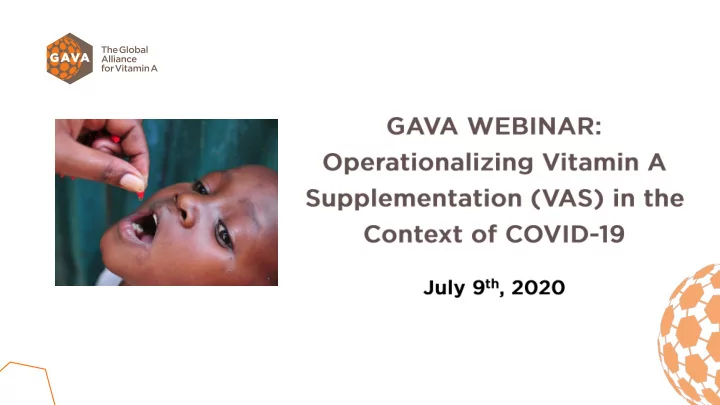
SLIDE 1
SLIDE 2
- Introduction
- Background and context
- Preparing for VAS delivery
- Safe administration of VAS
- Questions & answers
- Wrap up
SLIDE 3 Alison Greig Chair of GAVA Technical Director, Global Technical Services (GTS) Unit Nutrition International Ottawa, Canada Rolf Klemm Vice President for Nutrition Helen Keller Int’l Senior Associate Johns Hopkins Bloomberg School of Public Health Baltimore, USA Annette Imohe Nutrition Specialist UNICEF New York, USA Caitlin Gomez Technical Officer Nutrition International Ottawa, Canada Andreas Hasman Nutrition Specialist UNICEF New York, USA Kudakwashe Chimanya Nutrition Specialist UNICEF ESARO Nairobi, Kenya Zivai Murira Nutrition Specialist UNICEF ROSA Kathmandu, Nepal
SLIDE 4 Alis o n Greig Ch air o f GAVA Tec h n ical Direc tor, Glob al Tec h n ical Ser vic es Un it Nu tritio n I ntern ation al Ottawa, Can ad a
SLIDE 5
- Technical advisory group and informal alliance of partners
- Supports scale-up and improvement of country VAS programs
where vitamin A deficiency (VAD) remains a public health problem
- Accelerate progress towards child survival and reducing global
impact of VAD
- Forum for achieving consensus, translating evidence into action,
sharing lessons learned, coordinating policy an guidelines
- Focused on role of VAS within the context of other VAD control and
child survival programs
SLIDE 6
- Catalyze consensus for evidence-based VAS policies and
programs within broader child mortality and vitamin A deficiency reduction and control strategies.
- Identify and address priority knowledge gaps for VAS
programs.
- Provide program support to improve effective implementation
and monitoring of VAS programs.
- Advocate for political will and sustained attention, as well as
for financial and technical support for VAS in the context of the broader global nutrition landscape.
SLIDE 7
SLIDE 8
SLIDE 9 Ro lf Klemm V ic e Pres id ent for Nu trition Helen Keller I nt ’l Sen io r As s oc iate Jo h n s Hop kin s B loomb erg Sc h ool of Pu b lic Health B altimo re, USA
SLIDE 10
- Why is it critical to ensure that VAS
continues to be provided to children under 5 years of age in context of COVID-19 critical?
- What is GAVA’s updated statement
(issued June 22) and how has it been revised?
SLIDE 11
- Major public health problem
- Affects ~190 million children
under five years of age (WHO)
- Predisposes children to increased
risk of a range of problems— respiratory diseases, diarrhea, measles, blindness and it can lead to death
Bilateral corneal scars
SLIDE 12 Not much change in Vitamin A Deficiency (VAD) over 25 years in Sub-Saharan Africa and South Asia
Stevens G et al, Lancet Global Health, 2015
SLIDE 13
SLIDE 14 Percent change in child mortality
Sommer and West, 1996
SLIDE 15
countries in SSA with ≥80% coverage
- UNICEF. Coverage at a Crossroads: New directions for vitamin A supplementation programmes. New York: UNICEF; 2018
SLIDE 16
income
- Food system disruptions
- Higher food prices
- Disruption to essential
health and nutrition services
SLIDE 17 WHO declares COVID-19 a pandemic March 11 April 7 GAVA issues statement to temporarily suspend mass VAS campaigns June 22 GAVA issues updated statement &
(i) continuation of routine VAS should be guided by local factors (ii) temporarily suspend mass VAS campaigns; (iii) do not miss other opportunities to deliver VAS (e.g. vaccination campaigns during an outbreak); and (iv) plan intensified, catch-up VAS distribution so VAS can be resumed when conditions allow.
SLIDE 18
Balancing demands of COVID-19 response and need to maintain delivery of essential child and maternal health services
SLIDE 19
- Local factors and local context need to
drive local decisions
- Deliver VAS with a package of essential
child services as much as possible.
- Implement best practices related to
COVID-19 prevention
- Need to weigh risks and benefits given
local context and factors
- If VAS delivery is temporarily suspended,
plan for catch-up now!
SLIDE 20
Framework for decision-making: VAS campaigns in context of COVID-19
Weigh the potential benefits of mass VAS campaign, country capacity to implement it safely & effectively with the potential risk of increased COVID-19 transmission associated with the mass VAS campaign. Determine the most appropriate actions considering the COVID-19 epidemiological situation.
SLIDE 21
Framework for decision-making: VAS campaigns in context of COVID-19
If decision is made to proceed with VAS campaign, implement best-practices. Follow WHO & local guidance on infection prevention and control (IPC) in all aspects of the campaign including coordination, planning, training, securing PPE, protecting community, health worker and individuals If decision is made NOT to proceed with VAS campaign, reinforce Routine VAS, reassess regularly, and plan for future catch-up VAS strategies where required
SLIDE 22
SLIDE 23 An n ette I moh e Nu tritio n Sp ec ialist UNI CEF New Yo rk, USA
SLIDE 24
SLIDE 25
Physical distancing Hand hygiene Screening Appropriate personal protective equipment (PPE) Best practices for VAS deliv livery
SLIDE 26
- Preparing for the delivery of VAS
- Administration of VAS
- Additional considerations for the
delivery of VAS
- Annexes
- Features and requirements for the
administration of VAS by health workers and caregivers
- Safe administration of VAS by health
workers
- Safe administration of VAS by caregivers
SLIDE 27
- Enabling environment
- VAS as an essential service
- Updating guidelines and allocating
budget accordingly
- Preparing the health workforce
- Decide on cadre of health workers
for VAS administration
- Decide on administration model –
health worker or caregiver
- Consider additional training needs
SLIDE 28
- Community engagement and communication
- Develop and budget for communication strategy
- Key messages for VAS
- Ensuring adequate supplies
- Capsule supply chain
- Additional resources required for COVID-19 context
(e.g. IPC)
- Supervision and monitoring
- Innovative methods for reporting and supportive
supervision
- Adjust monitoring systems where VAS is shifting to
routine delivery
- Extra effort to ensure timeliness and quality
SLIDE 29 Caitlin Gomez Tec h n ical Of f ic er Nu tritio n I ntern ation al Ottawa, Can ad a
SLIDE 30
- VAS administration requires close contact – physical
distancing cannot be maintained between administrator and caregiver and child.
SLIDE 31
SLIDE 32
- There are no sicknesses or illnesses that prevent a child from
being given vitamin A; all children aged 6 to 59 months, whether screened positive or negative for COVID-19, should be given twice-yearly VAS.
- Screen immediately prior to VAS administration
- Screening is done to ensure that appropriate IPC measures are
followed to protect health workers from exposure to the virus
SLIDE 33
SLIDE 34
SLIDE 35
SLIDE 36
SLIDE 37
SLIDE 38
SLIDE 39
SLIDE 40 Healt lth worker ad admin inistration Car aregiver ad admin inistration
- Medical masks used by health
workers
- Physical distancing maintained
except when administering the capsule to the child
worker
referr rred method whe here re medic edical l mas asks are are av avai aila lable le for hea health workers
- Medical masks not required
- Physical distancing maintained between
health worker and caregiver and child
- Capsule administered under supervision
- f health worker
- Additional supplies required, and
additional steps required to clean tools
- Hand hygiene by health worker and
caregiver
SLIDE 41
- Plan ahead to reduce the risk of
crowding
- Increase the number of days and
distribution sites
- Organize catchment into small groups
- Integrate with other child health and
nutrition services
- Ensure that the space and patient
flow allow for physical distancing
- Additional staff focused on crowd
control
- Require all staff, caregivers and
children to wash hands when entering distribution site
SLIDE 42