
SLIDE 1
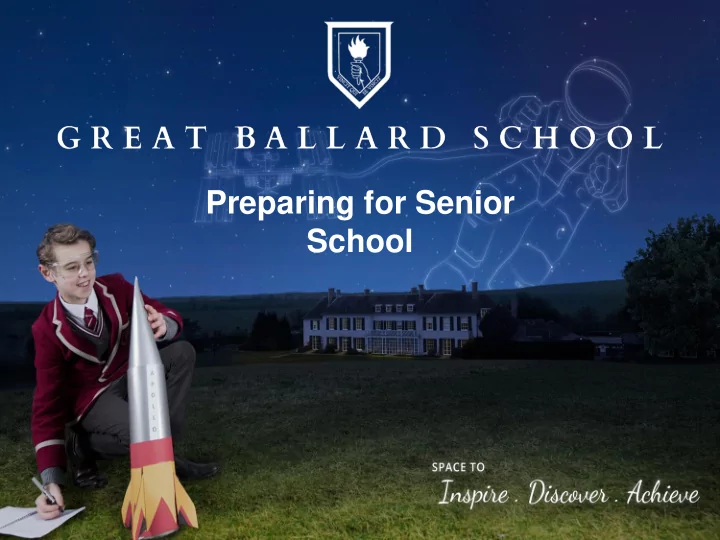
Preparing for Senior School Why Have This Meeting? To provide more - - PowerPoint PPT Presentation
Preparing for Senior School Why Have This Meeting? To provide more information on Common Entrance and Scholarships To give you a clearer idea of what is expected at each stage, both of your child, yourself and of Great Ballard. To
Scholarships
your child, yourself and of Great Ballard.
to support your child’s continued academic and all round development.
foundation and potential to do well at their senior school
suitable standard in a wide range of academic subjects.
selection.
This provides the children with an acknowledged, broad and high quality academic education. Some of the work covered in Form 6 lays the foundations down for this syllabus. At Great Ballard, the children in their final two years will follow the 13+ Common Entrance Syllabus.
The syllabus and exams themselves are set by the Independent Schools Examination Board (ISEB). They determine the syllabus and prepare and send out the exams to prep schools. There are two or three ability levels in some core subjects. The ISEB website will give you further details about the Common Entrance Syllabus itself - www.iseb.co.uk
English-Comprehension, creative writing and literature (2 levels) Geography – Includes a project worth 20% Mathematics (3 levels) Religious Studies Science – Physics, Biology and Chemistry (2 levels) History French – includes a speaking and listening exam (2 levels) Latin, Greek or Mandarin (Not compulsory) Children with formal evidence of additional support needs, can be given further time in the examinations.
at all Prep Schools straight after Summer Half Term
by, the specific senior school each child is registered with. Thus, you can only choose one senior school, which MUST be selected by January
entrance standard. As a result the pass grade can vary from school to school depending on how selective the school is.is.
highlights talent and ability in other areas (For example; sport, music, drama or art as well as
responsibilities the children may have.
to school and academic work. This must be an honest view, and I do endeavour to be as positive as I can, which is normally very easy.
shown, or family links with the school.
about progress. If there are any potential concerns, we initially talk directly with you and then, if appropriate, the Head of the senior
prior to the exams.
schools all over the UK.
means that we know and can prepare for the topics which are likely to be included in exams.
pupils.
preparation and revision methods. Children have regular examination experience in Forms 6, 7 & 8 to develop their confidence and raise their own expectations of success.
and how you can support your child outside of the classroom.
work or exam revision timetables we give out are completed properly.
All teachers take pride in their subjects and want your child to do well.
child to be a little nervous. This is normal; just wait until GCSE or A level!
Academic Scholarship. We will then need to extend their learning in order to cover the additional expectations of the scholarship papers.
scholarship papers are set and marked by the senior school. Exams normally take place during the Spring Term.
consultation with the school. The standards are very high and all entries MUST have the strong support of the school. Final entry deadlines are normally early in December or
the opportunity to enter for a scholarship.
scholarship applications. This will be discussed with you.
and potential. Final decisions about this normally
interviews or practical assessments.
additional or a higher level of work
least two instruments, one up to Grade 5. They may well need Grade 5 theory of music as well.
performances
Sport, music, art, drama etc. Criteria varies between schools.
references, a CV of past successes/ability and possibly an interview.
Great Ballard has an enviable record of scholarship success. Although a small school, in the last 5 years alone we have been awarded 36 different scholarships. These include many academic, as well as all- rounder, music, art, drama and sports scholarships.
Note - scholarships vary in monetary value. They are generally less than in the past, and it is now usual practice to potentially supplement any awards with means-tested bursaries.
This is never an easy decision!
website, read inspection reports and educational guides and speak to other parents.
teaching hours and ensure you meet teachers and ideally the Head.
looking to host again in March 2019. This is a good way to speak to lots of schools under one roof. If you want some further advice, do arrange a meeting with me.
This involves a number of factors:-
future expectations e.g. GCSE, A Levels, or International Baccalaureate?
parents?
Make sure you clarify exactly what you and your child want from their Senior School education before choosing your school.
returnable deposit, but it will reserve a place for your child subject to them meeting their entrance requirements.
with the school and appropriately prepare children for any early entrance tests, Common Entrance or, if appropriate, a Scholarship.
and Verbal reasoning and often an interview.
you, as well as liaising with us to ensure that things are progressing as expected. If there are any concerns we will discuss these at an early opportunity with you.
school offering a more personalised
support which promotes academic, pastoral and social progress.
school staff in 11 to 18 schools who may well prefer to be teaching their GCSE or A level students, which is why they are at senior schools.
there is no treading of water as is often experienced in the first few years of most 11-18 senior schools.
It is a recognised fact that children who experience positions of responsibility at 13 in Prep schools often take on similar responsibilities at senior school.
If you do want to go to a particular 11-18 senior school, in virtually every instance this is also possible at 13+. I know because I have asked every school and Headteacher I have visited! Great Ballard does have an excellent reputation and senior schools want
education, will contribute a great deal to many different areas of senior school life and invariably achieve a great deal at the end of their schooling.