
SLIDE 1
Prepared and presented by: Jill Javelosa- Alvarez (ELS York Region) 11/06/2018 1
- Ice-Breaker
- Playful Math Presentation
- Table Activities
- Summary
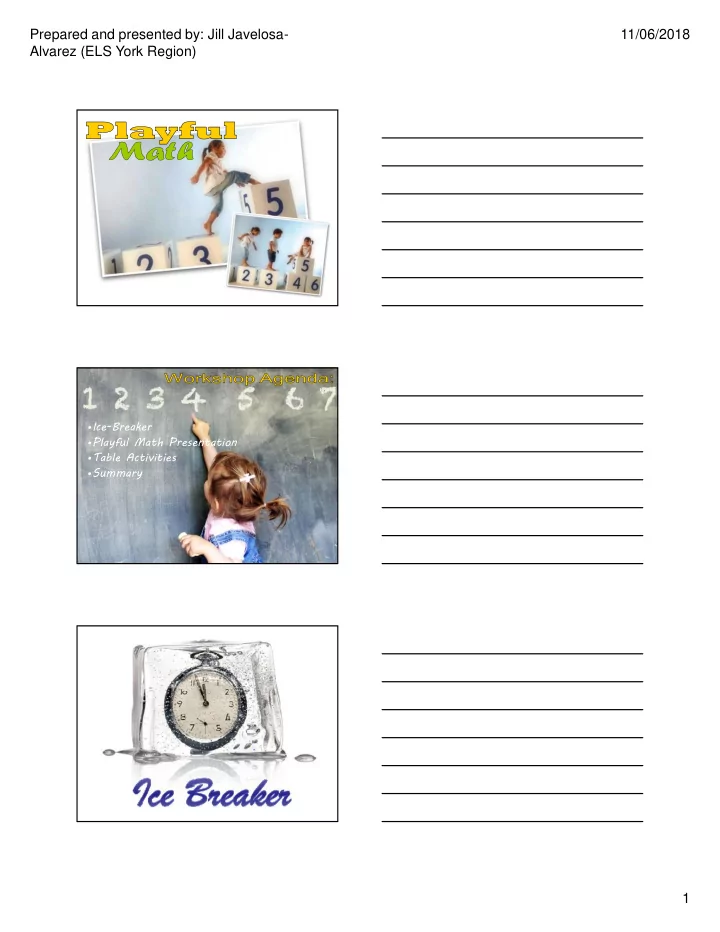
Prepared and presented by: Jill Javelosa- 11/06/2018 Alvarez (ELS - - PDF document
Prepared and presented by: Jill Javelosa- 11/06/2018 Alvarez (ELS York Region) Ice-Breaker Playful Math Presentation Table Activities Summary 1 The way we view others changes the way we interact with them . It all starts with
The way weview others changes the way we
Ontario’s Pedagogy for the Early Years
It all starts with Your
competent, Capable of complex thinking, Curious and rich in potential
Ontario’s Pedagogy for the Early Years
Belove, 2 years old Belove, 2 years old Erill, 6 years old Erill, 6 years old
Experts who know Their children better Than anyone & have important information to share
Ontario’s Pedagogy for the Early Years
Early Brain Development:
Infant Mental Health:
Self-Regulation:
Foods for the Brain:
Nishta Saxena
Emergent Literacy:
Jill Javelosa-Alvarez
Early Numeracy:
Brenda Smith-Chant
Music in the Early Years:
Movement:
Rae Pica
Play:
Pierre Harrison
Technology:
Lisa Guernsey
Nature:
Diane Kashin
Physical Literacy:
Lindsey Siple
Positive Parenting:
Shawna Lee
Early Intervention:
Marlene Green and Catherine Saul
"My children and I have been traumatized by the way we were treated in the past few months because of the colour of our skin and our cultural beliefs. My 6yo child kept telling me ‘Mom, why are people treating us like this
Sometimes the pain is unbearable to the point of feeling hopeless. But programs like this give me hope that one day the world will be a kinder place for everyone."
knowledgeable, reflective, resourceful, & Rich in experience
Ontario’s Pedagogy for the Early Years
through
What children know? What do children wonder about? What are their working theories about the world around them?
It helps educators to:
impact on children and their families.
Numeracy skills in
preschool years are
powerful predictors of
school-aged math performance
Numeracy skills are More predictive than
literacy skills in future career
attainment.
Better math performance is
associated with attitude, especially
attitude of adults (parents, teachers)
ACTIViTY
“Mathematical experiences can be narrowed down into two forms, play that involves mathematics and playing with mathematics itself.”
Samara and Clememts, 2009
Sarama and Clements stress that “the importance
the ages of the children, should not be
contributes to mathematics learning”
Samara and Clememts, 2009
number’ (the quantity of the set)
quantity is used (Snakes and Ladders, etc.)
determine quantity in real-world activities
about money
things that move (e.g. from car windows)
(start from a middle number)
information and its location
mental tasks
like matching and concentration
their memory to go through steps (e.g. doing a task, following a recipe)
world problems in their heads instead
culture, community and environment
materials (loose parts)
express the ‘100
Provocations, or invitations, inspire and invite learners to explore, investigate and discover.
It is intentional in their intended purpose, such as being based on a student’s interest or linked to curriculum or for assessment for learning purposes.
seasons, light)
in a new way,
(e.g. a presentation, a holiday)
Reggio-Inspired Math by Janice Novakowski
Math Provocation provides an opportunity for students to engage in Math in a personal, meaningful way that creates opening for them to be participants in uncovering the curriculum.
Direct Prompt
A prompt, question
provided by the teacher orally or included in the visual/written prompt with accompanying materials..
Can you stack 5 rocks?
FOCUS: Counting 1-5, one-to-one correspondence, pattern (possibility), decomposing 5
Implied Prompt
through Modeling A visual, model, suggestion or
with the accompanying materials
Can you make a pattern? FOCUS: identifying, reproducing, extending, and creating repeating patterns. Other areas: one-to-one, counting
Open Exploration
An open invitation to exploration, with intentionally selected materials FOCUS: counting, one-to-one correspondence, representing numbers and relating numerals to quantity.
Involves understanding the concept of number, quantity, order, ways
numbers,
correspondence (that one object corresponds to one number), and counting.
correspondence (one number for one object)
2, 3, 4, … not 1, 2, 7, 5, …)
number counted tells how many)
A child will know that there are different ways to represent a quantity – for example, 18 can be represented as 20 – 2 and as 15 + 3.
We use measurement to determine the height, length and width of objects, the area that objects cover, the amount that objects hold (capacity) and the space that objects take up (volume). We also measure time and money.
estimate an amount. We don’t always need an exact measure.
measured in different ways.
to be used the same way each time.
units of time takes practice and experience.
passage of time to personal events, he or she will begin to develop an understanding of measurement terms involving duration:
slower • First and last • Before and after
Understanding shapes, solids, dimensions, directions, positions, navigation, mapping and etc.
A child will learn the foundations for geometric thought – namely, that the location of objects can be described mathematically.
A child will learn some basic concepts about maps – most importantly, that pictures and symbols
actual objects in the world.
The ability to recognize and identify patterns helps us to make predictions based on
Help a child to recognize the patterns that are all around – and to describe them by using mathematical words, such as repeat, over again, it’s the same and it changes to.
In a repeating pattern, the pattern core is the part that repeats over and over – for example, in the pattern ABB ABB ABB, the pattern core is ABB.
A child will learn that a pattern continues beyond what he or she can see – the basis for mathematical predictions! What different types of pattern can you make?
Do patterns always make a straight line?
Early experiences in sorting and classifying objects can help prepare children for
meaningful categories.
.
A child learns that we collect and organize to answer questions and to make plans for the future! How can you sort these materials?
assigned Math Strand.
that ties in with your chosen set up. (Direct, Indirect, Open Exploration)
size quantity categorization patterns spatial concepts space speed sequence
Kindergarten to Grade 6
Janet Novakowski http://www.edu.gov.on.ca/kindergarten/index.html
Prepared and Presented by:
Jill Javelosa-Alvarez York Region, Early Literacy Specialist www.familydaycare.com