Premcor Delaware City Refinery Premcor Delaware City Refinery FCCU - - PowerPoint PPT Presentation

premcor delaware city refinery premcor delaware city
SMART_READER_LITE
LIVE PREVIEW

Premcor Delaware City Refinery Premcor Delaware City Refinery FCCU - - PowerPoint PPT Presentation

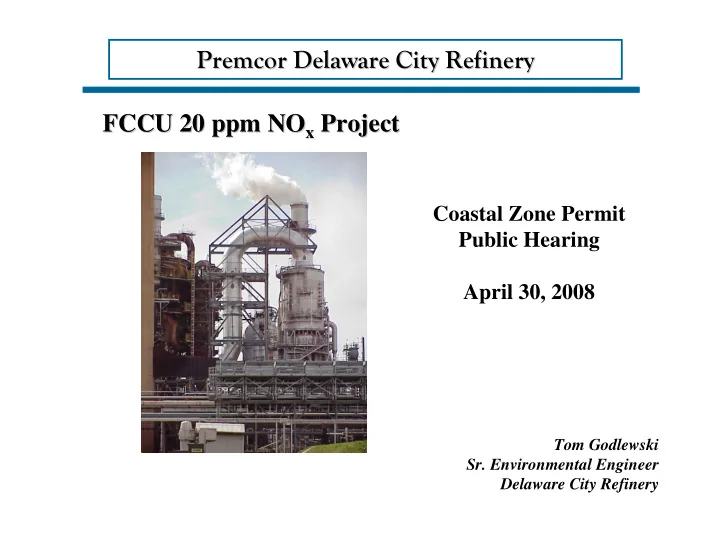
Premcor Delaware City Refinery Premcor Delaware City Refinery FCCU 20 ppm NO x Project FCCU 20 ppm NO x Project Coastal Zone Permit Public Hearing April 30, 2008 Tom Godlewski Sr. Environmental Engineer Delaware City Refinery Representing


slide-1
SLIDE 1

Premcor Delaware City Refinery Premcor Delaware City Refinery FCCU 20 ppm NO FCCU 20 ppm NOx

x Project

Project

Coastal Zone Permit Public Hearing April 30, 2008

Tom Godlewski

  • Sr. Environmental Engineer

Delaware City Refinery

slide-2
SLIDE 2

2

Representing the Refinery

Valero DCR Personnel Tom Godlewski, Sr. Environmental Engineer Heather Chelpaty, Environmental Manager David Billingsley, Staff Process Engineer Environ International Corporation Meint Olthof, Ph.D, P.E., Senior Manager

slide-3
SLIDE 3

3

Project Goals / Overview

To install pollution control equipment to comply with the conditions of

an Agreement entered in to by DNREC and Premcor on July 6, 2006 aimed at reducing oxides of nitrogen (NOx) emissions from the FCCU to 20 ppm (dry, 0% O2 corrected basis) on an annual average.

To select a technology capable of meeting the emission limitations in

the Agreement and able to be integrated into the existing SO2 and Particulate Matter pollution control equipment installed at the FCCU in December 2006

To implement the technology and mitigate any negative project impacts

to the extent feasible in accordance with the requirements of DNREC’s Regulations Governing Delaware’s Coastal Zone Air Emissions Decrease of at least 512.5 TPY NOx

slide-4
SLIDE 4

4

What is NOx?

Nitrogen oxides, or NOx, is the generic term for a group of highly reactive

gases, all of which contain nitrogen and oxygen in varying amounts.

NOx forms when fuel is burned at high temperatures, as in a combustion

  • process. The primary manmade sources of NOx are motor vehicles, electric

utilities, and other industrial, commercial, and residential sources that burn

  • fuels. NOx can also be formed naturally.

NOx is one of the main ingredients involved in the formation of ground-level

  • zone (smog), which can trigger serious respiratory problems.

New Castle County is in an area designated as moderate non-

attainment for ozone

Source: EPA Website

slide-5
SLIDE 5

5

NOx Emissions History of the FCCU

Based on Refinery Emission Inventory Submittals

FCCU NOx Emissions by Year

769 207 1118 889 723 719 200 400 600 800 1000 1200 2003 2004 2005 2006 Current Limit Post Project Year Tons

slide-6
SLIDE 6

6

Technology Selection

Wet Gas Scrubber Plus (WGS+) technology to be installed

downstream of the existing particulate and sulfur dioxide control devices.

Top of existing vessel will cut off and a new ~20-30’ section for

WGS+ will be installed.

NOx will be “scrubbed” out of the flue gas stream and resulting

purge liquid will be sent to the Waste Water Treatment Plant for processing.

Modify 1st stage of the existing Waste Water Treatment Plant to

mitigate nitrate effluent increase.

Modification targets 80% - 90% removal of nitrates generated by

the project

Project to be implemented during May 2009 FCCU Turnaround

slide-7
SLIDE 7

7

Wet Gas Scrubber Plus Technology Overview

  • Developed by ExxonMobil, licensed by Hamon Research-Cottrell

Lo pH Zone NO NO NO NaCLO2 NaCLO Highly Soluble NO3 removed in First Stage Oxidize NO/NO2

To make Water Soluble

NO + NaOCl -> NO2 +NaCl NO2 + NaOCl -> HNO3 +NaCl Converts NO2 to NO2

  • Soluble in H2O

NO2 (g) NO2 (l) NO2 (l) + SO3

_ NO2 _ + SO4 2-

2nd RXN Drives Henry’s Const in 1st to pull more NO2 into Solution

Purge to WWTP H2O – Once Thru

0.25 GPM/Ft2

170 GPM Sulfite Solution(SO32-) – Recycle

2.5 – 4.0 GPM/Ft2

2600 GPM (60 GPM Purge) 23-C-401 20 ppm NOX Dry, O2 Free
slide-8
SLIDE 8

8

Project Permitting

Air permit application submitted to Air Quality Management Division

  • n June 1, 2007

Coastal Zone Status Decision submitted on Aug. 1, 2007 Project is strictly a pollution control project No significant negative environmental impacts

  • Sec. Hughes decision on Nov. 14, 2007 that a Coastal Zone permit

would be required due to increased effluent discharges to DE River

Coastal Zone Permit Application Submitted Dec. 28, 2007 Air Permits must be issued by July 1, 2008 to Meet Implementation Schedule for May 2009 FCCU Process Turnaround per Agreement with DNREC

slide-9
SLIDE 9

9

Coastal Zone Permit Application Overview

Project Description Impact Analysis Environmental Impacts Economic Impacts Aesthetic Effects

Full Application Available on DNREC Website

slide-10
SLIDE 10

10

Effluent Discharge Impacts Considered

Sulfates (SO4

2-)

Calculated 13 mg/L increase in refinery Outfall 001 to the DE

River (increasing to ~ 420 mg/L)

Sulfate fluctuations in DCR vicinity of DE river can be over

900 mg/L due to tidal influence

Conclusion: Increased sulfate loading is well within natural

  • ccurring levels of sulfate concentration.

Chlorides (Cl-) Also naturally occurring in seawater Estimated chloride concentration in DCR area: 2,900 mg/L Project impact of 2 mg/L is negligible and within normal

naturally occurring variation.

Increases of these constituents are within ranges found normally in nature

slide-11
SLIDE 11

11

Effluent Discharge Impacts Considered - Nitrates

Nitrate (NO3

  • as N) Impacts with No WWTP Modifications

Nitrates are not regulated compounds under the refinery NPDES

water discharge permit

Conservative estimate is a maximum of 219 TPY nitrates generated

by WGS+

Existing concentration of DCR Effluent to DE River : ~2.0 mg/L Post Project calculated concentration: ~2.5 mg/L Impact after complete mixing in DE River: 0.01 mg/L The Delaware River Basin Commission has noted that current

nutrient concentrations are elevated in this area of the DE River

No signs of eutrophication (fish kills, algal blooms, etc.) No apparent other aquatic impacts To protect dissolved oxygen levels from decreasing, the DRBC

may set a TMDL limit

  • Current DE River concentration near the DCR: 1.5 mg/L

In light of the nitrate impact concerns, Premcor voluntarily undertakes a multimillion dollar WWTP modification to reduce the nitrates impact

slide-12
SLIDE 12

12

Modifications to Biological Treatment System at WWTP Computer modeling and pilot plant studies show no negative impact on existing organic removal rates

slide-13
SLIDE 13

13

Addressing Nitrate Concerns – WWTP Modifications 1st Stage Biological Treatment Tanks Modifications

slide-14
SLIDE 14

14

Effluent Discharge Impacts Considered - Nitrates

Significant capital investment to address nitrate concerns Nitrate (NO3

  • as N) Impacts

Nitrates impact after WWTP 1st Stage Biological treatment

modifications reduced from 219 TPY to 33 TPY

Impacts at Outfall 001 is projected to be very small following the

WWTP modifications

  • 0.06 mg/L above existing average discharge of 2.0 mg/L

Impact on DE River after complete mixing: 0.002 mg/L Project impact on DE River is not statistically significant 0.002 mg/L impact on mean reported value of 1.5 mg/L for Pea

Patch Island area

DRBC has not yet established acceptable mass loading limits for

total Nitrogen (EPA deadline is 2019)

Impact on DE River from increased nitrate is “zero” when considering significant figures

slide-15
SLIDE 15

15

Environmental Impacts

Air Emissions:

  • Refinery wide decrease based on 2006 Emission Inventory Total

WWTP Effluent Discharges to DE River 71.2% dec. FCCU 18.0% dec. Refinery wide

  • 512.5 TPY

NOx % Increase / Decrease Emissions Impact Pollutant 0.08% 1,267 TPY Cl- 3.1% 6,846 TPY SO4

2-

3.0% 33 TPY NO3

  • (as N)

% Increase over Current Discharge to DE River Outfall 001 Incremental Increase (TPY) Constituent

Nitrates, Sulfates and Chlorides are not regulated by the current refinery NPDES discharge permit

slide-16
SLIDE 16

16

Environmental Conclusions

DCR is located within non-attainment area for ozone

NOx is well known ozone precursor NOx reductions are significant and important to DNREC’s ambient air

quality attainment goals

Water impacts Evaluation shows impacts are statistically neutral No further environmental offsets required to meet CZ Regulatory

Standards:

Project is “clearly and demonstrably more beneficial to the environment in

the Coastal Zone” (Coastal Zone standard)

Project meets Environmental Requirements of the Coastal Zone Regulations

slide-17
SLIDE 17

17

Economic Effects

Workforce Project will require 50 workers prior to the turnaround

  • Estimated 30 from Delaware

Project will require approximately 150 workers for the turnaround

  • Estimated 30 from Delaware

Weekly Construction Payroll $300,000 per week prior to the turnaround $1,575,000 per week during the turnaround Construction Supplies $8MM estimated to be purchased in Delaware (+/- 50%)

Current Estimate for the Project (WGS+ plus WWTP Modifications) ~ $60,000,000 - $80,000,000

slide-18
SLIDE 18

18

Aesthetic Effects

All project work is within the existing footprint of the

refinery

The increase in height (20’-25’) from the WGS+ addition

may be noticeable from outside the facility

This stack will remain below the heights of other nearby

structures and will likely be unnoticeable

Project impacts will be aesthetically compatible with the existing facility and surrounding land use.

slide-19
SLIDE 19

19

The Delaware City Refinery – FCCU Area