SLIDE 1
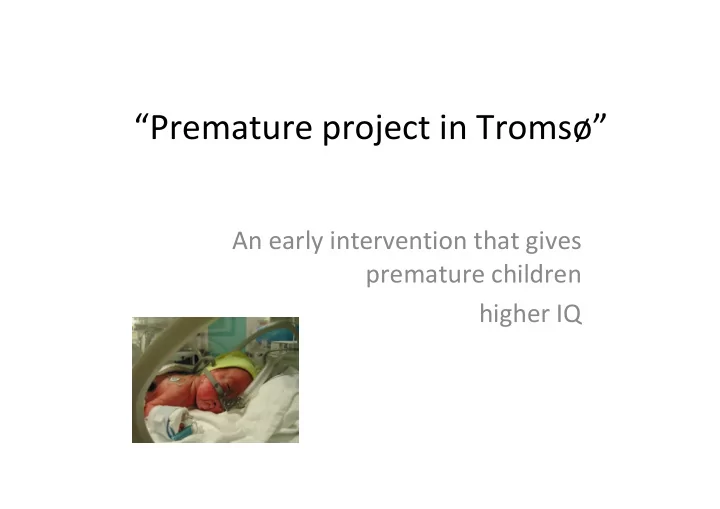
“Premature project in Tromsø”
An early intervention that gives premature children higher IQ
SLIDE 2
Early intervention of premature infants less than 2000 grams.
A research project. A collaboration between Department of Pediatrics, University Hospital, Tomsø and Institute of Clinical Medicine, University of Tromsø
SLIDE 3
- Avdeling for barne- og ungdomspsykiatri
- Prof. John A. Rønning
- Prof. Stein Erik Ulvund
Barneavdelingen
Overlege Lauritz Bredrup Dahl
- Forskningsspl. Jorunn Tunby
- Seksj. overlege Per Ivar Kaaresen
- Inklusjon fra mars 1999 tom. sept. 2002
SLIDE 4
SLIDE 5
" " !"
!
($
*+",-" % %$. ! !
% %"
SLIDE 6
Early Intervention in Tromsø
Introducing to the parents a method of social interaction with babies just before they left NICU for home
SLIDE 7 Intervention
Modified version of the Vermont Mother Infant Transactional Program, inspired by Neonatal Behavioral Assessment Scale, NBAS The parents were trained in adjusting to the individual characteristics of the infant, and the transactional nature
- f development was emphasized.
The parents were sensitized to the infant´s cues, with a particular emphasis on those that signal stimulus
- verload, distress and readiness for interaction.
SLIDE 8
SLIDE 9
Intervention
One hour debrief of the preterm birth experiences Seven daily 1-hour sessions last week before planned discharge Four home-visits after discharge Intervention administered by eight specially trained neonatal nurses
SLIDE 10
The Tromsø-version of the Vermont-program
! "# $ %& '() * + *
SLIDE 11
- 1. Home visit: Consolidation and adjustment
- 2. Home visit : Mutual enjoyment through play
- 3. Home visit : Temperamental patterns
- 4. Home visit : Review of program and termination
- f the intervention
– about 3 months after discharge
SLIDE 12
SLIDE 13 The goal of the intervension
Teach parents to read the childs reactions to internal and external stimuli Teach parents to understand the childs natural changes in state levels And understand when the baby is receptive for social interaction
- recognice the golden moments
SLIDE 14
Parenting Stress
SLIDE 15 A randomized controlled trial of the effectiveness of an early intervention program in reducing parenting stress in mothers and fathers of preterm infants.
Per Ivar Kaaresen1,2, John A. Rønning2, Stein Erik Ulvund2, Lauritz B. Dahl1,2.
1)Pediatric Department, University Hospital North Norway, Tromsø, Norway 2)Institute of Clinical Medicine, University of Tromsø, Norway
SLIDE 16
Background
A preterm birth is a stressful event for the parents and family relations Many studies have shown increased stress in mothers during the NICU stay Longitudinal studies are few and the results are conflicting Fathers less studied
SLIDE 17
Background
Increased parenting stress has been associated with later behavioral problems in both preterm and other children No studies has examined the effects of an early intervention program in reducing parenting stress in both mothers and fathers after a preterm birth
SLIDE 18
Hypothesis
Parents of preterm infants experience increased parenting stress during the first year after a preterm delivery compared to their term peers An early intervention program will reduce parenting stress in both mothers and fathers of a preterm infant
SLIDE 19
Methods
A randomized controlled trial
Preterm intervention group Preterm control group: Standard discharge examinations Term control group
SLIDE 20
Inclusion- and exclusion criteria
Birth weight < 2000 gram Exclusion:
Congenital anomalies Non-Norwegian speaking parents Triplets or higher plurality
SLIDE 21
** +***$ +**+ +,**$ +,*+ -***$ +*&)
+-
+ + + +&*) ./$%&'() 0-#
*&-) +&-,) &) *+&,) +&-) &,*) &+)
!!/!/
SLIDE 22
Instrument
Parenting Stress Index (PSI)
Self-reported questionaire 101 questions measured on a 5-point scale Child Domain: Measures stress related to the child’s characteristics Parent Domain: Measures stress related to the parents themselves Total Stess is the sum of Child and Parent Domain
SLIDE 23
PSI
The PSI was administered only to the mother at 6 months, to both mother and father at 1, 2, 3, 5 years
SLIDE 24
Patients
203 infants with birth weight<2000 g born from March 1999 to August 2002 136 were randomized (14 died,13 non-Norwegian speking parents, 22 parental refusals, 8 other) 6 were later withdrawn
SLIDE 25 PSI at 6 months - mothers
#
11" /0 +2- / 0
&
&++-*)
&+)
%.
&+-+,)
3% *
+&,--,)
SLIDE 26 PSI at 12 months
#
11" /0 +2- / 0
,*&1*+*)
+&+,)
%.
&+,+,)
++*+&-*,)
3% *
+&+-,)
+,&*)
, &+,) &+*+-)
&+-)
%.
, +*,&+)
+*&+,)
3% *
, +&) +&-+-)
+,&-)
SLIDE 27
Mothers´ PSI - Child Domain
SLIDE 28
Mothers´ PSI -Total Stress
SLIDE 29
Conclusion
Parents in the preterm control group experienced increased parenting stress after a preterm birth compared to their term peers An early intervention program can reduce parenting stress in both mothers and fathers of preterm infants to a level comparable to their term peers
SLIDE 30
No early cognitive effects
SLIDE 31 . 2 % 45 . "% % 456 . 2 %2 + ."% % 3."% % 456
7
)/) %)0 +5) !)/)0 !
)/!)60 )/)0 )6/) %)0 +5) !)/)0
)/)0 )/!) %)0 +5)6 )!/)0
SLIDE 32
- No significant difference in motoric, mental or
behavioural development between PI and PK at 2 years corrected age Both poorer than TK Instruments are not optimal at 2 years
SLIDE 33
First intervention effect on the children
SLIDE 34 Early intervention and social communication at 12 months corr. age for preterm and term infants Kåre S. Olafsen, John A. Rønning, Stein Erik Ulvund, Per Ivar Kaaresen, Bjørn Helge Handegård, Lauritz Bredrup Dahl
Center for Child and Adolescent Mental Health, Medical Faculty, University of Tromsø. Department of Pediatrics, University Hospital for Northern Norway, Tromsø. Department of Educational Research, University of Oslo.
SLIDE 35
SLIDE 36
Joint Attention in preterm and term infants The capacity to coordinate attention to a social partner. Associated with linguistic and cognitive, as well as social development (Adamson & Russel, 1999; Schertz & Odom, 2004; Sheinkopf, Mundy, Claussen, & Willoughby, 2004; Smith & Ulvund, 2003).
SLIDE 37
SLIDE 38 Important milestone in development; emerges normally at about 9 months, and fully developed at about 18 months. Developmental course from face-to-face social play (3 months) and interest in objects (6 months). Basis for verbal language. Medium for understanding social acts, perspectives
- f others, flexibility in give-and-take transactions.
SLIDE 39 Research questions
Could an early intervention designed to increase the parents2 sensitivity to the infants2 individual patterns enhance Joint Attention performances at 12 months
Would there be gender differences in Joint Attention performances? Would early intervention be differentially favorable for the different weight groups?
SLIDE 40 $ '($ ,**
.% # 9/0:%/0 /*0 # 9/0:%/0 /*0
/*0 ) 93 .)
) /)60 ) /6)6!0 ) /)0 ) /)0 !)6 /)0 )6! /)0 )== )!= )
><&
6) /)0 ) /)60 6) /)0 )! /)0 ) /)0 6) /)0
)=== )===
)
?>
) /)0
) /6)0
) /)0 ) /)!0 6) /6)0 ) /)0
)!== )=
)
>>
) /)0 ) /)0 )/)0 )! /)0 ) /)0 )6! /)0
)= )
)!
>*
6) /)660 )! /)!0 ) /!)0 )! /)0 )! /!)0 ) /)60
)!== )===
)! ,**,*%"%..-" %*") <& $<% & %)><&>+%$ %<% & %)?> $ ?@" >A- $)>>>+%$ %>A- $)>*>+%$ %*%" " %) )== )=== )
SLIDE 41 !$ '(+$ ,**
.% ,-./
/*0 456456 1-./ 2 *0 /*0 4545
2
*0
/*0 45!45 )
/$ $
) /)0 !) /)0 ) /!)60 )6 /)!0 6) /)0 )6 /)0 )! )= )
><&
)!6 /)0 ) /)0 6)!! /)0 )! /)60 )6 /)0 )6 /)0 )6 )6 )
?>
) /)0 )! /!)!0 ) /)0 ) /6)0 )!6 /)60 ) /)0 )== ) )6
>>
) /)60 ) /)!0 ) /)0 ) /)0 ) /)0 )6 /)0 )6== ) )
>*
) /)60 ) /)0 ) /)0 6) /)!0 ) /)0 6) /)60 )
)!===
)6 ,**,*%"%..-" %*") <& $<% & %)><&>+%$ %<% & %)?> $ ?@" >A- $)>>>+%$ %>A- $)>*>+%$ %*%" " %) )== )=== )
SLIDE 42
Summary
Significantly higher scores for the preterm intervention group in all weight groups compared to the preterm control group on Initiating JA (small to medium ES). The term group had significantly higher scores than preterm control and preterm intervention groups on Responding to JA (medium to large ES).
SLIDE 43 Summary
The preterm intervention group scored higher than the preterm control group on RSI (Responding to Social Interaction) in all weight groups (medium to large ES). The term group had also higher scores than the preterm control group.
- Girls outperformed boys on all aspects of social
communication, particularly on the element responding to joint attention, where the difference could be represented as a medium to large effect size.
SLIDE 44
Child rearing
SLIDE 45 A randomized study of the impact of a sensitising intervention on the child-rearing attitudes of parents of low birth weight preterm infants.
Solveig Marianne Nordhov, Per Ivar Kaaresen, John A. Rønning, Stein Erik Ulvund, Lauritz Bredrup Dahl
Department of Pediatrics, University Hospital for Northern Norway, Tromsø. Institute of Clinical Medicin, University of Tromsø. Department of Educational Research, University of Oslo.
SLIDE 46
- Child Rearing Practices Report (CRPR) (Block,
1965)
Consists of 65 questions on parents attitude toward different aspects on childrearing Example: ”I do not allow my children to question my decisions”
SLIDE 47
Signifikant more sensitiv child-rearing in PI compared to PK at 1, 2 and 3 years corrected age More parent agreement on child-rearing in PI
SLIDE 48
"# !$ "# #%%&'()
3+-
* ,-&*) *-& * **) *,- ***
3- , &*+) , ,+&*) *+& *+ **) ** **+
3 , ,%&*)
*--& *- **+) * **
4- ,-
**& *--**) *- ** , *&*) 4 ,* ,*&*) + ,+&*,*) **& *%-**) *+ ** , ,*&*%)
!5$!!$67/'51/
SLIDE 49
Cognitive and behavioral outcome
SLIDE 50 Early intervention improves cognitive and behavioural outcomes for preterm infants: Randomized controlled trial.
Solveig Marianne Nordhov, John A. Rønning, Lauritz Bredrup Dahl, Stein Erik Ulvund, Jorunn Tunby, Per Ivar Kaaresen
Department of Pediatrics, University Hospital for Northern Norway, Tromsø. Institute of Clinical Medicin, University of Tromsø. Department of Educational Research, University of Oslo.
SLIDE 51 Child Behavior Checklist for ages 2-3 years (CBCL/2-3) – a parent report questionnaire on behaviour last 2 months
Internalising (angious/depressed, reserved) Externalising (agressiv, destructiv) Totalproblem score
The higher score – the more problems
SLIDE 52 "8-/!!5$
#
#
45 45 45! ,5 )/)0 )6/6)0 )!/)67 )0 +5) )/)60 *5 )/!)!0 6)/!)0 )/)7 )0 +5) !)/!)0
)6/)0 )/)7 )0 +5) )6/!)0 %4 45 45!6 456 ,5 6)/)0 )/)0 )/)!7 )0 +5) )6/!)60 *5 !)/)60 )/)!0 )/)7 )0 +5) )/)0
!)/)0 )/6)7 )0 +5) 6)/)0
SLIDE 53
Wechsler Preschool and Primary Scale of Intelligence Revised(WPPSI-R) (Wechsler, 1989)
Assess childrens intelligens at the age 4 to 6½
- years. Consists of 13 subtester.
Administered at 5 years
SLIDE 54
The intervention had positive influence on the parents child rearing attitudes Conditions considered to influence the premature childrens development positively are seen in greater extent in PI Results at 5 years shows intervention effects
- n the childrens cognitive skills
SLIDE 55
Consequences
SLIDE 56
Participation in the group organiced by the Directorate for Health and Social Affairs Faglige retningslinjer for oppfølging av for tidlig fødte 9July 2007 The principles of intervention are adopted by several NICUs and public health nurses Establishing an education in NBAS and the counselling method - Newborn Behavioral Observation – NBO in Norway/Tromsø
SLIDE 57
International conference held in Tromsø in October 2010 ”Strengthening Parenting Competence in Parents of Infants and Toddlers at Risk” The lectures are streamed, placed on the Prematureproject homepage: http://uit.no/prematur
SLIDE 58
Under construction…
Establishing a regional network of professionals with the aim of developing a web-based information-, dialogue and counseling-services.
First for the professionals in the basic health care services, NICUs, well-baby clinics, public health nurses Later for the parents
SLIDE 59