
SLIDE 1
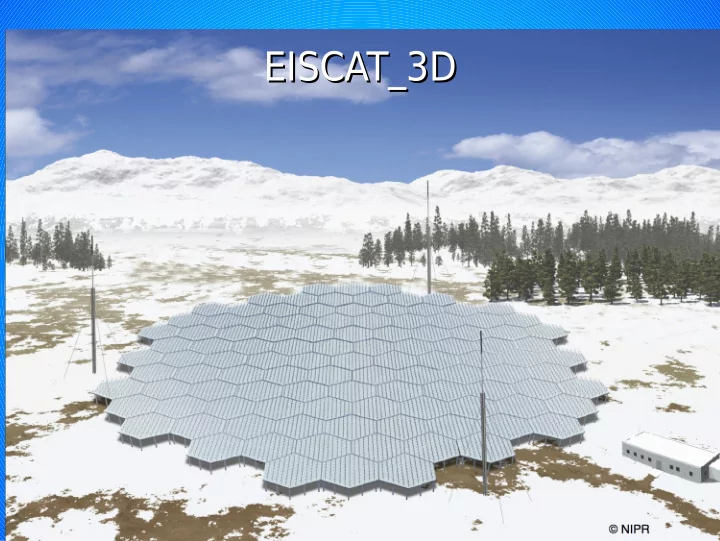
EISCAT_3D EISCAT_3D EISCAT Radars Kiruna, Sweden Troms, Norway - - PowerPoint PPT Presentation
EISCAT_3D EISCAT_3D EISCAT Radars Kiruna, Sweden Troms, Norway Sodankyl, Finland Longyearbyen, Svalbard EISCAT Science How is Earths atmosphere coupled to space? The Near-Earth Space Environment Space weather effects Ionosphere,
The Near-Earth Space Environment Ionosphere, Plasmasphere, Magnetosphere Neutral Atmosphere Below, Heliosphere Above
Credit: J. Grebowsky NASA/GSFC
CRIRP, PRC NIPR/ISEE, Japan Suomen Akatemia, Finland* Forskningsrådet, Norway* Vetenskapsrådet, Sweden* NERC, U.K. AARI, Russia IRA, Ukraine * EISCAT host countries IRAP, France KOPRI & KASI,
European Commission (Horizon2020, InfraDev-3): 3.1 M€ to prepare the EISCAT_3D design for a large-scale production environment. Finland: A total of 12.8 M€ have been allocated by the Finnish Academy and the University of Oulu for participation in the EISCAT_3D project. This includes both in-kind contributions and a stipulation that suffjcient funds are raised from other sources. Norway: The Research Council of Norway allocated 228 MNOK for participation in the EISCAT_3D production phase project under the condition that the project start by the end of 2016. Sweden: The Swedish Research Council (VR) have allocated 120 Million SEK for the construction of EISCAT_3D under the conditions that suffjcient funds are raised from other funding sources and a percentage of the funds be used in Sweden. Japan: E3D is included in programme ‘Study of Coupling Processes in the Solar T errestrial System.’, which in turn is one of the 10 selected projects in the Roadmap 2014. China: China’s Research Institute for Radio Wave Propagation (CRIRP) are proposing EISCAT_3D for the next fjve year plan. United Kingdom: EISCAT_3D has been identifjed on the Research Councils UK capital roadmap.
– Provide requirements details for use cases, data model, searching, visualisation – Prepare and provide testing/sample data
– Portal development (liferay) – T
esting with sample data
– Visualisation
– Connect the Portal with NeIC Grid/Cloud distributed storage
– Provide technical supports, introduce best practices – Provide logistical support, e.g, booking Webex, training – Monitoring the progress
– fjrst portal prototype based on the fjrst version of
– fjnd some EISCAT users to test the portal and provide
– fjnal portal delivery by the end of Feb 2016
facilities allowing users to authenticate, search, visualize, stage and (re)analyse and download desired datasets.
– MUST include an online graphical web interface – MUST implement user authentication – SHOULD include access APIs for the most commonly used languages
– SHOULD include data citation by PID in order to track the usage and publication of EISCAT 3D data – SHOULD include a scientifjc gateway integrating community applications/tools/services allowing users
to run workfmows for experiments, data mining and analysis
– MAY include collaboration areas, which allows registered users to share their experimental data,
workfmows and experiences.
Part Function Comments
Network Data transfer, system control, possibly distributed timing File format and transfer TBD. Evaluating FTS, GridFTP etc Operations and data centre Control and configuration of
multi-site data. Location to be evaluated: central cluster vs distributed computing Archive Long-term archival Tape archives at two separate redundant sites Stage Temporary storage to retrieve and reprocess archived data Computation resources for reprocessing Portal User interface for search, retrieval and reprocessing EISCAT user authentication
– should make sure names of fjelds etc follow standards from DC,
SKOS, ISO-xyz…
– Should probably defjne one or more separate experiment detail
and scheduling object(s)
– transmitter and receiver status logging
– pack the difgerent fjles into data and metadata objects for archival? – Pack into hdf5 fjles upon retrieval
– Identifjer syntax
Element Name Semantics Syntex Type experiment passive (radio astronomy: reception only) active(radar:transmit and receive) passive active text station receiver location e.g., proposed EISCAT-3D sites in Skibotn, Karesuvanto, Bergfors text
e.g., star or other celestial object (passive experiment) or transmitter location (e.g., Tx station in Skibotn, for active experiment)) text band frequency, e.g., 235MHz, 500MHz, 930MHz number bandwidth beam_pattern
Element Name Semantics Syntax Type selection_of_frequenci es selection of transmitter frequency/frequencies coding_of_pulses the coding of the transmitted pulses (different pulse code programs are used
and time resolutions) text number_of_beams number of beams in EISCAT-3D number beam_direction beam direction in EISCAT-3D text transmitter_power transmitter power in EISCAT-3D antenna_pointing antenna pointing or scan patterns in EISCAT text number_of_channels configuration of receiver: number of channels, digital filter settings, etc. number digital_filter_settings configuration of receiver: digital filter settings text flag_of_store_voltage_ domain_samples_level _1 whether to store voltage domain samples (level 1 data) boolean settings_of_level_2 integration time and storage of level 2 data text settings_of_level_3 integration, calibration and other analysis settings for level 3 data text
Radar site Name string Type active/passive Location (latitude, longitude, height
Operator Contact info etc Source Passive: Celestial object RA, dec, catalogue name Active Transmitter site
Active Transmitter mode
Rx mode Experiment type active/passive
band eg 230 MHz analog settings gain, anti aliasing filter ever changed? bandwidth (need to specify separately?) MHz sample rate MHz
filter 1 digital channel settings eg filter parameters, window (ion line, plasma line) (repeat channels as needed) downsampling part of digital filter parameters, decide on how to specify
Tx mode Frequency1 Center frequency MHz Power1 per amplifier and total ...