The search of water in Mars using radars Toms Ahumada Motivation - PowerPoint PPT Presentation
The search of water in Mars using radars Toms Ahumada Motivation First publication Following publications How to do it? ESA The Satellite Mars Explorer MARSIS Radar specifics Radargram Diagram to explain
The search of water in Mars using radars Tomás Ahumada
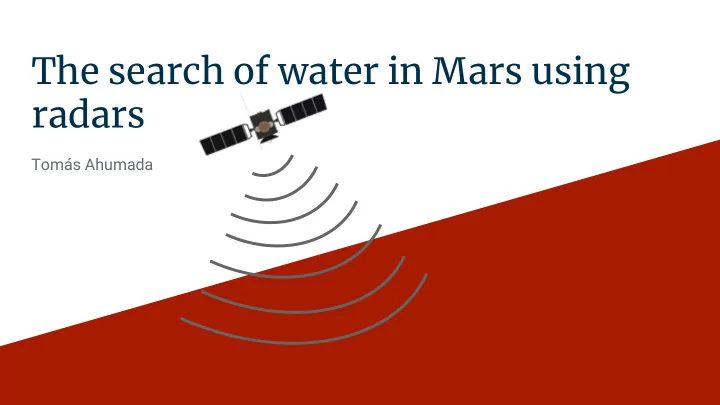
Motivation ● First publication ● Following publications ● How to do it?
ESA The Satellite ● Mars Explorer ● MARSIS ● Radar specifics
Radargram ● Diagram to explain ● Permittivity
The data ● Data downloaded ● Signal to Noise ● Location of the footprints ● Radargrams
Radar Reduction Step 1: Decompress the level 1A data. sequence Step 2: Transform the data to power expresses in the units of dBm. Raw Telemetry data Step 3: Convert power to the antenna by correcting for system gain. The system gain is frequency Decompress + express in dBm dependent and data are corrected for variations in system gain over frequency via a lookup table Power - Gain Step 4: Divide by the bandwidth (10.9KHz) and antenna length squared; (20m2) Divide by bandwidth and antenna length squared V 2 /m 2 /Hz
Methods ● Image analysis ● Threshold detection per line ● Detection algorithm
Results ● Power spectra of layer features
Future work For the surface (s) ● Getting the permittivity ● Spatial comparison For the layer underground Porcello et al. 1974
Conclusions ● SNR constraints over MARSIS data ● Data management ● Determination of the composition of subsurface layers is based on the estimate of their dielectric properties. Carter et al. 2009
Recommend
More recommend
Explore More Topics
Stay informed with curated content and fresh updates.