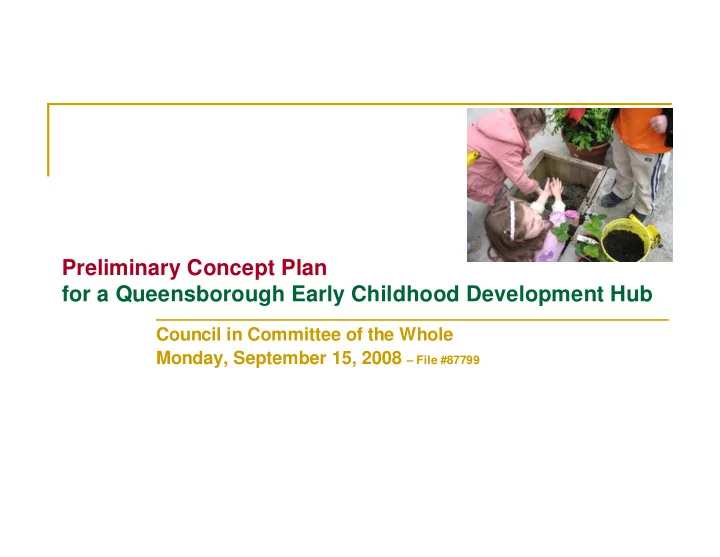
Preliminary Concept Plan for a Queensborough Early Childhood - - PowerPoint PPT Presentation
Preliminary Concept Plan for a Queensborough Early Childhood Development Hub Council in Committee of the Whole Monday, September 15, 2008 File #87799 Outline of Presentation This presentation will address the following areas: ECD Hubs
Outline of Presentation
This presentation will address the following areas:
ECD Hubs – Definition and Benefits ECD Hub Development in Queensborough – History, Needs and Consultation Draft Child Care Needs Assessment – Findings Related to Queensborough Official Community Plan and Draft Child Care Strategy ECD Public Partners – Role and Contributions Preliminary Concept Plan for a Queensborough ECD Hub Conclusions and Next Steps
ECD Hubs – Definition and Benefits
ECD hubs support the healthy development of young children and their families; and
include at least two early childhood development or family strengthening services, one of which is licensed child care.
ECD hubs act as focal points for their neighbourhoods and enable families to obtain
information and seamlessly access a continuum of services related to their needs.
ECD hubs have been proven to enhance child outcomes, including school readiness and
- success. They also facilitate inter-sectoral collaboration and partnership building.
ECD Hub Development in Queensborough
- In 2003, the New Westminster ECD Committee was established, which included the City’s
Parks and Recreation Department. As a result of this committee, community agencies and groups began to develop partnerships to more effectively and efficiently deliver services to families with children aged 0 to 6.
- In 2004, the ECD Committee developed its Five-Year Strategic Plan. This plan, among
- ther actions, called for the development of four ECD hubs, including a Queensborough
ECD Hub.
- In 2005, Parks and Recreation conducted a community consultative process to identify and
prioritize future parks and recreation amenities in Queensborough. The need for child care and spaces for multi-purpose programming were identified priorities.
- In 2005, the Early Development Instrument Mapping Project identified Queensborough as
the neighbourhood having the highest proportion of ‘vulnerable’ children. It also identified a number of gaps in services. As a result, several community organizations partnered with the Queensborough Community Centre in order to work towards meeting these gaps.
ECD HUB Development in Queensborough
- In 2006, a Queensborough Action Team was established.
- In 2007, Tina Holden was retained by the New Westminster ECD Committee with funding
support from MCFD, to work with the community and community organizations to identify a suitable location for and specific programs and services that could be included in a Queensborough ECD Hub.
- Based on the results from this process, the Queensborough Action Team recommended
that the New Westminster EDC Committee prepare a preliminary concept plan regarding possible program space requirements at Queensborough Community Centre.
- The New Westminster EDC Committee committed funding, through MCFD, to retain David
Norman to work with the Queensborough Action Team on a preliminary concept plan for a Queensborough ECD Hub.
Draft Child Care Needs Assessment
The draft Child Care Needs Assessment found that of the five sub-areas in New
Westminster, Queensborough is the least-resourced from a child care perspective.
In June 2008, Queensborough had the smallest share of child care spaces, accounting
for 4.9% of the total child care spaces in New Westminster.
With regard to group child care spaces to population, Queensborough has the lowest
proportion at 3.8 spaces per 100 children aged 0 to 12. By comparison, the East End, Uptown and West End sub-areas all had in excess of 15.4 spaces per 100 children aged 0 to 12.
OCP and Draft Child Care Strategy
The City’s Official Community Plan refers to “child care as an essential community-
based service” and includes the following statement: “child care be considered in the context of neighbourhood planning by evaluating the need for child care in proposed developments.”
The draft Child Care Strategy includes the following proposed recommended action:
“Examine building or incorporating space for new child care facilities as part of the development of new municipal facilities or major renovations to existing ones.”
Role of the Public Partners
The ECD Public Partners Committee was established to work closely with the ECD
Committee and its Action Teams to achieve four ECD hubs in New Westminster.
The Public Partners Committee is comprised of senior management and staff from the
following publicly funded organizations: the City of New Westminster, Fraser Health, the Ministry of Children and Family Development, the School District and the United Way of the Lower Mainland.
The Public Partners Committee has been meeting for about 18-months and they recently
reached agreement on a Memorandum of Understanding. This MOU states that the partner organizations will:
- advocate on behalf of hub development within their respective organizations
- coordinate planning among the five organizations
- identify and access funding and other resources in support of hub development
Of note, other municipalities have expressed an interest in this innovative model.
Contributions of Public Partners
To date, each of the Public Partners have made significant contributions, which
are benefiting both the residents of Queensborough and the larger City. These contributions include but are not limited to:
- The preparation of two studies in support of ECD hub development, along with a
preliminary concept plan, funded by MCFD. Depending on the timing of an ECD hub, there may also be capital dollars available through MCFD.
- The ongoing work of the ECD Committee and Public Partners which is being funded
by the United Way of the Lower Mainland.
- The recent opening of a StrongStart Centre and 20 out-of-school care spaces at
Queen Elizabeth Elementary School by the School District. These initiatives contribute to and build a strong foundation for a Queensborough ECD Hub.
- The willingness of Fraser Health to consider providing services targeting the needs of
parents and young children in Queensborough.
The City can also play an important role by considering the incorporation of an
EDC hub as part of the expansion to the Queensborough Community Centre.
Queensborough ECD Hub; Process Chart
Queensborough ECD Hub; Aerial Context
Preliminary Concept
Queensborough ECD Hub; Schematic Plan
Preliminary Concept
Conclusions and Next Steps
The preliminary concept plan as presented today represents one possible use for the
expansion of the Queensborough Community Centre. The plan would address many of the early childhood development needs, including child care, within the neighbourhood, and would enhance child outcomes, including school readiness and success. It would also fit within the context of development which is occurring in Queensborough, which has a far larger share of ground-oriented housing, which is appealing to families with young children.
It is hoped that this preliminary concept plan, which is based on extensive community
consultation and planning, will inform the next phase of consultation into the expansion
- f the Queensborough Community Centre.