PPI PENSIONS POLICY INSTITUTE Should earnings-related pensions be - - PDF document

ppi
SMART_READER_LITE
LIVE PREVIEW

PPI PENSIONS POLICY INSTITUTE Should earnings-related pensions be - - PDF document

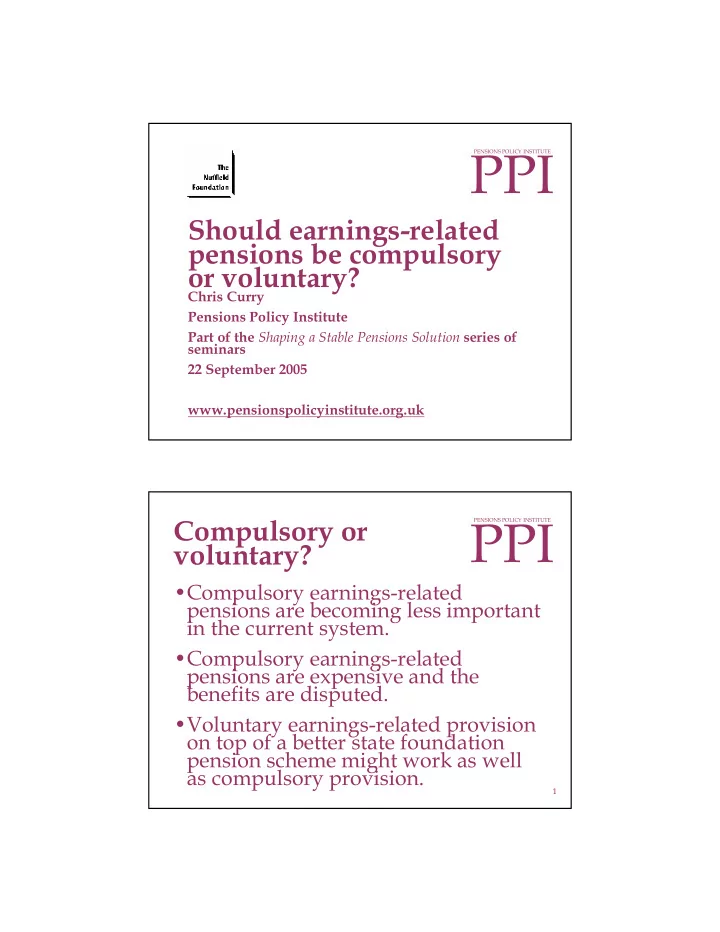
PPI PENSIONS POLICY INSTITUTE Should earnings-related pensions be compulsory or voluntary? Chris Curry Pensions Policy Institute Part of the Shaping a Stable Pensions Solution series of seminars 22 September 2005


slide-1
SLIDE 1

PPI

PENSIONS POLICY INSTITUTE

Chris Curry Pensions Policy Institute Part of the Shaping a Stable Pensions Solution series of seminars 22 September 2005 www.pensionspolicyinstitute.org.uk

Should earnings-related pensions be compulsory

  • r voluntary?

1

PPI

PENSIONS POLICY INSTITUTE
  • Compulsory earnings-related

pensions are becoming less important in the current system.

  • Compulsory earnings-related

pensions are expensive and the benefits are disputed.

  • Voluntary earnings-related provision
  • n top of a better state foundation

pension scheme might work as well as compulsory provision.

Compulsory or voluntary?

slide-2
SLIDE 2

2

PPI

PENSIONS POLICY INSTITUTE

S2P takes time to improve pensions at low income levels

Pension entitlement on reaching SPA in 2024/5 as a

proportion of NAE by constant annual earnings in 2005/6 earnings terms

Additional available from S2P Amount that would have been delivered by SERPS had it continued BSP 0% 5% 10% 15% 20% 25% 30% 35%

  • 5,000

10,000 15,000 20,000 25,000 30,000 35,000 40,000

3

PPI

PENSIONS POLICY INSTITUTE

State pensions will be less earnings-related in future

Pension entitlement on reaching SPA in 2054/5 as a

proportion of NAE by constant annual earnings in 2005/6 earnings terms

Additional available from S2P Amount that would have been delivered by SERPS had it continued BSP 0% 5% 10% 15% 20% 25% 30% 35%

  • 5,000

10,000 15,000 20,000 25,000 30,000 35,000 40,000

slide-3
SLIDE 3

4

PPI

PENSIONS POLICY INSTITUTE

What should the role of the state be?

  • 1. Alleviation of poverty
  • 2. Prevention of poverty
  • 3. Belonging and participation

in the community

  • 4. Continuance of economic

status

Broadly accepted In debate

5

PPI

PENSIONS POLICY INSTITUTE
  • Minimise the risk of future

disappointment.

  • Save the state money.
  • Encourage growth in the voluntary private

pension sector.

  • Provide a positive effect on the economy,

along with a clear incentive to work.

  • Maintain the status quo and avoid

disrupting the existing pension provision framework.

Compulsory earnings-related provision could:

slide-4
SLIDE 4

6

PPI

PENSIONS POLICY INSTITUTE

State pension reform is likely to be expensive

Estimated illustrative cost in 2040 of alternative state pension systems 8.3%

Flat-rate pension of £90 a week uprated in line with earnings and an earnings-related pension

8.2%

Simple flat-rate pension of £109 a week uprated in line with earnings

9.5%

Flat-rate pension of £109 a week uprated in line with earnings and an earnings-related pension

6.5%

Current system % GDP in 2040

7

PPI

PENSIONS POLICY INSTITUTE

A higher flat-rate pension is better for lower earners

0% 5% 10% 15% 20% 25% 30%

  • 6,000

12,000 18,000 24,000 30,000 36,000

Pension entitlement on reaching SPA in 2053/4 as a proportion of NAE by constant annual earnings in 2005/6 earnings terms, working for 40 years A: Universal pension of £90 a week B: Earnings- related pension Universal pension of £109 a week at the same cost as A+B

slide-5
SLIDE 5

8

PPI

PENSIONS POLICY INSTITUTE

A higher flat-rate pension means less means-testing

Illustrative number of pensioners entitled to Pension Credit in 2040

3 million (20%)

Flat-rate pension of £90 a week uprated in line with earnings and an earnings-related pension

1 million (5%)

Simple flat-rate pension of £109 a week uprated in line with earnings

0.5 million (5%)

Flat-rate pension of £109 a week uprated in line with earnings and an earnings-related pension

13 million (75%)

Current system Number (proportion)

  • f pensioners on PC

in 2040

9

PPI

PENSIONS POLICY INSTITUTE

What should the role of the state be?

  • 1. Alleviation of poverty
  • 2. Prevention of poverty
  • 3. Belonging and participation in the

community

  • 4. Continuance of economic status

Could undermine here If do too much here

slide-6
SLIDE 6

10

PPI

PENSIONS POLICY INSTITUTE
  • Is unable to guarantee an adequate

pension income.

  • Could increase the need for means-testing

and other Government costs.

  • Could undermine voluntary private

saving through added complexity, increased regulation and consequently higher costs.

  • Would not have a significant impact on the

economy.

Some think compulsory earnings- related provision:

11

PPI

PENSIONS POLICY INSTITUTE

Spectrum of options for state involvement in earnings-related pension provision

Do Nothing Inform Enable Incentivise Compel Deliver

slide-7
SLIDE 7

12

PPI

PENSIONS POLICY INSTITUTE
  • Can the state afford to provide both poverty

prevention and earnings-replacement?

  • Is it more important for the state to prevent

poverty for all, or is there an ‘acceptable’ level of poverty consistent with giving more resources to earnings-replacement?

  • Would voluntary saving for earnings-

replacement be easier with or without a compulsory earnings-replacement scheme?

  • Could a revitalised voluntary system be good

enough to improve upon the existing compulsory system?

Questions for discussion