Powering a number Problem: Compute a n , where n N . Naive - - PowerPoint PPT Presentation

powering a number
SMART_READER_LITE
LIVE PREVIEW

Powering a number Problem: Compute a n , where n N . Naive - - PowerPoint PPT Presentation

CS 3343 -- Spring 2009 Powering a number Problem: Compute a n , where n N . Naive algorithm: ( n ). Divide-and-conquer algorithm: (recursive squaring) a n/ 2 a n/ 2 if n is even; a n = More Divide & Conquer a ( n 1) / 2 a (


slide-1
SLIDE 1

1

2/5/09 CS 3343 Analysis of Algorithms 1

CS 3343 -- Spring 2009

More Divide & Conquer

Carola Wenk Slides courtesy of Charles Leiserson with small changes by Carola Wenk

2/5/09 CS 3343 Analysis of Algorithms 2

Powering a number

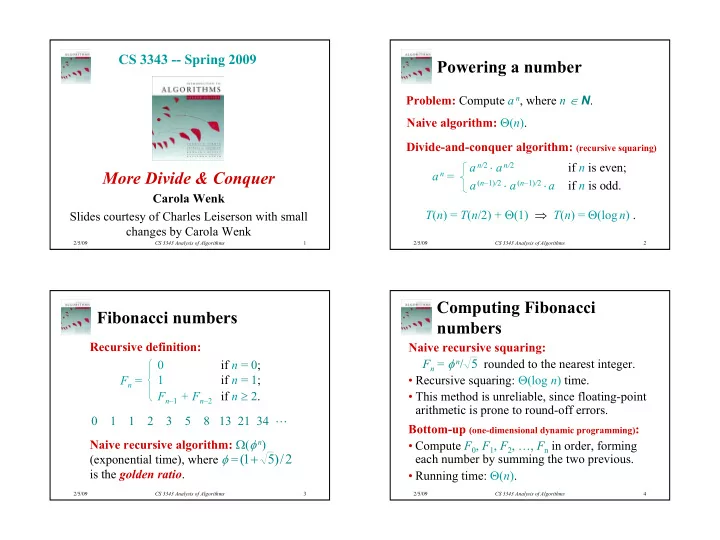
Problem: Compute a n, where n ∈ N. a n = a n/2 ⋅ a n/2 if n is even; a (n–1)/2 ⋅ a (n–1)/2 ⋅ a if n is odd. Divide-and-conquer algorithm: (recursive squaring) T(n) = T(n/2) + Θ(1) ⇒ T(n) = Θ(logn) . Naive algorithm: Θ(n).

2/5/09 CS 3343 Analysis of Algorithms 3

Fibonacci numbers

Recursive definition: Fn = if n = 0; Fn–1 + Fn–2 if n ≥ 2. 1 if n = 1; 1 1 2 3 5 8 13 21 34 L Naive recursive algorithm: Ω(φ n) (exponential time), where φ = is the golden ratio.

2 / ) 5 1 ( +

2/5/09 CS 3343 Analysis of Algorithms 4

Computing Fibonacci numbers

Naive recursive squaring: Fn = φ n/ rounded to the nearest integer.

5

  • Recursive squaring: Θ(log n) time.
  • This method is unreliable, since floating-point

arithmetic is prone to round-off errors. Bottom-up (one-dimensional dynamic programming):

  • Compute F0, F1, F2, …, Fn in order, forming

each number by summing the two previous.

  • Running time: Θ(n).
slide-2
SLIDE 2

2

2/5/09 CS 3343 Analysis of Algorithms 5

Convex Hull

  • Given a set of pins on a pinboard
  • And a rubber band around them
  • How does the rubber band look

when it snaps tight?

  • We represent convex hull as the

sequence of points on the convex hull polygon, in counter-clockwise

  • rder.

2 1 3 4 6 5

2/5/09 CS 3343 Analysis of Algorithms 6

Convex Hull: Divide & Conquer

  • Preprocessing: sort the points by x-

coordinate

  • Divide the set of points into two

sets A and B:

  • A contains the left n/2 points,
  • B contains the right n/2 points
  • Recursively compute the convex

hull of A

  • Recursively compute the convex

hull of B

  • Merge the two convex hulls

A B

2/5/09 CS 3343 Analysis of Algorithms 7

Merging

  • Find upper and lower tangent
  • With those tangents the convex hull
  • f A∪B can be computed from the

convex hulls of A and the convex hull

  • f B in O(n) linear time

A B

2/5/09 CS 3343 Analysis of Algorithms 8

can be checked in constant time right turn or left turn?

Finding the lower tangent

a = rightmost point of A b = leftmost point of B while T=ab not lower tangent to both convex hulls of A and B do{ while T not lower tangent to convex hull of A do{ a=a-1 } while T not lower tangent to convex hull of B do{ b=b+1 } }

A B

a=2 1 5 3 4 1 2 3 4=b 5 6 7

slide-3
SLIDE 3

3

2/5/09 CS 3343 Analysis of Algorithms 9

Convex Hull: Runtime

  • Preprocessing: sort the points by x-

coordinate

  • Divide the set of points into two

sets A and B:

  • A contains the left n/2 points,
  • B contains the right n/2 points
  • Recursively compute the convex

hull of A

  • Recursively compute the convex

hull of B

  • Merge the two convex hulls

O(n log n) just once O(1) T(n/2) T(n/2) O(n)

2/5/09 CS 3343 Analysis of Algorithms 10

Convex Hull: Runtime

  • Runtime Recurrence:

T(n) = 2 T(n/2) + cn

  • Solves to T(n) = Θ(n log n)

2/5/09 CS 3343 Analysis of Algorithms 11

Matrix multiplication

            ⋅             =            

nn n n n n nn n n n n nn n n n n

b b b b b b b b b a a a a a a a a a c c c c c c c c c L M O M M L L L M O M M L L L M O M M L L

2 1 2 22 21 1 12 11 2 1 2 22 21 1 12 11 2 1 2 22 21 1 12 11

=

⋅ =

n k kj ik ij

b a c

1

Input: A = [aij], B = [bij]. Output: C = [cij] = A⋅ B. i, j = 1, 2,… , n.

2/5/09 CS 3343 Analysis of Algorithms 12

Standard algorithm

for i ← 1 to n do for j ← 1 to n do cij ← 0 for k ← 1 to n do cij ← cij + aik⋅ bkj Running time = Θ(n3)

slide-4
SLIDE 4

4

2/5/09 CS 3343 Analysis of Algorithms 13

Divide-and-conquer algorithm

n×n matrix = 2×2 matrix of (n/2)×(n/2) submatrices: IDEA:       ⋅       =       h g f e d c b a u t s r C = A ⋅ B r = a·e+b·g s = a·f+ b·h t = c·e+d·g u = c·f +d·h

8 recursive mults of (n/2)×(n/2) submatrices 4 adds of (n/2)×(n/2) submatrices

2/5/09 CS 3343 Analysis of Algorithms 14

Analysis of D&C algorithm

nlogba = nlog28 = n3 ⇒ CASE 1 ⇒ T(n) = Θ(n3). No better than the ordinary algorithm. # submatrices submatrix size work adding submatrices T(n) = 8T(n/2) + Θ(n2)

2/5/09 CS 3343 Analysis of Algorithms 15

7 mults, 18 adds/subs. Note: No reliance on commutativity of mult! 7 mults, 18 adds/subs. Note: No reliance on commutativity of mult!

Strassen’s idea

  • Multiply 2×2 matrices with only 7 recursive mults.

P1 = a ⋅ ( f – h) P2 = (a + b) ⋅ h P3 = (c + d) ⋅ e P4 = d ⋅ (g – e) P5 = (a + d) ⋅ (e + h) P6 = (b – d) ⋅ (g + h) P7 = (a – c) ⋅ (e + f ) r = P5 + P4 – P2 + P6 s = P1 + P2 t = P3 + P4 u = P5 + P1 – P3 – P7

2/5/09 CS 3343 Analysis of Algorithms 16

Strassen’s idea

  • Multiply 2×2 matrices with only 7 recursive mults.

P1 = a ⋅ ( f – h) P2 = (a + b) ⋅ h P3 = (c + d) ⋅ e P4 = d ⋅ (g – e) P5 = (a + d) ⋅ (e + h) P6 = (b – d) ⋅ (g + h) P7 = (a – c) ⋅ (e + f ) r = P5 + P4 – P2 + P6 = (a + d)(e + h) + d(g – e) – (a + b)h + (b – d)(g + h) = ae + ah + de + dh + dg –de – ah – bh + bg + bh – dg – dh = ae + bg

slide-5
SLIDE 5

5

2/5/09 CS 3343 Analysis of Algorithms 17

Strassen’s algorithm

  • 1. Divide: Partition A and B into

(n/2)×(n/2) submatrices. Form P-terms to be multiplied using + and – .

  • 2. Conquer: Perform 7 multiplications of

(n/2)×(n/2) submatrices recursively.

  • 3. Combine: Form C using + and – on

(n/2)×(n/2) submatrices. T(n) = 7T(n/2) + Θ(n2)

2/5/09 CS 3343 Analysis of Algorithms 18

Analysis of Strassen

T(n) = 7T(n/2) + Θ(n2) nlogba = nlog27 ≈ n2.81 ⇒ CASE 1 ⇒ T(n) = Θ(nlog 7). Best to date (of theoretical interest only): Θ(n2.376L). The number 2.81 may not seem much smaller than 3, but because the difference is in the exponent, the impact on running time is significant. In fact, Strassen’s algorithm beats the ordinary algorithm

  • n today’s machines for n ≥ 30 or so.

2/5/09 CS 3343 Analysis of Algorithms 19

Conclusion

  • Divide and conquer is just one of several

powerful techniques for algorithm design.

  • Divide-and-conquer algorithms can be

analyzed using recurrences and the master method (so practice this math).

  • Can lead to more efficient algorithms