Dynamic programming Algorithm design technique A technique for - - PowerPoint PPT Presentation

dynamic programming
SMART_READER_LITE
LIVE PREVIEW

Dynamic programming Algorithm design technique A technique for - - PowerPoint PPT Presentation

CS 3343 -- Spring 2009 Dynamic programming Algorithm design technique A technique for solving problems that have overlapping subproblems and, when used for optimization, have an optimal substructure property Dynamic Programming


slide-1
SLIDE 1

1

CS 3343 Analysis of Algorithms 1 3/17/09

CS 3343 -- Spring 2009

Dynamic Programming

Carola Wenk Slides courtesy of Charles Leiserson with small changes by Carola Wenk

CS 3343 Analysis of Algorithms 2 3/17/09

Dynamic programming

  • Algorithm design technique
  • A technique for solving problems that have
  • overlapping subproblems
  • and, when used for optimization, have an optimal

substructure property

  • Idea: Do not repeatedly solve the same subproblems,

but solve them only once and store the solutions in a dynamic programming table

CS 3343 Analysis of Algorithms 3 3/17/09

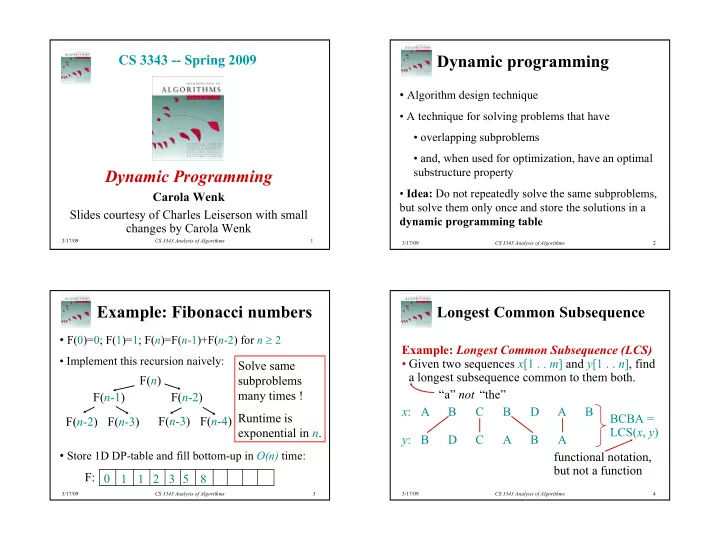
Example: Fibonacci numbers

  • F(0)=0; F(1)=1; F(n)=F(n-1)+F(n-2) for n ≥ 2
  • Implement this recursion naively:

F(n) F(n-1) F(n-2) F(n-2) F(n-3) F(n-3) F(n-4) Solve same subproblems many times ! Runtime is exponential in n.

  • Store 1D DP-table and fill bottom-up in O(n) time:

F: 0 1 1 2 3 5 8

CS 3343 Analysis of Algorithms 4 3/17/09

Longest Common Subsequence

Example: Longest Common Subsequence (LCS)

  • Given two sequences x[1 . . m] and y[1 . . n], find

a longest subsequence common to them both. x: A B C B D A B y: B D C A B A “a” not “the” BCBA = LCS(x, y) functional notation, but not a function

slide-2
SLIDE 2

2

CS 3343 Analysis of Algorithms 5 3/17/09

Brute-force LCS algorithm

Check every subsequence of x[1 . . m] to see if it is also a subsequence of y[1 . . n]. Analysis

  • 2m subsequences of x (each bit-vector of

length m determines a distinct subsequence

  • f x).
  • Hence, the runtime would be exponential !

CS 3343 Analysis of Algorithms 6 3/17/09

Towards a better algorithm

Two-Step Approach:

  • 1. Look at the length of a longest-common

subsequence.

  • 2. Extend the algorithm to find the LCS itself.

Strategy: Consider prefixes of x and y.

  • Define c[i, j] = | LCS(x[1 . . i], y[1 . . j]) |.
  • Then, c[m, n] = | LCS(x, y) |.

Notation: Denote the length of a sequence s by | s |.

CS 3343 Analysis of Algorithms 7 3/17/09

Recursive formulation

Theorem. c[i, j] = c[i–1, j–1] + 1 if x[i] = y[j], max{c[i–1, j], c[i, j–1]} otherwise. Let z[1 . . k] = LCS(x[1 . . i], y[1 . . j]), where c[i, j] = k. Then, z[k] = x[i], or else z could be extended. Thus, z[1 . . k–1] is CS of x[1 . . i–1] and y[1 . . j–1].

  • Proof. Case x[i] = y[j]:

...

1 2 i m

...

1 2 j n

x: y: =

CS 3343 Analysis of Algorithms 8 3/17/09

Proof (continued)

Claim: z[1 . . k–1] = LCS(x[1 . . i–1], y[1 . . j–1]). Suppose w is a longer CS of x[1 . . i–1] and y[1 . . j–1], that is, |w| > k–1. Then, cut and paste: w || z[k] (w concatenated with z[k]) is a common subsequence of x[1 . . i] and y[1 . . j] with |w || z[k]| > k. Contradiction, proving the claim. Thus, c[i–1, j–1] = k–1, which implies that c[i, j] = c[i–1, j–1] + 1. Other cases are similar.

slide-3
SLIDE 3

3

CS 3343 Analysis of Algorithms 9 3/17/09

Dynamic-programming hallmark #1

Optimal substructure An optimal solution to a problem (instance) contains optimal solutions to subproblems. If z = LCS(x, y), then any prefix of z is an LCS of a prefix of x and a prefix of y.

Recurrence

CS 3343 Analysis of Algorithms 10 3/17/09

Recursive algorithm for LCS

LCS(x, y, i, j) if x[i] = y[ j] then c[i, j] ← LCS(x, y, i–1, j–1) + 1 else c[i, j] ← max{LCS(x, y, i–1, j), LCS(x, y, i, j–1)} Worst-case: x[i] ≠ y[ j], in which case the algorithm evaluates two subproblems, each with only one parameter decremented.

CS 3343 Analysis of Algorithms 11 3/17/09

same subproblem , but we’re solving subproblems already solved!

Recursion tree

m = 3, n = 4:

3,4 3,4 2,4 2,4 1,4 1,4 3,3 3,3 3,2 3,2 2,3 2,3 1,3 1,3 2,2 2,2

Height = m + n ⇒ work potentially exponential.

2,3 2,3 1,3 1,3 2,2 2,2

m+n

CS 3343 Analysis of Algorithms 12 3/17/09

Dynamic-programming hallmark #2

Overlapping subproblems A recursive solution contains a “small” number of distinct subproblems repeated many times. The number of distinct LCS subproblems for two strings of lengths m and n is only mn.

slide-4
SLIDE 4

4

CS 3343 Analysis of Algorithms 13 3/17/09

Dynamic-programming

There are two variants of dynamic programming:

  • 1. Memoization
  • 2. Bottom-up dynamic programming

(often referred to as “dynamic programming”)

CS 3343 Analysis of Algorithms 14 3/17/09

Memoization algorithm

Memoization: After computing a solution to a subproblem, store it in a table. Subsequent calls check the table to avoid redoing work.

Time = Θ(mn) = constant work per table entry. Space = Θ(mn).

LCS(x, y, i, j) if c[i, j] = NIL then if x[i] = y[j] then c[i, j] ← LCS(x, y, i–1, j–1) + 1 else c[i, j] ← max{LCS(x, y, i–1, j), LCS(x, y, i, j–1)} same as before for all i, j: c[i,0]=0 and c[0, j]=0

CS 3343 Analysis of Algorithms 15 3/17/09

nil nil nil nil nil nil nil nil nil nil nil nil nil nil nil nil nil nil nil nil nil nil nil nil nil nil nil nil D nil nil nil nil nil nil nil nil nil nil nil nil C nil nil nil nil nil nil nil nil nil nil nil nil nil nil nil nil A nil nil nil nil nil nil nil nil nil nil nil nil B nil nil nil nil nil nil nil nil nil nil A

Memoization

A B C B D B B A nil nil 6 1 2 3 4 5 7 2 3 4 5 1 6 nil nil nil nil LCS(x,y,7,6) x: y: 1 1 (4,5) (6,6) (7,5) (5,5) (6,4) (5,4) (5,3)

  • 1

2 2

CS 3343 Analysis of Algorithms 16 3/17/09

Recursive formulation

c[i, j] = c[i–1, j–1] + 1 if x[i] = y[j], max{c[i–1, j], c[i, j–1]} otherwise.

c[i,j] c[i,j]

i j j-1 i-1 c:

slide-5
SLIDE 5

5

CS 3343 Analysis of Algorithms 17 3/17/09

1 1 1 1 1 1 1 1 1 1 1 1 1 1 1 1 1 1 2 2 2 2 2 2 D 1 1 2 2 2 2 2 2 2 2 C 2 2 1 1 1 1 2 2 2 2 2 2 3 3 3 3 A 1 1 2 2 2 2 3 3 3 3 3 3 B 4 4 1 1 2 2 2 2 3 3 A

Bottom-up dynamic- programming algorithm

IDEA: Compute the table bottom-up. A B C B D B B A 3 3 4 4 Time = Θ(mn). 4 4

CS 3343 Analysis of Algorithms 18 3/17/09

A A B C B D B D C A B B A A B C B B 1 1 1 1 1 1 1 1 D D 1 1 1 1 1 1 1 1 1 1 1 1 2 2 2 2 C 2 2 2 2 1 1 2 2 2 2 2 2 2 2 A A 2 2 2 2 1 1 1 1 2 2 2 2 2 2 3 3 3 3 B B 3 3 1 1 2 2 2 2 3 3 3 3 3 3 4 4 4 4 A 1 1 2 2 2 2 3 3

Bottom-up dynamic- programming algorithm

IDEA: Compute the table bottom-up. 3 3 4 4 Time = Θ(mn). 4 4 Reconstruct LCS by back- tracing. 4 4 Space = Θ(mn). Exercise: O(min{m, n}).