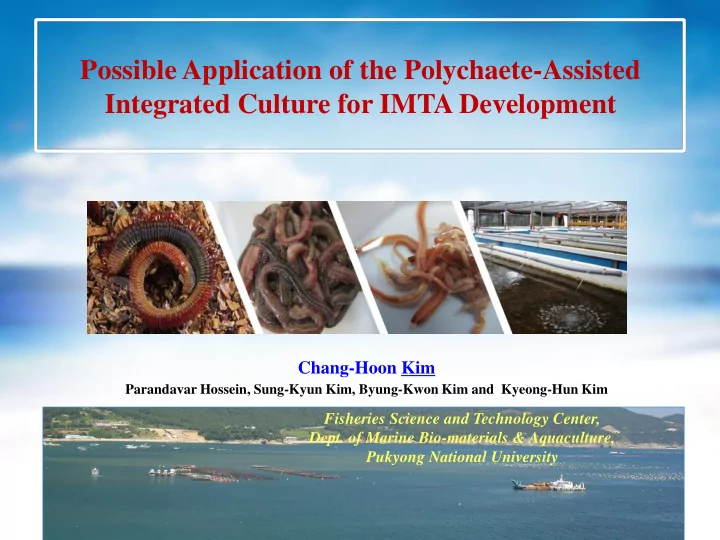
SLIDE 1
Possible Application of the Polychaete-Assisted Integrated Culture for IMTA Development
Fisheries Science and Technology Center,
- Dept. of Marine Bio-materials & Aquaculture,
Pukyong National University
Chang-Hoon Kim
Parandavar Hossein, Sung-Kyun Kim, Byung-Kwon Kim and Kyeong-Hun Kim
SLIDE 2
IMTA Concept and Approaches
(by T. Chopin)
SLIDE 3 Seaweeds Cultivation in the South-west coast, Korea
Jindo- Haenam South Wando East Wando
Seaweeds, the Future of Human in the Sea
- Sustainable management
- f fisheries resources
- Conditions with clean,
harmonized Wando areas
SLIDE 4 HABs Development and Fisheries Damages in the South-east coast, Korea
▪ HABs since 1980s ▪ Summer Blooming of Ichthyologic Cochlodinium polykrikoides ▪ Vernal Shellfish Toxification by PSP-producing Alexandrium tamarense
- The great potential of the polychaete worms for bioremediation
- The possibility of water quality improvement
by the polychaete-assisted integrated culture system
SLIDE 5
Polychaete Seed Production & Applications in FSTC
SLIDE 6
Settings Rearing Maintain Measure
Water quality improvement of rockworm, Marphysa sanguinea in the integrated culture system with olive flounder, Paralichthys olivaceus
SLIDE 7
Integrated culture systems : Flow-through and Semi-recirculation
SLIDE 8
A) the integrated culture system B) worms at the beginning of study C) transport of fish feces & uneaten feed by siphon into the worm box D) collecting of worms at the end of study E) worms fed on fish feces and uneaten feed F) worms fed on commercial feed
SLIDE 9
- Fig. Comparisons of growth performance in final weight of rockworm Marphysa sanguinea
according to the size groups when fed on fish feces & uneaten feeds (T1-T3), and commercial diet (T5) in the integrated culture with olive flounder.
SLIDE 10
Table 1. Wastewater quality improvement by M. sanguinea in the integrated culture with olive flounder for 13 weeks in flow-through system
SLIDE 11
Table 2. Wastewater quality improvement by M. sanguinea in the integrated culture with olive flounder for 13 weeks in semi-recirculating system
SLIDE 12
Summary: ❖ The rockworm Marphysa sanguinea could grow readily by feeding on fish feces and uneaten feed of flounders as a food source ❖ Different effects on the removal efficiency were appeared both in culture systems and among treatments, but the highest removal efficiency showed in TN (63 %-semi), TP (59%-flow), TSS (86%-flow) and COD (30%-flow) ❖ So, this species is an excellent candidate in connection with an integrated aquaculture for wastewater treatment and nutrient recycling
SLIDE 13
Applications to Land-based Aquaculture Farms
SLIDE 14 14
Mass production techniques development for aquaculture industrialization of high-value polychaete and its application to coastal preservation
(2014. 10. 1 start)
1) Establishment of systematic technology on mass production of the rockworm polychaete Marphysa sanguinea 2) Construction of model system for introducing mass production techniques 3) Education, guidance and transfer of high production techniques 4) Environmental preservation by applications of polychaete-assisted aquaculture techniques
SLIDE 15
Fisheries-Polychaete Combined Systems for the Regulation of Aquaculture Discharges
SLIDE 16 Integrated Link System in Coastal Areas 개방식 연안 연계양식 개념
Land Based Culture
Sea Bottom
Tides
Land
Link System Tidal Flat & Bottom (Hanging) - Technical Applications
Fisheries Cage Culture Artificial Polychaete Culture Ground
시험구 대조구 현장 설치 사례
IMTA (Integrated Multi-Trophic Aquaculture)
(Intensive Recirculating Aquaculture)
SLIDE 17 17
Finfish (flounder) Combined Culture
국내 넙치 최대생산지 친환경 저에너지 양식 제주권 Abalone, Seaweeds Combined Culture Tidal Flats Mixed culture 갯벌양식 및 전복, 해조류 최대생산지 갯벌생태계 활용 서남권 친환경 양식 선진 기술 개발 FSTC 수산과학기술센터 Basic Researches Technics Edu & Transfer 산업화 기술 선진화 Finfish Combined Cult. 어류, 패류, 가두리 양식 중심지 어장 생태환경 복원 동남권 협력 체계
국·도립연구소- 민관-대학
협력 체계
대학-민관-국·도 립연구소
협력 체계
대학-국·도립연 구소- 민관
Bentic Subst. Restoration
Eco-friendly Practical Models in Korean Coasts
SLIDE 22
Expectations
❖ Contribution to increase of the fisheries income by mass production of high-value marine polychaete ❖ Removal of organics discharged from aquaculture farm and coastal pollution mitigation by application of polychaete-assisted aquaculture techniques ❖ Activation of marine bio-industry according to an establishment of eco- friendly mass production ❖ Substitution effects on import and adversely export of polychaete by domestic mass production and techniques improvement ❖ Employment and job creation effects by augmentation of the production in high-value polychaete ❖ Applications to an environment-related, bio-industry and the pharmaceutical industry
SLIDE 23