POLLI NATORS, CLI M ATE CHANGE, & YOUR GARDEN F R A N C E S - - PDF document

polli nators cli m ate change amp your garden
SMART_READER_LITE
LIVE PREVIEW

POLLI NATORS, CLI M ATE CHANGE, & YOUR GARDEN F R A N C E S - - PDF document

3/23/2020 POLLI NATORS, CLI M ATE CHANGE, & YOUR GARDEN F R A N C E S F I S C H E R POLLI NATORS HONEY BEES 1 3/23/2020 SPECI ALI ST VS GENERALI ST PHENOLOGI CAL M I SM ATCH A generalist species is able to thrive in a wide


slide-1
SLIDE 1

3/23/2020 1

POLLI NATORS, CLI M ATE CHANGE, & YOUR GARDEN

F R A N C E S F I S C H E R
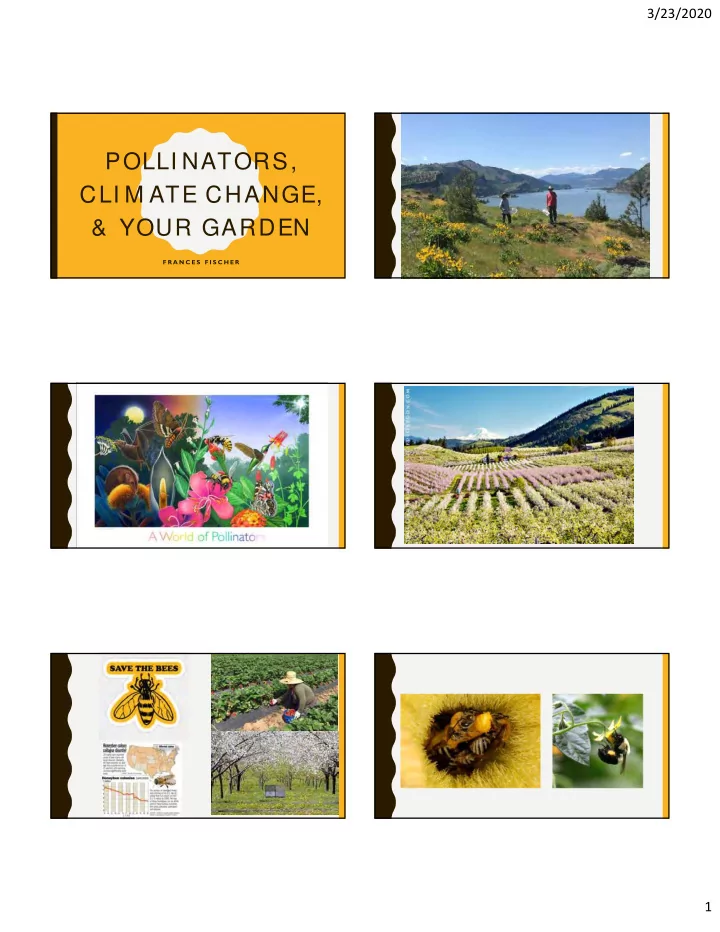
POLLI NATORS HONEY BEES

slide-2
SLIDE 2

3/23/2020 2

SPECI ALI ST VS GENERALI ST

  • A generalist species is able

to thrive in a wide variety of environmental conditions and can make use of a variety of different food sources.

  • A specialist species can

thrive only in a narrow range

  • f environmental conditions
  • r has a limited diet.

PHENOLOGI CAL M I SM ATCH YOUR GARDEN, YARD, FARM YOUR GARDEN – PLANTI NG, M AI NTAI NI NG

  • Try to have something

that blooms all year

  • Native plants
  • Avoid ornamentals with

inadequate nectar and pollen source

  • Have a diverse array for

different pollinators

  • Try not to spray

insecticides if possible

  • Be careful not to plant

invasive, naturalizing weeds

POLLI NATOR ATTRACTI NG PLANTS

W I NTER-EARLY SPRI NG ( FEB-APRI L)

  • *Vine maple (Acer circinatum)
  • *Tall Oregon grape (Berberis aquifolium, formerly Mahonia)
  • *Camas (Camassia spp.)
  • ~Crabapple (Malus floribunda, *Malus fusca)
  • ~Willow (Salix spp.)
  • *Columbia Desert Parsley (Lomatium columbianum)
  • *Pungent Desert Parsley (Lomatium grayi)

*=native species ~=native species available (from the OSU Horticulture Department)

slide-3
SLIDE 3

3/23/2020 3

POLLI NATOR ATTRACTI NG PLANTS

SPRI NG-EARLY SUM M ER ( APRI L-JUNE)

  • *Western serviceberry (Amelanchier alnifolia spp.)
  • Borage (Borago officinalis)
  • ~California lilac (Ceanothus spp.)
  • ~Tickseed (Coreopsis spp.)
  • ~Geranium (Geramium spp.) – [~watch for shiny geranium

and herb Robert when at the nursery!~]

  • *Globe gilia (Gilia capitata)
  • ~Lupine (Lupinus spp.)
  • ~Chokecherry (Prunus virginiana)
  • ~Bee balm (Monarda spp.)
  • *Buckwheats: sulfur flower buckwheat (Eriogonum

umbellatum) arrowleaf/heartleaf buckwheat (E. compositum), *=native species ~=native species available

POLLI NATOR ATTRACTI NG PLANTS

M I D-LATE SUM M ER ( JULY-SEPTEM BER)

  • Blue giant hyssop (Agastache foeniculum and spp.)
  • California poppy (Eschscholzia californica)
  • *Oregon gumweed (Grindelia stricta or integrifolia)
  • *Sneezeweed (Helenium autumnale)
  • *Showy tarweed (Madia elegans)
  • Catmint (Nepeta x faassenii) !!
  • Russian sage (Perovskia atriplicifolia)
  • Phacelia (Phacelia spp.)
  • ~Stonecrop (Sedum spp.)
  • *Milkweed (Asclepias fascicularis, Asclepias speciosa)
  • *Fire weed (Chamerion angustifolium)
  • *Oceanspray (Holodiscus discolor)

*=native species ~=native species available ~mint species can be very invasive, catmint is not, but watch for other mint species especially lemon balm~

POLLI NATOR ATTRACTI NG PLANTS

LATE SUM M ER – FALL ( SEPTEM BER-NOVEM BER)

  • Michaelmas daisy (Aster amellus)
  • *Goldenrod (Solidago canadensis)
  • *Asters: Douglas aster (Symphyotrichum subspicatum),

Eaton’s aster (Symphyotrichum bracteolatum), Henderson’s aster (Symphyotrichum hendersonii), Oregon golden aster (Heterotheca oregona), roughleaf aster (Eurybia radulina), hoary aster (Dieteria canescens)

  • *Buckwheats: barestem buckwheat (E. nudum), tall

woolly buckwheat (E. elatum)

  • *Hummingbird trumpet or California fuchsia

(Epilobium canum)

POLLI NATOR W ATER SOURCE NESTI NG BEES HOVER FLY

slide-4
SLIDE 4

3/23/2020 4

BEE HOUSES

Structures Straws, tubes, wood with holes drilled in them, may need screen

  • Can be a source for disease and parasites
  • Need to be maintained and cleaned every year
  • Emergence tub to empty the nest
  • Pipe cleaners
  • Half cup bleach per gallon

YOUR GARDEN – CLEAN UP

Don’t be tidy!

  • Leave bare ground – avoid mulch and weed cloth
  • Leave the leaves
  • Leave the stems (cut at 18-20 inches)
  • Gather stems and place out of the way

BEE LAW N

  • More drought tolerant, needs less fertilizer
  • Dutch white clover
  • Yarrow
  • Thyme (pink chintz)
  • Self heal (Prunella)
  • Roman Chamomile
  • English lawn daisy
  • Portland Lawn Seed

COVER CROPS FOR HOM E GARDENS

  • Flowering Cover crops such as crimson clover, buckwheat, vetch, alfalfa and mustard

attract bees and beneficial insects

QUESTI ONS? ? ?