SLIDE 1
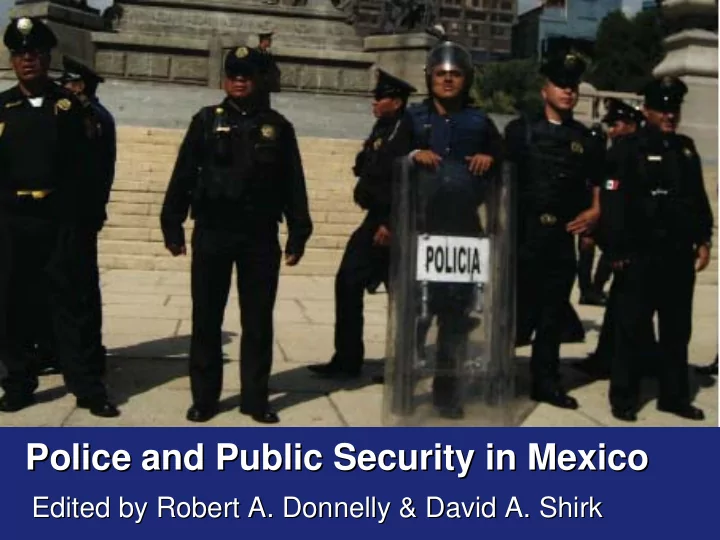
Police and Public Security in Mexico Police and Public Security in Mexico
Edited by Robert A. Donnelly & David A. Shirk Edited by Robert A. Donnelly & David A. Shirk
SLIDE 2 Overview Overview
Background
Summary
Lessons
Recommendations
Policy Horizon
Comments
SLIDE 3
Book Summary Book Summary
SLIDE 4 Police and Public Security in Mexico Police and Public Security in Mexico
Large-
- scale troop deployments throughout
scale troop deployments throughout Mexico beginning late 2006 Mexico beginning late 2006
- Militarization of public security a concern
Militarization of public security a concern
– – Human rights worries Human rights worries – – Potential for corruption; open Potential for corruption; open-
ended? – – Net effectiveness Net effectiveness
Role of the police
– – Effectiveness of police indicator for Effectiveness of police indicator for militarization militarization
SLIDE 5 Marcos Pablo Marcos Pablo Moloeznik Moloeznik “ “The Militarization of Public Security The Militarization of Public Security and the Role of the Military in Mexico and the Role of the Military in Mexico” ”
- Militarization not new; part
Militarization not new; part
- f longer
- f longer-
- term trend
term trend
Military involvement dependent partly on dependent partly on competence of police competence of police
Military’ ’s role becoming s role becoming more institutionalized more institutionalized
SLIDE 6 Guillermo Zepeda Guillermo Zepeda Lecuona Lecuona “ “Mexican Police and the Mexican Police and the Criminal Justice System Criminal Justice System” ”
Rigor of inquisitorial system & inadequacies of system & inadequacies of affidavit affidavit-
based justice system system
State, federal justice reforms (accusatorial reforms (accusatorial system) applied unevenly system) applied unevenly at state level at state level
SLIDE 7 Jorge Rocha Quintero Jorge Rocha Quintero “ “Public Security and Human Rights: Public Security and Human Rights: Reflections on the Experience of Reflections on the Experience of Jalisco Jalisco” ”
False dichotomy between civil between civil liberties, security liberties, security
Social construction
stereotyping of stereotyping of vulnerable groups vulnerable groups
SLIDE 8 Carlos Antonio Flores P Carlos Antonio Flores Pé érez rez “ “Organized Crime and Organized Crime and Official Corruption in Mexico Official Corruption in Mexico” ”
End of “ “grand bargain grand bargain” ”
- rganized crime vs.
- rganized crime vs.
state state
Political plurality and fragmentation of state fragmentation of state-
mafia relations
Organized crime more brazen in attacks on brazen in attacks on public targets public targets
SLIDE 9 Mar Marí ía Eugenia Su a Eugenia Suá árez de Garay rez de Garay “ “Mexican Law Enforcement Culture: Mexican Law Enforcement Culture: Testimonies from Police Behind Bars Testimonies from Police Behind Bars” ”
Ethnography of the police police
Police cultures and structural corruption structural corruption
Collectivization to individualization of individualization of security responsibilities security responsibilities
SLIDE 10 Elena Elena Azaola Azaola “ “The Weaknesses of Public Security The Weaknesses of Public Security Forces in Mexico City Forces in Mexico City” ”
forces, Mexico City
SLIDE 11
Case Study: Chihuahua Case Study: Chihuahua
SLIDE 12 Daniel Daniel Sabet Sabet “ “Two Steps Forward: Two Steps Forward: Lessons from Chihuahua Lessons from Chihuahua” ”
Administrative and policy continuity policy continuity
Complications of institutional design institutional design
- Prestige of international
Prestige of international-
accreditation programs, CALEA CALEA
SLIDE 13
Lessons Lessons
SLIDE 14
Lesson 1: Lesson 1:
Mexico Mexico’ ’s public s public security problem security problem is twofold: is twofold: common crime common crime and organized and organized crime crime
SLIDE 15
Lesson 2: Lesson 2:
Police are Police are neither the neither the cause nor the cause nor the solution of the solution of the problem problem
SLIDE 16 Lesson 3: Lesson 3:
Nonetheless, Nonetheless, police can play a police can play a pivotal role, in pivotal role, in either a positive either a positive
- r a negative
- r a negative
sense sense… …
SLIDE 17 Lesson 4: Lesson 4:
Better law Better law enforcement, requires enforcement, requires more professional more professional “ “democratic, democratic,” ” and and community community-
policing. policing.
SLIDE 18 Lesson 5: Lesson 5:
The military gambit The military gambit has been both has been both dangerous and dangerous and ineffective in ineffective in reducing organized reducing organized crime crime
Heriberto Lazcano, Head of Zetas
SLIDE 19
Recommendations Recommendations
SLIDE 20
Recommendation 1: Recommendation 1:
Provide more Provide more professional professional working conditions working conditions and civil service and civil service protections protections
SLIDE 21
Recommendation 2: Recommendation 2:
Promote judicial Promote judicial reforms and due reforms and due process for the process for the accused to raise the accused to raise the bar for police and bar for police and prosecutors prosecutors
SLIDE 22
Recommendation 3: Recommendation 3:
Strengthen and Strengthen and institutionalize institutionalize internal and internal and external control external control mechanisms mechanisms
SLIDE 23
Recommendation 4: Recommendation 4:
Promote continuous Promote continuous career development career development and greater and greater continuity across continuity across administrations administrations
SLIDE 24 Policy Horizons Policy Horizons
Realizing that the military is not the answer military is not the answer
Debating the future of local police forces local police forces
Realizing that progress is not inevitable after is not inevitable after 2012 2012
SLIDE 25
Comments Comments
SLIDE 26 Discussants Discussants
Marcelo Bergman, , Centro de Centro de Investigaci Investigació ón n y y Docencia Docencia Econ Econó ómicas micas (CIDE) (CIDE)
Michael McCullough, , American Bar Association American Bar Association
SLIDE 27 Trans-Border Institute University of San Diego 5998 Alcalá Park San Diego, CA 92103
transborder@sandiego.edu www.sandiego.edu/~dshirk
¡Gracias!