PoIe. These and other shorter studies show that CO2 Ls increasing. If - - PDF document

poie these and other shorter studies show that co2 ls
SMART_READER_LITE
LIVE PREVIEW

PoIe. These and other shorter studies show that CO2 Ls increasing. If - - PDF document

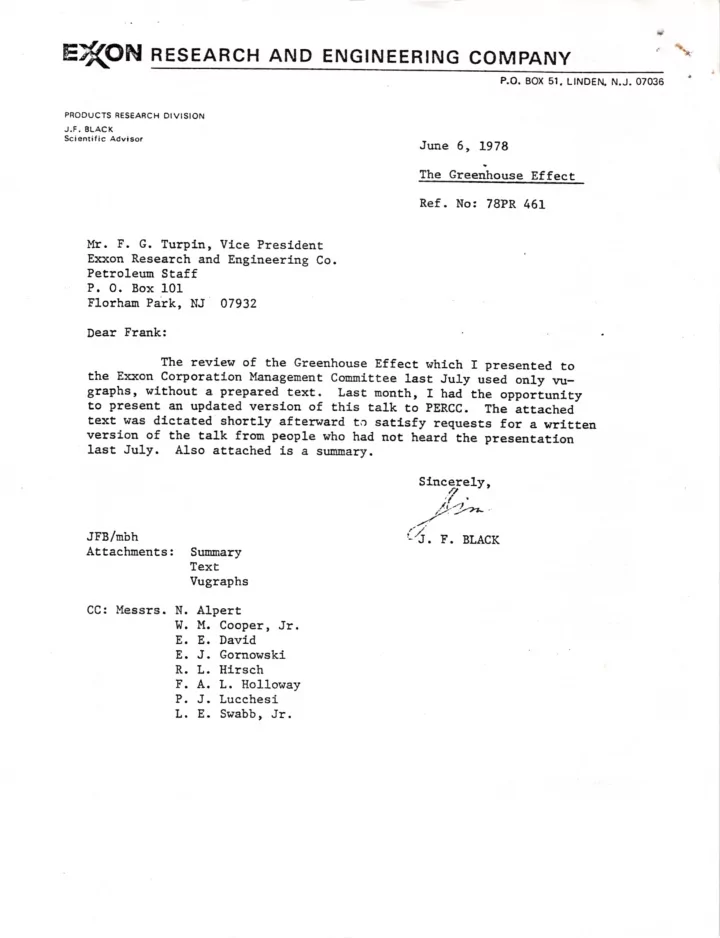
EKsN RESEARCH AND ENGINEERING COMPANY P.O. BOX 5r. LTNDEN N.J. 07036 PROOUCTS RESEAfi CH DI VISION J.F. ELACK Scientific Advisot Juue 6, 1978 The Greenhouse Effect Ref. No: 78pR 461 Mr. F. G. Turpin, Vlce President E:ocon Research and Engineerlng


slide-1
SLIDE 1

EKsN RESEARCH AND ENGINEERING COMPANY

P.O. BOX 5r. LTNDEN N.J. 07036

PROOUCTS RESEAfi CH DI VISION

J.F. ELACK Scientific Advisot

Juue 6, 1978 The Greenhouse Effect

  • Ref. No: 78pR 461
  • Mr. F. G. Turpin, Vlce President

E:ocon Research and Engineerlng Co.

Petroleun Staff

  • P. O. Box L01

Florhan Park, NJ 07932 Dear Frank: The review of the Greenhouse Effect which r presented. to

the E:oron Corporatlon Management congrittee last July used only rnr-

graphs, wLthout a prepared text. Last month, r had the opportunlty

to present an updated verslon of this talk to pERCC. The attached text was dlctated shortly afterward to satlsfy requests for a written

version of the talk from people who had not heard the presentation

last July. Also attached is a sunmary.

Slncerely,

//'-'"'-

{4. s. BLAcK

JFB/nrbh

Attachments: Sumrnary

Text

Vugraphs

CC: Messrs. N. Alpert

  • W. !f. Cooper, Jr.
  • E. E. David
  • E. J. Gornowski
  • R. L. Hlrsch
  • F. A. L. Holloway
  • P. J. Lucchesi
  • t. E. Swabb, Jr.
slide-2
SLIDE 2

THE GREENHOUSE EFFECT

  • J. F. Black, Products Research Dlvisidn

E:r:con Research and Engineerlag Co.

SI'MMARY

The earthts atmosphere presently contains about 330 pprn of CO2.

This gas does not absorb an appreciable amount of the incoming solar

energy but lt can absorb and return part of the lnfrared radiatlon whlch

the earth radiates toward space. COZ, therefore, contrlbutes to warming the lower atmosphere by what has been ca1led the rrGreenhouse Effect.r'

The C02 content of the atmosphere has been monltored slnce L957 at two Locations, the Mauna Loa Observatory, Hawaii and the South

  • PoIe. These and other shorter studies show that CO2 Ls increasing. If

the Lncrease is attributed to the combustion of fossil fuels, it can be

calcuLated that the CO2 content of the atmosphere has already been ral.sed by about 10 to L5% and that slightLy trore than half of the C02 released by fossil fueL combustion is remalning in the atmosphere.

Assuni.ng that the percentage of the CO2 renaining in the atmosphere rr111 stay at 532 as fossil fuel consumptlon Lncreases, one recent

study predicts that ln 2075 A.D., COZ concentratlon will peak at a Level about twLce what could be considered normal. This predictlon

assrrmes that fosstl fueL consumptlon will grorr at a rate of 27" per year

until 2025 A.D. after which lt wl1L follow a syuretrlcal decrease. This

growth curve is close to that predicted by Exxonrs Corporate Planning Departnent. Matheuatical uodels for predicting the clinatic effect of a

C02 lncrease have not progressed to the poi.nt at whieh all the feedback

interactlons which ean be lmportant to the outcome can be included. I,lhat is considered the best presently available climate model for treatlng the Greenhouse Effect predlcts that a doubling of the C02 concentratlon ln the atmosphere would produce a mean temperature increase of about

2"C to 3oC over most of the earth. The model also predicts that the temperature lncrease near the poJ-es may be t!f,o to three times this value. The CO2 increase rneasured to date is not capable of producing an effect large enough to be distlnguished from norual clinate variations. As an example of normal varl.ations, studies of meteorological and his-

torlcal records in England indlcate that the mean temperature has varied

  • ver a range of about t0.7oC ln the past 1000 years. A study of past

climates suggests that if the earth does become warmerrmore rainfall

should result. But an increase as large as 2"C would probably also

affect the dlstrlbutlon of the rainfall.

A possibl-e result night be a

shlft of both the desert and the fertile areas of the g1-obe toward higher l-atitudes. Some countries would benefit but others could have their

agricuJ-tural output reduced or destroyed. The picture is too unclear

to predict which countrles might be affected favorabJ-y or unfavorably.

slide-3
SLIDE 3
  • 2-

It seems 1lke1y that any general. tempetature increase would

be acceutuated ln the polar reglons, possibly as much as trro- or three- foLd as Eentl'oned above. Any large temperature increase at hlgh lati- tudes would be assoclated wlth a reductj.on in sno\r cover and a melting

  • f the floatlng lce-pack. Present thlnking suggests that there would

be llttle

  • r no neltlng of the polar ice-caps it re"porrse to rf,armer

temperatures on a tlme scale over which the Greenhouse Effect is pre-

dicted to apply.

A nurnber of assrmrptions and uncertairlties are iuvolved, ia

the predictlons of the Greenhouse Effect. The fLrst is the assunption

that the observed Co2 lncrease can be attributed eati.rel-y to fossil. fuel

  • coubustLon. At Presentr meteorol.ogists have no direct evldence that

the incremental C02 tn the atmosphere comes from fossil carbon. The

increase could be at least partly due to changes in the natural balance. There is eonsiderable uncertainty regarding what controls the exchange

  • f atuospheric Co2 wlth the oceans and with carbonaceous uaterlals on

the contlnents.

Models whlch predict the climatic effects of a CO2 lncrease

are in a prfurltlve stage of development. The atmosphere i.s a very com- p]-icated system, particuLarry on a global- scaLe. rn existlng models, lmportant lnteractions are neglected, ei.ther because they ar! not com-

pletely understood or because thelr proper roathematical treatment is too

  • cuobersome. Substantlal efforts are being expended to improve exlsting
  • models. But there is no guarantee that better knowleage wfU lessen

rather than auguent the severity of the predictions.

The Greenhouse Effect has been the subject of a number of

lnternatlonal sclentlflc conferences during the past two years. These

neetlngs have identified the infonoation needed to definitely establish

the source and ultlmate signiflcance of the C02 increase fn lne atmo-

  • sphere. Present thlnklng holds that man has a tlne window of five to

ten years before the need for hard decisions regarding changes in energy strategles might become critical.

The DOE is presentiy ""ekirrg Congrei-

sional supPort for a research program whieh will produce the necessary

inforrnatLon ln the required ti.ne. This proglam is deseribed.

slide-4
SLIDE 4

''

TIIE GREENHOUSE EFFECT

By

  • J. F. BI.ACK

Transcript of a Talk Delivered Sefore the PERCC MeetJ.ng

May L8, 1978

slide-5
SLIDE 5

The Greenhouse Effect refers to a warning of the earth's atEosphete due to an lncreage ln the concentlatlon of carbon dloxlde. As a background for the discusslon today, the first vugraph outlines

the basis for the Greenhouse Effect.

The earth recelves energy ln the fora of both v1s1b1e and

ultraviolet radlatlon fron the sun. soae of this radiatlon 1s reflected

back into space, soDe 1s absorbed by the atEosphere but nost ls ab- sorbed at the earthrs surface. Tte earth ln turns reeolts energy in

the form of lnfrared radlatlon toward space. Cerbon dloxlde and other

atEospherlc coostl.tuents absorb part of the Lnfrared radiatlon. Thls

abgorbed energy lrarus the atnosphere. Therefore, higher carbon dloxlde

concentratlons result ln a nore lapld absotptlon of the outgolng lnfra- red radl-atlon and waraer teDperatures near the earthrs surface. In Ey

talk today I am plannlng to dlscuss: I.

The Source aDd Projected Magnltude of the CO2

Increase ln the Atmosphere

II.

The Global Teupelsture Increase Which Can Be Expected Frou Hl.gher C02 Concentlatlons

III.

The Potentlal Problems Arlslng Froo a Global Tempera-

tule Increase

  • IV. Research Needed to Establlsh rhe Validlty and Si.gnlfi-

cance of Projected Increases of CO2 in the AtEosphere. My lnforrnatloa ls derlved fron followlng recent llterature iD thls area and froo talks lrlth some of the leadlng research people 1o the fleld.

L

The Solr"ce and Projected Magnltude of the CO? Increase in the Atnosphere Slnee 1958, C02 has been uonitored at a nr:ober of reDote eltes

nhleh are ftee froo locsl Lnputs (Vugraph 2), These are polnt Ba!ror,, Alaska; so'e Snedlsh alrcraft fllghts; Mauna Loa, Eawali; Aoerican Samoa

end the South Po1e. Ttre calbon dloxlde concentratlon has been for:nd to be increaslng rather uulforroly at all loca!1ons wlth the South pole

measureDents rathe! lagglng those lD the Notthern l{eulsphere.

AtDospherlc dcientists generally attrlbute thls grovth in C02

to the coDbustlon of fossll fue1. A prlnclpal reaeon for this Ls that fossll fuel coEbustlon ls the only readlly ldentlflable gource whlch ls (1) growlng at the 6ase tat.e, (2) large enough !o account for the ob-

eerved lncreases, and (3) capable of affectlng the Northera tseolsphele

flrst. If thls assulaptlon regardlng the orlgln of carbon dloxlde 1s

slide-6
SLIDE 6
  • t
  • t!ue, it ean be calculated that a lIttle over 502 of the CO2 enterlng

the ataosphere 1s reoalning thele and the rest ls belng absorbed ln aurface slnks on the contineDts or ln the oceao. ExtrapoletLag back- nerds ln tlne to fo1low the history of fossl1 fuel corobuetlon, lt can

be estlDated that slnce 1850 the coacentratloo of this gas ln the

atEosphere has lncreased by about 132. Thls iacrease sDounts to

about 75 bl111on netrlc tona of carbon dloxlde.

It ls also posslble to extlapolate lnto the future. One of

the Dost cormonly guoted exttapolatlons is that-of the oak Rldge Natlonal Laboratory whlch was publlshed in 1976r. Thls study pro-

duced two scenarlos for the grorrth of fossil fuel coasrnptlorr (Vu- graph 3). Prior Eo 1973, fossl1 fuel use had beea growf.ng exponentlally

at about 4.37. pet yeat. The scenarlo for nost rapld growth as€rned that this gronth rate nould coutlaue, Eodlfled by a depletlon factor whlch re-

duced the exponent ln proportlon to the aoount of foesll fuel whlch temalned unburned. Thel! second end uore cooselvative assuaption pre- suaed ihat fosel1 fuel utllLzatlon would grow wlth a 2Z grolrth late out

to 2025 A.D. follolred by a srtetrlcal decrease. Ttrls latter Ecenario is

cloae to that developed indepeadently by the CoordlDatlon and Plaanlng

DepartEent of the E:o(on Corporatlon. Vugraph 4 plesents the predicted atuospherlc carbon dioxlde

1eve1s whlch would result from each of these scenarlos. The vertical

axls in thls vuglaph preseuts the atuospherLc carbon dloxlde concentla-

tlon lelat1ve to that shlch was calculated to have exlsted ln 1850, prlor to the corobu8tlon of appreclable anounts of fossll fuel. It can be seen that the acenarlo baeed upon very rapid gronth pledictE thst by 2075 the

atDosphellc carbon dloxlde concentretlon w111 be about 4 to 5 tlDes that

whLch exlEted prlor to the lndustrlal revolution. Moreover, at that

tLne, the carbon dloxlde concentratloa ry'111 sti11 be Lncreasing. The

Dore conservatlve assunptlon, showtr ilr the lol'e! curve, predicts that carbon dloxlde concentratlons \ri1l level out about a century frm now

at a value shlch 1s about tlrice that ln exlstence ln 1850 and then nould

declLne at a very s1o!r !ste. Although carbon dloxlde Lnclease is predomlnantly attrlbuted

to foss11 fuel conbustlon, lo8t sclentlEts agree that more research ls

needed !o deflnltely establlsh thls relatlonshlp. The posslbillty rhat Ehe lncleasfng carbon dloxlde ln the atnosphere Ls due to a change lfl

the natural balance ha6 aot yet beeD ellelnated. In fact, a look at the Eagnltude of the aatural lnterchanges, as shovn 1n Vugtaph 5, shows

that thls posslbillty should be taken Berlously.

The data 1n Vugraph 5 are taken floD a Scientlflc Workshop on Atmospherlc C02 spouaored by the World Meteorologlcal Organizatlon Ln Deceober 1976. The vugraph sho\rs the fluxeg of CO2 lnto and out of the atnosphe"e 1n un1t6 of blll1ons of netlic tons of -arbon per year. It

slide-7
SLIDE 7
  • 3-

can be aeen that fossll fuels are estlnated to contrlbute flve b1l11oa

tons of catbon per yea! to the atnosphere aDd that about half of thls 1s reabsorbed by the oceans or by the biosphere. The concluslon that

fossll fuel coabustlon represents the sole source of lncreaental carbon

dloxlde involves assr:olng not only that the contrlbutions fron the b1o_

sphere and flou che oceans are not changlng but also that these tlro soulces are coDtlnulng to absorb exactly the aame aEount as they are

  • enlttlnS. The World Meteorologlcal Organizatlon recognlzed the Deed

to valldate these assulrptlons, paltlcuiarly 1n vlew of the fact that

the rate of earbon dloxlde Lncrlase ".pr.".rrt" less than ZZ ot tii- -

rale at lrh1ch the atnosphere 1s exchanglng carbon dloxlde lrlth the

biosphere and the oceans.

  • The blologlsts have been clalnlng that deforestatlon and

assoclated blogenlc effects on the contln.it" ,.p.es"ot an lEportant

lnput of carbou dloxlde to the atmosphere. Vuglaph 6 s,,"'r,"112Es glE results f!o!_ recent papers by a nr.rnblr of biologlsts on the conEribu_ rlon of rhe bio.phere to rhe grorrrh of Co2 1n rie atuospher" -;i;;i;. to the contrlburlon of fossll fuel coubusilon, thetr esttoat;;l;;--

thls rarlo are presented ln the flrst columr. rn Apr1l ot igii,-ai"r"2

estlnated that the ratlo of the lrelght of carbon fron net ,nooa trrrl.J-

to the erelght of carboo frou fosEil fuel burned ln thls """t"ry-i""-- *:l_1.-1:,"::,0:-1 :"!. nay have approaehed 1.0. rrre fouonrng io;ii,

  • or:.nJ cralued that the increase 1n carbon dioxlde due to th! expani

sion of folestly and agricuJ.ture nas at least half that due to il""

f111- lonUust fo1r. In Augusr of 1977, rhe Natlonal Acadeey of Scfeic.s

lssued a report+ whlch attrlbuted the Greenhouse Effect to foss11 fuel coEbustlon and whlch recelved a considerable aoount of sensetlonal

  • publlclty. Thls has produced a rash of papers by rhe blol;;i;;;lo

support thelr posltlon. In January of this year, IloodweliS-""J-.-- lr:mber of other authors froo acadealc and oceanographic ccnters !ub_

llshed a paper claiulng that the terrestrlal blomass appears to be a net source of carbon dloxlde for the atnosphere whlch is po""itfy- - greater then that due to fossil fuel con-bustlon. the foliowln!1eek,

Stulver6 publlshed resulrs r.".a-"po"-if57ii2-i"aro" whlch reported

thet the net release of carbon dloxlde froa the blosphere 1n ihe

ceutury prl0r to 1950 was tvice as great as that f!o; foss1l fuel coo_

  • bustlon. Even Lf 1t ls assumed thai the blospherLc release "aopp.J-L

1950, the contllbutlon of the blosphere up to the present tfr" ,o,ria

stlll be 1.2 thar fron fossll fue1. t"tre iast four' arrlcles'ii"i-i- 1,fl.-:9.:.3.yere.atl published 1n Sclence. ra the present DoDrh,

w1J-son, pubushed an artlcle 1n Nature whlch sugportE the elaln ihat

defolestatlon ha6 produced at least half as uuch carbon dloxlde in the atDosphere as can be attllbuted to foss1l fuel.

Non, you ldlI reDeEbe! that eerller 1n this talk lt rras polnted

  • ut that 1f the lncrease ln catbon dl0xlde in the at'osphere ls arr" to-

fossil fuel conbustlon, about 502 of the CO2 belng released remalns ln

the atoosphere and the rest 1s absorbed 1n llther the oceans or the co'-

  • tlnents. If thete have been substaDtlal releases of carbon dloxlde ln

addltion to that whlch can be attllbuted to foss11 fuels, the natural

slide-8
SLIDE 8
  • 4-

slnks for carbon dloxlde Dust be larger and aore efflclent than pre_ viously esthated. Thlg would reduce the levels to whlch carbon dl_

  • xlde has been proJected- to r.nctease. ?hls posslblllty 1s veheoe'tly

denled by the oceanographers, who cla!.D thet the oceans cannot posslbiy absorb nuch nore carbon dloxlde. Hovever, lt 16 Ey lmpreeslon that

the scleDce of oceaooglaphy has Dot a6 yet reached a slate of develop_

Eent lrhlch can Justl.fy such a posltlve claln. The culaetrt atatus of gclentlflc opLnion regardlng the carbon

cycle ls sur@allzed ln Vugraph 7. First, curreut sctinttttc oplnlon

  • verwhelnlngly favore attrlbutlng at'ospheric carbon dloxlde lncrease

to fo6s11 fuel coobustlou. Holrever, Dost scientlats feel that r0ore

research 1e needed to Bupport an unquallfled concluelon. Flna11y, soue

aclentlats, partlculerly the blologlEts, clalm that part or all ti tne

co2 lncrease arlses fron the destructloo of folests and othe! land b1ota.

II.

Pledlctlons on the slgaiflcances of lncreases ln atmospheric

C02 rust be based upon clLEete oodellng. Modellng cliDatlc effeits ls

currently haadlcapped by an 1nab1llty to hsndle all the coDpllcated lEter-

actlons whlch are lmportant to pledlctlng ghe cllEate. Soo! of these are sholrn in Vugraph 8.

One iDteracrlon whlch ha6 not has yet been lncluded wlth any

degree of sophlstlcatloo ln cll'ate nodels le the effect of eloudlness.

clouds can reflect lneoalng vlslble aad ultravlolet radlatlon back into

space lrlth greater efflclency than would occur at the glound. On the

  • ther hand' at thelr bottom surface they absorb outgolng radiatl0u aod

the cloud tops also ealt lnftared radlatlor\ dependlng uton the teEpela-

ture (that 1s altltude) at lrhlch the top 1s'located. fhe effect oi a

cloud n111 thelefore depeod upon its slze, 1ts shepe, and the altltude

at lrhlch lt ls loceted

Another uncertalnty whlch has not, as yet, been handled ln any

gleat deta1I ls the atDosphere - oceau clrculatlon - aea Burface teDpela- ture lnteractlon. Eow should the heat capaclty of the oceans be handled

1n vlev of the turbulence at the surface aod to whet depths are the oceans

lnvolved ln lnteractlDg nlth the etooBphere? TheEe are laportant que6-

tlons because the etrtlre heat content of the atDosphere t"s equal to the

heet content of Just lhe fl:ist thlee Deters of the oceans. A third un-

certalnty ln rnodellog ls the iotelactlon betweeE the seasons and long- terE cllmate treods. Ia present oodele, the ehaages vhlch are pre- dlcted for lncreaslng carbon dloxLde concentratlons are calculaled wlth

legpect to a constant clLDate, that is a perpetual epring or sumer

  • seaaotr. It ls quite posslble thet thls assl@ptlon 1s luadequate. lor

example, the best accepted explanatlon for the on-set of the Lce ages

ls that orbltal and other changes resulE in the earth euteling a plrlod

slide-9
SLIDE 9
  • 5-

ln whlch 6u@ers are coore! and vlnters are lrar'er than no'-al. Thus , thls produces uore preclpltation and faster glacier grolrth durr'g the

wlnter and less Eelliog duling the srr@e!,

Flnally, a serlous questlon has been ralsed as to lrhether

c1fuate 1s really predlctable. Thls posslblllty nas ralsed by LorenzS

1n 1970. He drew an aaalogy to eathenatlcal oodellng. Many BatheDatl_

cal oodels of coropllcated phenonena are based upon a large nruber of noa-llaear equatlons .olth a varlety of cmplex feedback interactlons,

If the l[ath$atlcLan ls fortunate, when a model of thls type ls run on

the couputet, {t rr111 converge and glve hfu a deflalt,e .rri".r.

Such a

Dodel ls called transltlve. On the other hand, when a couplicated

nodel 1s tested, 1t ls not at aIl unusual to flnd that the solutlon

v111 trot converge but w111 oscillate back and forth vlthout produclng

a stable aasner. Such a nodel is ca11ed 1ntlansltlve. There 1s alio

an lDterredlate co[dltlon. occasloually, a nodel Ls found to converge

lnltla11y upon a deflnlte a!.s!rer but after a sholt perlod to 1,,,t ofi

thls solutlon aad settle down upon anocher one. Aflet a E.coid io_ definite perLod, lt will J rnp up and couverge agaln upon a thlrd solu_ tlon and eo on produclng a nr:mber of appalent solutlons 1n a randou

  • DaDner. Such a mdel 1s ca11ed alnost transitlve (or alDost lntran_

sltlve). Lorenz polnted out that the cll.sate ls a systeE whLch is the

result of a 1a!ge number of non-lLnear energy lnputs betlreea whlch there

are l0any corDpllcated feedback lnteractlons. He therefole Euggested that the cllnate nay be a natula1 exauple of an alEoat tlansltlve ;ysten whlch does not heve a stable solut1on. It !1111 settle dorrn lnto an apparently stable condltion but then after a randou perlod w111 J uEp over

to a[other apparent stabillty, etc.

It ls not certain, hovever, that such a pesslmlgtlc outlook

16 Justlfied and lt has not stopped the development of uany roodels of

the Creenhouse Effect and other cllnate phenoEena. The sluplest of

these are the one-diDenslonal oodels in whlch the Ltrput at the earthrs gurface ls averaged over the globe and detalled caleulatloas are earrled

  • ut to predlct veltlcal verlatlons. such nodels.do not requile uuch con-

puter t lae and can lnclude detailed treatDent of vertlcal jheumena such

as radlatlve transfer. They suffer, however, flou the fact that the

lnfluence of latltudlnal varlatlons 1s corpletely lgnored.

The next roore coupllcated oodele are so-called zonally avereged uodele Ln shlch varlous latltude reglon€ are treated separately

ln e trro-dlDensional oanirer. These take nore co!0puter tlae but are stil1

Bhort enough to per:E1t conslderable sophlstlcatLon ln the calculatLoos.

They Eti1l suffer, however, from an lacomplete treatl0ent of letltudlnal

  • lntelactlons. In 6plte of thls, oany nodelers feel that they are the

nost valuable type of aodel upon which to work,

The nost c@plicated models are the so-called general circu-

latlon nodels rhlch are three-dlaenslonal 1n character. These take

very long tlnes to c@pute snd the ratlo of real to mschlne tlme can
slide-10
SLIDE 10
  • 6-

be as low as 10 to 1. A great deal of the coEputer tlne ls spent ln uovlng large masses of alr around the globe and recalculatlng the enyoptlc proflles every 10 to 15 Dlnutes. Thelr Edvantage ls that latl-

tudl.nal effects ele coupletely lncluded but the sophlstlcstlon rlth vhlch vertlcal effects ean be treated ls ll.mlted due to the tlme and

e:<penge aEsoclated lrlth runDfug the Eodel. One of the best geDela1 clrculation uodels of the Greenhouse

Effect, and the one whlch ls Dost frequently quoted" ls that developed by

Manabe end Wetherald9. Thelr predlctlons for the eliEatlc effect of a

doubllng of C02 are ptesented in Vugraph 9. Thls vugraph predicts rhar a doubllng of the aEnospherlc C02 conceDtratlon would produce a tenpera-

tule rise at lolrer eltltudes and a temperatule decrease above twenly

  • kiloDeters. At the surfsce the teuperature !1se would be ebout 2 to 3oC

from the equator up to about 600 latltude, with a Euch greater increase predlcted for the poles, The larger lnerease at the poles results froa two effects. Fllst, vertlcal nlxlng at the poles 1s reduced due to a

natursl decreese ln the helght of the lnversion layer ln these reglons,

Second, the Eodel contalns a teuperature - lce and snow cover - reflec-

tlvity lnteractlon by which lncreages in etDospherLc teDperature uelt

the snolr and lee cover and reduce the aoount of heat reflecled back

lnto sPace. SlDpllflcatlons lDcolporated ln this nodel include fixed

cloudlnese, a ttswa&p t' ocean which has zero heat capaclly, and ldealLzed treatDent of the topography. The oodel also contalns a siupllfled treatDent of the lnfraled ladiatlon tranEfer ln the atmosphere. In a separate calculatlon, l,taoabel0 calculated that the use of a nore sophls-

ticated trealuent, developed by Rodgers ead Walshawfl, would reduce the

indlcated teDpelature lncreases at the 6urface by about 0.5"C. Ia the

11ght of this and other Dodels, 1t Ls genela11y accepted by cllDatologlsts

that a doubllng of the carbon dloxlde concenttatl.on ln the at8osphere

would produce fron 1.5oC-3.0"C wanolng at the eerth's sulface ln the lower and Eld-latltudes nith about 2 to 3 tl8es greater effect at the poles. The next nalural questlon ls the slgniflcance of such a tem-

perature tlse copared to the oagnltude of lhe Batural teEperatule changes

whlch have been obsenred to occur ln the pagt. A conparlson lrlth respect

to hl.sto!1cal teoperatule changes sloce 185O accordlng to Kelloggl2, is

presenEed 1a Vugraph 10. In thls fLgurq the observed oeen Northern Heolsphere teEperature ls plotted as the soIld l1ne. It can be seen

that thls has varled less than iloc over the last century. The extrapo- latlons past 1977 reeult from the appllcetlon of llanabe and Wetherald I s

nodelv wlth the aesroptloo that the earbon dloxlde leve1s w111 double

by 2050 A.D. The 1olrer dashed 11ne ln the flgure represents an estlDate

  • f nhat the recent teEperatule tleDds nould have been lf the CO2 lncrease

had not occurred.

slide-11
SLIDE 11
  • 7-

The slgolflcance of a teDperature 1nclease of the aagnitude

pledlcted by l.lanabe and Wetherald wlth respect to the long tero record

  • f clLaate 1s presented ln Vugraph 11 whlch was prepared by M1tche1113.

lhls flgure sholrs lhat the expected temperaiure lncrease would be large

even cmpared to lhe teEperatules at the tlne of the last intelg1aclal.

As thls tenperature Lncrease decayed, however, lt would replesent an

aoelloration of an expected natural coollng trend.

III.

The Potentlal Probleus Arlslng froa a Globa1 Teoperature Increase

fhe lEpllcatlons arlslng froa l'lanabe and ldetherald's predic- tlous fo! the teoperature effects resultlng fron a doubllng of carbon dloxlde concentrallons ln tbe atuosphere are outllned ln Vugraph 12.

It appears falrly certain that 1f the hlgh lncreaseg they predl.ct in

Ehe pola! reglons do occur, the perEanent 6no!r cove! and floatlug sea

lce wtl1 be reduced or posslbly ellDlnated. Thls w1ll have a negliglble

effect on sea 1eveJ., horrever, slnce the gnon cove! does not represent an

appreclable aaou8t of water and the floatlDg lce ls already 1n equili- brlum r'1th lhe sea. Thele lr11l probably be no effect on the polar lce sheets. These

are thlee Ln nu&ber. The Greenland lce sheet ln the Northero Uenlsphele

represents an anount of nater equlvalent to a flve eeter rlse 1n sea

  • 1eve1. If the floatlng sea ice Ls reuoved, the creenland ice cap would

be surrounded by water. Ttris nlght produce lncreased precipl.tation and

actually result ln the gronth of thls lce Eheet.

The worldrs largest 1ce sheet ls the East Antalctic Eheet lrhlch

contalns vater equlvalent to a rlse of 70 Deters ln the worldrs oceaDg.

It is eetlnated that the teEperature effecls produced by doublltrg the

atmosphellc C02 concentratlon nould not sffect thls vely large glacler and that lt too rdght lncreage 1n slze. The erea on vhleh oost uncertalnty exlsts ls nith lespect to

the West Antarctlc lce sheet. The nate! Ln thls glacler ls equivalent

to about e seven Deter rlse ln the worldt6 oceans. The West Anlalctlc

1ce sheet extends out ove! the ocean f1oor. I{arnet ocears Dlght result 1n aD lntru61on of the ocean waters underaeaih thls Lce sheet and a decrease ln 1ts slze nlght occur. If thls happens, an oceaaic rlse

  • f sone ftactlon of the Eaxleua aaount (7 Detels) Dighr take place.

Wllh a lraaer cllnate around the world, it seens falrly certaln

that preclpltatlon rould lncrease. 0n a g1obal basls, thls should re-

sult ln e lengthenLng of the grovLng season. Glolrlug seasona are eati-

lrated to increase about ten days for each loC rlse 1o teoperature.

The ehauglng preclpltatlon patterns, however, lrould beneflt soue arees end nould harm others. It ls not poss1b1e, on the basls of

present lnforratlor., to predlct Just where these effects would occur.

As a fllst e6tLuete, one nlght say that the cllDatlc zones 1n the lrorld would nove nolthwafd, The effect of thls on the agriculture of the U,S. and RuseLa 16 ludlcated ln Vugraph 13.

slide-12
SLIDE 12
  • 8-

The broadenlng of the equatorlal reSlons Dlght result ln a

northnald Elgratlon of the deBert areas ln the Uolted States. Qur present con and sheat belts would also nove uolthwerd and Elgrate

lnto canada. It csn be eeen that Russla, lft1ch ls lndlcated by the

cloesed hatched aree, lies conelderably farthe! oorth than does the

unlted Stetes. The very dark areas lodlcate the agllcultura1 reglons

  • f Russla. If cllsatic zones Elgrate aorthrtsrd, the Russlatrs have

plenty of roolr to adopt to the change. Even those nations shlch are favored, howeve!, would be dauaged for a whl1e slnce thei! agrlcultural

end induEtrlal patterns have been establlshed on the bals of the present c1lmate.

rv.

The Creenhouee Effect haE been attracthg a large asouat of

sclentlflc ettentloa. Sone of the Eore Loportent recent Deetlngs on thls eubject are ptesented ln Vugraph 14. The llorld lleteorologlcal

Organlzatloa held I sclentlflc workshop oo atnosPherlc CO2 ln WaEhlngtou ' DC, ln Deceob et !976. ERDA held a workshop ou the Envllonnental Effect

  • f C02 from Foesll !ue1 Corbustlon at Mlaal la March of L977, Thls Deet-

lDg rras organlzed by thelr Advl.sory co@lttee for research on the Green-

trouse Effect, the Chalnoan of which 1s Dr. Alvln Welnberg. DOErs present

research effort on the G:eenhouse Effect is a dlrect result of thls

workshop end I !1111 be saylng Eore about thelr ProglaD late!.

SCOPE

(Standlng Cofiolttee on the Planetary EnvlronmeDt), a l{est European organl-

zation, held a workshop on the world carbon budget in l'larch of 1977 ln

Haoburg, Gernany. The most recent DaJor Beetlng !ta6 that organlzed Ln

luxenburg, Austrla, thls Past february by IIASA (Interoatlonal Instltute

for Applled SysteEs Analysls) for the lJor1d Meteorologlcal organlzatlon,

the U.N. Co@1ttee on the EnvllonDeut and SCoPE.

Ttre concluslons frql thls last oeetlng srnnarLze the present

vorld selentlflc oplulon lrtth lesPect to the Greenhouse Effect. The

IIASA ueetlng ras organLzed lnlo three worklng grouPs. Sone of the lore

slgnlfleant recmendatlons of these wotklng groups are Presented ln

Vugraph 15. The worklng group on the cetbon cycle concluded that sclentlflc

confidence Ln oodels of that cycle 1s conslderably less than lt nas ten

yeals ago. Ilhat 1s necessery to ln8tl11 greater coufl'dence is to Pro- vlde a better underetaoding of the flux floD the biosphere as rePorted by the bj.ologlets. The worklng group also recomended that Dore lnforma-

tlon be obtalned on the jtterchange of CO2 lnto the ocean and holt lt

18 transported to greate! depthE.

lhe Eecond worklng grouP' on the clLuatlc lupact of a doubling

  • f COL, reached concluElons cloee to those whlch have been sr:noarlzed

1n the present ra1k. They felt thae a doubllng of ataospherlc carbon

dloxlde vould produce a 2-3 degree centlgrade lncrease 1n tenperature

depending upon the lnfluence of clouds.

slide-13
SLIDE 13
  • 9-

The thlrd lrorking group lyes concerned rrlth the lapact of Ehe Gteenhouse Effect on eoergy slrategles. They reco@ended that -Ean can

afford a 5-10 yr. tLoe !'lndow to establlsh the val.ldlty and algnlficance

  • f rhe Greenhouse Effect. They sald that lt is preaature to tlllt

the use of fos811 fuele at plesent but that thelr u6e should not be en-

couraged . ihls group went on to rec@end nore research and greater

effort on the developDent of enelgy aoulces lrh1ch vould not resul! ln

C02 release.

The DOE bas lnltlated a EaJo! research plogt:lD on the Creeo- house Effect unde! lhe leadershlp of Davld Slade. Detalled recomenda-

tlons for this effort have been prepared by an Advlsory Corollttee. The6e

reco@endatlons nould have the DOE reseelch progran concentrate prlncl- pa11y upor obtalalng better lnfotuallon. legErdlng the carbon eycle

nhile research on cllllatic effects, lncludlng clitate roodeling, rould

be left up NOAA. Slx prograns for research on the calbou cycle are being recomended f or lmedLate fundlng . These are presented ln order of

prlorlty 1n Vugraph 15.

Thls l@edlete prograe nould cost $1.56 I6i 1n the flrst year

attd lrould soon grolr to about $10 MM per year. lhe prograo to recelve

highest priorlty, le obtalnlng 4 better estlBate of fossl1 fuel C02 out-

  • put. fhls nould lnvolve a worldwlde study of how fosel1 fuel coabus-

tlon Blght be expected to increaae and what would I1alt this Lncrease

ln both the under-developed aad developed countrles. The second ploject lelates to the use of carbon i.sotopes to obtala a better estfuate of

the lrlput of carbon dloxlde fron the blosphere. It ls hoped that

CL3 /cI2 ratlos as well as cL4 /cLz ratios ;atr be used for thls purpose.

Ttle thlrd project 16 to obtah a direct essesa&ent of the blosphere lnput by observlng the grolrth or depletlon of vegetated areae around the world fron the Landstat satellltes. ltigh resolutlon radar and aer1al photography w111 probably be requlred in s@e lnstances to

ldentlfy vegetetlon types. The global vegetatlon oap provlded by these

Dethod6 would be u6ed to ldeotlfy sample areas for 1) further analysls

uslng photographs of hlgher resolutlon and 2) ground velldatlon of vegetatlon aad eoll type to deflne the relatlonehlp betweea lnage

cheracterlstlcs and deslred grouud lufonnatlon. TIJo hundled to a

thousaud such areas would be ldentlfled and would be resurveyed at

2 to 5 year lntervals 1n a proglan whlch vould be expected to be able

to detect e 2Z chenge 1n the vegecatlon. Thls 1€ an expeoelve prog!:ro

and would requlle about 93 !1M per year lthen 1t is runnlng 1u ful1 fotce. The fourth project ls to expand and lmprove the carbon dloxlde

aonltorlng Decvork. Thls would lnvolve addlug 10 to 15 addltlonel noaltorlag statlons at suitably leloote areas and expandlng the lnstru-

lentatlon at all statlons so that Lt could detemlne carbon tsotope

ratlos .

slide-14
SLIDE 14
  • 10-

The flfth proJect ls !o obtaln better lnforuatlon on Bhe traas-

fer of carbon dloxlde froo surface lraters Lnto the deeper ocean. Thls

would lnvolve uot ooly studies of C02 but also of tracers 6uch as trltium, he1fi:o-3 and radlocarboa. Thls would tequlre teEearch wlth oceanographlc

shlps and, when conpletely under way, would cost about $5 W/year. The

last of the hlgh prlorlty programs fo! 1@edlate fuudlng is to obtaln

better lnforEetlon on the buffering of C02 absorptlon Ln the ocean. After the 1nlt1al ptoglaDs are uoder !ray, the Advlsory Coe- Elttee 1s recmendlng that an addltlonal effort Lovolvlug seven Dore

proglao6 be establlshed. These are l1sted, tn order of prlorlty, ln

Vugraph 17. The ent1re proglao nouLd cost 91.26 loi l.tr th€ plaonl.ng phase and would rlse to $5 MM/year when under !ray. The flrst ltem 1n thls prograD, and the aeventh ln the overall

prlorlty list, 1s to deternlne lrhether shallos lrate! calbonates are dls-

solvlug because of C02 1evels. The secoad lteE rrould be to obtaln a

better estlDate of the lesponse of the blota as a slok for addltlonel

carbon dloxlde. The thlrd ln thls program is to develop better models

fo! the carbon cycle. Although nodellng is en extreDely tmportant

undertaklng, 1t 1s pleced n1trth on the overall 1lst because lnforDatlon

flon the earller pro8lans ls needed for bette! nodel developuent.

Iteo nuober teD reco@ends a study and a better deflnltlon of the late of cErbon dloxlde exchange actoss the lnterface befireen the air

and the ocean. The next project would be to study the flux of organlc carbon lnto and rrlthln the eea. IteD number twelve 1s to develop lo- proved carbon dloxlde Deaauleuent technlques, rhl1e the floal lteu on

thls 1lst iB to study the dlssolutloa of deep sea calciuo carbonate aE

a final slak for etDospherlc carbon dloxl.de.

  • V. Suppary

A euuoary of rny talk 1s presented ln Vugraph 18. In the filst

place' there 1s geoeral eclentlflc agreement that the Eost 1lkely nanner

ln whlch oaukiad ia lnfluetrclng the global cllsate ls through earbon

dloxlde release floa the buralag of fossll fuels. A doubllng of earbon dloxlde 16 egtlaated to be eapable of lacreaslng the average global ten- perature by fron 10 to 3oC, wlth a 10"C rlse predlcted at the poles. More

research i.B needed, howeve!, to estab116h the va11d1ty and signiflcance

  • f predlctlons wlth respect to the Greeahouse Effect. It ls eurrently

estlDated that Danklad hes a 5-10 yt. tfue wlndov to obtaln the neces- sery lnf omatlon. A nal or research effort ln lhls area is belng con- sldered by the U.S. Departnent of Eoergy.

slide-15
SLIDE 15
  • 11 -

BIBLIOGM?IIY

  • 1. The Global Carbon Dloxlde Problem, 0RNL-5194, C. F. Baes, Jr.,

H.. E. Goeller, J. S. 0l-son and R. M. Rotty: Oak Rldge National

Laboratory, August L976.

  • 2. J. A. S. Adams, M. S. M. llantovani, and L. L. Lundell: Scfence,

196, 54, ApriJ. I-, L977.

  • 3. Bert Bolln: Sclence, 196, 613, May 6, L977.
  • 4. Energy and Climate, National Academy of Sciences, Washlngton, DC,

L977.

  • 5. G. M. WoodwelL, R. H. I{hittaker, W. A. Reiners, G. E. Likens,
  • C. C. Delwlche and D. B. Borkla: Science, €,

141, January 13, 1978.

  • 6. Minze Stuiver: Science, !!!,

253, Jaur:ary 20, 1978.

  • 7. A. T. Wllson: Nature, 273, 40, May 4, L978.
  • 8. E. N. Loreaz: J. Appl, Meteorol., 9, 3251 1970
  • 9. Syukuro llanabe and Richard T. Wetherald: J. Atoospherie Sciences,

32, 3, January 1975.

  • 10. Syukuro Manabe: Manfs Impact on Cl{mate, W. 11. Matthews, W. W. Kellogg,

and G. D. Robinson, Eds, The MIT Press, 256, 1971.

  • 11. C. D. Rodgers and C. D. Walshaw: Quart. J. Roy. Meteor. Soc.r 92,

67, Lg66

  • 12. W. W. Kellogg, Effects of lluoan Activltles on Global Cllnate, Report

to the Executlve Coumlttee, Panel of Experts on Cllmatic Change,

I{orld Meteorologlcal Organization, Feb . L977;

  • 13. J. Murray Mltchel-L, Jr.:

Envlronmental Data Servlee, NOAA, March L977.

slide-16
SLIDE 16

THE GREENHOUSE EFFECT

J.

  • F. BLACK

TALK BEFORE

PERCC IVIEETING

t'lAY 18, 1978

slide-17
SLIDE 17

VI,GRAPII 1

BASIS FOR THE GREENHOUSE EFFECT

  • I. EARTH RECEIVES VISIBLE & UV RADIATION FROTI SUN
  • A. Some Reflected lnto Space
  • B. Some Absorbed By Atmosphere
  • C. Most Absorbed At Earth's Surface
  • II. EARTH EM|TS INFRARED RADIATION TOWAFD SPACE
  • A. Carbon Dioxide And Other Atmospheric Constituents Absorb Part Ol The

Infrared Radiation

  • B. Absorbed Energy Warms The Atmosphere
  • lll. THEBEFORE HIGHER COr CONCENTRATIONS wARtl THE tOwER

ATMOSPHEFE

slide-18
SLIDE 18

VI,GRAPI{ 2

CO2 MEASURED AT REMOTE SITES

^ 328

trj =

3 sze

  • > 324

(D

z

g 32?

  • t

J

3 leo

E

H 3rB

a

F

E 316

(L

*.

314

  • (J

312

a

  • I

6

Foinl Borrow

Swedish Flighls Mouno Loo Americon Somoo

Soulh Pole

f958 t960 1962 1964 1966 1968 1970 1972 1974 1976

slide-19
SLIDE 19

WGRAPH 3

POSSIELE LIMITING SCENARIOS FOR THE USE OF FOSSIL FUELS

28.O 24.O

d.*

20.o r6.o

t2.o

'5

C'

  • E,

€t

,;

  • E

3

lr,

a

l J

lr,

f, l! J

fr

(/)

B E

l^,

F

(E

8:

"""

e'ddu8d

d

@ o.3"zo GRowrH RATE TIMES

DEPLETION FACTOR (eq. lll

2% GROWTH RATE TO 2025

FOLLOWED 8Y SYMMETRICAL DECREASE

YEAR

pddd

slide-20
SLIDE 20

WGRAPH 4

PROJECTED ATiIOSPHERIC GOz CONCENTRATIONS RELATIVE TO 1860

6.0

z

  • tr 5.0

(r

F

Gt 4'o

  • z
  • to, 3.0
  • I

(f

UJ

il 2.o

U)

  • F

UJ

tr

J

ul

(f

1.0

1975 1 995

201 5

2035 2055 2075

YEAR

slide-21
SLIDE 21

WGRAPH 5

COr EXCHANGE

(Bllllon$ Of Tons Ol Carbon Per Year)

BIOSPHERE ON CONTINENTS

slide-22
SLIDE 22

WGRAPII 6

RATIo 0F C02 DERIVED FR0t'l BIOSPHERE VS FOSSIL FUEL

DATE

RATIO

0,1-1,0

0,5

0,g-1,6(1) 2,0(2)

0,5

(1) PRESENT

lsr AUTHOR

ADAI'IS

BOLIN

}{OOD}IELL STUVIER hlILSON RATE JOURNAL SCIENCE SCIENCE SCIENCE SCIENCE NATURE

Q) 1850-1950

q/u77

5/6/77 LlT3/78 Ll19/78 5/4/78

slide-23
SLIDE 23

WGRAPH 7

CURRENT STATUS OF SCIENTIFIC OPINION

  • l. Current Opinion Overwhelmingly Favors

Atlributing Atmospheric COz lncrease To Fossil Fuel Combuslion

  • ll. Most Scientists Feel More Research ls

Needed To Support An Unquaftlied Conclusion

  • lll. Some Scientists Claim That Part Or All Of The COz Increase

Arises From The Destruction Of Forests And Other Land Biota.

slide-24
SLIDE 24

WGRAPH 8

UNCERTAINTIES WHICH LIMIT CLIiIATE MODELING

  • I. CLOUDINESS
  • A. Effect Ol A Cloud Depends On Size, Shape and Position.
  • II. ATTIOSPHERE - OCEAN INTERACTIONS
  • A. How Should Heat Capacity Be Handled
  • B. To What Depth ls The Ocean lnvolved
  • III. THE INTERACTION BETWEEN SEASONS AND LOI{G TERM TRENDS
  • IV. IS CLIIIATE REALLY PREDICTABLE
  • A. Could Be An "Almost Transitive " System Which Fluctuates Between

Stable States.

slide-25
SLIDE 25

d

Y

J ll,

420

ul

3n

u,

  • Ft0

I

L

r! I

WGRAPH 9

TEIIPERATURE EFFECT OF DOUBLING COz

60" 50' /,o" 30"

I.AIIIUDE

slide-26
SLIDE 26
  • F

z,

LrJ

a

l'r,

(r

  • .

5

lr,

(r f F

E.

td

(L

trJ

F

trj (J

L

E,

:)

a

  • lrJ

(9

z

I

(J

WGRAPH 10

HOW PREDICTEDAT

COilPARES WITH RECENT TEIIPERATURES

rllrrrllr

  • |.----I--T-_--r---r

Eslimoled Polor Reg ions Temperolur€ -oo.

r3 t2

ll

ro 9

I

7

6 5 4 3

2

I

  • l
  • Eslimoled Globol Meon Temperoture

Approximbte Ronge of

Undislurbed Climole

in Posl Few Cenluries

  • --t'

Observed Meon

Nor lhern Hemisphere """

Temperolure ":itll

t850

slide-27
SLIDE 27

\n'GRAPTI 11

EFFECT OF COz ON AN INTERGLACIAL SCALE

  • roo
  • 75

25 TIME IN THOUSANDS OF YEARS LAST

PRESEN' rNlERGrACrAt- LAST GLACIAT rED

TURAI,

slide-28
SLIDE 28

WGRAPH 12

IiIPLICATION OF PREDICTED GREENHOUSE EFFECT

  • t. PERMANENT SIIIOW COVER A]IID FLOATING SEA ICE W|LL BE

REDUCED

  • A. Negligible Effect On Sea Level
  • II. PROBABLY NO EFFECT ON POLAR ICE SHEETS
  • A. West Antarctic lce Sheet Most Critical
  • III. LENGTH OF GROWING SEASOI{ WOULD INCREASE
  • A. l"C Temperature Rise Adds 1O Days
  • IV. CHANGES IN PRECIPITATION PATTERNS WILL BENEFIT SOIIE

AREAS AND HARM OTHERS.

  • A. Models Can Not Predict These Effects
  • B. Can Study Evidence From Climatic Optimum 4000-8000 Years Ago.
slide-29
SLIDE 29

MOST OF THE USSR'S VAST

AGRICULTURAL LAND BASE LIES LATITUDINALLY NORTH

OF THE UNITED STATES

I

sovrET AcRrcuLTuRAL LArrrtrg

c) 4l

b

E ts

slide-30
SLIDE 30

WGRAPH 14

RECENT MEETINGS ON GREENHOUSE EFFECT

I . }{ORLD ]VIETEOROLOGICAL ORCANIZATION

scIENTIFIcW0RKSHOP0NATIYIOSPHERIcc02

  • NOV. 28 - DEC. 3, !976, I'IASHINGTON, D, C.

II, ERDA - }'IORKSHOP

ENVIRoNI{ENTAL EFFECT 0F c02 FR0t'/i FOsslL FUEL C0MBUSTI0N

T'IIARCH 7-LL, L977, I'IIAI'II BEACFI, FLA'

I I I. SCOPE

I^IORKSHOP ON hIORLD CARBON BUDGET I'4ARCH 2L-26, !977, HAIVIBURG, GERtvlANY

IV, I IASA

CARBON DIOXIDE, CLIlqATE AND SOCIETY

  • FEB. ?L-24, Lg7B, LAXENBURG, AUSTRIA
slide-31
SLIDE 31

VUGRAPIT 15

}{ORKING GROUP REPORTS - IIASA }{ORKSHOP

  • I. THE CARBON CYCLE
  • A. CONFIDENCE IN I'IODELS CONSIDERABLY LESS THAN 10 YEARS AGO

B, BIOSPHERE FLUX l'lUST BE ESTABLISHED

  • II. WHAT l.lILL BE CLII,IATE II'IPACT OF 2 X COz
  • A. 2-3'C INCREASE DEPENDING ON IIOII CLOUDS ACT

rrr, c02 oUESTI0N vs. ENqBGY {l4IEqlEs

  • A. I4AN CAN AFFORD 5-10 YR. TII'IE l,lINDO}l TO ESTABLISH },IHAT I4UST BE DONE.
  • B. IT IS PREMATURE TO LII'IIT USE OF FOSSIL FUELS BUT THEY SHOULN NOT

BE ENCOURAGED.

slide-32
SLIDE 32

WGRAPH 16

ERDA PROPOSALS FOR IIVII'IEDIATE FUNDING

($1,50 fiM ro sTART s00N uP T0 $9,8 fiM/YR,)

1, BETTER ESTIflIATE 0F F0SSIL FUEL C02 0UTPUT

  • 2. USE CARBON ISOTOPES TO GET INPUT FROtYl BIOSPHERE

3, DIRECT ASSESSIVIENT OF BIOSPHERE INPUT tS; fiM-I

  • 4. EXPAND AND II{PROVE [.,IONITORING NET}'IORK

5, TRANSFER 0F ClZ INTo DEEPER oCEAN ($5 mM) 6, BUFFERING 0F C02 ABSORPTI0N IN 0CEAN

slide-33
SLIDE 33

WGRAPH 17

PROJECTS STARTING AFTER INITIAL PROGRAI'IS ARE UNDER }{AY

($1.26 fifi TO START - RISES TO S5.O Mft/YR)

7, ARE SHALLOI'| WATER CARBONATES DISSOLVING

8, RESPONSE 0F BI0TA T0 C02 INCREASE

  • 9. BETTER I'IODELS OF CARBON CYCLE

10, c02 EXCHANGE ACROSS AIR-SEA INTERFACT

  • 11. FLUX OF ORCANIC CARBON INTO & WITHIN SEA

12, II'IPR0VE C02 MEASUREMENT TECHNI0UES

T3, DISSOLUTION OF DEEP SEA CNCO3 AS FINAL SINK

slide-34
SLIDE 34

I i

I

I I

\nIGRAPH 18 SUI*II'IARY

I, COz RELEASE m0ST LIKELY souRcE 0F INADVERTENT CLII',IATE I{0DIFICATI0N, II, pREVAILING oPINI0N ATTRIBUTES C}Z INCREASE T0 FOSSIL FUEL C0IIBUSTI0N'

I I I , DoUBLINC C02 c0uLD INCREASE AVERAGE GL0BAL TEI'IPERATURE l'C T0 3'c BY

2O5O A.D. (10"C PREDICTED AT POLES).

  • IV. l.,lORE RESEARCH IS NEEDED ON t'lOST ASPECTS OF GREENHOUSE EFFECT

rl, 5-10 yR, TItvlE }ltNDOl'l T0 GET NECESSARY INFORwIATION

VI.tvlAJORRESEARCHEFF0RTBEINGCONSIDEREDBYDOE