PLURALIST PRESENT, UNCERTAIN FUTURE? The role and calling of - - PowerPoint PPT Presentation

pluralist present
SMART_READER_LITE
LIVE PREVIEW

PLURALIST PRESENT, UNCERTAIN FUTURE? The role and calling of - - PowerPoint PPT Presentation

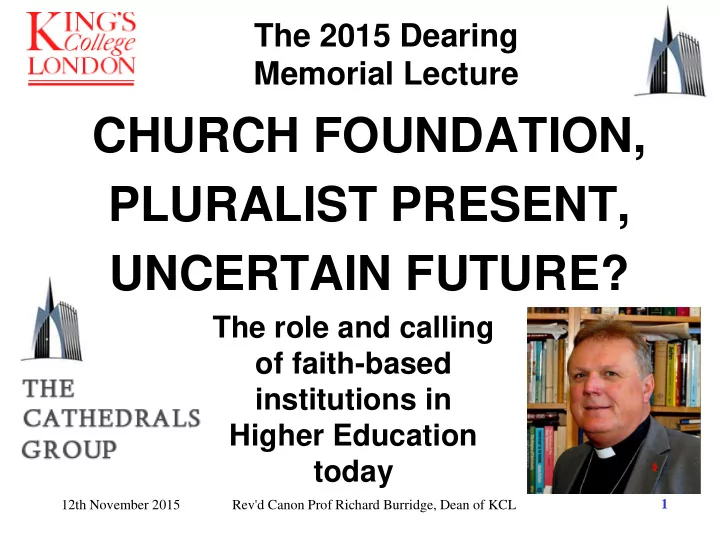
The 2015 Dearing Memorial Lecture CHURCH FOUNDATION, PLURALIST PRESENT, UNCERTAIN FUTURE? The role and calling of faith-based institutions in Higher Education today 1 12th November 2015 Rev'd Canon Prof Richard Burridge, Dean of KCL


slide-1
SLIDE 1

12th November 2015 Rev'd Canon Prof Richard Burridge, Dean of KCL 1

The 2015 Dearing Memorial Lecture

CHURCH FOUNDATION, PLURALIST PRESENT, UNCERTAIN FUTURE?

The role and calling

  • f faith-based

institutions in Higher Education today

slide-2
SLIDE 2

In this 7th lecture in memory of Lord Dearing, after a brief Introduction, we will look at three main parts: Church Foundation, Pluralist Present, Uncertain Future? My purpose is to examine the role and calling of faith- based institutions in Higher Education today and the contribution the Cathedral Group might make to HE. We are facing a crisis in HE today, so first we need some scene setting – how did we get here?

12th November 2015 Rev'd Canon Prof Richard Burridge, Dean of KCL 2

Introduction

slide-3
SLIDE 3

“Universities today have a moral obligation to assist our fellow human beings in a global context” Context: King’s College London senior leadership ‘retreat’ to consider our ‘vision’ for next 25 years ‘retreat’ and ‘vision’ spiritual, even religious, words Going away into silence? 200 yards, consultant As Dean, I referred to our Anglican foundation, yet many nervous about doing so in our world today Dominant consideration was student satisfaction in the world of £9,000 tuition fees – ‘NSS is king’!

12th November 2015 Rev'd Canon Prof Richard Burridge, Dean of KCL 3

Introduction

slide-4
SLIDE 4

Discussion was part of a debate which goes back to Socrates arguing in the Agora, and Plato’s Academy Newman’s The Idea of the University 1852, 1887 Robbins Report on HE, 1963 – ‘common culture’ 7th Memorial: Various Dearing Reports 1994 on the National Curriculum 1996 Exam system, bringing schools and technical training closer 2001 Church schools for Synod 2007 Languages in schools

12th November 2015 Rev'd Canon Prof Richard Burridge, Dean of KCL 4

Introduction

slide-5
SLIDE 5

1997 ‘Higher Education in the learning society’ Involved 240 meetings and 380 public submissions Nearly 2,000 pages and 93 recommendations Vision for next 20 years A ‘learning society’ Discussed HE purpose ‘main business’ of HE Addressed HE funding ‘Graduate contribution’

  • but recouped through income contingent means

12th November 2015 Rev'd Canon Prof Richard Burridge, Dean of KCL 5

Introduction

slide-6
SLIDE 6

What is the relationship between the market and academy? View across Agora from the Acropolis towards Plato’s Academy Socrates’ divine mission as ‘wisest man’ from the oracle to question business & politics; ignorant of ignorance; led to death

12th November 2015 Rev'd Canon Prof Richard Burridge, Dean of KCL 6

Introduction

slide-7
SLIDE 7

Dearing took as their ‘starting point’ the 1963 Robbins Committee which identified four aims and

  • bjectives of higher education, summarised as:

“instruction in skills for employment; promoting the general powers of the mind; the advancement of learning and search for truth the transmission of a common culture and common standards of citizenship.” These were then reinterpreted in 1997 for the vision for the next 20 years of the ‘learning society’:

12th November 2015 Rev'd Canon Prof Richard Burridge, Dean of KCL 7

Introduction

slide-8
SLIDE 8

Para 5.11 “The four main purposes of higher education are: to inspire and enable individuals to develop their capabilities to the highest potential levels throughout life, so that they grow intellectually, are well-equipped for work, can contribute effectively to society and achieve personal fulfilment; to increase knowledge and understanding for their own sake and to foster their application to the benefit of the economy and society; to serve the needs of an adaptable, sustainable, knowledge- based economy at local, regional and national levels; to play a major role in shaping a democratic, civilised, inclusive society.” (Dearing Report, p. 72)

12th November 2015 Rev'd Canon Prof Richard Burridge, Dean of KCL 8

Introduction

slide-9
SLIDE 9

First point about individual fulfilment, work & society Next two are about the economy Shaping society in the final point Report led to fees, end of grants – against his wishes Dearing set up by Secretaries for Education & Employment 2001 Dept for Education & Skills 2007 Dept for Innovation, Universities & Skills 2009 Business, Innovation & Skills: agora>academy

12th November 2015 Rev'd Canon Prof Richard Burridge, Dean of KCL 9

Introduction

slide-10
SLIDE 10

BIS Green paper, Nov 6th Stress on teaching standards, Teaching Excellence Framework Focus on student satisfaction and graduate employability Greater social diversity / mobility Allows successful to raise fees Opening up for new universities Reforming HE ‘architecture’ Implications for research funding

12th November 2015 Rev'd Canon Prof Richard Burridge, Dean of KCL 10

Introduction

slide-11
SLIDE 11

5.46 There may be less emphasis now on the role

  • f higher education in transmitting a common

culture than there was at the time of Robbins, partly because cultures within the UK have become more diverse, and partly because there are so many other forms of cultural transmission available through the mass media. But this reinforces the need for higher education to preserve and transmit those forms and aspects of culture which may be, for the time being, unfashionable or in danger of being overwhelmed by the majority culture. (Dearing last para, p. 80)

12th November 2015 Rev'd Canon Prof Richard Burridge, Dean of KCL 11

Introduction

slide-12
SLIDE 12

Business and politics in the Agora, the market-place, are no longer between religion & Academy The market has taken over churches & universities In an individualistic and increasingly diverse society, what is the role and calling of higher education institutions with a religious foundation? Is it merely to ‘preserve and transmit . . aspects of culture which may be unfashionable or in danger of being overwhelmed by the majority culture’? Or might it offer something to or even save culture,

  • r at least, save the academy from the marketplace?

12th November 2015 Rev'd Canon Prof Richard Burridge, Dean of KCL 12

Introduction

slide-13
SLIDE 13

The Cathedrals Group: ‘sixteen universities with Church foundations’ ‘Ethical principles informed by faith- based values’ ‘Share a common faith heritage’ Clear links to the three Churches

12th November 2015 Rev'd Canon Prof Richard Burridge, Dean of KCL 13

1 Church Foundation

slide-14
SLIDE 14

In 1999 I preached before HM Queen at the 750th anniversary service of the 1249 grant of William of Durham for the ‘great hall of the University’, Oxford. Influenced by, and based, on the example of Paris Definition of a university: a quad v benefaction! Right up to the 19th century, the English ancient universities of Oxford and Cambridge required staff and students to be communicant members of the Church of England: Shelley. An Anglican ‘lock-out’ stopping others having higher education. All changed in pluralism after the Napoleonic Wars

12th November 2015 Rev'd Canon Prof Richard Burridge, Dean of KCL 14

1 Church Foundation

slide-15
SLIDE 15

1826: Founding of University College London by mix of utilitarians, dissenters, Catholics, Jews.

12th November 2015 Rev'd Canon Prof Richard Burridge, Dean of KCL 15

1 Church Foundation

Human rights in the American and French revolutions: ‘Freedom from religion’ – French secularism, or ‘freedom for religion’ – USA free market?

slide-16
SLIDE 16

June 19th 1828 – The London paper Evening Standard announces a meeting to ‘to establish

  • n Christian and constitutional principles a

great metropolitan school’ ‘With such a seminary in a prosperous position, there will be neither motive nor excuse for any parent to inflict upon his offspring the disgrace

  • f education in the infidel and godless college

in Gower Street.’ Leads to the founding of King’s College London

12th November 2015 Rev'd Canon Prof Richard Burridge, Dean of KCL 16

1 Church Foundation

slide-17
SLIDE 17

Proposal to instigate King’s by Reverend Dr George D’Oyly, Rector of Lambeth 21st June 1828 – Founding meeting takes place with present: Arthur Wellesley, Duke of Wellington (PM in the Chair) the Archbishop of Canterbury eight other archbishops and bishops attend with a number of prominent laymen

Caricature from 1828: the bishops’ involvement in the founding of King’s weighs down one end of the see-saw against the “University of London”!

12th November 2015 Rev'd Canon Prof Richard Burridge, Dean of KCL 17

1 Church Foundation

slide-18
SLIDE 18

12th November 2015 Rev'd Canon Prof Richard Burridge, Dean of KCL 18

1 Church Foundation

Duel between the Duke of Wellington and the Earl of Winchilsea over Catholic emancipation and founding King’s, Saturday 21 March 1829, Battersea Fields

slide-19
SLIDE 19

1829 Royal Charter: the objects of King’s College are to keep the connection of ‘sound learning’ with teaching the ‘doctrines and duties of Christianity’ and ‘the various branches of literature and science’

12th November 2015 Rev'd Canon Prof Richard Burridge, Dean of KCL 19

1 Church Foundation

slide-20
SLIDE 20

To ensure this Christian vision King’s Principals had to be ordained clergy

  • f the Church of England

William Otter was the first Principal of King’s College London, 1831–1836 Bishop of Chichester, 1836–1839 Bp Otter College founded as a memorial April 1839 1.25 million children in Sunday schools by 1831 Leads to

12th November 2015 Rev'd Canon Prof Richard Burridge, Dean of KCL 20

1 Church Foundation

slide-21
SLIDE 21

Chichester is typical of both the explosion of the decade 1839-1850, and in its admitting women (1873) and subsequent mergers (Bognor Regis College of Education) leading to university status. Similarly, Chester’s foundation in 1839 involved prime ministers and Archbishop of Canterbury 1840 Winchester Diocesan Training School, again an Anglican foundation for training teachers

12th November 2015 Rev'd Canon Prof Richard Burridge, Dean of KCL 21

1 Church Foundation

slide-22
SLIDE 22

This decade also sees the founding of other Anglican institutions for training teachers: 1840 St Mark’s and 1841 St John’s Colleges 1841 York Training School and St John’s College with in 1862 St Margaret’s Ripon for women 1847 Cheltenham Training College which leads eventually to the

12th November 2015 Rev'd Canon Prof Richard Burridge, Dean of KCL 22

1 Church Foundation

slide-23
SLIDE 23

But it’s not just Anglicans: 1850 St Mary’s Hammersmith founded by the Catholic Poor Schools Committee While other early foundations will later merge with ecumenical partners: 1841 Whitelands CofE for women, 1850 Digby Stuart, Roman Catholic, 1872 Southlands, Methodist, 1892 Froebel Institute; unite in 1975 1844 CofE Warrington College and 1856 Sisters of Notre Dame become

12th November 2015 Rev'd Canon Prof Richard Burridge, Dean of KCL 23

1 Church Foundation

slide-24
SLIDE 24

Meanwhile, back in Wales: 1822 St David’s College for clergy of Church in Wales, later becoming the University of Wales, Lampeter. 1847 South Wales and Monmouthshire Training College, Carmarthen, later Trinity. Swansea College of Art founded 1853, College of Education 1872 and the Technical College 1895. 2010-13 various mergers finalise into UWTSD group.

12th November 2015 Rev'd Canon Prof Richard Burridge, Dean of KCL 24

1 Church Foundation

slide-25
SLIDE 25

The complications of the 19th century for the church and education are also seen in Heythrop Founded in 1614 to educate English Jesuits first in Louvain, then in Liège. Revolutionary France and Napoleonic war brought return to Stonyhurst in England, doing London degrees, then move to Heythrop Hall Oxford 1926, moved into London University in 1970 with own Charter. 1862 Lincoln CofE teacher training college, through several names to 13thc Bishop of Lincoln

12th November 2015 Rev'd Canon Prof Richard Burridge, Dean of KCL 25

1 Church Foundation

slide-26
SLIDE 26

19th century church impetus to train teachers led to 1870 Forster Elementary Education Act setting up compulsory primary schools for all children by law. Next boom comes with 1960s, ROSLA up to 16; Robbins expansion new universities & polytechnics both C of E and Roman Catholic foundations 1962 Christ Church College Canterbury 1964 St Martin’s College Lancaster 1966 Trinity College & All Saints College 1968 Newman College of HE

12th November 2015 Rev'd Canon Prof Richard Burridge, Dean of KCL 26

1 Church Foundation

slide-27
SLIDE 27

Our church foundations lie in the 19th century response to religious pluralism in Europe and a deep desire to save children from child labour by training teachers to educate them instead. This happened a generation before the state’s provision for universal primary education in 1870. This was repeated again in the pluralistic 1960s. Our church foundations were motivated by a strong faith in God who wants everyone to grow. This is surely something in which to take pride!

12th November 2015 Rev'd Canon Prof Richard Burridge, Dean of KCL 27

1 Church Foundation

slide-28
SLIDE 28

12th November 2015 Rev'd Canon Prof Richard Burridge, Dean of KCL 28

2 Pluralist Present

And yet it takes several steps to find history pages and many seem coy or embarrassed: Oxford has some old pictures and narrative

slide-29
SLIDE 29

Cambridge starts with a scary dinosaur before pages work through its various periods

12th November 2015 Rev'd Canon Prof Richard Burridge, Dean of KCL 29

2 Pluralist Present

slide-30
SLIDE 30

King’s overview: ‘founded by King George IV and the Duke of Wellington (PM)’ ‘in the tradition

  • f the Church
  • f England’

‘now welcomes all faiths and beliefs’.

12th November 2015 Rev'd Canon Prof Richard Burridge, Dean of KCL 30

2 Pluralist Present

slide-31
SLIDE 31

Foundation of KCL: ‘eminent politicians, churchmen, others. They wanted a Church of England alternative to UCL’ But more interested in the Duke’s duel than in Archbishop

  • f Canterbury!

12th November 2015 Rev'd Canon Prof Richard Burridge, Dean of KCL 31

2 Pluralist Present

slide-32
SLIDE 32

The Cathedrals Group: ‘sixteen universities with Church foundations’ ‘Ethical principles informed by faith- based values’ ‘Share a common faith heritage’ Clear links to the three Churches

12th November 2015 Rev'd Canon Prof Richard Burridge, Dean of KCL 32

2 Pluralist Present

slide-33
SLIDE 33

This is indeed a strong and proud statement about ‘founded by the churches for purpose of training teachers before state provided education for all’ and admitting ‘women on an equal footing’

12th November 2015 Rev'd Canon Prof Richard Burridge, Dean of KCL 33

2 Pluralist Present

slide-34
SLIDE 34

12th November 2015 Rev'd Canon Prof Richard Burridge, Dean of KCL 34

2 Pluralist Present

‘Campus based’ ‘Attractive locations’ ‘Excellent facilities’ ‘Welcoming atmosphere’

slide-35
SLIDE 35

When you follow the links: the four Catholic members identify themselves: Heythrop, Leeds, St Mary’s, Newman Liverpool Hope is ‘ecumenical’ Of the others, only Chester and Bishop Grossteste say C of E Rest prefer to stress other attributes, location, community, facilities – being ‘different’

12th November 2015 Rev'd Canon Prof Richard Burridge, Dean of KCL 35

2 Pluralist Present

slide-36
SLIDE 36

Individual websites are more forthcoming Like Oxford, Cambridge and King’s, not on front page, but requires 2 or 3 clicks through sections ‘about us’ to find an account of ‘our history’ Other key words include ‘heritage’, ‘tradition’, ‘experience’ leading to ‘vision’, ‘mission’, ‘ethos’ ‘inspired by our Christian / church foundation’ ‘proud of our rich heritage’ Often long and complex process with mergers to get to today’s Cathedral Group university

12th November 2015 Rev'd Canon Prof Richard Burridge, Dean of KCL 36

2 Pluralist Present

slide-37
SLIDE 37

Welcome / Home page: ‘faith-based values’ Excellent list of four areas where faith-based values will have an important impact. Not clear how are these based on faith or whether other universities would not also say the same without values being based on faith.

12th November 2015 Rev'd Canon Prof Richard Burridge, Dean of KCL 37

2 Pluralist Present

slide-38
SLIDE 38

‘only grouping in HE . . informed by faith-based values’ ‘a distinctive contribution . reflects our identity & values’ ‘a distinctively ethical perspective in HE landscape’ ‘celebrates our heritage as Christian foundations’ strong statements – how do they get worked out?

12th November 2015 Rev'd Canon Prof Richard Burridge, Dean of KCL 38

2 Pluralist Present

slide-39
SLIDE 39

‘Church / Christian foundation’ – only in past? ‘Strong ethical principles’ ‘Social justice’ and the ‘public good’ ‘Responsible stewards of the environment’ ‘Embrace diversity, combat prejudice, respect’ What is the link between the first and the rest?

12th November 2015 Rev'd Canon Prof Richard Burridge, Dean of KCL 39

2 Pluralist Present

slide-40
SLIDE 40

Analysis of individual websites: 10 had page on ‘values’; no ‘values’ found in 3; another 3 had ‘values’ placed under local area heritage, the constituent colleges, or ‘jobs’. Excellence – mentioned by 10 (everyone today) Diversity, inclusive – 10 (WP; Equality Diversity) Environment, sustainability, fair trade – 8 Holistic, whole person, dignity, worth – 7 Public good, social justice, service society – 6 Are these ‘faith-based’ or ‘distinctive’?

12th November 2015 Rev'd Canon Prof Richard Burridge, Dean of KCL 40

2 Pluralist Present

slide-41
SLIDE 41

Analysis of individual websites: Truth and intellectual freedom of enquiry – 4 ‘celebrate’, ‘recognise’, ‘take faith seriously’ – 4 interfaith dialogue – 3 ‘regardless of faith or belief’, ‘different faiths’ – 2 ‘all faiths or none’, ‘don’t profess faith’ – 2 No challenge from faith-based academy to the Agora, or economic values of the market place Lord Nolan ‘Standards in Public Life’ 1994-7 values without faith lasts a generation, no ethics

12th November 2015 Rev'd Canon Prof Richard Burridge, Dean of KCL 41

2 Pluralist Present

slide-42
SLIDE 42

So who or where is the keeper of the foundation? GORs for V-Cs or senior staff is a sensitive area 4 Catholic foundations require a Catholic GOR. Also GOR at Liverpool Hope (R-C / C of E union) Thank V-C of Bp Grossteste sending his job spec; some places require V-C to be a church member. Others use words like ‘empathy with’, ‘supportive’ Even atheists need someone to hold the tradition; I was appointed as Dean of KCL by an atheist: ‘I need someone to do the believing for both of us’!

12th November 2015 Rev'd Canon Prof Richard Burridge, Dean of KCL 42

2 Pluralist Present

slide-43
SLIDE 43

How did it move from strong church foundation to present pluralist coyness or embarrassment? 1960’s ‘death of God’ and rise of ‘new atheists’, R Dawkins etc – hence references to ‘no faith’. Multicultural and pluralist challenge of recent decades, immigration, international students. BIS’ stress on equality, diversity and inclusivity. As new universities, CG needs to compete in the market place: will the values and mission be still ‘faith-based’ and distinctive, or the same as everybody else’s in the uncertain future?

12th November 2015 Rev'd Canon Prof Richard Burridge, Dean of KCL 43

2 Pluralist Present

slide-44
SLIDE 44

Understandable tendency to assume that this slide from proud ‘church foundations’ through a ‘pluralist present’ will lead inexorably to the end

  • f Christian distinctiveness in Cathedral Group.

Final section will argue that this is not inevitable: partly because of changes in our society partly because of initiatives already happening within the Cathedral Group and elsewhere. But now is the time for action to be taken. First, a view from over the water in the USA:

12th November 2015 Rev'd Canon Prof Richard Burridge, Dean of KCL 44

3 Uncertain Future?

slide-45
SLIDE 45

“Many American universities were founded as religious institutions, explicitly designed to cultivate their students’ spiritual and moral natures. But over the course of the 20th century they became officially or effectively

  • secular. Religious rituals like mandatory chapel services

were dropped. Academic research and teaching replaced character formation at the core of the university’s mission. Administrators and professors dropped spiritual language and moral prescription either because they didn’t know what to say or because they didn’t want to alienate any part

  • f their diversifying constituencies.”

12th November 2015 Rev'd Canon Prof Richard Burridge, Dean of KCL 45

3 Uncertain Future?

slide-46
SLIDE 46

“Universities are more professional and glittering than ever, but in some ways there is emptiness deep down. Students are taught how to do things, but many are not forced to reflect on why they should do them or what we are here for. But things are changing. . . Institutes are popping up — with interdisciplinary humanities programs and even meditation centers — designed to cultivate the whole student: the emotional, spiritual and moral sides and not just the intellectual. The trick is to find a way to talk about moral and spiritual things while respecting diversity.”

12th November 2015 Rev'd Canon Prof Richard Burridge, Dean of KCL 46

3 Uncertain Future?

slide-47
SLIDE 47

The failure of the secularization hypothesis: 1960s theory that religion would die away. Yet perhaps it is the most important political and social issue facing the world in 21st century –and the one most misunderstood by politicians 1960s-1970s assumption that science would have all the answers & put God out of business Star Trek ‘to boldly go’ came home with the 4th series, Voyager; nostalgic prequel, Enterprise. Post-Christian – or post-atheistic? R Dawkins?

12th November 2015 Rev'd Canon Prof Richard Burridge, Dean of KCL 47

3 Uncertain Future?

slide-48
SLIDE 48

Church-going may have declined recently: 5 million members; 2-3m in church on Sundays. Compare 350,000 at Premier League matches. Total capacity Premier League grounds: 750,000 Total capacity of 92 football grounds: 2 million. Total membership of all political parties: 700,000 150k Conservatives; 110k SNP; 61k LibDem; 65k Greens; 42k UKIP; 290k Labour (plus 148k union affiliates and 112k £3 members to vote). British Humanist Association 40k; Secular similar

12th November 2015 Rev'd Canon Prof Richard Burridge, Dean of KCL 48

3 Uncertain Future?

slide-49
SLIDE 49

12th November 2015

2011 National Census: 59.3% Christian (2001: 71.1%); 4.8% Muslim (3%); 1.5% Hindu (1%); 0.8% Sikhs (0.5%); 0.5% Jews (0.5%); 0.4% Buddhist (0.3%); 25.1% ‘no religion’ (14.1%); 7.2% ‘no answer’ Large Christian majority, with a tenth for other world faiths and a quarter stating ‘no religion’. Linda Woodhead’s 2013 Lecture

Rev'd Canon Prof Richard Burridge, Dean of KCL 49

3 Uncertain Future?

slide-50
SLIDE 50

‘They’re all old people – what about students today?’ CUE project 2010-2013 in five different HE contexts 51% Christian; 34% none; 15% others. Backed up by

  • ther surveys, 44-50%

Christians: 50% church in term, and 66% in vacations 40% religious, 31% ‘spiritual’

12th November 2015 Rev'd Canon Prof Richard Burridge, Dean of KCL 50

3 Uncertain Future?

slide-51
SLIDE 51

The rise of the ‘spiritual’ category from ECU now being used in HEFCE/HESA statistics: Used in KCL staff survey – concludes tomorrow ‘spiritual . . . without conventional religion’ Linda Woodhead’s definition; as 2013 lecture showed, decline in Christians ≠ not religious ‘Mindfulness’ appearing in classes & meetings ‘Atheist church’ and Sunday Assemblies Rituals – e.g. Remembrance Sunday being replaced by Remembrance Services yesterday.

12th November 2015 Rev'd Canon Prof Richard Burridge, Dean of KCL 51

3 Uncertain Future?

slide-52
SLIDE 52

‘Faith-based values’: what is the doctrinal basis for our ethics? Compare EIAG policies; needed to be distinctively Christian How does Creation–fall–election –incarnation–atonement–eschat

  • ology drive our view of human

beings? This can provide a real ‘faith-basis’ for ethical values. See also Mike Higton Theology

  • f Higher Education OUP 2012

12th November 2015 Rev'd Canon Prof Richard Burridge, Dean of KCL 52

3 Uncertain Future?

slide-53
SLIDE 53

Several recent projects on Christian or C of E identity In May 2009, I gave the first keynote at the inaugural CUAC-UK conference with Jeremy Law giving the other. Fascinating set of essays from around the world. Concluding reflections from Archbishop Rowan Williams.

12th November 2015 Rev'd Canon Prof Richard Burridge, Dean of KCL 53

3 Uncertain Future?

slide-54
SLIDE 54

CG report from HE Leadership Foundation, HEFCE, 2011

“These values contrast strongly with a vision of the future of HE which is market-focused.” (p. 1) Distinctive features and definable identity: core values, holistic approach, student volunteering, community, vibrant Chaplaincies, handling change, supporting staff,

  • ther faith-based partnerships.

12th November 2015 Rev'd Canon Prof Richard Burridge, Dean of KCL 54

3 Uncertain Future?

slide-55
SLIDE 55

Gloucester: ‘Anglican Identity report’ and the Foundation Fellows, 2012-13; filed under ‘Gloucestershire>heritage’;

12th November 2015 Rev'd Canon Prof Richard Burridge, Dean of KCL 55

3 Uncertain Future?

Foundation Fellows; Anglican identity report was endorsed by Council April 2013. glos.ac.uk log-in only.

slide-56
SLIDE 56

12th November 2015 Rev'd Canon Prof Richard Burridge, Dean of KCL 56

3 Uncertain Future?

CofE web: CG & CUAC Anglican Identity Project 2011-12 Year One Report and plan for Year Two Literature Review ‘Identity and Character’ Stephen Heap and Jeremy Law Nov 2013 Day conference +Tim Dakin Winchester 2015

slide-57
SLIDE 57

Canterbury Christ Church Jeremy Law’s two papers: ‘vision statement’ using the triquetra symbol to ground the vision in three dimensions – the Trinity. ‘Religion and Belief’ paper

  • n link to C of E, including

GOR’s, C of E Ethos, Christian distinctiveness and Inter-Faith. March 2015

12th November 2015 Rev'd Canon Prof Richard Burridge, Dean of KCL 57

3 Uncertain Future?

slide-58
SLIDE 58

‘Vibrant Chaplaincies’ in Cathedral Group universities Evident in most of websites But true of many HEIs Faiths in HE Chaplaincy project funded by Dept of Communities & Local Gov’t Survey 2006-7 of all HEIs 95% have prayer spaces 75% Christian Chaplains

12th November 2015 Rev'd Canon Prof Richard Burridge, Dean of KCL 58

3 Uncertain Future?

slide-59
SLIDE 59

Pluralist context today: 51% have Chapels, 58% multi-faith rooms, 68% Muslim prayer rooms Other faiths do not want a ‘soft-pedal’ approach but respect Christians who pray, or keep Lent Rabbi Lord Sacks’ latest book argues for us to be strong together Muslim chaplaincy in prisons & NHS – HE?

12th November 2015 Rev'd Canon Prof Richard Burridge, Dean of KCL 59

3 Uncertain Future?

slide-60
SLIDE 60

The church colleges originally had a distinctive curriculum for teacher training with faith basis Various attempts to include something today Winchester: on-line course on ‘making sense of religion’, plus new King Alfred award programme CCC ran Associateship Programme 2001-2010; now planning on-line course for launch 2016-17 Associateship of King’s College London: original award, predates London degrees; one hour a week with annual exam; 2,000 students enrolled; distance learning version – possible extension?

12th November 2015 Rev'd Canon Prof Richard Burridge, Dean of KCL 60

3 Uncertain Future?

slide-61
SLIDE 61

How to build on church foundation in the pluralist present and still include diversity? KCL’s 1829 Charter ‘CofE’; 1980 ‘Christianity’ 2009 Ordinance E.3: “The Dean shall be responsible for ensuring that the College builds upon the Anglican tradition associated with its foundation and, in recognition of the multi-ethnic and international nature of its community, encourages and supports all its members of all beliefs and backgrounds (as required by the Charter, Article 3(1)).” Lord Sacks’ defence of the establishment of C of E

12th November 2015 Rev'd Canon Prof Richard Burridge, Dean of KCL 61

3 Uncertain Future?

slide-62
SLIDE 62

We have looked at the role & calling of faith-based institutions in Higher Education today in the light of Church Foundation, Pluralist Present, Uncertain Future?

Churches in the 1840s and 1960s responded to needs of society and to challenge of pluralism Extraordinary vision of founders and foundation We must draw on this deep and sound foundation to go forward into a certain future.

12th November 2015 Rev'd Canon Prof Richard Burridge, Dean of KCL 62

Conclusion

slide-63
SLIDE 63

The contribution the Cathedral Group might make to HE today is evidenced in all these reports Be founded on church foundations Ensure values are truly faith-based and distinctive Graeme Davies, HEFCE, 1995, had Golden Rule: “the man who has the gold, makes the rules!” Jesus’ Golden Rule different: “God and Mammon” Can the faith-based academy challenge the Agora/market-place in future – or will it be assimilated & its distinctive individuality erased?

12th November 2015 Rev'd Canon Prof Richard Burridge, Dean of KCL 63

Conclusion

slide-64
SLIDE 64

Dearing: relationship between the market and academy? View across Agora from the Acropolis towards Plato’s Academy Tonight I may have been Socrates, goading some questions But I hope and pray we can all avoid drinking the hemlock!

12th November 2015 Rev'd Canon Prof Richard Burridge, Dean of KCL 64

Conclusion

slide-65
SLIDE 65

12th November 2015 Rev'd Canon Prof Richard Burridge, Dean of KCL 65

The 2015 Dearing Memorial Lecture

CHURCH FOUNDATION, PLURALIST PRESENT, UNCERTAIN FUTURE?

The role and calling

  • f faith-based

institutions in Higher Education today