Please mute your phones, computers AND turn off cameras. Open chat - - PowerPoint PPT Presentation

please mute your phones computers and turn off cameras
SMART_READER_LITE
LIVE PREVIEW

Please mute your phones, computers AND turn off cameras. Open chat - - PowerPoint PPT Presentation

Thank You for Joining Us, We Will Begin Shortly Please mute your phones, computers AND turn off cameras. Open chat box for questions Mute Type and send (optional) Turn on Turn Camera Microphone questions here Closed Captioning Off here


slide-1
SLIDE 1

Thank You for Joining Us, We Will Begin Shortly

Please mute your phones, computers AND turn off cameras.

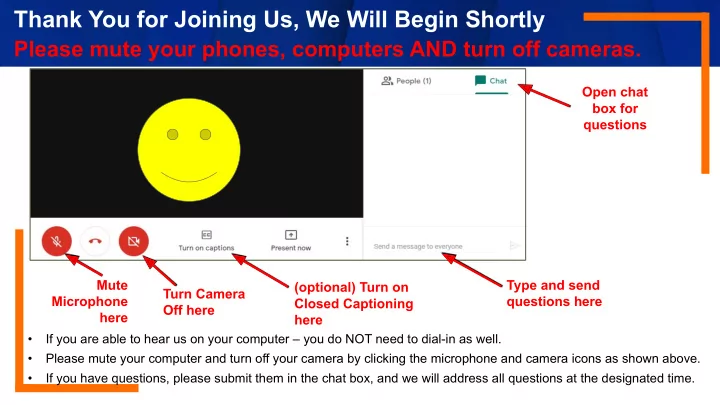
  • If you are able to hear us on your computer – you do NOT need to dial-in as well.
  • Please mute your computer and turn off your camera by clicking the microphone and camera icons as shown above.
  • If you have questions, please submit them in the chat box, and we will address all questions at the designated time.

Open chat box for questions Turn Camera Off here Mute Microphone here Type and send questions here (optional) Turn on Closed Captioning here

slide-2
SLIDE 2

Office of Tribal Relations Division of Developmental Disabilities - Tribal Informational Forum August 19 & 27, 2020

slide-3
SLIDE 3

Welcome

Leah Landrum Taylor Assistant Director Director’s Office of Community Engagement Jocelyn Beard Tribal Relations Manager Director’s Office of Community Engagement

slide-4
SLIDE 4

Silent Invocation

slide-5
SLIDE 5

COVID-19 Updates & Resources

OIFA Program Manager - Barbara Picone

slide-6
SLIDE 6

COVID-19

DDD’s top priority is the health and safety of our members, their families, and the professionals in our program that support them The Division created several guidance documents and implemented service delivery changes in an effort to ensure the continuation of necessary services for our members and to support the financial viability of our providers.

  • Regular updates on the DDD COVID-19 Website:

https://bit.ly/DDD_COVID19Actions

slide-7
SLIDE 7

Guidance for Congregate Settings (Group Homes/Developmental Homes) and Direct Care Workers (DCW)

Guidance for Congregate Settings

  • Mitigating Risk of Spreading COVID-19
  • Cleaning and Disinfection
  • Environmental Measures
  • Agency Preparedness
  • Anticipatory Member Protections
  • Guidance on Suspected and Confirmed

Cases of COVID-19 in Staff and Members

  • Providing Care to Members Confirmed with

COVID-19

  • Reporting Cases of COVID-19
  • Appendix 1: Social distancing to limit further

spread

  • Appendix 2: Room isolation
  • Appendix 3: Caregiver guidance
  • Appendix 4: Supporting members who have

confirmed cases of COVID-19

  • Appendix 5: Non-Emergency Transportation
  • Appendix 6: Summary of Changes

Guidance can be found at DDD COVID-19 webpage: https://bit.ly/DDDProviderGuidance

slide-8
SLIDE 8

CDC Guidance for People at Higher Risk for Severe Illness

Underlying health conditions for vulnerable individuals include:

  • Risk for Severe Illness Increases with Age
  • People living in a nursing home or long-term care facility.
  • People of any age with the following conditions:
  • Cancer
  • Chronic Obstructive Pulmonary Disease (COPD)
  • Immunocompromised state from solid organ transplant
  • Obesity (body mass index [BMI] of 30 or higher)
  • Serious heart condition
  • Type II Diabetes Mellitus
  • Chronic kidney disease (and undergoing dialysis)
  • Hemoglobin disorders such as Sickle Cell Disease and Thalassemia
slide-9
SLIDE 9

CDC Guidance for People at Higher Risk for Severe Illness

  • Asthma (moderate-to-severe)
  • Cerebrovascular disease
  • Cystic fibrosis
  • Hypertension or high blood pressure
  • Immunocompromised state

(weakened immune system) from

  • blood or bone marrow transplant,
  • immune deficiencies,
  • HIV,
  • use of corticosteroids, or use of other

immune weakening medicines

  • Neurologic conditions, such as

dementia

  • Liver disease
  • Pregnancy
  • Pulmonary fibrosis
  • Smoking
  • Thalassemia (a type of blood disorder)
  • Type I Diabetes Mellitus

The following health conditions might be at increased risk:

Updated by the CDC on July 17, 2020

slide-10
SLIDE 10

CDC Guidance for People- Extra Precautions

People with Disabilities:

  • People who have limited mobility or who cannot avoid coming into close

contact with others who may be infected, such as direct support providers and family members

  • People who have trouble understanding information or practicing preventive

measures, such as hand washing and social distancing

  • People who may not be able to communicate symptoms of illness

https://www.cdc.gov/coronavirus/2019-ncov/need-extra-precautions/people-with-disabilities.html https://www.cdc.gov/coronavirus/2019-ncov/need-extra-precautions/people-at-higher-risk.html

slide-11
SLIDE 11

Behavioral Health Support for Members

Behavioral Health Support for Members and Families

  • Peer and family support agencies are equipped to quickly provide virtual

behavioral health support, tips and guidance.

  • They are able to assist a member who may have unique worries associated

with the fear of COVID-19 as well as difficulty with adjustments to normal activities as a result of the COVID-19 pandemic.

  • Agencies are able to evaluate the member to determine if a behavioral

health referral is needed in addition to their current supports.

  • Families or staff can contact these agencies directly

DDD has resources available on its COVID-19 webpage under the “Resources for Families and Members” section: https://bit.ly/DDD_COVID19Actions

slide-12
SLIDE 12

DDD Resources

DDD COVID-19 Actions Website: https://bit.ly/DDD_COVID19Actions

  • General Resources
  • CDC Activities and Initiatives Supporting COVID-19
  • Qualified Vendors and Providers
  • Members and Families
  • List of Service Delivery Changes
  • COVID-19 Temporary Provider Payment Strategies
  • Qualified Vendor/Provider Surveys
  • Provider FAQs: https://bit.ly/DDD_COVIDFAQ
  • Past Town Hall Presentations and Upcoming Town Hall Information:

https://bit.ly/COVID_TownHall

slide-13
SLIDE 13

Remote Learning

The topic of school aged DDD members who are not able to attend in-person school and who need support to engage in remote learning continues to be a national issue that we are also working through. DDD has engaged with AHCCCS, the Arizona Department of Education, and the Attorney General's Office to determine whether exemptions will be allowable during the pandemic. For now, DDD is not changing service plans for the purposes of supporting remote learning, until DDD receives further guidance. Benchmarks for Safely Returning to In-Person Instruction

slide-14
SLIDE 14

COVID-19 Reporting – August 17, 2020

Data gathered from:

  • Incident Reports submitted to the Division
  • Arizona Health Information Exchange
  • Monday Close of Business Data Posted each Tuesday.

COVID-19 Update

Residential Setting Total Members Positive COVID-19 Cases Member Deaths Family/Own Home 39,064 409 9 Licensed Residential Setting 4,973 368 29 Total 44,027 777 38

slide-15
SLIDE 15

15

Customer Service Center

1-844-770-9500 option 1

DDDCustomerServiceCenter@azdes.gov Office of Individual and Family Affairs (OIFA)

slide-16
SLIDE 16

Questions

slide-17
SLIDE 17

Current and Future DDD-American Indian Health Plan Integration

DDD Medical Director – Dr. Pamela Tom

slide-18
SLIDE 18

Guide to Acronyms

BH Behavioral Health CRS Children’s Rehabilitative Services DDD-AIHP DDD-American Indian Health Plan DDD Division of Developmental Disabilities DFSM Division of Fee-for-Service Management HCBS Home and Community Based Services LTSS* Long Term Care Services and Supports PH Physical Health TRBHA Tribal Regional Behavioral Health Authorities SMI Serious Mentally Ill

*Includes HCBS, home-based nursing, therapies, attendant care, respite, habilitation, etc.

slide-19
SLIDE 19

19

DDD American Indian Health Plan (AIHP)

AHCCCS (Medicaid) ฀ Financially Eligible ALTCS ฀ Financially Eligible ฀ Medically Eligible DDD Health Plan ฀ Mercy Care ฀ United Healthcare AIHP (Fee-for-Service)

slide-20
SLIDE 20

DDD American Indian Health Plan (AIHP)

October 1st, 2019

Statewide Integrated Contracts DDD Continues to Provide ฀ Support Coordination ฀ Qualified Vendors & Specialty Contractors ฀ Home and Community Based Services DDD American Indian Members ฀ DDD Health Plans ฀ Mercy Care and UnitedHealthcare Community Plan ฀ DDD American Indian Health Plan (DDD AIHP) - FFS ฀ IHS, Tribally Operated 638, and Urban Native Health Facilities (Not All Services May Be Available) Integration of Healthcare Services

฀ Physical Health Services ฀ Behavioral Health Services ฀ Children’s Rehabilitative Services (CRS)* ฀ Limited Long-Term Services and Supports

  • Emergency Alert System

Services

  • Nursing Facilities
  • Physical Therapy for

Members Over 21

slide-21
SLIDE 21

Effective October 1, 2019

slide-22
SLIDE 22

Effective October 1, 2019

slide-23
SLIDE 23

DDD AIHP Enrollment

527 83 11

DDD AIHP Enrollment 8/6/2020 DDD AIHP CRS Enrollment 8/6/2020 DDD AIHP SMI Enrollment 8/6/2020

slide-24
SLIDE 24
  • Challenges with continued administration of the program in its current form for the

long-term future.

  • DDD’s strengths are Case Management and Long-Term Services and Supports.
  • Challenges with delivering physical and behavioral health services through a Fee for

Service system.

  • Benefit to the member to identify a system that better meets their need.
  • AHCCCS expertise w/ Fee for Service and AIHP.
  • DDD began collaboration w/ AHCCCS to determine long-term solution that is in the best

interest of DDD AIHP members.

  • Any changes would not occur until 10/2021 at earliest.

Future of DDD AIHP

slide-25
SLIDE 25
  • Discussion is underway between DDD and AHCCCS in understanding the possibilities in

enhancing current DDD AIHP.

  • This work had led to identifying potential options to have both organizations work closer

together through an integrated approach.

  • Seeking Tribal feedback as to the current thinking.
  • Assigned Division and AHCCCS resources to dedicate time and attention to completing

work once confirmed.

Progress to Date

slide-26
SLIDE 26

Guide to Acronyms

BH Behavioral Health CRS Children’s Rehabilitative Services DDD-AIHP DDD-American Indian Health Plan DDD Division of Developmental Disabilities DFSM Division of Fee-for-Service Management HCBS Home and Community Based Services LTSS* Long Term Care Services and Supports PH Physical Health TRBHA Tribal Regional Behavioral Health Authorities SMI Serious Mentally Ill

*Includes HCBS, home-based nursing, therapies, attendant care, respite, habilitation, etc.

slide-27
SLIDE 27

Current and Potential Future Options for AI/AN ALTCS Members

Current Potential Future

Current Health Plan Enrollment / Assignments Physical Health Behavioral Health CRS* LTSS** Proposed Division of Developmental Disabilities Options for American Indian / Alaska Native members Option 1 DDD HP DDD HP (SMI) DDD HP DDD No change

  • Approx. 1,246

Option 2 DDD HP TRBHA (SMI) DDD HP DDD No change

  • Approx. 212

Option 3 DDD AIHP TRBHA (SMI) DDD AIHP DDD DDD AIHP with AHCCCS *AHCCCS DFSM would become responsible for PH (CRS) claims/care management, no sooner than 10/1/21 (including SMI)

  • Approx. 313

Option 4 DDD AIHP DDD AIHP (SMI) DDD AIHP DDD DDD AIHP with AHCCCS *AHCCCS DFSM would become responsible for PH and BH (CRS) claims/care management, no sooner than 10/1/21 (including SMI)

  • Approx. 209

* If eligible ** Includes HCBS, home-based nursing, therapies, attendant care, respite, habilitation, etc.

slide-28
SLIDE 28

Questions and Tribal Discussion

slide-29
SLIDE 29

Closing Remarks & Announcements

DES Office of Tribal Relations Contact Information DES Tribal Relations Manager: Jocelyn Beard jbeard@azdes.gov DBME Tribal Liaison: Anisia Sieweyumptewa anisiasieweyumptewa@azdes.gov call/text: 480-528-2312 DDD Tribal Liaison: Eva Bighorse ebighorse@azdes.gov call/text: 480-261-7945

For more information, visit: des.az.gov/about-des/tribal-relations Upcoming Virtual Meetings: DBME Tribal Informational Forum August 26, 2020 1pm to 2pm – MST DDD Tribal Informational Forum August 27, 2020 1pm to 2pm – MST

DES Virtual Community Partner Communication Session September 1, 2020, 10am to 11am – MST DES Tribal Consultation Thursday - November 19, 2020

slide-30
SLIDE 30

Thank you!