PLEASANT RIDGE WIND ENERGY CENTER NOISE ANALYSIS RESULTS Presented - - PowerPoint PPT Presentation

pleasant ridge wind energy center
SMART_READER_LITE
LIVE PREVIEW

PLEASANT RIDGE WIND ENERGY CENTER NOISE ANALYSIS RESULTS Presented - - PowerPoint PPT Presentation

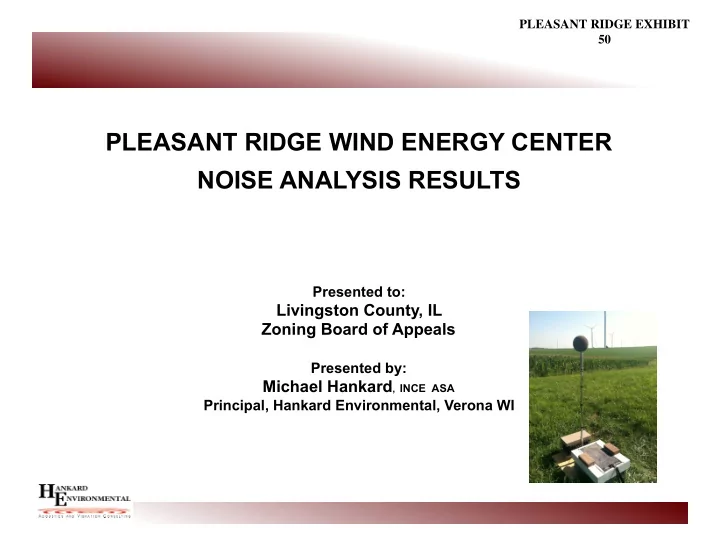
PLEASANT RIDGE EXHIBIT 50 PLEASANT RIDGE WIND ENERGY CENTER NOISE ANALYSIS RESULTS Presented to: Livingston County, IL Zoning Board of Appeals Presented by: Michael Hankard , INCE ASA Principal, Hankard Environmental, Verona WI


slide-1
SLIDE 1

PLEASANT RIDGE WIND ENERGY CENTER NOISE ANALYSIS RESULTS

Presented to:

Livingston County, IL Zoning Board of Appeals

Presented by:

Michael Hankard, INCE ASA

Principal, Hankard Environmental, Verona WI

PLEASANT RIDGE EXHIBIT 50
slide-2
SLIDE 2

Environmental Noise Experience

November ¡17, ¡2014 ¡ Pleasant ¡Ridge ¡Wind ¡Energy ¡Center ¡Noise ¡Analysis ¡

Industrial Roadway Power Plant

  • 25 Years of Environmental

Noise Measurements and Analyses

  • Principally Involved in over

400 Projects

  • Projects Located across the

U.S. and Internationally

slide-3
SLIDE 3
  • Industrial Facilities
  • Conventional Power Plants
  • Wind Turbine Power Plants
  • Mining Operations
  • Major Roadway Projects
  • Shooting Ranges
  • Generators
  • Land Development
  • Sound Transmission Loss

Measurements

Pleasant ¡Ridge ¡Wind ¡Energy ¡Center ¡Noise ¡Analysis ¡

Environmental Noise Experience

Mining Land Development

November ¡17, ¡2014 ¡

slide-4
SLIDE 4

Wind Turbine Noise Experience

  • California Ridge Noise Study

(3.5 months, IPCB Compliance)

  • Currently managing a multi-year

compliance program for wind farm in Western U.S.

  • Principal Acoustical Consultant for

proposed Highland Wind Project in WI

  • Principal Acoustical Consultant for

Shirley Wind Project in WI

November ¡17, ¡2014 ¡ Pleasant ¡Ridge ¡Wind ¡Energy ¡Center ¡Noise ¡Analysis ¡

CA Ridge Western US CA Ridge

slide-5
SLIDE 5

Wind Turbine Noise Experience

November ¡17, ¡2014 ¡ Pleasant ¡Ridge ¡Wind ¡Energy ¡Center ¡Noise ¡Analysis ¡

  • Compliance measurements for wind

farm in New York

  • Ambient noise measurement surveys for

wind turbine projects in:

  • Wisconsin
  • Michigan
  • Oregon
  • New York

Shirley Michigan Ambient New York

slide-6
SLIDE 6

Quantifying Noise – The Decibel

November ¡17, ¡2014 ¡ Pleasant ¡Ridge ¡Wind ¡Energy ¡Center ¡Noise ¡Analysis ¡

  • We hear pressure fluctuations in the air
  • We can detect an enormous range of

pressure fluctuations, measured in Pascals (Pa)

  • From 20 to over 100,000,000 µPa (micro-

Pascals)

  • The decibel (dB) numerically compresses

this range to about 0 to 140

slide-7
SLIDE 7

Quantifying Noise – The Decibel

November ¡17, ¡2014 ¡ Pleasant ¡Ridge ¡Wind ¡Energy ¡Center ¡Noise ¡Analysis ¡

  • Adding two or more sources

is done logarithmically Thus: Rather: Because:

​𝑞↓𝑈𝑝𝑢𝑏𝑚↑2 ​= ¡𝑞↓1↑2 ¡+ ¡​𝑞↓2↑2 ¡ 50+50 ¡≠100 50+50=53

50 dB 50 dB 53 dB

slide-8
SLIDE 8

Quantifying Noise – Frequency

November ¡17, ¡2014 ¡ Pleasant ¡Ridge ¡Wind ¡Energy ¡Center ¡Noise ¡Analysis ¡

slide-9
SLIDE 9

November ¡17, ¡2014 ¡ Pleasant ¡Ridge ¡Wind ¡Energy ¡Center ¡Noise ¡Analysis ¡

Quantifying Noise – Frequency

Human Speech 500 Hz to 4,000 Hz Train Horn 300-600 Hz Train Rumble 10 to 200 Hz Piano 30 to 4,000 Hz

slide-10
SLIDE 10 20 40 60 80 100 120

1 10 100 1,000 10,000

Sound Pressure Level (dB)

Frequency (Hertz)

Audible Frequency Range (20 to 20,000 Hz)

20 20,000

Audible Frequency Range

November ¡17, ¡2014 ¡ Pleasant ¡Ridge ¡Wind ¡Energy ¡Center ¡Noise ¡Analysis ¡

slide-11
SLIDE 11 20 40 60 80 100 120

1 10 100 1,000 10,000

Sound Pressure Level (dB)

Frequency (Hertz)

IPCB Compliance Range (22 to ~10,000 Hz)

22 10,000

Audible Frequency Range (20 to 20,000 Hz)

20 20,000

IPCB Compliance Frequency Range

November ¡17, ¡2014 ¡ Pleasant ¡Ridge ¡Wind ¡Energy ¡Center ¡Noise ¡Analysis ¡

slide-12
SLIDE 12 20 40 60 80 100 120

1 10 100 1,000 10,000

Sound Pressure Level (dB)

Frequency (Hertz)

Infrasonic Range (0 to 20 Hz)

1 20 22 200 10,000

Low Frequency Range (20 to 200 Hz) IPCB Compliance Range (22 to ~10,000 Hz)

Low and Infrasonic Frequency Ranges

November ¡17, ¡2014 ¡ Pleasant ¡Ridge ¡Wind ¡Energy ¡Center ¡Noise ¡Analysis ¡

slide-13
SLIDE 13

10 20 30 40 50 60 70 80 31.5 63 125 250 500 1000 2000 4000 8000

Octave Band Sound Pressure Level (dB) Octave-Band Center Frequency (Hertz)

69 dB 67 dB 62 dB 54 dB 47 dB 41 dB 36 dB 32 dB 32 dB

IPCB Nighttime Noise Limits

Nighttime Limits Noise emitted from Class ‘C’ land to Class ‘A’ land

November ¡17, ¡2014 ¡ Pleasant ¡Ridge ¡Wind ¡Energy ¡Center ¡Noise ¡Analysis ¡

slide-14
SLIDE 14

10 20 30 40 50 60 70 80 31.5 63 125 250 500 1000 2000 4000 8000

Octave Band Sound Pressure Level (dB) Octave-Band Center Frequency (Hertz)

IPCB Nighttime Limit CA Ridge - Max Measured 69 dB 67 dB 62 dB 54 dB 47 dB 41 dB 36 dB 32 dB 32 dB

CA Ridge Measured Levels

November ¡17, ¡2014 ¡ Pleasant ¡Ridge ¡Wind ¡Energy ¡Center ¡Noise ¡Analysis ¡

slide-15
SLIDE 15

10 20 30 40 50 60 70 80 31.5 63 125 250 500 1000 2000 4000 8000

Octave Band Sound Pressure Level (dB) Octave-Band Center Frequency (Hertz)

IPCB Nighttime Limit PRW - Max Predicted 69 dB 67 dB 62 dB 54 dB 47 dB 41 dB 36 dB 32 dB 32 dB 69 dB 67 dB 62 dB 54 dB 47 dB 36 dB 32 dB 32 dB

PRW Predicted Levels

November ¡17, ¡2014 ¡ Pleasant ¡Ridge ¡Wind ¡Energy ¡Center ¡Noise ¡Analysis ¡

slide-16
SLIDE 16

Wind Turbine Noise Emission Factors

  • Manufacturers measure and calculate

sound power levels per IEC 61400-11

  • All measurements taken downwind of

turbine

  • 61400-14 quantifies uncertainty
  • Primary noise source at 1,500+ feet is

aerodynamic noise (blades interacting with air)

  • Gearbox, cooling system, generator,

and motor noise are produced but are secondary

November ¡17, ¡2014 ¡ Pleasant ¡Ridge ¡Wind ¡Energy ¡Center ¡Noise ¡Analysis ¡

International Electrotechnical Commission Standard 61400-11

slide-17
SLIDE 17

Our Analysis Used the Highest Level in Each Octave Band

Wind Turbine Noise Emission Factors

November ¡17, ¡2014 ¡ Pleasant ¡Ridge ¡Wind ¡Energy ¡Center ¡Noise ¡Analysis ¡

slide-18
SLIDE 18

Low Noise Blades

November ¡17, ¡2014 ¡ Pleasant ¡Ridge ¡Wind ¡Energy ¡Center ¡Noise ¡Analysis ¡

  • Project is considering 100 meter and

103 meter long blades

  • Noise predictions made for each length
  • Employing Low Noise Trailing Edge

(LNTE) blades on eleven 100 meter turbines or four 103 meter turbines where additional noise reduction was projected to be needed Low Noise Wind Turbine Blades Available to Help Meet Regulations

slide-19
SLIDE 19

Estimating How Noise Will Travel: ISO 9613-2

International Organization for Standardization Method 9613-2

November ¡17, ¡2014 ¡ Pleasant ¡Ridge ¡Wind ¡Energy ¡Center ¡Noise ¡Analysis ¡

  • Emission Levels
  • Directivity
  • Divergence
  • Atmospheric Absorption
  • Ground Effects
  • Barriers
  • Vegetation
  • Meteorology
slide-20
SLIDE 20

Octave-Band Frequency (Hz) GE 1.7-100 Maximum PWL (dBA) 31.5 81.1 63 90.8 125 95.7 250 98.3 500 102.0 1000 102.9 2000 99.5 4000 91.9 8000 72.9 Overall PWL 107.6

Application of ISO 9613-2 on Pleasant Ridge Wind

November ¡17, ¡2014 ¡ Pleasant ¡Ridge ¡Wind ¡Energy ¡Center ¡Noise ¡Analysis ¡

  • Standard Applied: ISO 9613-2
  • Emission Factors: Absolute Maximum
  • Directivity: No Deductions
  • Divergence: Standard Applied
  • Atmospherics: Lowest Deduction
  • Ground Effect: Reflective Ground (0)
  • Barriers/Reflections: No Corrections
  • Vegetation: No Deductions
  • Meteorology: Downwind under a

moderate temperature inversion Conservative Noise Modeling Techniques Used to Ensure Compliance With IPCB Limits

slide-21
SLIDE 21

Summary of Pleasant Ridge Noise Analysis

November ¡17, ¡2014 ¡ Pleasant ¡Ridge ¡Wind ¡Energy ¡Center ¡Noise ¡Analysis ¡

  • Used loudest noise emission levels published by manufacturer

(measured downwind of turbine)

  • Applied the least amount of deductions to the predictions
  • Predicted levels for stable, nighttime conditions, which are when

turbine noise travels through the atmosphere most efficiently

  • Validated method against very loudest California Ridge noise

measurements

  • All predicted levels are below IPCB nighttime limits, and will be less

than predicted a majority of the time

slide-22
SLIDE 22

Critics of IEC and ISO Methodology

November ¡17, ¡2014 ¡ Pleasant ¡Ridge ¡Wind ¡Energy ¡Center ¡Noise ¡Analysis ¡

  • “IEC emission level method does not capture all conditions”
  • “ISO 9613-2 does not represent worst-case atmospheric conditions”
  • “Additional ‘safety factors’ should be used in calculations”
  • “Low frequency noise propagates better than ISO 9613-2 predicts”
  • “Should not average levels as this ‘hides’ peaks”
  • Other unsubstantiated theories
slide-23
SLIDE 23

PRW Noise Analysis Validation

November ¡17, ¡2014 ¡ Pleasant ¡Ridge ¡Wind ¡Energy ¡Center ¡Noise ¡Analysis ¡

  • Measurements made as part of California

Ridge IPCB compliance assessment used to validate PRW model

  • Valid measurement data supersedes theories
  • 3.5 months of measurements (Aug – Nov)
  • Wide range of atmospheric conditions

captured

  • Conducted in association with Paul Schomer,

and to a high degree of professional standard

slide-24
SLIDE 24

PRW Noise Analysis Validation

November ¡17, ¡2014 ¡ Pleasant ¡Ridge ¡Wind ¡Energy ¡Center ¡Noise ¡Analysis ¡

  • CA Ridge model over-predicts by 2+ dB in

all Octave-Bands except 500 Hz.

  • CA Ridge model under-predicts by 1 dB in

500 Hz Octave Band - accounted for this

  • IPCB uses one-hour average, but validation

used 10 second averages in addition to ensure “peaks” were accounted for

  • Airports use 24 hour Average
  • WHO Nighttime is an Annual Average

Validation of the Predictions was Conservative

slide-25
SLIDE 25

20 25 30 35 40 45 50 55 60

1 26 51 76 101 126 151 176 201 226 251 276 301 326 351 376 401 426 451 476 501 526 551 576 601 626 651 676 701 726 751 776

Sound Pressure Level (L50, dBA)

10 Minute Avg Running Hourly Avg Maximum Project Noise Level

Jan Feb Mar Apr May June July Aug Sept Oct

EXISTING WIND FARM - 2014 DATA Typical Measured vs Predicted

Long-term Measurements Show Consistent Level

November ¡17, ¡2014 ¡ Pleasant ¡Ridge ¡Wind ¡Energy ¡Center ¡Noise ¡Analysis ¡

  • Measured levels over

10 months

  • Maximum hourly level

consistently meets the known stated 41 to 42 dBA maximum level

  • No seasonal trends

regarding maximum levels

  • No “spikes” in levels

above known maximum

slide-26
SLIDE 26

Must Separate Turbine and Non-Turbine Noise

November ¡17, ¡2014 ¡ Pleasant ¡Ridge ¡Wind ¡Energy ¡Center ¡Noise ¡Analysis ¡

  • Wind turbine noise

assessments require long- term measurements

  • Generally unattended
  • Measurements include

turbine and non-turbine sources

  • Operational data allows one

to separate non-turbine noises

  • Opponents generally do not

have such data, and non- turbine “spikes” are claimed to be turbine noise

slide-27
SLIDE 27

Infrasound and Low Frequency Noise (LFN)

November ¡17, ¡2014 ¡ Pleasant ¡Ridge ¡Wind ¡Energy ¡Center ¡Noise ¡Analysis ¡

  • Wind turbines produce LFN at low,

mostly inaudible levels, and infrasound at inaudible levels

  • Levels are FAR lower than

historically applied limits and guidelines

  • Other sources produce Infrasound

and LFN, often at higher levels than wind turbines

  • Health effects of Infrasound and

LFN will be discussed by Dr. Roberts and Dr. Ellenbogen

slide-28
SLIDE 28

Wavelength and Frequency

November ¡17, ¡2014 ¡ Pleasant ¡Ridge ¡Wind ¡Energy ¡Center ¡Noise ¡Analysis ¡

  • The lower the frequency the

longer the wavelength

  • Longer wavelengths travel through

the air and structures more easily

  • People perceive changes in low

frequency sounds more readily

  • People do not hear low frequency

sounds as well

[credit: marinebio.org]

slide-29
SLIDE 29

10 20 30 40 50 60 70 80 31.5 63 125 250 500 1000 2000 4000 8000

Octave Band Sound Pressure Level (dB) Octave-Band Center Frequency (Hertz)

IPCB Nighttime Limit PRW - Max Predicted 69 dB 67 dB 62 dB 54 dB 47 dB 41 dB 36 dB 32 dB 32 dB 69 dB 67 dB 62 dB 54 dB 47 dB 36 dB 32 dB 32 dB

Wind Turbine LFN Levels Below IPCB Limits

November ¡17, ¡2014 ¡ Pleasant ¡Ridge ¡Wind ¡Energy ¡Center ¡Noise ¡Analysis ¡

Low Frequency Octave-Bands

slide-30
SLIDE 30

10 20 30 40 50 60 70 31.5 63 125 250 500 1000 2000 4000 8000

Octave Band Sound Pressure Level (dB) Octave-Band Center Frequency (Hertz)

PNC-25 PRW - Max Predicted Corrected for Typical Structure

Wind Turbine LFN Levels Below PNC

November ¡17, ¡2014 ¡ Pleasant ¡Ridge ¡Wind ¡Energy ¡Center ¡Noise ¡Analysis ¡

Predicted Pleasant Ridge Wind Estimated Indoor Maximum Noise Levels Compared with Preferred Noise Criterion (PNC) 25

slide-31
SLIDE 31

30 35 40 45 50 55 60 65 70 75 80 85 90

Sound Pressure Level (dB) Time

31 Hz Octave Band 63 Hz Octave Band 125 Hz Octave Band Traffic

Other Rural LFN Sources

November ¡17, ¡2014 ¡ Pleasant ¡Ridge ¡Wind ¡Energy ¡Center ¡Noise ¡Analysis ¡

slide-32
SLIDE 32

30 35 40 45 50 55 60 65 70 75 80 85 90

Sound Pressure Level (dB) November 2013 31.5 Hz Octave-Band Data

Known Maximum Wind Turbine Octave-Band Noise Level

Other Rural LFN Sources

November ¡17, ¡2014 ¡ Pleasant ¡Ridge ¡Wind ¡Energy ¡Center ¡Noise ¡Analysis ¡

slide-33
SLIDE 33

30 35 40 45 50 55 60 65 70 75 80 85 90

Sound Pressure Level (dB) November 2013 63 Hz Octave-Band Data

Known Maximum Wind Turbine Octave-Band Noise Level

Other Rural LFN Sources

November ¡17, ¡2014 ¡ Pleasant ¡Ridge ¡Wind ¡Energy ¡Center ¡Noise ¡Analysis ¡

slide-34
SLIDE 34

30 35 40 45 50 55 60 65 70 75 80 85 90

Sound Pressure Level (dB) November 2013 125 Hz Octave-Band Data

Known Maximum Wind Turbine Octave-Band Noise Level

Other Rural LFN Sources

November ¡17, ¡2014 ¡ Pleasant ¡Ridge ¡Wind ¡Energy ¡Center ¡Noise ¡Analysis ¡

slide-35
SLIDE 35

20 40 60 80 100 120 1 1.25 1.5 2 2.5 3.15 4 5 6.3 8 10 12.5 16 20 25 31.5 40 50 63 80 100 125 160 200 250 315

Sound Pressure Level (dB) One-Third Octave Band Center Frequency (Hz)

ISO 226 Watanabe and Moller Pleasant Ridge Wind Predicted Maximum Outdoor Levels

Predicted PRW LFN and Audibility

November ¡17, ¡2014 ¡ Pleasant ¡Ridge ¡Wind ¡Energy ¡Center ¡Noise ¡Analysis ¡

slide-36
SLIDE 36

Infrasound – Not Just Wind Turbines

November ¡17, ¡2014 ¡ Pleasant ¡Ridge ¡Wind ¡Energy ¡Center ¡Noise ¡Analysis ¡

  • South Australian EPA Study

compared infrasound levels in rural environments both near and far from wind turbines

  • Overall, infrasound levels at rural

locations near wind turbines were on the low end of the range of levels measured in rural areas removed from turbines

  • Rural measurement location 1.5 km

from nearest wind turbine had generally lower infrasound levels compared to non-wind farm locations and urban locations

slide-37
SLIDE 37

Infrasound – Turbines On/Off Study

November ¡17, ¡2014 ¡ Pleasant ¡Ridge ¡Wind ¡Energy ¡Center ¡Noise ¡Analysis ¡

Interior Noise Measurements at Residence at Shirley Wind Farm Show Little Change with Wind Farm Online vs Offline

  • Measurements taken inside residence near Shirley Wind Farm

in Brown County in 2011

  • Residence is just over 3,000 feet from nearest turbine, which

are 2.5 mega-watt turbines

  • House was vacant at time of testing
  • Wind Farm in full operation(all turbine running at 100%

capacity) during all “On” measurements

  • Wind Farm completely shut down during all “Off” measurements
slide-38
SLIDE 38

10 20 30 40 50 60 70

Noise ¡Level ¡(~5 ¡minute ¡Leq, ¡dB) 1/3 ¡Octave ¡Band ¡Center ¡Frequency ¡(Hertz)

12:05 ¡Kitchen ¡OFF 12:25 ¡Kitchen ¡OFF 12:40 ¡Kitchen ¡ON 13:25 ¡Kitchen ¡ON 14:15 ¡Kitchen ¡ON

November ¡17, ¡2014 ¡ Pleasant ¡Ridge ¡Wind ¡Energy ¡Center ¡Noise ¡Analysis ¡

Kitchen: Infrasound Levels are Highest with Turbines Off

Infrasound – Turbines On/Off Study

slide-39
SLIDE 39

10 20 30 40 50 60 70

Noise ¡Level ¡(~5 ¡minute ¡Leq, ¡dB) 1/3 ¡Octave ¡Band ¡Center ¡Frequency ¡(Hertz)

12:10 ¡Living ¡Room ¡OFF 12:45 ¡Living ¡Room ¡ON 13:30 ¡Living ¡Room ¡ON 14:20 ¡Living ¡Room ¡ON

November ¡17, ¡2014 ¡ Pleasant ¡Ridge ¡Wind ¡Energy ¡Center ¡Noise ¡Analysis ¡

Living Room: Infrasound Levels with Turbines Off are Either Slightly Higher or Lower than When Turbines are On

Infrasound – Turbines On/Off Study

slide-40
SLIDE 40

10 20 30 40 50 60 70

Noise ¡Level ¡(~5 ¡minute ¡Leq, ¡dB) 1/3 ¡Octave ¡Band ¡Center ¡Frequency ¡(Hertz)

12:20 ¡Bedroom ¡OFF 12:55 ¡Bedroom ¡ON 13:40 ¡Bedroom ¡ON 14:30 ¡Bedroom ¡ON

November ¡17, ¡2014 ¡ Pleasant ¡Ridge ¡Wind ¡Energy ¡Center ¡Noise ¡Analysis ¡

Upstairs Bedroom: Infrasound Levels with Turbines Off are Either Slightly Higher or Lower Than When On

Infrasound – Turbines On/Off Study

slide-41
SLIDE 41

10 20 30 40 50 60 70

Noise ¡Level ¡(~5 ¡minute ¡Leq, ¡dB) 1/3 ¡Octave ¡Band ¡Center ¡Frequency ¡(Hertz)

12:15 ¡Hallway ¡OFF 12:50 ¡Hallway ¡ON 13:35 ¡Hallway ¡ON 14:25 ¡Hallway ¡ON

November ¡17, ¡2014 ¡ Pleasant ¡Ridge ¡Wind ¡Energy ¡Center ¡Noise ¡Analysis ¡

Upstairs Hallway: Infrasound Levels are Highest with Turbines Off

Infrasound – Turbines On/Off Study

slide-42
SLIDE 42

20 40 60 80 100 120 1 1.25 1.5 2 2.5 3.15 4 5 6.3 8 10 12.5 16 20 25 31.5 40 50 63 80 100 125 160 200 250 315

Sound Pressure Level (dB) One-Third Octave Band Center Frequency (Hz)

ISO 226 Watanabe and Moller Shirley Cooperative Study Measured Inside 20 Infrasound

Threshold of Audibility for Infrasound

November ¡17, ¡2014 ¡ Pleasant ¡Ridge ¡Wind ¡Energy ¡Center ¡Noise ¡Analysis ¡

Measured Wind Turbine Noise Levels are Well Below Internationally Established Infrasound Threshold of Audibility Levels

slide-43
SLIDE 43

Threshold of Audibility for Infrasound

November ¡17, ¡2014 ¡ Pleasant ¡Ridge ¡Wind ¡Energy ¡Center ¡Noise ¡Analysis ¡

Response of the Ear to Low Frequency Sounds, Infrasound Salt & Hullar

  • Conducted experiment involving the application of low frequency

“bias-tone” to the ears guinea pigs ears

  • Then extrapolated measured effect on guinea pigs to the response

we might get from a human ear

  • Suggest a MUCH lower threshold of hearing based on Outer Hair

Cell response – more than 40 dB below accepted threshold of hearing

  • Munich paper similarly tested 30 Hz at 120 dB on humans, but this is

much higher than wind turbine levels which are closer to 50 to 55 dB at 30 Hz

  • Regardless, wind turbine infrasound is still below Outer Hair Cell

response threshold

slide-44
SLIDE 44

[credit: Salt Hullar, 2011]

Outer Hair Cell Threshold

November ¡17, ¡2014 ¡ Pleasant ¡Ridge ¡Wind ¡Energy ¡Center ¡Noise ¡Analysis ¡

slide-45
SLIDE 45

20 40 60 80 100 120 1 10 100 1000

Sound Pressure Level (dB) Frequency (Hz)

20

Shirley Cooperative Study Measured Inside

Infrasound

Outer Hair Cell Threshold

November ¡17, ¡2014 ¡ Pleasant ¡Ridge ¡Wind ¡Energy ¡Center ¡Noise ¡Analysis ¡

slide-46
SLIDE 46

Navy Study and Infrasound

November ¡17, ¡2014 ¡ Pleasant ¡Ridge ¡Wind ¡Energy ¡Center ¡Noise ¡Analysis ¡

[credit: Schomer, Wind Turbine Noise, - Denver, 2013]

  • Navy Study tested whole-body

human vibration testing and induced sickness after hours of exposure

  • Schomer has postulated that

this may explain reported wind turbine health effects

  • Schomer: “The motion sickness

hypothesis”

  • Others have taken this

hypothesis as proven science

slide-47
SLIDE 47

Misapplication of EPA Community Reaction Method

November ¡17, ¡2014 ¡ Pleasant ¡Ridge ¡Wind ¡Energy ¡Center ¡Noise ¡Analysis ¡

slide-48
SLIDE 48

November ¡17, ¡2014 ¡ Pleasant ¡Ridge ¡Wind ¡Energy ¡Center ¡Noise ¡Analysis ¡

  • Cayuga Ridge Wind Farm in Livingston

County has had zero complaints to date

  • Hessler study found a range of 2% to

5% complaints

  • Health Canada Prince Edward Island -

6% responded negatively to noise questionnaire (Ontario 16% amid anti- wind climate)

  • Benton County IN – Purdue study found

widespread acceptance, 7% sometimes felt bothered by noise

Real-World Wind Turbine Noise Complaint Rates

slide-49
SLIDE 49

Pleasant Ridge Wind Noise Analysis Summary

November ¡17, ¡2014 ¡ Pleasant ¡Ridge ¡Wind ¡Energy ¡Center ¡Noise ¡Analysis ¡

The Noise Analysis Conducted for the Pleasant Ridge Wind Farm Cleary Demonstrates Levels Will Be Lower Than IPCB Limits

  • Wind Turbines were sited more than 1,500 feet from residences.
  • Siting based on a noise analysis methodology that is much more

conservative than the common practice in the U.S.

  • Predicted Low Frequency Noise levels are lower than accepted

standards and thresholds. Some LFN could be audible, and could have a modulation component.

  • Measured Infrasound levels on other projects are well below

threshold of audibility, and even below Outer Hair Cell threshold.

  • Operating wind farms in Illinois and elsewhere do not produce

significant noise complaints.