
SLIDE 1
5/4/2014 1
PLANNING & SCHEDULING PROFESSIONAL CERTIFICATION
REVIEW COURSE
1
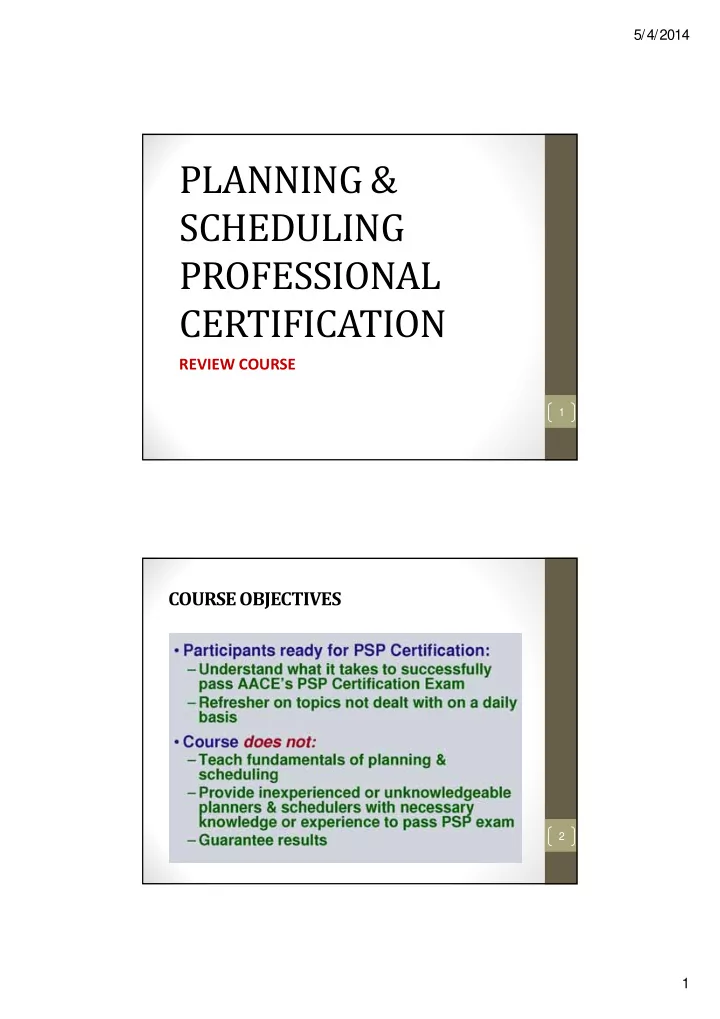
COURSE OBJECTIVES
2
PLANNING & SCHEDULING PROFESSIONAL CERTIFICATION REVIEW COURSE - - PDF document
5/4/2014 PLANNING & SCHEDULING PROFESSIONAL CERTIFICATION REVIEW COURSE 1 COURSE OBJECTIVES 2 1 5/4/2014 CERTIFICATION PROCESS 3 SCOPE OF KNOWLEDGE 4 2 5/4/2014 SCOPE OF KNOWLEDGE 5 PRIMARY REFERENCES 6 3 5/4/2014 PSP GLOSSARY 7
5/4/2014 1
REVIEW COURSE
1
COURSE OBJECTIVES
2
5/4/2014 2
CERTIFICATION PROCESS
3
SCOPE OF KNOWLEDGE
4
5/4/2014 3
SCOPE OF KNOWLEDGE
5
PRIMARY REFERENCES
6
5/4/2014 4
PSP GLOSSARY
7
PSP STUDY GUIDE FORMAT
8
5/4/2014 5
PREPARATION SUGGESTIONS
9 10
5/4/2014 6
PLANNING & SCHEDULING
11
PLANNING & SCHEDULING PROCESS
12
5/4/2014 7
PURPOSE OF PLANNING & SCHEDULING
13
WHY PLANNING ANDSCHEDULING
14
5/4/2014 8
PLANNING OUTLINES
15
PLANNING & SCHEDULING BENEFITS
16
5/4/2014 9
PLANNING & SCHEDULING BENEFITS
17
PLANNING VS. SCHEDULING
18
5/4/2014 10
PLANNING VS. SCHEDULING
19
PLANNING VS. SCHEDULING
20
5/4/2014 11
PLANNING VS. SCHEDULING
21 22
5/4/2014 12
SCHEDULINH BEGINS WITH PLANNING
23
Major Elements of Planning
24
5/4/2014 13
Results of Good Planning
25
Why Planning Works
26
5/4/2014 14
Program vs. Project
27
Opportunity for Influence
28
5/4/2014 15
Process Map
29
Example Question: Planning
30
5/4/2014 16
Example Question: Planning
31
Example Question: Planning
32
5/4/2014 17
INPUT / DATA
33
Establish a Planning Culture
34
5/4/2014 18
Planning Tools
35
Planning – The Project Triangle
36
5/4/2014 19
Stakeholders Input & Feedback
37
Example Questions: Stakeholders
38
5/4/2014 20
Example Questions: Stakeholders
39
RESOURCE CONSIDERATIONS & CONSTRAINTS
40
5/4/2014 21
RESOURCE PLANNING FLOWCHART
41
Planning Inputs & Outputs
42
5/4/2014 22
Example Question: Planning Input
43
PHASED EXECUTION APPROACH
44
5/4/2014 23
Design‐Bid‐Build ‐> Fast Track / Design Build ‐> Flash Track
45
EPC Projects (Design‐Build)
46
5/4/2014 24
Baseline Plan
47
Example Question: Phased Execution
48
5/4/2014 25
49
Work Breakdown Structure (WBS)
50
5/4/2014 26
WBS Development
51
WBS Development
52
5/4/2014 27
WBS Structure Example
53
WBS Levels Illustrated
54
5/4/2014 28
WBS ‐ OBS ‐ Schedule Relationship
55
WBS Issues
56
5/4/2014 29
Developing a Better WBS
57
WBS Development & Use
58
5/4/2014 30
WBS & OBS Relationship
59
WBS Issues
60
5/4/2014 31
Example Question: WBS
61 62
5/4/2014 32
OUTPUT / DELIVERABLES
63
Developing Specifications
64
5/4/2014 33
Specifications Components
65
Specifications Components
66
5/4/2014 34
Specifications Considerations
67
Specifications Considerations
68
5/4/2014 35
Specifications Details
69
Specifications Details
70
5/4/2014 36
Specifications Issues
71
Specifications Issues
72
5/4/2014 37
Potential Specifications Conflicts
73
Advanced Planning Topics
74
5/4/2014 38
75
SCHEDULING OUTLINE
76
5/4/2014 39
ESSENCE OF SCHEDULING
77
Integrated Planning & Scheduling
78
5/4/2014 40
Schedule Development
79
SCHEDULING METHODOLOGIES
80
5/4/2014 41
Basic Schedule Types
81
Schedules: What's the Purpose?
82
5/4/2014 42
STAKEHOLDER’S PERSPECTIVES
83
Stakeholders: Contractors
84
5/4/2014 43
Stakeholders: Subcontractors & Vendors
85
Stakeholders: Owners
86
5/4/2014 44
Example Question: Schedule Development
87 88
5/4/2014 45
INPUT / DATA
89
INPUT / DATA
90
5/4/2014 46
INPUT / DATA
91
INPUT / DATA
92
5/4/2014 47
INPUT / DATA
93
Why do Projects Fail?
94
5/4/2014 48
CREATING A SCHEDULE
95
CREATING A SCHEDULE
96
5/4/2014 49
Example Question: Schedule Development
97 98
5/4/2014 50
Schedule Activities Types
99
Examples: Activities Types
100
5/4/2014 51
Schedule & Activity Durations
101
DEVELOPING DURATIONS
102
5/4/2014 52
DEVELOPING DURATIONS
103
Understanding Activity Durations
104
5/4/2014 53
DEVELOPING DURATIONS ‐ CPM
105
Example Question: CPM Durations
106
5/4/2014 54
Example Question: Durations
107
Example Question: Durations
108
5/4/2014 55
Example Question: Durations
109
ACTIVITY SEQUENCING
110
5/4/2014 56
Developing Activity Sequences
111
Soft vs. Hard Logic
112
5/4/2014 57
CPM Model Detail Evolution
113
Duration & Sequence Issues
114
5/4/2014 58
Schedule Basis Documentation
115 116
5/4/2014 59
NON LOGIC‐DRIVEN SCHEDULES
117
Bar / Gantt Charts Advantages
118
5/4/2014 60
Bar / Gantt Charts Disadvantages
119
Gantt Chart Example
120
5/4/2014 61
Example of Combined Data Charts
121
NON LOGIC‐DRIVEN SCHEDULES
122
5/4/2014 62
Linear Advantages
123
Linear Disadvantages
124
5/4/2014 63
Linear / LOB Schedules
125
LOB Planning Process
126
5/4/2014 64
Roadwork LOB Summary Schedule
127
Analyzing LOB Schedules
128
5/4/2014 65
LOB Scheduling Issues
129
Example Question: Linear Schedules
130
5/4/2014 66
Milestone & Specialty Schedules
131
LOGIC‐DRIVEN SCHEDULES
132
5/4/2014 67
133
PERT
134
5/4/2014 68
PERT Schedule Mechanics
135
PERT Activity Durations
136
5/4/2014 69
DEVELOPING DURATIONS ‐ PERT
137
Example Question: PERT Durations
138
5/4/2014 70
In Class Exercise
139 140
5/4/2014 71
Network Schedules
141
Logic Diagrams (CPM Schedules)
142
5/4/2014 72
CPM Networks – Basic Functions
143
CPM Advantages
144
5/4/2014 73
CPM Disadvantages
145
CPM Bar Chart Graphics: A Caution
146
5/4/2014 74
Network / CPM Schedules
147
CPM – Today’s “Global Solution”
148
5/4/2014 75
Critical Path Method (CPM)
149
PDM ‐‐ Precedence Diagramming
150
5/4/2014 76
PDM ‐‐ Precedence Diagram
151
PDM ‐‐ Precedence Diagramming
152
5/4/2014 77
PDM Activity Notations
153
PDM ‐ Creating Relationships
154
5/4/2014 78
PDM – Level Of Effort Activities
155
MOST WIDELY USED CPM FORMATS
156
5/4/2014 79
157
Work Calendars
158
5/4/2014 80
Calendar Conventions
159
Work Day Change Example
160
5/4/2014 81
Calendars [P6 Example]
161
Resource Calendars
162
5/4/2014 82
Example Question: Calendars
163
Example Question: Calendars
164
5/4/2014 83
165
CPM Schedule Calculations
166
5/4/2014 84
CPM Schedule Calculations
167
CPM Schedule Calculations
168
5/4/2014 85
Forward Pass
169
Forward Pass Example
170
5/4/2014 86
Backward Pass
171
Backward Pass Example
172
5/4/2014 87
Example Question: Calculations
173
Example Question: Solution
174
5/4/2014 88
Example Question: Solution in Primavera SureTrak
175
In‐Class Exercise
176
5/4/2014 89
Draw Logic Diagram & Calculate Float
177 178
5/4/2014 90
179
Float Values Defined
180
5/4/2014 91
What is Float?
181
Float Calculations
182
5/4/2014 92
Float : Early & Late Schedules
183
Float : Early & Late Schedules
184
5/4/2014 93
Common Float Issues
185 186
5/4/2014 94
Common Float Issues (Continued)
187
Common Float Issues (Continued)
188
5/4/2014 95
Other Float Values
189
Example Question: Float
190
5/4/2014 96
191
Types of Constraints
192
5/4/2014 97
Date Constraints [P6 Example]
193 194
5/4/2014 98
Critical Path
195
Critical Path through Network
196
5/4/2014 99
Critical Path Concepts
197
Longest versus Critical Path
198
5/4/2014 100
Example Question: Critical Path
199 200
5/4/2014 101
CPM Data: A Peek Below the Water Line
201
CPM Database Sophistication
202
5/4/2014 102
P6 Coding & User Defined Fields
203
P6 WBS “Module”
204
5/4/2014 103
205
Schedule Model Quality Analysis
206
5/4/2014 104
Reviewing Baseline Schedule
207
Schedule Model Quality Analysis
208
5/4/2014 105
Schedule Model Quality Analysis
209
Model Quality Analysis
210
5/4/2014 106
Documenting Schedule Basis
211
Horizontal Traceability
212
5/4/2014 107
Vertical Traceability
213
SCHEDULING PITFALLS
214
5/4/2014 108
SCHEDULING PITFALLS
215
Example Question: Scheduling Issues & Pitfalls
216
5/4/2014 109
217
Resource Scheduling
218
5/4/2014 110
Resource Leveling
219
Resource Allocation
220
5/4/2014 111
Resource Leveling Benefits
221
Resource Leveling Benefits (continued)
222
5/4/2014 112
Example of Resource Profile
223
Example of Resource Leveling
224
5/4/2014 113
Non‐consumable Resources
225
Consumable Resources
226
5/4/2014 114
Resource Modeling / Analysis
227
Example Question: Resource Leveling
228
5/4/2014 115
229
Schedule Maintenance
230
5/4/2014 116
Schedule Maintenance
231
Data Date Concepts
232
5/4/2014 117
Progress / Updating the Schedule
233
Updating Considerations
234
5/4/2014 118
Updating Procedures
235
Updating Procedures
236
5/4/2014 119
Updating Procedures
237
Updating Procedures
238
5/4/2014 120
Reviewing Schedule Updates
239
Example Question: Schedule Maintenance
240
5/4/2014 121
Example Question: Schedule Maintenance
241 242
5/4/2014 122
Earned Value Considerations
243
Earned Value Terminology
244
5/4/2014 123
Earned Value Terminology
245
Earned Value Calculations
246
5/4/2014 124
EV Activity Statusing Methods
247
EV Activity Statusing Methods
248
5/4/2014 125
Example Question: EV Work Progress
249
Schedule Variance/Index Calculations
250
5/4/2014 126
Schedule Variance/Index Calculations
251
Schedule Variance/Index Calculations
252
5/4/2014 127
EV Trended Forecasting
253
Example Question: Schedule Maintenance
254
5/4/2014 128
Example Question: Updating for Progress
255
Example Question: Work Progress
256
5/4/2014 129
257
Change Management
258
5/4/2014 130
Change Management
259
Change Management / Control Outputs
260
5/4/2014 131
Schedule Change Control
261
Schedule Control
262
5/4/2014 132
Example Question: Change Control
263 264
5/4/2014 133
Schedule Levels of Detail / Filtering
265 266
5/4/2014 134
Management Summary
267
Level II Schedule Example ‐ 1/2
268
5/4/2014 135
Level II Schedule Example ‐ 2/2
269 270
5/4/2014 136
Progress & Trend Forecasting
271
Process Map for Forecasting
272
5/4/2014 137
Inputs & Outputs of Forecasting
273 274
5/4/2014 138
Example Question: Forecasting
275
Example Question: Forecasting
276
5/4/2014 139
Example Question: Forecasts
277 278
5/4/2014 140
Schedule Compression
279
Schedule Compression
280
5/4/2014 141
Schedule Compression
281 282
5/4/2014 142
Crashing Analysis
283
Directed Acceleration
284
5/4/2014 143
Constructive Acceleration
285
Example: Acceleration
286
5/4/2014 144
Example Question: Acceleration
287 288
5/4/2014 145
Identifying & Documenting Schedule Change
289
Analyzing Schedule Delays
290
5/4/2014 146
Time Impact Analysis (TIA)
291
Time Impact Analysis (TIA)
292
5/4/2014 147
Time Impact Analysis (TIA)
293
Time Impact Analysis (TIA)
294
5/4/2014 148
Time Impact Analysis (TIA)
295
Reporting Status & Forecasting
296
5/4/2014 149
Example Question: Changes & Delays
297
Control Inputs, Tools & Techniques
298
5/4/2014 150
Control Inputs, Tools & Techniques
299
Example Question: Baselines
300
5/4/2014 151
Example Question: Recovery Plans
301 302
5/4/2014 152
CPM Schedule Reporting
How good are your Communications Skills?
303
OUTPUT / DELIVERABLES
304
5/4/2014 153
Reporting to Stakeholders
305
Why Important to Management?
306
5/4/2014 154
Reviewing Schedules
307
Variability, Risk & Credibility
308
5/4/2014 155
Report, Advise & Decide
309
Example Question: Reporting to Management
310
5/4/2014 156
Credibility in Planning & Scheduling
311
What's Going On Here?
312
5/4/2014 157
Use following table / data to answer questions
313
Example: Scenario Questions
314
5/4/2014 158
Example: PDM Diagram – TF & FF
315
Example: CPM Network Solution
316
5/4/2014 159
Example: Delay Chart
317
Example: Answers
318
5/4/2014 160
Example: Communications Problem
319