Plan Components of the motor systems Focus on spinal control of - - PDF document

plan
SMART_READER_LITE
LIVE PREVIEW

Plan Components of the motor systems Focus on spinal control of - - PDF document

Plan Components of the motor systems Focus on spinal control of limbs and trunk Same principles apply to to head control Introduction to the Motor Systems via brain stem Basic principles of movement control What is helpful


slide-1
SLIDE 1

1

Introduction to the Motor Systems

John H. Martin, Ph.D. Center for Neurobiology and Behavior

Plan

  • Components of the motor systems

– Focus on spinal control of limbs and trunk – Same principles apply to to head control via brain stem

  • Basic principles of movement control

– What is helpful for understanding basic motor system organization

  • Motor programs for voluntary movement
  • Descending motor pathways

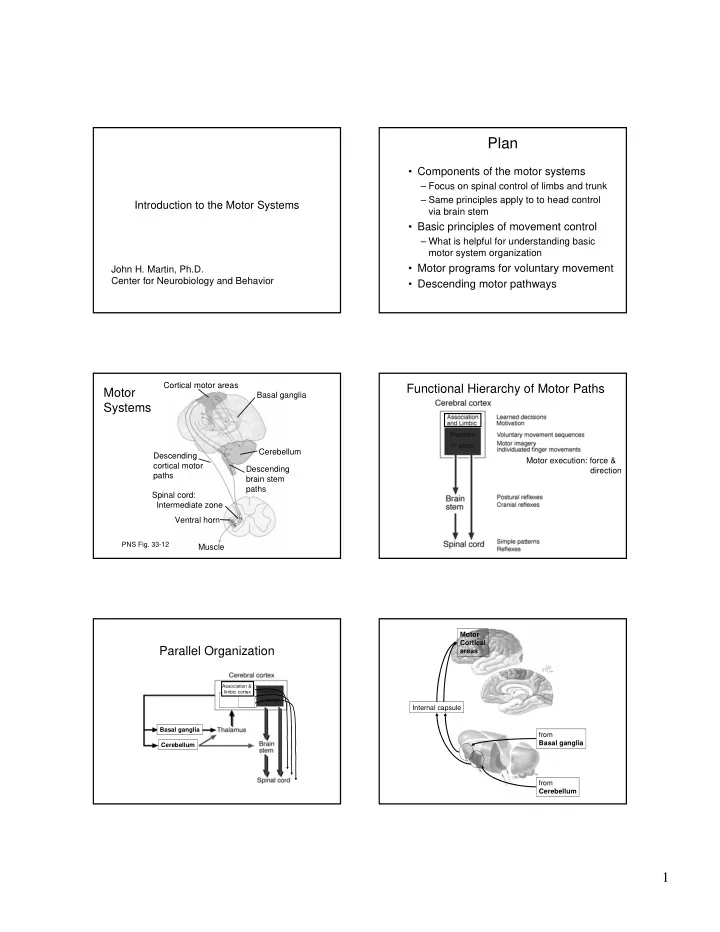
Motor Systems

Cortical motor areas Basal ganglia Cerebellum Descending brain stem paths Descending cortical motor paths Spinal cord: Intermediate zone Ventral horn Muscle

PNS Fig. 33-12

Functional Hierarchy of Motor Paths

Motor execution: force & direction

Parallel Organization

Basal ganglia Cerebellum

Association & limbic cortex

from Cerebellum Internal capsule Motor Cortical areas from Basal ganglia

slide-2
SLIDE 2

2

Hierarchical & Parallel Organization

  • f the motor systems
  • Top down organization of the motor pathways--
  • pposite that of sensory paths
  • Subcortical motor centers--cerebellum & basal

ganglia--access cortical motor areas via the thalamus (not just sensory)

  • Organization of multiple subcortical and cortical

motor circuits-reminiscent of parallel sensory pathways

Organization of Movements

  • Hierarchical: 3 major types

– Reflexes – Postural adjustments – Voluntary movements

  • …from simple to complex
  • Diverse & adaptive

– Purposeful

Organization of Movements

  • Hierarchical: 3 major types

– Reflexes Spinal cord circuits – Postural adjustments Spinal & Brain stem – Voluntary movements Spinal cord, Brain stem, & cortex

Postural adjustments & voluntary movements depend more on cerebellar and basal ganglia function than reflexes Dual purpose: 1) upcoming lectures; 2) context for motor pathways

Reflexes

  • Stimulus-evoked involuntary muscle

contraction

  • Monosynaptic (+) reflex

– Knee-jerk – Jaw-jerk

  • Simple neural representation (circuit)

Knee Jerk

From muscle stretch receptors to muscle

Ventral horn

Reflexes

  • Stimulus-evoked involuntary motor

muscle contraction

  • Monosynaptic (+) reflex

– Knee-jerk – Jaw-jerk

  • Disynaptic reflex (+)

– withdrawal

slide-3
SLIDE 3

3

Why Disynaptic?

  • Greater control (neural gate)

– Very simple context

  • More complex response

from periphery from higher centers to muscle Response blocked by inhibition

Greater control:

Motor I/O

Knee-jerk Automatic postural adjustments Flexible than reflexes (greater #; each w/control) Constrained than voluntary

  • Balance
  • Limb support

Postural adjustments

  • Context important

– Can reorganize depending on context

  • Feedback control-reactive

– Error correction – Response lags stimulus; sometimes too late; sometimes vicious circle

  • Feed-forward control-predictive

– Response anticipates stimulus – More timely, but depends on practice

  • Depends on cerebellum, brain stem

pathways & spinal cord

  • More complex neural representation

Voluntary movements

  • Organized around purposeful acts
  • Flexible input-output relationships

– Limitless – Price to pay: whole brain

  • Recruits all motor systems components &

much of the association cortex Discuss:

  • Goal representation
  • Motor programs

The goal of voluntary movements is represented… somewhere

  • Motor equivalence

– Individual motor actions share important characteristics even when performed in different ways

  • Abstract representation; effector independent

– Hand writing – Soccer

  • Goal representation
  • ??Association & Premotor cortex
slide-4
SLIDE 4

4

Voluntary movements are

  • rganized by motor programs
  • Translate goal into action

– Formation of a movement representation, or motor program

  • ??Premotor cortex --> Primary motor cortex
  • Program

– To produce the desired goal, which muscles should contract and when

  • 2 Key movement characteristics that are

programmed

– Spatial (hand path; joint angles) Kinematic program – Force Dynamic program

Kinematic & Dynamic Programs in Reaching

  • Reach to target--(Sensation to Action)

– Visual cortex-->Association cortex-->Premotor-->1° motor

  • Distinct kinematic and dynamic programs

– Reach up

  • Against gravity
  • More force to achieve goal

– Reach down

  • Gravity assists
  • Less force to achieve goal

– Flexible control

Summary

  • Motor behavior hierarchy

– Reflexes – Postural adjustments – Voluntary movements

  • Internal/neural representations

– Reflexes simple; invariant – Postural adjustments – Voluntary movements complex; flexible

  • Voluntary movements

– Goal representation – Kinematic and dynamic programs – No wonder why voluntary movement recruit entire motor system

Motor Pathways

Cortical motor areas Descending brain stem paths Descending cortical motor paths Spinal cord: Intermediate zone Ventral horn Muscle 1° motor cortex Premotor cortex Red nucleus Reticular formation Vestibular nuclei Superior colliculus

PNS Fig. 33-12

Motor Pathways Hierarchy

Direct Indirect

Premotor areas

Origins of motor paths

Motor Pathways Hierarchy

Premotor areas

slide-5
SLIDE 5

5

Motor Pathways Hierarchy

Premotor areas

Motor Pathways Hierarchy

Premotor areas

Motor Pathways Hierarchy

Premotor areas

Motor pathways organized around the motor nuclei

Motor columns (motor neurons) Propriospinal-- Intersegmental-- neurons

Spinal Motor Columns

Short Long

From brain Segmental interneuron Motor neuron

PNS Fig. 33-13

Ventral Horn Organization: Proximal - distal rule

Lateral pathways: limb control Medial pathways: trunk control

NTA Fig. 10-2

slide-6
SLIDE 6

6

Brain Stem Motor Paths

Red nucleus Rubrospinal tract Tectum Tectospinal tract Reticular formation Reticulospinal tracts Vestibulospinal tracts Vestibular nuclei Medial Lateral Bilateral Contralateral

PNS Fig. 33-14

Brain Stem Pathways

  • Lateral

– Rubrospinal tract: distal limb control; crude (red nucleus)

  • Medial

– Tectospinal tract: eye-head coordination (superior colliculus) – Reticulospinal tract: automatic postural adjustments and movements (hip; shoulder) (reticular formation) – Vestibulospinal tract: balance (axial muscles); automatic postural adjustments (vestibular nuclei) Ventral corticospinal tract Lateral Cortico- spinal tract

Pyramidal X Red nucleus Rubro- spinal tract Vestibular & Reticular nuclei Medial brain stem paths

Medial Lateral

Cortical Motor Paths

Bilateral Contralateral

PNS Fig. 33-15

Cortical motor paths

  • Lateral corticospinal tract

– Limb control mostly

  • Ventral corticospinal tract

– Proximal muscle control; mostly upper body

  • For cranial muscle control:

Corticobulbar tract

– with medial and lateral components

Origins of cortical motor paths

  • Primary motor cortex
  • Premotor cortex
  • Supplementary motor area (SMA)
  • Cingulate motor area (CMA)

Why bother study the motor pathways?

  • Anatomical substrates: How it works
  • Multiple parallel paths & diversity of spinal

connections

– Damage to 1° motor cortex and pre-motor cortex projections recover some lost functions – Damage to cortex and brain stem paths recover some lost functions – With spinal cord injury. loss of monosynaptic connections and alternate paths via segmental and intersegmental interneurons can recover some lost functions