Plan for Today Remarks by OLLI Director Megan Whilden Introduction - - PowerPoint PPT Presentation

plan for today
SMART_READER_LITE
LIVE PREVIEW

Plan for Today Remarks by OLLI Director Megan Whilden Introduction - - PowerPoint PPT Presentation

Plan for Today Remarks by OLLI Director Megan Whilden Introduction of MFW and Kate Discussion of Zoom features and how to use them (practice with Polls #4 and #5 ) A Land Acknowledgment Outline of Topics to be addressed in this


slide-1
SLIDE 1

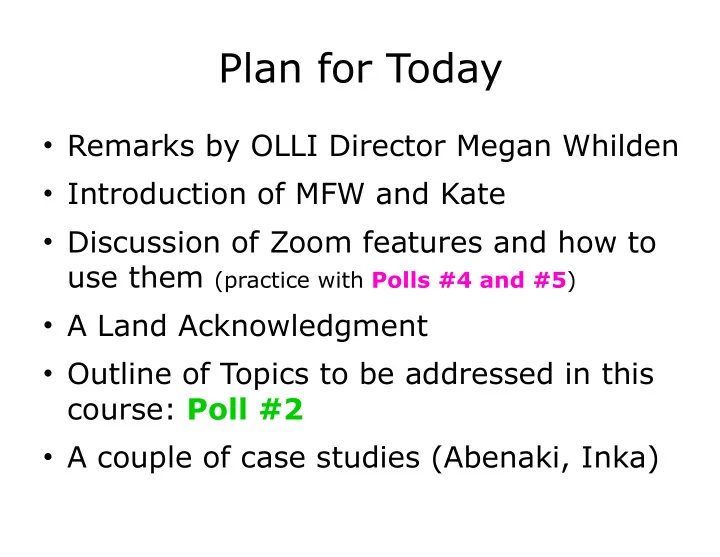
Plan for Today

  • Remarks by OLLI Director Megan Whilden
  • Introduction of MFW and Kate
  • Discussion of Zoom features and how to

use them (practice with Polls #4 and #5)

  • A Land Acknowledgment
  • Outline of Topics to be addressed in this

course: Poll #2

  • A couple of case studies (Abenaki, Inka)
slide-2
SLIDE 2

Michael Forbes Wilcox

  • lli@mfw.us

Born and Raised in Stockbridge Active in Civil Rights Movement and in the Vietnam Anti-War Movement MA in Economics, Trinity College CFA (Chartered Financial Analyst) – Quantitative Professional Career included:

  • 11 years in the Hartford area: IT/Finance
  • 12 years on Wall Street (Principal, Morgan Stanley)
  • Founder of QWAFAFEW
  • 2 years money management State Street Boston
  • several years independent research/consulting/expert witness

Political Organizer and Disability Rights Advocate (Massachusetts Special Commission Relative to Autism, Boards of AANE, Autism Connections) Currently Alford Town Moderator, formerly on the Board of the Massachusetts Moderators Association

slide-3
SLIDE 3

A Land Acknowledgment

We will begin (each time) with a land

  • acknowledgment. I am speaking from Alford.

Please adapt the sentiments here to your own locale. I would be glad to provide details to anyone wishing to personalize this concept. Key words: Muhheconneok, Muhheconnituck, Pitawbagok, Podunk, Seekonk, Seg8gw, Algonkian, moz, Indiantown, Shawenon, Greenland Grant, Anushiik (Munsee), Oneewe (Mohican), Wliwni (Abenaki) https://northstarcasinoresort.com/news/temporary- closure-notice

slide-4
SLIDE 4

M103 Indigenous Cultures in the Berkshires and Beyond

NB: The themes listed on this and the next slide are interwoven into

  • ur “case studies” and will mostly be explored via these examples

1491: New Revelations of the Americas Before Columbus

  • People arrived in the Americas earlier than had been thought

Poll #6

  • There were many more people in the Americas than in

previous estimates

  • American cultures were far more sophisticated than had

been believed

  • Environmental management was widespread and hugely

impactful (belying the concept of “wilderness”)

slide-5
SLIDE 5
slide-6
SLIDE 6

Some of the other things we will talk about

Please put in the Q&A any comments about your preferences and suggestions (including resources you would recommend)

Changes in the Land Case Studies Language Lewis Henry Morgan Indigenous Values: religious beliefs, myths, and story-telling The History of Balance Exchange of Values The Little Ice Age Lost Opportunity

slide-7
SLIDE 7

Issues Raised/Implied in the Land Acknowledgment

Exonym versus Endonym (Mohican/Muhheconneok) [Muhheconneew] another example: Haudenosaunee 1755 Massachusetts/New York Border Population Die-Off from Disease Private Property/Usufruct Rights Woodlands Management Language/Dialects and Tribal Boundaries Orthography: Skunk = seg8gw | segȏgw

slide-8
SLIDE 8
slide-9
SLIDE 9

In no particular order...

Language

There was no word for time or clock in the Abenaki Language and so our ancestors came up with a word for clock. Papulkweezultozik which means “that thing which makes much noise but does nothing at all of any real use.” Judy Dow [pizwiwi = useless] The concept of time was related to the accumulation of change. Since Indian languages were oral, and (for the most part) had no written records, and some dialects died out, we rely on colonial documents that attempted to record what they heard. The European orthography, naturally enough, reflects the way they write their own language sounds. In New England, as the English pushed north and confiscated Abenaki lands, the Native people fled north and west, many of them ending up in what is now Canada. The French were more welcoming of the Indians, often living among them and even inter-marrying, and attempted to understand their culture, even as they tried to save their souls by converting them to Christianity. So early Abenaki dictionaries and grammars were written in the French style. In contrast, many of the documents that record other Algonkian dialects, those along the Eastern seaboard, use English-style orthography. In trying to find cognates between Abenaki and Mohican, for example, I find that I have to say the words out loud in order to comprehend whether they might be the same word, even if altered slightly, because the spellings are so different that at first glance they seem to have no similarity. I'll give some examples later.

slide-10
SLIDE 10

People arrived in the Americas earlier than had been thought

Laurentine Glaciation

  • Our part of the “New World” was inhabited

before parts of northern Europe

  • More of the Continental Shelf was exposed

“History is written by the victors”

  • What was Holmberg's Mistake? Poll #3
  • Who controlled the narrative that we (of

European descent) have come to know? [rhetorical question!]

slide-11
SLIDE 11
slide-12
SLIDE 12
slide-13
SLIDE 13

Where are the Wabenaki homelands? What does the name mean?

Much of my information here comes from a talk by Ron Paul (Penobscot) at UMass on February 26, 2020 In Abenaki (and, by extension, Algonkian) culture, the creation of all life was done by the sun and the earth, with the sun as the father and the earth as the mother. The dawn of a new day is an important event, because every day is a “do-over” – you get to correct the mistakes of the past and to launch new and exciting ventures. ckuwi = come this way ckuwap = look this way ckuwapon = the sun is looking our way (dawn)

slide-14
SLIDE 14

ckuwi = come this way ckuwap = look this way ckuwapon(ah) = the sun is looking our way (dawn) ki = earth, soil, land kik = on the ground, on the land kiyig = the people who live on the land the suffixes ik ak uk ok are all locatives or indicative of people the suffix abe (ah-bay) = people ak is also a suffix indicating plural the “g” and “k” sounds are somewhat interchangeable, and speaker- dependent ckuwaponahkik = the land where the sun first looks our way ckuwaponahkiyig = the people who live on the land where the sun first looks

  • ur way (people of the dawnland)

ckuwaponahkiyig = wabenaki (singular) wabenakiak (plural)

slide-15
SLIDE 15

Exonym versus Endonym It wasn't just the English

The Europeans had great difficulty comprehending Indian naming schemes. They did not understand, for example, that individuals did not necessarily keep their birth name throughout their lives, but were often given new names to reflect their accomplishments

  • r roles. Also, the Europeans did not fathom that groups of Indians that lived great

distances apart and seemed (to them) to be unconnected could actually be part of the same nation. When, for example, Samuel de Champlain explored the gaspeguyuk (gaspé in French) peninsula, he encountered several large groups of Indians living along the river. He always asked what they called themselves, and his scribe recorded the answers. There was probably a lot of sign language and gesturing involved, because the two cultures had not had much contact, so spoken words were probably not well understood. gaspeguyuk = end of water (where fresh and salt waters mix) One of the first groups he encountered told him they were Wabenaki (pronounced ah- ben-AH-key in English, but ah-BEN-ah-key in Algonkian). A hundred miles away, he encountered another group who told him the same thing. “Impossible!” he said, “I just met some people down the river who told me that!” “8h8h (Yes),” they said, “nimicamog (those are my people)” And so Champlain called them the Micmac. There are many other examples.
slide-16
SLIDE 16

Where are the Wabenaki homelands? What does the name mean?

slide-17
SLIDE 17

Maliseet means “slow speaker”

slide-18
SLIDE 18
slide-19
SLIDE 19

Western Abenaki

Southern Border west of the Kwenitegok (kweni = long, tekw = river,

  • k = to)

seems to be the Pokw8mtekw (Pocumtuck; pokw8m = very narrow), now the Deerfield River Time for Quiz #7

slide-20
SLIDE 20
slide-21
SLIDE 21

Morgan on the left, a contemporary account on the right

slide-22
SLIDE 22

How the Tuscarora squeezed in

slide-23
SLIDE 23

Time for Poll #1 (and a break?) Some random gleanings

“L” and “R” languages/dialects Western Abenaki dog = alemos

slide-24
SLIDE 24

More Tidbits

  • “Cahokia … was once the greatest population center

north of the Río Grande.” p. 29

  • “… manitou, the world-suffusing spiritual power at the

heart of coastal Indians' religious beliefs.” p. 41

  • New England (1616) previously called “Norumbega” 42
  • “glottochronology” p. 43 -- common Algonkian ancestor

a few hundred years BC

  • Hopewell culture ~2K years ago, ending ~400 AD, may

have been the source of Algonkian languages pp. 43-44

  • pp. 45-49 discussion of heating methods for dwellings,

diet, absence of war (beginning? of palisades)

slide-25
SLIDE 25

Results of Poll #1?

slide-26
SLIDE 26
slide-27
SLIDE 27
slide-28
SLIDE 28
slide-29
SLIDE 29
slide-30
SLIDE 30
slide-31
SLIDE 31
slide-32
SLIDE 32
slide-33
SLIDE 33
slide-34
SLIDE 34