Pilot on Thermal Enhanced SVE of Mercury in Soil and Bedrock under - - PowerPoint PPT Presentation

pilot on thermal enhanced sve of mercury in soil and
SMART_READER_LITE
LIVE PREVIEW

Pilot on Thermal Enhanced SVE of Mercury in Soil and Bedrock under - - PowerPoint PPT Presentation

Pilot on Thermal Enhanced SVE of Mercury in Soil and Bedrock under an active Chloro-Alkali Plant Eric Bergeron (Golder Associates, Montreal, QC, Canada) Lena Torin & ke Eriksson (Golder Associates, Gothenburg, Sweden) Berndt-Olof Jorlv


slide-1
SLIDE 1

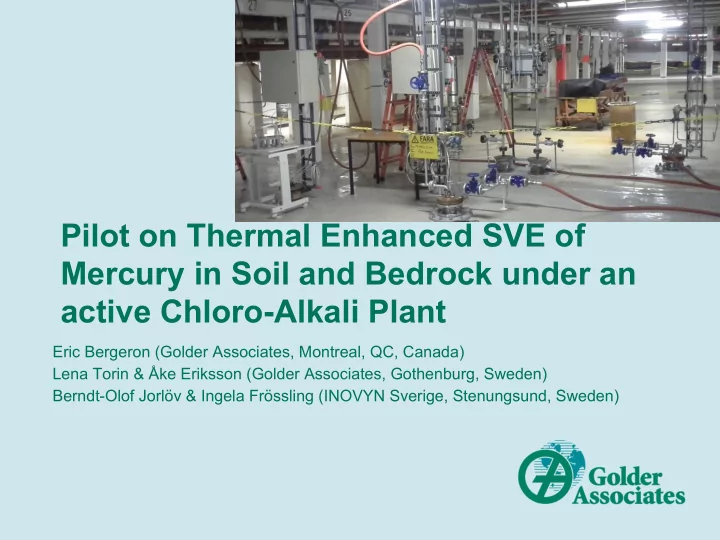
Pilot on Thermal Enhanced SVE of Mercury in Soil and Bedrock under an active Chloro-Alkali Plant

Eric Bergeron (Golder Associates, Montreal, QC, Canada) Lena Torin & Åke Eriksson (Golder Associates, Gothenburg, Sweden) Berndt-Olof Jorlöv & Ingela Frössling (INOVYN Sverige, Stenungsund, Sweden)

slide-2
SLIDE 2

Background

March 14, 2016 2

Mercury based Chlor-Alkali plant started in 1969 in Stenungsund

Decision from the Sweden government:

■ Plant must be closed down by

December 2017

■ The mercury contamin-ation

needs to be remediated

Investigations show almost no contamination outside the plant building

Up to 1,5 ton of primarily elemental Hg could be present directly under the plant

slide-3
SLIDE 3

Cross-Section of the Site

March 14, 2016 3

  • Approx. 1 500 kg Hg
  • Approx. 500 kg Hg are thought to be

present in deep fractures

Excavation of the thin fill will probably remediate less than approx. 25 % of the Hg. Low temperature heating of soil/ bedrock coupled with SVE was determined as the preferential, sustainable remediation technique for the site.

slide-4
SLIDE 4

Pilot design

March 14, 2016 4

Collaboration between INOVYN (process engineering) and Golder Associates

3 heating wells (HW), triangular pattern

■ Indirect heating of stainless steel

casing by 140OC steam from plant

■ 2.5 m down, into the bedrock ■

2 extraction wells (EW)

■ EW-S: 1 m deep (sand and top highly

fractured ”bad” bedrock)

■ EW-D: 2.6 m deep (”good” bedrock) ■

2 monitoring wells (MW), ~5 m deep, 4 sampling levels (0.3 m, 1.75, 3, 5 m)

SVE started May 7th (baseline), heating started May 21th

slide-5
SLIDE 5

The pilot inside the Chloro-Alkali plant

March 14, 2016 5

EW-S &D MW-1 MW-2 HW-1 to 3

slide-6
SLIDE 6

Results from drilling for the pilot

March 14, 2016 6

10 m ■

Water encountered 1.3 mbgs inside, but ~ 5 mbgs or more outside the plant

Shallow wells will be drilled next week to try to dewater the pilot zone

Deep bedrock → very low permeability

Mass balance shows within the pilot:

■ Approx. 5 kg Hg in vadose zone ■ A few mg in water in the bedrock 20 m boring

Hg in matrix (mg/ kg) Max Mean Sand 4 900 850 ”Bad” top bedrock 7.2 3.0 Bedrock 2.3 0.6

Sand Top bedrock Bedrock

MW:s EW-S

slide-7
SLIDE 7

Results from the pilot

March 14, 2016 7

~20% of Hg extracted after 8 months Virtually no gas extracted from ”good” bedrock

Hg in gas Temperature

slide-8
SLIDE 8

Hg-speciation results for soil and bedrock

March 14, 2016 8

Speciation by Braunschweig University of Technology

■ Pyrolysis speciation for soil and bedrock ■ University developed speciation method for

water and gas (bubbled through water)

Not only elemental Hg in soil and bedrock

Almost 50% elemental Hg in sand that had Hg droplets

Elemental Hg has probably diffused into the ”bad” top bedrock

No elemental Hg in ”good” bedrock

Several other Hg-species present (HgCl2, HgS and/or HgO) Sand: 4900 mg/kg ”Bad” top bedrock: 7,2 mg/kg

slide-9
SLIDE 9

Hg-Speciation of Gas

March 14, 2016 9 Hgpart: Particle bound Hg; HgIIb: Dissolved organic Hg (bound to BrCl-oxidable organic compounds); HgIIa: Dissolved inorganic, reactive Hg; Hg0: Elemental Hg During = 3 months after heating started

slide-10
SLIDE 10

Extraction Rate Over Time

March 14, 2016 10

slide-11
SLIDE 11

Energy Requirements

March 14, 2016 11

Sandy layer ( ̴ 0,5 m): 178 kW.h/m3

Bad bedrock layer ( ̴ 0,4 m): 157 kW.h/m3

Gneissic Bedrock ( ̴ 3,1 m): 60 kW.h/m3

Adapted from TerraTherm and Weston 1997

slide-12
SLIDE 12

Results

March 14, 2016 12

Observations:

Extraction rate needs to be increased significantly

Temperature increase of 22°C → a seven-fold increase in vapor pressure → 2.6 fold increase in extraction rate

Estimated treatment time : 12 years

Bedrock dewatering is necessary Solution:

↑soil temperature up to 100 oC

Soil temperature ↑ 50 to 100 oC → 26 fold increase of the vapor pressure

7.2 fold increase of the extraction rate expected

Estimated treatment time : 21 months

slide-13
SLIDE 13

Full-Scale

March 14, 2016 13

slide-14
SLIDE 14

Full-Scale

March 14, 2016 14

slide-15
SLIDE 15

Next steps…

March 14, 2016 15

Full scale detail design

Get a decision from the regulators on necessary remediation

The plant will close down during autumn 2017

After that process equipment (cells etc.) will be taken down and remediated

Drilling for full scale remediation will probably not start before the cells are away Control room

slide-16
SLIDE 16

The good collaboration with INOVYN has been key for the success of this pilot! Thanks: to INOYN! to the team! for the good teamwork!

Skall försöka hitta mer foton på

  • ss som varit

inblandade, har ni några på er?