
SLIDE 1
Scientific Study: Presentation
Physiological Effects
- f Low Temperature
Physiological Effects of Low Temperature Infrared Treatment. - - PDF document
Scientific Study: Presentation Physiological Effects of Low Temperature Infrared Treatment. Findings of the Study. Abstract The study confirmed the working hypothesis that the use of direct low temperature infrared treatment of Study Title
Study Title “Exploratory Investigations into Physiotherm Low Temperature Infrared Treatment Technology with ILCS (instant leukocyte culture system) by means of Physiological and Immune-modulating Effects” The study was designed to investigate the physio- logical effects – especially on the immune system –
an addition to and in comparison with simple heat
with low temperature radiators were used in the
ment technology means that the distance between the radiation source and the body can be kept very short, which ensures a relatively high infrared radiati-
ning relatively low room temperatures. Study Design Monocentric, controlled, randomised, prospective, single-blind pilot study. monocentric - carried out in a single test centre controlled - a control group is used to monitor the effects of a placebo (placebo group) randomised - the subjects are assigned at random to the different groups prospective - the study follows a course of treat- ment throughout, assessing it continuously, not just after completion (this would be retrospective) single-blind - the subjects do not know whether they are receiving real treatment (verum group)
stance (placebo group) pilot study - tests the tenability and utility of an hypothesis. Abstract The study confirmed the working hypothesis that the use of direct low temperature infrared treatment of the back of humans (an application of Physiotherm) when compared with simple heat treatment can in fact produce significant physiological and immunolo- gical effects in the whole physical system. Particular Circumstances of the Study Healthy subjects - It was important in this pilot study to have healthy subjects since an initial concern was to demonstrate the harmlessness of the applica- tion and to create a set of data. Only now, with a data set obtained through trials, is it possible serious- ly to plan and assess studies which investigate the immunological effects when different indications are treated. Over 150 applicants needed to be screened before the 18 healthy subjects, all meeting the stringent exclusion and inclusion criteria of the study, could be identified and recruited. 4 subjects breached the study protocol so that only the data of 14 subjects were included in the final assessment procedure. Successful blinding - In the placebo cabins, the low temperature radiators were covered with aluminium
was the same as in the cabins of the verum group. This meant that even after several treatment cycles the subjects could not tell whether they were in the verum group or the placebo group, and the subjects confirmed this in the responses they were regularly asked to give with the help of the questionnaire. Optimisation of blood tests - The blood samples were analysed in a special laboratory (E.D.I.) in Tübingen, Germany. A particular feature of this system for immunological analyses, which has been both developed and patented there, is its high degree of accuracy and validity. 2
Immediately after the blood samples are taken, they are established in culture in special vials contai- ning an activator fluid which are placed in a heating block at body temperature. This is to increase the reliability of the immunological data. After 24 hours, the serum and cell components of the blood samples are separated and frozen at -20° C and sent to the laboratory for analysis. Exclusion of ambient factors - The result of prior tests was that CO2 concentrations increased sharply during a cabin session whereas O2 concentrations
heat is applied in closed cabins (saunas, heat cabins etc.) and up to now has obviously been scarcely noti-
(health cubs, hotels etc.) this needs not to be seen as posing a problem, but this phenomenon does need to be taken into count when developing a medical product or running a study. For the Physiotherm study, therefore, the manufacturer deve- loped cabins with special control instruments, which kept the interior at all times within a narrow tempe- rature range. Modification of the study settings - The quality and the cost of the trial met the standards of GCP (Good Clinical Practice). However, to make it possible to conduct the trial in a private doctor's surgery, Dr. Otto Pecher made some modifications in the field of quali- ty assurance. This entailed the recruitment of additio- nal qualified staff from the Institute for Heat and Immune Therapy (IWIT). They received training on the particular requirements of the study and their duties were confined solely to it. Findings and Interpretation This study was the first to provide evidence under controlled conditions of the systemic effects of both a single application and a series of six applications of low temperature infrared treatments to healthy sub- jects and its superiority over simple heat treatments. The data obtained (circa 120 safety parameters and a further 10 target parameters) provide a considerable body of evidence on the short-term and long-term effects of low temperature infrared treatments. This evidence can be used to develop treatment concepts for particular ailments using Physiotherm low tempe- rature infrared cabins. Some initial application recommendations, and also ideas for further trials can be derived from the following, careful interpretation of the data. Apart from that, the study data obtained confirm certain important aspects of the experiences and
technology.
Physiotherm sessions are comparable with moderate endurance training.
affected significantly.
in diastolic blood pressure.
temperature during verum applications.
pain-reducing neurotransmitters and therefore have a pain alleviating effect.
ters were noted.
moderate degree of physical training stimulus and the present findings show they can be recommended to persons with restricted motor ability (for example, age-related conditions). 3
Findings in Detail Cardiovascular data - Blood pressure and pulse count were measured during each session (continu-
evening (18.00 hours) of each trial day. During appli- cation, diastolic blood pressure fell in the verum group, with systolic readings remaining stable. Interpretation - It can reasonably be assumed that Physiotherm has an effect on the cardiovascular system analogous with that of moderate physical training because it regulates blood pressure. Since the subjects were exclusively all healthy young men, the
pressure) can be expected to be more pronounced in patients with hypertension. It may therefore be assu- med that patients with high blood pressure would benefit from low temperature infrared treatment. It must also be stated that applying Physiotherm produced no indications of any negative impact on the cardiovascular system, which makes it a treat- ment option for special patient groups (older people, patients with high blood pressure). Oxygen saturation in blood - Oxygen blood satura- tion was measured continuously throughout the ses-
group, but not in the placebo group. Interpretation - This observation squares well with sport medicine and hyperthermia findings. During exposure to heat, transcutaneous measurements with pulsoxymetry (SpO2 = O2 saturation in haemoglobin) lead to a phenomenon known as a shift to the right. Where pO2 remains constant, SpO2 drops somewhat, since absorption of O2 is temporarily reduced becau- se the erythrocytes are being temporarily warmed. This is an effect also observed in endurance perfor- mances involving increased body core temperature
Physiotherm sessions are therefore, in principle at least, comparable in their effect on oxygen blood saturation with endurance training or high-altitude training. Body core temperature - Body core temperature increased in the verum group during the session by a mean of 0.2° C. The initial body core temperature before infrared application increased in the verum group when com- pared with the placebo group. In line with this, the researchers documented significantly more perspirati-
Interpretation - During the whole course of the trial, the subjects in the verum group experienced increased levels of body core temperature. These fin- dings suggest increased metabolic activity, an increa- sed basal metabolic rate and an effect on thermore-
well be useful as an adjunct to a weight reduction
calories. Increased perspiration can be understood from understanding of the literature as having a detoxify- ing function. Still own measurements of toxicant con- centrations in the asservated perspiration have to be carried out. Endorphins - The literature has examples of old studies on increased endorphin secretion following fango therapy, which could not be confirmed howe- ver in sauna trials. The endorphin measurements must be interpreted with caution since a considerable number of the measurements (in both groups) was outside the line- ar – and therefore reliable – range of the measure- ment methodology used. However, if we restrict our- selves to the data in the valid range, the following assertions can be made: In the placebo group, the endorphin levels drop within a single session and during the whole applica- tion period more significantly than in the verum 4
produced signs of a rise in the mean endorphin level. The continuous decline in the placebo group can be explained as being the result of habituation. The fact that this phenomenon was not recorded in the verum group can be interpreted as being due to the increa- sed release of endorphins in that group. Interpretation - The rise in endorphin secretion squares with clinical observations of reduced pain (e.g. from backache) when Physiotherm is applied. Routine laboratory parameters - A routine labora- tory check was conducted into all parameters at the start of the study (Day 1) and at the end (Day 16). The main purpose of this was to detect any potenti- al undesirable effects. Bearing in mind the variability of the individual parameters, no treatment-related effects – statisti- cally speaking – were noted. The observed changes could, as single events, essentially be interpreted as supporting the view that there was increased meta- bolic activity. Questionnaires - Right up to the final stages of the study, the subjects were unable to tell whether they were assigned to the verum or placebo group. This means that the blinding can be regarded as success-
daily habits including eating habits, medication) also demonstrated that both groups compared well with each other. Cortisol - Daily cortisol levels in healthy people have a distinct profile, with a sharp drop between 12.00 and 18.00 hours. This circadian rhythm was not affected in the placebo group – plasma concentrati-
after applications, whereas in the verum group, though this drop is, physiologically speaking, to be expected, it was scarcely possible to detect it. The general cortisol level, however, was not affected during the whole treatment period. Interpretation - Depending on how intense it is, physical training causes cortisol levels in blood to rise. The fact that the drops in cortisol levels in the sub- jects of the verum group were relatively slight sup- ports the hypothesis that a Physiotherm session, as
moderate training stimulus. Cytokines (as indicators of immune system functionality) - Cytokines from the non-specific, spe- cific and also transitional immune systems (IFN gamma, IL-1ß and MCP-1, IL-10, IL-12) were recorded. Repeated Physiotherm sessions have a slightly dampening effect on the daily profile of cytokine measurements, though without any change to the basic level during the treatment period. This effect correlates with the effect on cortisol levels. However, the physiological, circadian rhythm does not get neu- tralised. No long-term stimulating effects on the immune system throughout the observation period could be verified because the number of subjects was low; furthermore this was not to be expected because these subjects had optimal regulated immune systems before entering the study. There was no evi- dence of an influence on cell counts (routine labora- tory test). Interpretation – A Summary The study confirmed the initial hypothesis. Compared with the application of heat alone (e.g. in cabins), there is a considerable advantage in applying additio- nal infrared radiation directly to the back. The special low temperature technology causes very little impact
5
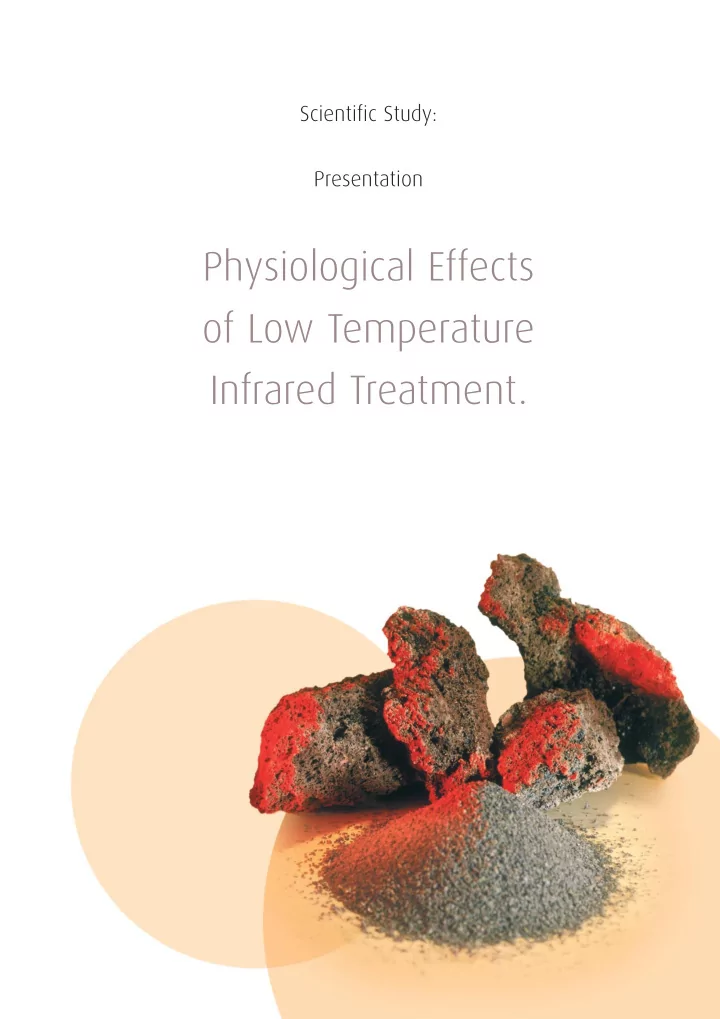
Caption In Physiotherm low temperature technology, the infrared radiation source is surrounded with lava sand. Thanks to the filtering effect of this technology, the body can remain close to the radiation source, ensu- ring that it absorbs high levels of infrared radiation. Low temperature infrared radiation has a modula- ting effect on the systemic, controlling aspects of the immune system. It is highly probable, however, that the effects of this radiation when applied in specific illnesses will take on a specific character adapted to the particular immune pathology. This character needs to be targeted and investigated for any parti- cular indication. We need to look at the field of sports medicine for physiological effects which most closely matches those observed here. Put simply, a training session reduces the number of pro-inflammatory cytokines and increases the number of anti-inflammatory ones. It is known that moderate endurance sports training can still have a health-promoting effect on the body. A Physiotherm session initiates physiological changes which resemble the stimulus provided by a moderate training session. It is obvious therefore that a health- promoting effect, which otherwise is mainly obtained through moderate endurance sports training, can be achieved by a Physiotherm session. There was considerably increased perspiration in the verum group and hence greater levels of detoxifi-
and endocrine systems were observed, which, becau- se the study relies on scientific data obtained in a controlled study, further underpins the safety of the application, whether used individually or serially. This means that Physiotherm sessions can be recommended for older people and those with impaired motor functions. In addition, older people are increasingly less liable to infections, but are more likely to develop chronic inflammatory and autoim- mune deseases. In this context, too, the present data suggest that using Physiotherm would prove overall to be a practical health-promoting measure. 6
Institute Director of the Department for Internal Medicine, Institute of Natural Therapy at the University of Zürich. Co-author of the bestselling guide “Bitter Natural Medicine” “I was surprised, initially, that anyone should want to conduct this sort of study and then how well the study had been planned – and that the findings could be presented in such a short time. These are primari- ly the three most important points, because there is very rarely any research in this complex area. I have already had experience of many potential studies but
planning and good subsequent execution. I can remember infrared radiation right from the beginning of my medical work, although some things, for example, the wave ranges, were not as well defined as they are today. That is definitely a distinct advantage of this study. Here, there has been a systematic approach to the issue of 'the effects of local low temperature infrared radiation on the back'. I also find the setting interesting – direct radiation using volcanic rock in ceramic tubes. This seems to me to be a practical and attractive method – combi- ning a period of recovery and well-being on the one hand with health promotion on the other.“
Internationally recognised specialist in heat therapy and Director of IWIT (The Institute for Heat and Immune Therapy in Vienna), Senior Researcher in Physiotherm Studies. “I have spent more than 15 years dealing with the issue of heat therapy and a wide range of infrared
logy convinces me medically is that the special filte- ring effect of lava sand, when compared with con- ventional infrared radiators, lowers the radiation tem- perature by a factor of 10. This means that people can apply infrared radiation without experiencing excess local heat stress. The subjects participating in the tests in this study reported that the heat treat- ment was a completely stress-free experience. The physiological and immunological findings of the study match the subjective experiences of the subjects – slight increase in body core temperature, modulation of stress hormone levels and immunolo- gical profiles.”
Many years of experience in the field of 'Quality Assurance' and also Head of Research Projects funded by the German Ministry for Education and Research, Member of the Research Team. “Besides the purely scientific issue, what struck me was whether a clinical study could be conducted at all in a doctor's surgery whilst maintaining the internationally required standards (GCP – good clinical practice). The organisational and personal aspects mean that this is essentially a tricky point. Preliminary work met the need for the organisa- tional and personal structures required for recruiting subjects and conducting the study. At the IWIT (The Institute for Heat and Immune Therapy in Vienna), additional staff was taken on and this was trained for the individual tasks and engaged solely in looking after the study. It is remarkable that the additional direct low tem- perature infrared radiation over the back – in compa- rison with simple heat treatment – triggers significant effects in the whole system (the body's defence mechanisms, the cardiovascular system and perspira- tion) without causing any notable negative impact on the cardiovascular system. This form of infrared treat- ment could therefore be extremely interesting for
It is also worth mentioning that of the 150 male subjects, who regarded themselves as healthy in terms of the study criteria, in the end only 18 could be accepted for participation in the study.” 7
20 years expertise in immunology, specialising in Human Immunology at Tübingen, Germany, Member
“The aim of the study presented here was to test whether low temperature infrared treatment locally restricted to the back could induce reactions of the immune system. In order to obtain precise measure- ments, the ILCS test system was used because this provides evidence of immunological communication processes, as found in the body, more completely and more naturally than any other test system cur- rently available. It was extremely interesting to note that, although only the backs of subjects were irra- diated, it was possible to detect the additional effect
equivalent effects were produced in quite different neurotransmitters. This means that this sort of local treatment can also be delivered to the rest of the body by means of the immune system cells circulating in the blood. This is an effect that has never been successfully shown before.” Luis Schwarzenberger, The driving force behind the study. A serious acci- dent, which almost resulted in paralysis, led to this native of Austria becoming aware of the effective- ness of infrared light. For further details, see 'Low Temperature Infrared Warmth Technology with Patented Lava Sand Filtering Technology' in the press folder (Pages 5-6) and Facilitator
who started proceedings by talking about the work
Infrared' and what his inspiration has been. “I have asked myself the questions 'What is infra- red, what does it mean for nature, what does it mean for human beings and what is the right way to deal with infrared?' And I am someone who has spent many years getting to grips with Chinese medi- cine, which says 'If your back is cold you are amazin- gly liable to other ailments. From rheumatism to flu.' That means that you are weak, because a cold back lacks energy and is thoroughly vulnerable. This begins with the back of the neck, which is vulnerable to the wind and cold, and goes right down to the lumbar
bility of compensating for areas of weakness – espe- cially areas of weakness in the immune system – by supplying the back with energy. Because energy is heat. Also, I have gathered from many conversations that this low temperature infrared radiation has hel- ped people to be in charge of their everyday lives, especially those people who spend all day in cars,
time they began regular infrared radiation treatment, they experienced considerable reduction in their pain levels.” 8
9
Luis Schwarzenberger Physiotherm is the only company in the world to manufacture cabins equipped with low temperature infrared radiators which filter the warmth through lava
the life and destiny of Luis Schwarzenberger, native of the Austrian Tyrol and trained electrical engineer (qualified in 1941) – because for him, 13 years ago, the nightmare feared by every enthusiastic sportsman suddenly became a reality. In 1993, Schwarzenberger had a skiing accident which sent him hurtling four metres down into a stream bed. While in hospital, he realised what his injury meant. A double fracture of the vertebrae had been diagnosed, with almost paraplegic effect. He had to give his consent to an operation with the risk
Nature-loving Schwarzenberger turned the operati-
different natural way to regain his health.
The crucial advice came from a friend, a practitio- ner of alternative medicine, who recommended irra- diating his injury with infrared deep heat. Schwarzenberger had already heard of infrared warmth as a form of therapy, although only in con- nection with sinusitis or ENT ailments. But he knew that when infrared warmth comes into contact with the skin it immediately converts into deep heat, with wonderful effects. Circulation is boosted, and the immune system enhanced. Blood vessels are activat- ed, toxicants excreted, tensions relax and the body releases self-healing forces. Lying on his stomach, Schwarzenberger had his extremely painful back warmed for 18 hours every day by an infrared lamp. The result was astonishing. Even in the very first days he was feeling significantly
remission, the tensions relaxed and the contusions in his lower back, resulting from the furious impact of his fall, disappeared. His mobility returned and as early as three weeks after the accident he was on his feet again. Schwarzenberger has been free of pain ever since. No after-effects of the accident have remained. After his complete recovery, Schwarzenberger began to occupy his time in earnest with infrared deep heat treatment. He developed the idea of app- lying infrared by using radiators working over the whole of the back, rather than just focally. His idea was that not only injuries, inflammations and other local conditions could be treated in this way but that the human body as a whole and the immune system in particular could be strengthened by whole-body warmth therapy, in order to ward off illnesses as well. Together with a Tyrolean infrared scientist, he began developing a health cabin which delivers these health-promoting features and is so cleverly designed that it fits into any home. One particular technical challenge was this – how can you reduce the extremely high temperatures emanating from the infrared radiation source by extremely simple means? The solution was Luis Schwarzenberger's develop- ment of special low temperature radiators with the radiant heat screened by a lava sand filtering system which allowed the body to absorb a particularly high degree of infrared warmth. In 1995, Schwarzenberger launched his first infrared Fitness and Health Cabin
Hall in the Austrian Tyrol. His version became reality. Today Schwarzenberger says, “The idea grew in the back of my mind to develop something of great practical benefit to other people.” The enormous success of Schwarzenberger's deve- lopment and of the company as well is evidenced now by some 15,000 low temperature Physiotherm cabins with the lava sand filtering principle in use around the world. They are to be found in private houses, health centres and wellness hotels from the Tyrol to New Zealand. But this success alone was not enough for Luis Schwarzenberger. He wanted to explore in depth the why and wherefore of the effects of local infrared radiation when coupled with Physiotherm technology. To this end, he commissio- ned a major scientific study aimed at shedding light
10
11 Press Liaison: Tel: [+43] 5223 / 547 77 E-mail: infrarot@physiotherm.com We will be glad to provide you with professional, sendable TV source material on the study and infrared technology in german language. For further information, visit: www.physiotherm.com