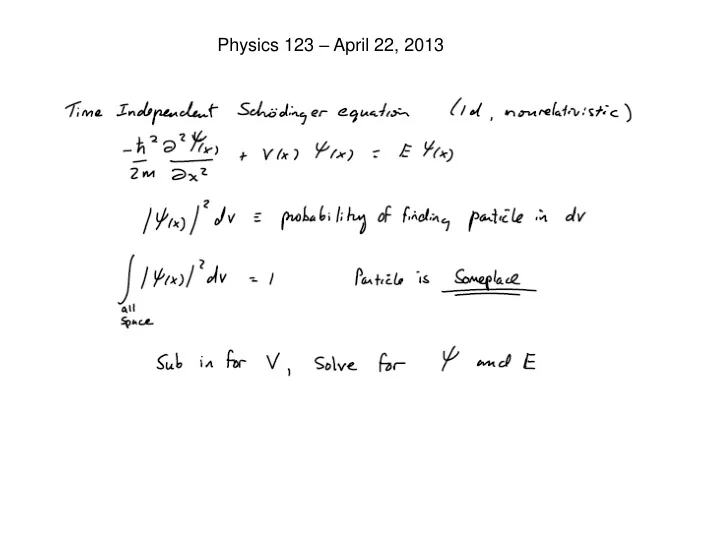
Physics 123 – April 22, 2013
Physics 123 April 22, 2013 Energy or principal quantum number n = - - PowerPoint PPT Presentation
Physics 123 April 22, 2013 Energy or principal quantum number n = 1, 2, 3 Orbital quantum number l = 0, 1, n -1 Magnetic quantum number -l, -|l- 1|, , 0, 1, l -1, l Probability distributions for several allowed atomic states
Energy or principal quantum number n = 1, 2, 3 … Orbital quantum number l = 0, 1, … n-1 Magnetic quantum number
- l, -|l-1|, …, 0, 1, … l-1, l
Probability distributions for several allowed atomic states for the 1-electron atom Increasing n adds new radial layers, l=0 give spherical symmetry, l not 0 brings in angular dependence
m z B z B F
z z z z
| |
General Quant. Mech. result regarding force on magnetic dipole in a non-uniform magnetic field
B detector e- beam in l=1 state has m=1,0,-1 components expect to see this
Stern-Gerlach experiment
m z B z B F
z z z z
| |
General Quant. Mech. result regarding force on magnetic dipole in a non-uniform magnetic field
B detector e- beam in l=0 state Has m=0 component only expect to see this
Stern-Gerlach experiment
m z B z B F
z z z z
| |
SURPRISE! … fundamental particle have an intrinsic magnetic moment. Call it spin.
B detector e- beam in l=0 state Has m=0 component only Actually see this
Stern-Gerlach experiment
m=+1/2 m=-1/2
Intrinsic spin - two varieties
Fermions = half integral spin, such as 1/2, 3/2, 5/2, … , 73/2 … protons, neutrons, electrons are all fermions (s=1/2) no two fermions can occupy the same exact quantum state Bosons = integral spin, such as 0, 1, 2 … photons (s=1) and pions (s=0) are examples of bosons bosons can occupy the same exact quantum state
Huge effect on multi-electron atoms
Rules for Filling of state for multi-electron atom n, l, ml, ms
- No two electrons in same state (Pauli exclusion)
- Electrons go into the state with the lowest possible
energy (Aufbau)
- Within a sublevel, electrons will have their spin unpaired
as much as possible (due to spin-spin interaction contribution to energy) 1s, 2s, 3s, 4s, 5s … 2p, 3p, 4p, 5p … 3d, 4d, 5d … 4f, 5f …
1s 2s 3s 2p 4s 3p 3d energy
Spectroscopic notation - s: l=0, p: l=1, d: l=2, f: l=3, …
Check out http:www.chemicool.com Interactive periodic chart