Gauge invariant Barr-Zee type contributions to fermionic EDMs in the - - PowerPoint PPT Presentation

gauge invariant barr zee type contributions to fermionic
SMART_READER_LITE
LIVE PREVIEW

Gauge invariant Barr-Zee type contributions to fermionic EDMs in the - - PowerPoint PPT Presentation

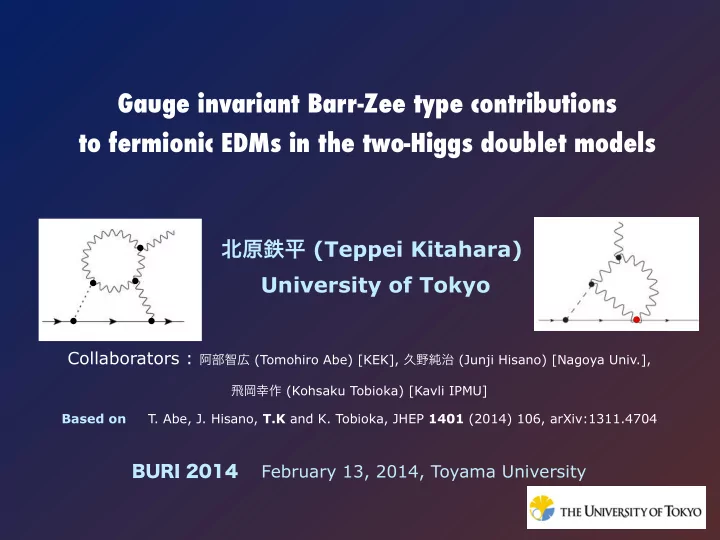
Gauge invariant Barr-Zee type contributions to fermionic EDMs in the two-Higgs doublet models (Teppei Kitahara) University of Tokyo Collaborators : (Tomohiro Abe) [KEK], (Junji Hisano) [Nagoya Univ.],


slide-1
SLIDE 1

北原鉄平 (Teppei Kitahara) University of Tokyo

Collaborators : 阿部智広 (Tomohiro Abe) [KEK], 久野純治 (Junji Hisano) [Nagoya Univ.],

飛岡幸作 (Kohsaku Tobioka) [Kavli IPMU] Based on T. Abe, J. Hisano, T.K and K. Tobioka, JHEP 1401 (2014) 106, arXiv:1311.4704

BURI 2014 February 13, 2014, Toyama University

Gauge invariant Barr-Zee type contributions to fermionic EDMs in the two-Higgs doublet models

slide-2
SLIDE 2

/21 Feb 13, 2014 BURI 2014 Teppei KITAHARA -Univ. of Tokyo

BURI 2014

2

slide-3
SLIDE 3

/21 Feb 13, 2014 BURI 2014 Teppei KITAHARA -Univ. of Tokyo

BURI 2014

Basis of the Universe

with ary Ideas 2014 ー

2 http://seriable.com/nbc-network/revolution-nbc-network/

slide-4
SLIDE 4

/21 Feb 13, 2014 BURI 2014 Teppei KITAHARA -Univ. of Tokyo

Our Revolutionary Idea

3

slide-5
SLIDE 5

/21 Feb 13, 2014 BURI 2014 Teppei KITAHARA -Univ. of Tokyo

We derive improved Barr-Zee type contributions → first make BZ contributions gauge invariant

+

We become able to evaluate theoretical value of EDM more correctly conceptually and numerically

Our Revolutionary Idea

3

slide-6
SLIDE 6

/21 Feb 13, 2014 BURI 2014 Teppei KITAHARA -Univ. of Tokyo

Introduction

4

slide-7
SLIDE 7

/21 Feb 13, 2014 BURI 2014 Teppei KITAHARA -Univ. of Tokyo

Electric Dipole Moment (EDM)

What is EDM?

L = − eQ` 4m` a`¯ `µ⌫`F µ⌫ − i 2d`¯ `µ⌫5`F µ⌫

Non-relativistic Hamiltonian

H = −µ` ~ B · ˆ ~ s − d` ~ E · ˆ ~ s

Magnetic dipole moment term Electric dipole moment term Spin-Electric field int. Spin-Magnetic field int. C-even P-even T-even C-even P-odd T-odd

EDM : dl ✔ Non-zero EDM violates T and CP symmetry

5

slide-8
SLIDE 8

/21 Feb 13, 2014 BURI 2014 Teppei KITAHARA -Univ. of Tokyo

Why does one focus on EDM?

✔ Observation of EDM implies NEW CP violation source ✔ Experiments of EDM are very precise. We can seek TeV scale physics indirectly.

Since our Universe experiences Baryogenesis, new CP violation source is needed in somewhere. New Physics!! SM EDM is too small to observe...

6

Electric Dipole Moment (EDM)

slide-9
SLIDE 9

/21 Feb 13, 2014 BURI 2014 Teppei KITAHARA -Univ. of Tokyo

The Model

✓ 2HDMs with softly-broken Z2 symmetry ✓ Higgs potential

7

Z2 transformation relative phase of VEVS

Im m2

3

λ5e2iφ

✔ CP violation phase

✔redefine Higgs field ✔stationary condition

λ5e2iφ

  • ne CP violation

physical phase

slide-10
SLIDE 10

/21 Feb 13, 2014 BURI 2014 Teppei KITAHARA -Univ. of Tokyo

  • The Yukawa interaction in this model is classified into the 4 types

SM + extra Doublet SUSY type Lepton Specific

8

Flipped type Z2 transformation

One can avoid the dangerous FCNC problem

The Model

slide-11
SLIDE 11

/21 Feb 13, 2014 BURI 2014 Teppei KITAHARA -Univ. of Tokyo

EDM in 2HDM

  • In 2HDMs, leading EDM contributions come from not one-loop

but two-loop diagrams

[S. M. Barr and A. Zee, Phys. Rev. Lett. 65, 21(1990)]

αα2 Yukawa2

Barr-Zee diagram

Because electron Yukawa is too small,

φ = H1, H2, H3 φ = H1, H2, H3

e− e− e− e−

∼ αα2 (4π)2 me v2 ∼ 10−27 [e cm]

∼ 1 (4π)2 m3

e

v4 ∼ 10−36 [cm]

< 10−40 [e cm]

  • cf. SM (4 loop)

9

slide-12
SLIDE 12

/21 Feb 13, 2014 BURI 2014 Teppei KITAHARA -Univ. of Tokyo

Gauge invariance of Barr-Zee diagram

  • Actually, The Barr-Zee contribution to EDM is not gauge invariant

[R. G. Leigh, S. Paban, R. M. Xu, Nucl. Phys. B 352, 45(1991)]

Barr-Zee diagram

φ = H1, H2, H3

e− e−

10

slide-13
SLIDE 13

/21 Feb 13, 2014 BURI 2014 Teppei KITAHARA -Univ. of Tokyo

Gauge invariance of Barr-Zee diagram

  • Actually, The Barr-Zee contribution to EDM is not gauge invariant

[R. G. Leigh, S. Paban, R. M. Xu, Nucl. Phys. B 352, 45(1991)]

Barr-Zee diagram

φ = H1, H2, H3

e− e−

1Mµ 6= 0

1

The previous works did not care about the gauge invariance of BZ contributions

10

slide-14
SLIDE 14

/21 Feb 13, 2014 BURI 2014 Teppei KITAHARA -Univ. of Tokyo

Gauge invariance of Barr-Zee diagram

  • Actually, The Barr-Zee contribution to EDM is not gauge invariant

[R. G. Leigh, S. Paban, R. M. Xu, Nucl. Phys. B 352, 45(1991)]

Barr-Zee diagram

φ = H1, H2, H3

The previous works did not care about the gauge invariance of BZ contributions e− e−

We improved BZ contribution to be gauge invariant one

1Mµ 6= 0

1

10

slide-15
SLIDE 15

/21 Feb 13, 2014 BURI 2014 Teppei KITAHARA -Univ. of Tokyo

Pinch Technique

  • Pinch technique is general method which can decompose

gauge fixing parameter ξ independent subamplitudes

  • Diagrammatic representation

T1(t, ξ) = ˆ T1(t) − f(t, ξ)

T2(t, mi, ξ) = ˆ T2(t, mi) + f(t, ξ) − h(t, mi, ξ)

T3(t, s, mi, ξ) = ˆ T3(t, s, mi) + h(t, mi, ξ)

[John M. Cornwall, Phys. Rev. D26, 6(1982)]

T2(t, mi, ξ)

11

slide-16
SLIDE 16

/21 Feb 13, 2014 BURI 2014 Teppei KITAHARA -Univ. of Tokyo

Pinch Technique

  • Pinch technique is general method which can decompose

gauge fixing parameter ξ independent subamplitudes

  • Diagrammatic representation

T1(t, ξ) = ˆ T1(t) − f(t, ξ)

T2(t, mi, ξ) = ˆ T2(t, mi) + f(t, ξ) − h(t, mi, ξ)

T3(t, s, mi, ξ) = ˆ T3(t, s, mi) + h(t, mi, ξ)

[John M. Cornwall, Phys. Rev. D26, 6(1982)]

T2(t, mi, ξ)

11

pinch!

slide-17
SLIDE 17

/21 Feb 13, 2014 BURI 2014 Teppei KITAHARA -Univ. of Tokyo

Pinch Technique

  • Pinch technique is general method which can decompose

gauge fixing parameter ξ independent subamplitudes

  • Diagrammatic representation

T1(t, ξ) = ˆ T1(t) − f(t, ξ)

T2(t, mi, ξ) = ˆ T2(t, mi) + f(t, ξ) − h(t, mi, ξ)

T3(t, s, mi, ξ) = ˆ T3(t, s, mi) + h(t, mi, ξ)

pinch!

[John M. Cornwall, Phys. Rev. D26, 6(1982)]

f(t, ξ) T2(t, mi, ξ)

11

slide-18
SLIDE 18

/21 Feb 13, 2014 BURI 2014 Teppei KITAHARA -Univ. of Tokyo

  • Pinch :

q k p p-q k+q k+p

kµγµ = (6 k+ 6 p m) (6 p m) ⊃

gauge 3 point vertex

  • r gauge propagator

gauge-fermion-fermion vertex

12

Pinch Technique

[John M. Cornwall, Phys. Rev. D26, 6(1982)]

slide-19
SLIDE 19

/21 Feb 13, 2014 BURI 2014 Teppei KITAHARA -Univ. of Tokyo

  • Pinch :

q k p p-q k+q k+p

kµγµ = (6 k+ 6 p m) (6 p m) ⊃

gauge 3 point vertex

  • r gauge propagator

gauge-fermion-fermion vertex

= i ✓ i 6 k+ 6 p m ◆−1 (6 p m)

second term cancel out

¯ u 6 p = ¯ um

Equation of mortion

Pinch Technique

[John M. Cornwall, Phys. Rev. D26, 6(1982)] 12

slide-20
SLIDE 20

/21 Feb 13, 2014 BURI 2014 Teppei KITAHARA -Univ. of Tokyo

  • Pinch :

q k p p-q k+q k+p

kµγµ = (6 k+ 6 p m) (6 p m) ⊃

gauge 3 point vertex

  • r gauge propagator

gauge-fermion-fermion vertex

= i ✓ i 6 k+ 6 p m ◆−1 (6 p m)

second term cancel out

¯ u 6 p = ¯ um

Equation of mortion

First term “pinch” fermion propagator

pinch!

Pinch Technique

[John M. Cornwall, Phys. Rev. D26, 6(1982)] 12

slide-21
SLIDE 21

/21 Feb 13, 2014 BURI 2014 Teppei KITAHARA -Univ. of Tokyo

+

  • Pinch :

Pinch

  • In order to obtain gauge invariant BZ type contribution, we

should sum these diagrams

13

Pinch Technique

pinch!

slide-22
SLIDE 22

/21 Feb 13, 2014 BURI 2014 Teppei KITAHARA -Univ. of Tokyo

  • calculate all gauge invariant Barr-Zee

contributions

  • check the gauge invariance analytically
  • get analytical formula of improved BZ

contributions All charged particle run

14

O(100) two-loop diagrams!

slide-23
SLIDE 23

/21 Feb 13, 2014 BURI 2014 Teppei KITAHARA -Univ. of Tokyo

Results of electron EDM

@YbF molecule @ThO molecule Recently ACME Collaboration got new upper bound by ThO molecule! current bound

15 [ACME Collaboration, Science 17 Vol.343 no.6168 (2014)]

slide-24
SLIDE 24

/21 Feb 13, 2014 BURI 2014 Teppei KITAHARA -Univ. of Tokyo

Parameter as a benchmark

tan β = O(10), λ1 = λ3 = λ4 = λ5 sin 2φ = 0.5, λ2 = 0.25

✔ Vacuum stability is safe ✔ EW precisions are safe @ M > 200GeV ✔ Lightest neutral scalar mass ∼ 126GeV ✔ not unnatural parameter region

tan β = v2 v1

16

slide-25
SLIDE 25

/21 Feb 13, 2014 BURI 2014 Teppei KITAHARA -Univ. of Tokyo

tanβ = 10

Gauge-inv. Barr-Zee vs. Ordinary Barr-Zee

We found that the difference between gauge-invariant and

  • rdinary (= not gauge invariant) Barr-Zee contribution to

electron EDM is about 5 - 8 %

Type II

Difference between de(gauge-inv. BZ) and de(ordinary BZ)

17 [T.Abe, J.Hisano, T.K, K.Tobioka, (2013)]

slide-26
SLIDE 26

/21 Feb 13, 2014 BURI 2014 Teppei KITAHARA -Univ. of Tokyo

tanβ = 10

We found that the difference between gauge-invariant and

  • rdinary (= not gauge invariant) Barr-Zee contribution to

electron EDM is about 5 - 8 %

Type II

Difference between de(gauge-inv. BZ) and de(ordinary BZ)

17

This is not so big improvement from the numerical point of

  • view. However, we would like to emphasize that our result

is now gauge invariant, which must be satisfied when we discuss observables.

[T.Abe, J.Hisano, T.K, K.Tobioka, (2013)]

Gauge-inv. Barr-Zee vs. Ordinary Barr-Zee

slide-27
SLIDE 27

Electron EDM

  • Contour Plot of

eEDM [e・cm] Current exp. bound (90% CL) Future Prospects

YbF, WN Fr ThO [T.Abe, J.Hisano, T.K, K.Tobioka, (2013)]

Heavy Higgs mass

slide-28
SLIDE 28

/21 Feb 13, 2014 BURI 2014 Teppei KITAHARA -Univ. of Tokyo

Electron EDM

  • eEDM vs Heavy Higgs scale
  • Type X ~ Type II, Type Y ~ Type I

19

Current exp. bound (90% CL) Future Prospects

YbF, WN Fr ThO

tanβ = 10

Future Prospects Exclude

tanβ = 10

[T.Abe, J.Hisano, T.K, K.Tobioka, (2013)]

Heavy Higgs mass Heavy Higgs mass

slide-29
SLIDE 29

/21 Feb 13, 2014 BURI 2014 Teppei KITAHARA -Univ. of Tokyo

  • eEDM vs Heavy Higgs scale
  • Type X ~ Type II, Type Y ~ Type I

19

Current exp. bound (90% CL) Future Prospects

YbF, WN Fr ThO

tanβ = 10

Future Prospects Exclude

tanβ = 10

Heavy Higgs mass Heavy Higgs mass

~ 20 TeV ~ 2 TeV

Electron EDM

[T.Abe, J.Hisano, T.K, K.Tobioka, (2013)]

slide-30
SLIDE 30

/21 Feb 13, 2014 BURI 2014 Teppei KITAHARA -Univ. of Tokyo

Summary

  • 2HDMs with Z2 symmetry have one new phase, and

are constrained by the electron/neutron EDM

  • An analytical formulae of full gauge-inv.

Barr Zee contribution is first derived by Using Pinch Technique

  • In Type II, X, Y 2HDMs, the future

expeRIments of electron/neutron EDM are expected to reach O(10) TeV new Heavy scalars

Type II tanβ = 10 ~ 20 TeV

200 400 600 800 1000 2 4 6 8 10 MH+ @GeVD D @%D

tanβ = 10 Type II

New New +

20

slide-31
SLIDE 31

/21 Feb 13, 2014 BURI 2014 Teppei KITAHARA -Univ. of Tokyo

Teppei Kitahara arXiv:1311.4704

Discussions

21 [G. C. Dorsch, S. J. Huber and J. M. No, JHEP 1310, 029 (2013)]

EWBG prefers low tanβ region

Is there a tension between EWBG and EDM?

  • EDM vs Electroweak Baryogenesis at the same

parameter region

slide-32
SLIDE 32

/21 Feb 13, 2014 BURI 2014 Teppei KITAHARA -Univ. of Tokyo

Backup

slide-33
SLIDE 33

/21 Feb 13, 2014 BURI 2014 Teppei KITAHARA -Univ. of Tokyo

neutron EDM

Future prospects can improve to 2 orders

  • f magnitude

current bound @Ultra cold neutron

  • The neutron EDM is obtained by QCD sum rule as follows

[J. Hisano, J. Y. Lee, N. Nagata, Phys. Rev. D85, 114044(2012)]

dn = 0.79dd − 0.20du + e(0.59dC

d + 0.30dC u )

(QCD sum rules)

assume PQ mechanism

35

slide-34
SLIDE 34

Neutron EDM

  • Contour Plot of

nEDM [e・cm] Current exp. bound (90% CL) Future Prospects Lightest Higgs Mass ~ 126 GeV Parameter Two Heavy Higgs Mass ~ MH+

λ5 sin 2φ = 0.5

[T.Abe, J.Hisano, T.K, K.Tobioka, (2013)]

slide-35
SLIDE 35

/21 Feb 13, 2014 BURI 2014 Teppei KITAHARA -Univ. of Tokyo

Neutron EDM

Lightest Higgs Mass = 126 GeV Parameter

  • In Type I and Type X, neutron EDM is too small
  • Type Y ~ Type II
  • nEDM vs Heavy Higgs scale

Two Heavy Higgs Mass ~ MH+

λ5 sin 2φ = 0.5

37

tanβ = 10

Exclude Future Prospects Current exp. bound (90% CL)

[T.Abe, J.Hisano, T.K, K.Tobioka, (2013)]

slide-36
SLIDE 36

/21 Feb 13, 2014 BURI 2014 Teppei KITAHARA -Univ. of Tokyo [T.Abe, J.Hisano, T.K, K.Tobioka, (2013)]

Neutron EDM

Lightest Higgs Mass = 126 GeV Parameter

  • In Type I and Type X, neutron EDM is too small
  • Type Y ~ Type II
  • nEDM vs Heavy Higgs scale

Two Heavy Higgs Mass ~ MH+

λ5 sin 2φ = 0.5

tanβ = 10

Exclude Future Prospects Current exp. bound (90% CL)

~ 5 TeV

37

slide-37
SLIDE 37

/21 Feb 13, 2014 BURI 2014 Teppei KITAHARA -Univ. of Tokyo

Barr-Zee diagram

  • In Barr-Zee diagrams calculation, we separated

them into “HVV effective couplings” part and

  • ther part

Generalize At first, we consider “HVV effective couplings”

13

slide-38
SLIDE 38

/21 Feb 13, 2014 BURI 2014 Teppei KITAHARA -Univ. of Tokyo

Tensor structure of effective coupling

  • ff-shell vector
  • n-shell photon

general tensor structure gauge symmetry (Ward-Takahashi identity) pµ

1Γµν = 0

14

slide-39
SLIDE 39

/21 Feb 13, 2014 BURI 2014 Teppei KITAHARA -Univ. of Tokyo

Tensor structure of effective coupling

  • ff-shell vector
  • n-shell photon

If HVV effective vertex is gauge invariant

1Mµ = 0

1Γµν = 0

Barr-Zee diagram is gauge invariant

15

slide-40
SLIDE 40

/21 Feb 13, 2014 BURI 2014 Teppei KITAHARA -Univ. of Tokyo

Effective coupling -W loop-

  • We explicitly calculate W loop contribution, and

result is as follows

  • ff-shell vector
  • n-shell photon

All set of W loop

16

slide-41
SLIDE 41

/21 Feb 13, 2014 BURI 2014 Teppei KITAHARA -Univ. of Tokyo

Effective coupling -W loop-

  • We explicitly calculate W loop contribution, and

result is as follows

  • ff-shell vector
  • n-shell photon

gauge invariant term gauge non-invariant term All set of W loop

slide-42
SLIDE 42

/21 Feb 13, 2014 BURI 2014 Teppei KITAHARA -Univ. of Tokyo

Effective coupling -W loop-

  • We explicitly calculate W loop contribution, and

result is as follows

  • ff-shell vector
  • n-shell photon

All set of W loop gauge non-invariant term

These terms drop when all external lines are on-shell. However, in this situation (external lines are off-shell), these term do not drop.

slide-43
SLIDE 43

/21 Feb 13, 2014 BURI 2014 Teppei KITAHARA -Univ. of Tokyo

Effective coupling -W loop-

  • ff-shell vector
  • n-shell photon

We can transform pinch term into effective coupling form

22

slide-44
SLIDE 44

/21 Feb 13, 2014 BURI 2014 Teppei KITAHARA -Univ. of Tokyo

Effective coupling -W loop-

  • ff-shell vector
  • n-shell photon

We can transform pinch term into effective coupling form

second term cancel out

22

slide-45
SLIDE 45

/21 Feb 13, 2014 BURI 2014 Teppei KITAHARA -Univ. of Tokyo

Effective coupling -W loop-

  • ff-shell vector
  • n-shell photon

We can transform pinch term into effective coupling form

last two terms does not contribute to dipole operator

22

slide-46
SLIDE 46

/21 Feb 13, 2014 BURI 2014 Teppei KITAHARA -Univ. of Tokyo

Effective coupling -W loop-

  • ff-shell vector
  • n-shell photon

We can transform pinch term into effective coupling form

We checked analytically and found that these sum become gauge invariant

last two terms does not contribute to dipole operator

22

slide-47
SLIDE 47

/21 Feb 13, 2014 BURI 2014 Teppei KITAHARA -Univ. of Tokyo

Some demands to parameter region

  • Vacuum Stability of Higgs potential
  • Electroweak Precessions
  • Higgs mass = 126 GeV
  • Before we calculate EDMs, we should consider the

following some demands to parameter region

demands to parameter region

26

slide-48
SLIDE 48

/21 Feb 13, 2014 BURI 2014 Teppei KITAHARA -Univ. of Tokyo

Vacuum stability

[N. G. Deshpande and E. Ma, Phys. Rev. D 18 (1978) 2574] [A. W. El Kaffas, W. Khater, O. M. Ogreid and P. Osland, Nucl. Phys. B 775, 45 (2007)]

  • The stability condition of the Higgs potential at tree-

level (one demand that EW vacuum becomes global minimum)

Tree-level stability condition

27

slide-49
SLIDE 49

/21 Feb 13, 2014 BURI 2014 Teppei KITAHARA -Univ. of Tokyo

Electroweak precision / ρ (T) parameter

  • The custodial SU(2) symmetry is broken in the CP

violation 2HDM at the tree level, and ρ(T) parameter might deviate from 1 at one-loop level

ρ ≡ m2

W

m2

Z cos2 θw

= 1 + ∆ρ ' 1 + αEMT

Theρ(T) parameter depends on the quadratic mass splitting among particles in the same isospin multiplet. If mass splitting is small, or heavy Higgs mass scale is large, theρ(T) parameter is small.

αEMT = ΠW W (0) m2

W

− ΠZZ(0) m2

Z

∝ m2

H± − m2 H

m2

W

[A. Pomarol and R. Vega, Nucl. Phys. B 413, 3 (1994)]

  • Texp. = 0.05 ± 0.12 (1 σ)

experimental bound @ not mH >> VEVs

28

@BSM effect

slide-50
SLIDE 50

/21 Feb 13, 2014 BURI 2014 Teppei KITAHARA -Univ. of Tokyo

Higgs mass = 126 GeV

  • 2HDM with CP violation have physical scalar

bosons as 3 neutral Higgs and 1 charged Higgs

3 neutral Higgs 1 charged Higgs 2 neutral Higgs and 1 charged Higgs are same mass scale M

where

mh1 ' v sin2 β p λ2

1 neutral Higgs is light

29

slide-51
SLIDE 51

/21 Feb 13, 2014 BURI 2014 Teppei KITAHARA -Univ. of Tokyo

λ2 Plot

demand h1 = 126.0 GeV

200 400 600 800 1000 0.245 0.250 0.255 0.260 0.265 0.270 M @GeVD Λ2

Higgs mass = 126 GeV

mh1 ' v sin2 β p λ2

We require the mass of lightest neutral scalar to be 126 GeV, then parameter λ2 is uniquely determined

30

slide-52
SLIDE 52

/21 Feb 13, 2014 BURI 2014 Teppei KITAHARA -Univ. of Tokyo

QCD correction from Four Fermi Operator

[J. Hisano, K. Tsumura, M. J. S. Yang, Phys. Lett. B713, 473(2012)]

slide-53
SLIDE 53

/21 Feb 13, 2014 BURI 2014 Teppei KITAHARA -Univ. of Tokyo

gg -> bb H/A, H/A -> tautau search Type II

[CMS PAS HIG 12 050]

slide-54
SLIDE 54

/21 Feb 13, 2014 BURI 2014 Teppei KITAHARA -Univ. of Tokyo

Flavor constraint

[F. Mahmoudi and O. Stal, Phys.Rev. D81 (2010) 035016]

Type I Type II Type Y Type X

slide-55
SLIDE 55

/21 Feb 13, 2014 BURI 2014 Teppei KITAHARA -Univ. of Tokyo

electron EDM tanB = 3

slide-56
SLIDE 56

/21 Feb 13, 2014 BURI 2014 Teppei KITAHARA -Univ. of Tokyo

electron EDM tanB = 50

slide-57
SLIDE 57

/21 Feb 13, 2014 BURI 2014 Teppei KITAHARA -Univ. of Tokyo

M_H+ = 150 GeV M_H+ = 380 GeV

  • p

2

  • p

4 p 4 p 2

  • 4. ¥10-27
  • 2. ¥10-27
  • 2. ¥10-27
  • 4. ¥10-27

f dêe @cmD

  • p

2

  • p

4 p 4 p 2

  • 2. ¥10-27
  • 1. ¥10-27
  • 1. ¥10-27
  • 2. ¥10-27

f dêe @cmD

slide-58
SLIDE 58

/21 Feb 13, 2014 BURI 2014 Teppei KITAHARA -Univ. of Tokyo

Higgs mass h1 h2 h3

200 400 600 800 1000 200 400 600 800 1000 MH+ @GeVD mh @GeVD

Neutral Higgs Mass

slide-59
SLIDE 59

/21 Feb 13, 2014 BURI 2014 Teppei KITAHARA -Univ. of Tokyo

Top couplings h1 h2 h3 h1 h2 h3

Vector coupling Axial coupling

200 400 600 800 1000 0.0 0.2 0.4 0.6 0.8 1.0 MH+ @GeVD »gtthV»êSM

200 400 600 800 1000 0.00 0.01 0.02 0.03 0.04 0.05 0.06 0.07 MH+ @GeVD »gtthA»êSM

絶対値 絶対値

slide-60
SLIDE 60

/21 Feb 13, 2014 BURI 2014 Teppei KITAHARA -Univ. of Tokyo

Bottom couplings h1 h2 h3 h1 h2 h3

Vector coupling Axial coupling

200 400 600 800 1000 1 2 3 4 5 6 7 MH+ @GeVD »gbbhV»êSM 200 400 600 800 1000 1 2 3 4 5 6 7 MH+ @GeVD »gbbhA»êSM

slide-61
SLIDE 61

/21 Feb 13, 2014 BURI 2014 Teppei KITAHARA -Univ. of Tokyo

WWh couplings h1 h2 h3

200 400 600 800 1000 0.0 0.2 0.4 0.6 0.8 1.0 MH+ @GeVD »gWWh»êSM

slide-62
SLIDE 62

/21 Feb 13, 2014 BURI 2014 Teppei KITAHARA -Univ. of Tokyo 200 400 600 800 1000

  • 1.5
  • 1.0
  • 0.5

0.0 0.5 1.0 MH+ @GeVD geehAêSM * gtthVêSM 200 400 600 800 1000

  • 0.4
  • 0.2

0.0 0.2 0.4 MH+ @GeVD geehVêSM * gtthAêSM

Some couplings h1 h2 h3 h1 h2 h3

slide-63
SLIDE 63

/21 Feb 13, 2014 BURI 2014 Teppei KITAHARA -Univ. of Tokyo 11

Electroweak precision / ρ (T) parameter

  • Texp. = 0.05 ± 0.12 (1 σ)

experimental bound

  • 0.02
  • 0.04
  • 0.04