Physical and social environment for sheep Effects on spacing - - PowerPoint PPT Presentation

physical and social environment for sheep
SMART_READER_LITE
LIVE PREVIEW

Physical and social environment for sheep Effects on spacing - - PowerPoint PPT Presentation

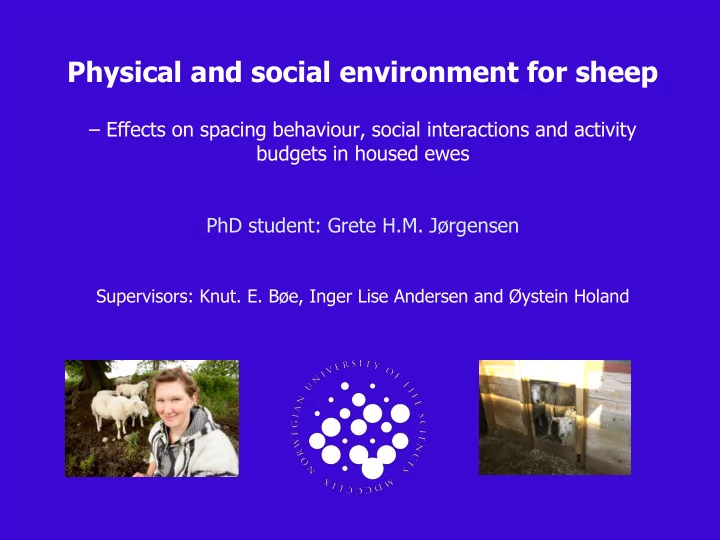
Physical and social environment for sheep Effects on spacing behaviour, social interactions and activity budgets in housed ewes PhD student: Grete H.M. Jrgensen Supervisors: Knut. E. Be, Inger Lise Andersen and ystein Holand NORWEGIAN


slide-1
SLIDE 1

Physical and social environment for sheep

– Effects on spacing behaviour, social interactions and activity budgets in housed ewes PhD student: Grete H.M. Jørgensen

Supervisors: Knut. E. Bøe, Inger Lise Andersen and Øystein Holand

slide-2
SLIDE 2

NORWEGIAN UNIVERSITY OF LIFE SCIENCES

www.umb.no

Overview

Background Aim of thesis List of papers Results Summary of the findings

Slide 2 of 23

slide-3
SLIDE 3

NORWEGIAN UNIVERSITY OF LIFE SCIENCES

www.umb.no

Background

Norwegian sheep are typically held

in expanded metal floor pens with 0.7-0.9 m2 per animal

2003: new EU regulation for organic

agriculture

– Demands at least 1.5 m2 per animal – 0.75 m2 per animal should be solid resting surface

Slide 3 of 23

slide-4
SLIDE 4

NORWEGIAN UNIVERSITY OF LIFE SCIENCES

www.umb.no

Aim of thesis

 To study the effects of the physical and social

environment on spacing behaviour, social interactions and activity budgets in housed ewes

 Sub questions:

– 1. How much space to sheep really need when indoors? – 2. Will sheep show less aggression in large groups than in small? – 3. Could a narrow resting platform on top of slatted floors be a solution for increasing resting comfort? – 4. Can extra pen partitions increase the utilization of a solid resting platform? – 5. How will sheep utilize an outdoor yard as part of the total area under different weather conditions?

Slide 4 of 23

slide-5
SLIDE 5

NORWEGIAN UNIVERSITY OF LIFE SCIENCES

www.umb.no

List of papers

1.

Differences in the spacing behaviour of two breeds of domestic sheep (Ovis aries) – influence of artificial selection?

(Submitted to Ethology)

2.

Feeding, resting and social behaviour in ewes housed in two different group sizes (2009, Appl. Anim. Behav. Sci. 116, 198-203)

3.

The effect of shape, width and slope of a resting platform on resting behaviour and floor cleanliness for housed sheep (2009,

Small Rumin. Res. 87, 57-63)

4.

The effect of different pen partition configurations on the behaviour of sheep (2009, Appl. Anim. Behav. Sci. 119, 66-70)

5.

Outdoor yards for sheep during winter - Effect of feed location, roof and weather factors on resting behaviour and activity (Submitted to Canadian Journal of Animal Science)

Slide 5 of 23

slide-6
SLIDE 6

NORWEGIAN UNIVERSITY OF LIFE SCIENCES

www.umb.no

Q 1. How much space do sheep really need when indoors?

Slide 6 of 23

slide-7
SLIDE 7

NORWEGIAN UNIVERSITY OF LIFE SCIENCES

www.umb.no

Paper 1. Individual distance

Aim: to investigate the individual distance during

resting and feeding for two breeds of sheep

80-90 kg 60-70 kg Nor-X Coloured Spæl 2.00 m 0.60 m 12.00 m Resting platform

Slide 7 of 23

slide-8
SLIDE 8

NORWEGIAN UNIVERSITY OF LIFE SCIENCES

www.umb.no

Results: Individual distance

Slide 8 of 23

** * 0,0 0,5 1,0 1,5 2,0 2,5 3,0 3,5 4,0 Resting Feeding Individual distance (mean + SE meters) Activity Nor-x Spæl sheep

ns P<0.0001

slide-9
SLIDE 9

NORWEGIAN UNIVERSITY OF LIFE SCIENCES

www.umb.no

Q 2. Will sheep show less aggression in large groups compared to in small?

Slide 9 of 23

slide-10
SLIDE 10

NORWEGIAN UNIVERSITY OF LIFE SCIENCES

www.umb.no

Paper 2. Effect of group size Aim: to test the effect of group size on the activity pattern, social interactions and feed intake in sheep

Slide 10 of 23

Batch 1

9 9 9 9 36

Period 1 14 days Period 2 14 days Batch 2

36 9 9 9 9

slide-11
SLIDE 11

NORWEGIAN UNIVERSITY OF LIFE SCIENCES

www.umb.no

Results

Small 9 Large 36 P-value Feeding 19.1 ± 0.4 19.8 ± 0.4 ns Queuing 4.1 ± 0.2 3.1 ± 0.2 <0.001 Stand/walk 10.8 ± 0.4 13.1 ± 0.5 <0.0001 Resting 64.7 ± 0.5 62.8 ± 0.6 <0.0001 Displacements 7.1 ± 0.6 7.4 ± 0.5 ns Other aggressive interactions * 12.0 ± 0.8 12.2 ± 0.8 ns

* pushing, mounting, kicking, butting and threatening

Slide 11 of 23

slide-12
SLIDE 12

NORWEGIAN UNIVERSITY OF LIFE SCIENCES

www.umb.no

Q 3. Could a narrow resting platform on top of slatted floors be a solution for increasing resting comfort?

Slide 12 of 23

slide-13
SLIDE 13

NORWEGIAN UNIVERSITY OF LIFE SCIENCES

www.umb.no

Paper 3. Resting platforms on slatted floors

  • Aim: to investigate the effect of shape, slope and

width of a solid resting area on the resting behaviour

  • f sheep. We also evaluated the cleanliness of these

platforms related to cleaning frequency

Slide 13 of 23

slide-14
SLIDE 14

NORWEGIAN UNIVERSITY OF LIFE SCIENCES

www.umb.no

 Sheep needed at least 0.9 m /animal of platform length  Increasing the slope from 0% to 5% did not affect resting

behaviour but platforms became drier and cleaner

 More sheep rested on the slatted floors when given narrow

platforms (0.5 m)

– Wider platforms (0.6 m) became more dirty – Platform width should be adjusted to the size of the breed  In pens with a larger platform area more sheep were

  • bserved to rest on the platforms rather than on the slatted

floors

 Daily cleaning of the platform is recommended

Slide 14 of 23

slide-15
SLIDE 15

NORWEGIAN UNIVERSITY OF LIFE SCIENCES

www.umb.no

Q 4. Can extra pen partitions increase the utilization of a solid resting platform?

Slide 15 of 23

slide-16
SLIDE 16

NORWEGIAN UNIVERSITY OF LIFE SCIENCES

www.umb.no

Paper 4. Additional walls on the resting area

Aim: to investigate the effect of different pen

partitions on resting pattern, use of the resting area and competition for resting space

Control Three walls

Slide 16 of 23

slide-17
SLIDE 17

Parallel wall Cross wall Perpendicular wall Cubicles

slide-18
SLIDE 18

NORWEGIAN UNIVERSITY OF LIFE SCIENCES

www.umb.no

Results

No difference between the pens in total resting

time

No difference in number of displacements from

the resting area

No difference in the resting synchrony Blocking access to the resting area especially in

pen with cubicles

Slide 18 of 23

slide-19
SLIDE 19

NORWEGIAN UNIVERSITY OF LIFE SCIENCES

www.umb.no

Q 5. How will sheep utilize an outdoor yard as part

  • f the total area under different weather conditions?

Slide 19 of 23

slide-20
SLIDE 20

NORWEGIAN UNIVERSITY OF LIFE SCIENCES

www.umb.no

Paper 5. Use of outdoor yard

Aim: to investigate how sheep utilize an outdoor

yard dependent on weather factors, feed location and the presence of a roof covering the yard

Slide 20 of 23

Feed rack Feed rack Feed rack Feed rack Open Roof Roof Open Pen 4 Pen 3 Pen 2 Pen 1 1880 1880 2400 Passage a+b South North c+e d+f g

slide-21
SLIDE 21

NORWEGIAN UNIVERSITY OF LIFE SCIENCES

www.umb.no

Results

 Weather factors had limited effects on ewe behaviour

– Precipitation more important than temperatures per se

 Ewes spent more time outdoors in yards that: – Were covered with a roof – Had feed located outdoors  Location of feed outdoors: – Sheep choose to rest indoors, where they are less disturbed by traffic

Slide 21 of 23

slide-22
SLIDE 22

NORWEGIAN UNIVERSITY OF LIFE SCIENCES

www.umb.no

Slide 22 of 23

Summary of the findings

  • 1. The mean individual distance was 2.2 m during resting and 2.7 m

during feeding. This is however breed dependent

  • 2. The level of aggression is probably more dependent upon space

quality and animal density than changes in group size per se

  • 3. Resting platforms of wood may be a cheap and easy way of

increasing the resting comfort of sheep in slatted floor pens. The perimeter length should be at least 0.9 m per animal

  • 4. For sheep it is probably more important to have sufficient space for

resting simultaneously combined with the possibility to maintain visual contact than to avoid resting in physical contact

  • 5. Weather had little impact. A roof covering the outdoor yard may be

beneficial in areas with a lot of precipitation. If a dry resting place is provided indoors, then the feed should be located outdoors

slide-23
SLIDE 23

NORWEGIAN UNIVERSITY OF LIFE SCIENCES

www.umb.no Slide 23 of 23

Thank you for your attention

 Acknowledgements

– The Norwegian Research council – Norwegian Food Safety Authorities – The Økosau Hordaland project – The farmers participating in the studies – Staff at the Animal Production Experimental Centre UMB

slide-24
SLIDE 24

NORWEGIAN UNIVERSITY OF LIFE SCIENCES

www.umb.no

DETTE ER TITTELEN PÅ PRESENTASJONEN

24