
SLIDE 1
Photons and Schr¨
- dinger Cats: Quantum
Optomechanics Lajos Di´
- si
Wigner Center for Physics
July 24, 2015
- Ψ(x)=
; m m m Ψ(x)=
?
1 / 10
Photons and Schr odinger Cats: Quantum Optomechanics Lajos Di osi - - PowerPoint PPT Presentation
Photons and Schr odinger Cats: Quantum Optomechanics Lajos Di osi Wigner Center for Physics July 24, 2015
Wigner Center for Physics
; m m m Ψ(x)=
?
1 / 10
1
Fotonic facilities: largest, smallest
2
Expanding domain of quantum theory
3
Quantum theory of massive bodies?
4
Quantum theory of massive bodies?
5
Mechanical Schr¨
6
Quantum optomechanics
7
Quantum optomechanics — theory
8
Quantum optomechanics — laser cooling
9
Quantum optomechanics — mechanical Cat
10 Back to largest, smallest
2 / 10
Quantum mechanics of massive mechanical motion produces paradoxical
would in principle evolve into the superposition of the live and the dead. For half a century, preparation of massive objects in macroscopically different superpositions was practically impossible. Some speculated that such superpositions should be precluded by modified quantum mechanics. Meanwhile a tremendous development happened in a different field: quantum optics. Photons became the most trustable and flexible probes of quantum systems coupled to them. They became the probes of massive mechanical objects. In quantum optomechanics, a quantized oscillator weighting nanograms or even grams, is coupled to photons for double purpose: preparation and detection of controlled quantum state of the massive oscillator. In the forthcoming decade, optomechanical experiments running already in labs or planned in space may confirm the validity of quantum mechanics for massive objects. Or, alternatively, optomechanics may confirm if standard quantum mechanics gets violated in massive
3 / 10
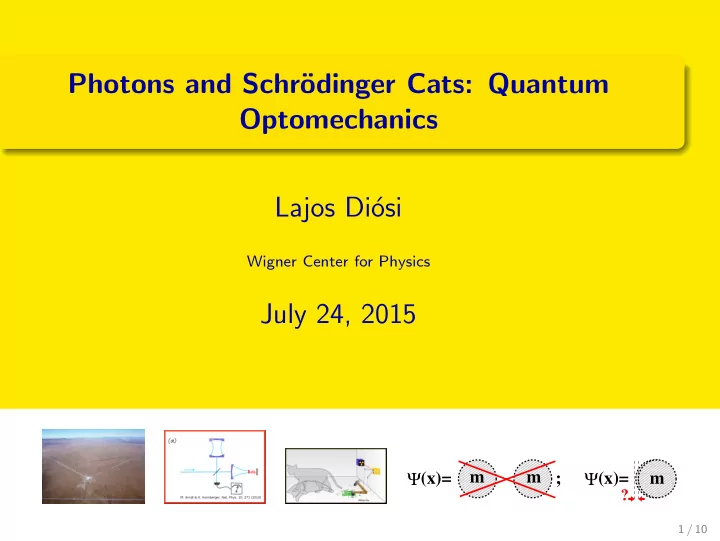
LIGO (Laser Interferometer Gravita- tional Wave Observatory) at Hanford, Washington State. Michelson interfer-
high power laser. Sketch of table top Michelson interfer-
by a single foton at a time, to test me- chanical Schr¨
1 / 10
black body radiation atom, molecule electron condensed matter elektrodynamics nucleus elementary particles massive bodies/gravitation ? cosmology? information living material ? human consciousness ?
2 / 10
QM at large can be paradoxical: Schr¨
Lock a live cat and a poisoning mech- anism triggered when radioactive decay detected, all inside a black box. Switch
cat is remains in superposition forever: Ψ = |alive + |dead. Unless you open the box and look at the cat, to cause wave function collapse at random:
That’s standard QM extended for large objects! Make tractable physics! Change cat for a massive sphere, alive-or-dead for here-or-there:
3 / 10
Mechanical “Schr¨
large “catness” small “catness”
No evidences yet: Experiments: max. 10000 amu (2013) Theory: ambiguity of Cat’s Newton field (1981) Why don’t we see any “Cats” in Nature: Cats are masked by environmental noise (1970) Cats decay spontaneously by gravity-related noise (1986)
4 / 10
Preperation: extremely demanding for isolation from environmental noise cooling to µK smart suspending, supporting, binding, trapping creation of distant here and there by interaction with an other Cat :) by many (controlled) interactions with microscopic systems Verification: extremely demanding for the point is interference between here and there can’t fly through double-slit, grating Light quanta helps! Optomechanics: thermal isolation, laser cooling, optical binding, trapping, controlled fotonic interactions, fotons map interference between here and there into detector counts, ...
5 / 10
Two end-mirrors form optical cavity, pumped by input laser beam ω0, excites nearest e.m. mode ωc = ω0 − ∆. Mirror on rhs is movable, vibrates like mechanical oscillator ωm, it is our massive object. Output laser beam encodes position of the rhs mirror.
6 / 10
i) simple part (Open Q-systems) cavity e.m. mode = damped
movable mirror = damped
coupling = light pressure ii) less simple part (Input-output formalism) laser input beam = periodic driving + vacuum fluctuations
field + vacuum fluctuations iii) difficult part (Q-monitoring theory) time-continuous measurement of the output beam extraction of information on position of movable mirror
7 / 10
Laser cooling was invented for atoms (1978) It works for our vibrating mirror as well In optomechanics: many cooling methods Ground state cooling: mK if ωm∼MHz (2011); µK if ωm∼kHz (????) Resolved side-band cooling: Laser ω0 tuned below cavity ωc just by the mechanical ωm:
Input beam foton can become resonant with the cavity by stealing one energy quantum of the vibrating mirror. The opposite process is
cavity mode. Then cavity dissipates it to the environment.
8 / 10
Pg mirror on cantilever, ωm∼kHz. Single foton splits into one of the arms. In “horizontal arm”: light pressure. In “vertical” arm: no light pressure. Foton reunites toward bottom or left. Detector clicks can verify Cat state: Ψ = |shifted osc. + |fiducial osc. Competing demands: soft (kHz) oscillator for light pressure is small hard (MHz) oscillator for ground-state cooling Will be a long march from proposal (2003) to Cat.
9 / 10
Advanced LIGO: smartly suspended 40kg mirror
control down to quantum limits Quantum Optomechanics on table top: Foundations: big mass is quantum Dozens of running exp.’s Proposal: table top on satellite (2012)
concepts of optomechanics JPB: At.Mol.Opt.Phys. 46, 104001 (2013).
superpositions Nat. Phys. 10, 271 (2014).
10 / 10