Photographs Plans Maintenance Items Report Attachments: SITE A: - - PDF document

photographs plans maintenance items
SMART_READER_LITE
LIVE PREVIEW

Photographs Plans Maintenance Items Report Attachments: SITE A: - - PDF document

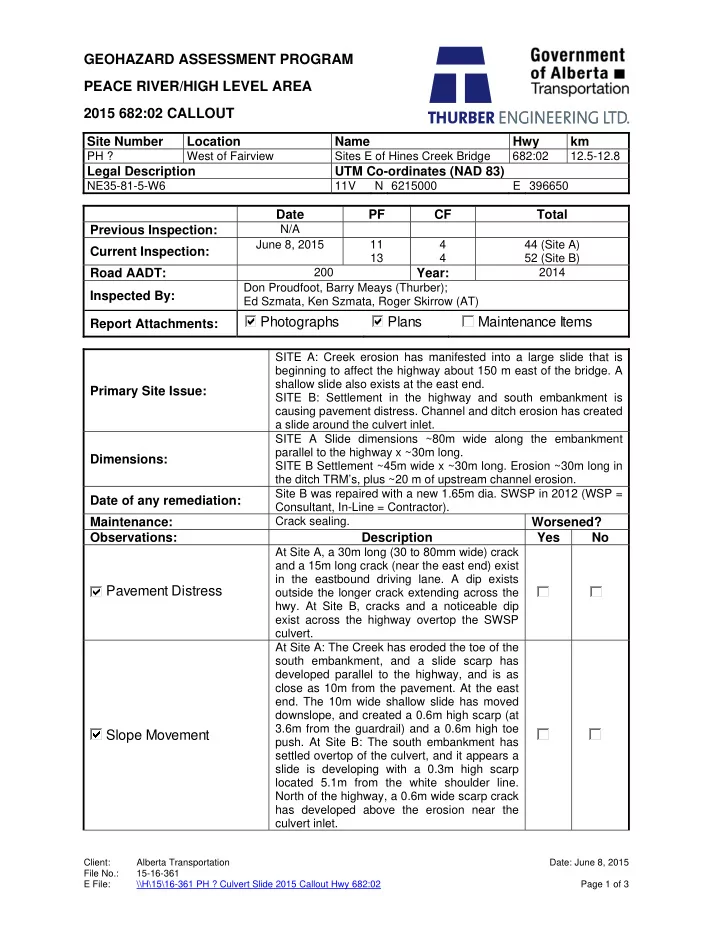
GEOHAZARD ASSESSMENT PROGRAM PEACE RIVER/HIGH LEVEL AREA 2015 682:02 CALLOUT Site Number Location Name Hwy km PH ? West of Fairview Sites E of Hines Creek Bridge 682:02 12.5-12.8 Legal Description UTM Co-ordinates (NAD 83)


slide-1
SLIDE 1

Client: Alberta Transportation Date: June 8, 2015 File No.: 15-16-361 E File: \\H\15\16-361 PH ? Culvert Slide 2015 Callout Hwy 682:02 Page 1 of 3

GEOHAZARD ASSESSMENT PROGRAM PEACE RIVER/HIGH LEVEL AREA 2015 682:02 CALLOUT

Site Number Location Name Hwy km

PH ? West of Fairview Sites E of Hines Creek Bridge 682:02 12.5-12.8

Legal Description UTM Co-ordinates (NAD 83)

NE35-81-5-W6 11V N 6215000 E 396650

Date PF CF Total Previous Inspection:

N/A

Current Inspection:

June 8, 2015 11 13 4 4 44 (Site A) 52 (Site B)

Road AADT:

200

Year:

2014

Inspected By:

Don Proudfoot, Barry Meays (Thurber); Ed Szmata, Ken Szmata, Roger Skirrow (AT)

Report Attachments: Primary Site Issue:

SITE A: Creek erosion has manifested into a large slide that is beginning to affect the highway about 150 m east of the bridge. A shallow slide also exists at the east end. SITE B: Settlement in the highway and south embankment is causing pavement distress. Channel and ditch erosion has created a slide around the culvert inlet.

Dimensions:

SITE A Slide dimensions ~80m wide along the embankment parallel to the highway x ~30m long. SITE B Settlement ~45m wide x ~30m long. Erosion ~30m long in the ditch TRM’s, plus ~20 m of upstream channel erosion.

Date of any remediation:

Site B was repaired with a new 1.65m dia. SWSP in 2012 (WSP = Consultant, In-Line = Contractor).

Maintenance:

Crack sealing.

Worsened? Observations: Description Yes No

Pavement Distress

At Site A, a 30m long (30 to 80mm wide) crack and a 15m long crack (near the east end) exist in the eastbound driving lane. A dip exists

  • utside the longer crack extending across the
  • hwy. At Site B, cracks and a noticeable dip

exist across the highway overtop the SWSP culvert.

Slope Movement

At Site A: The Creek has eroded the toe of the south embankment, and a slide scarp has developed parallel to the highway, and is as close as 10m from the pavement. At the east

  • end. The 10m wide shallow slide has moved

downslope, and created a 0.6m high scarp (at 3.6m from the guardrail) and a 0.6m high toe

  • push. At Site B: The south embankment has

settled overtop of the culvert, and it appears a slide is developing with a 0.3m high scarp located 5.1m from the white shoulder line. North of the highway, a 0.6m wide scarp crack has developed above the erosion near the culvert inlet.

Photographs Plans Maintenance Items

slide-2
SLIDE 2

Client: Alberta Transportation Date: June 8, 2015 File No.: 15-16-361 E File: \\H\15\16-361 PH ? Culvert Slide 2015 Callout Hwy 682:02 Page 2 of 3

Erosion

At Site A, erosion is occurring at the toe of the slope along the creek’s edge. At Site B, the TRM south of the highway along the east runoff ditch contains areas of erosion and undermining. North of the highway erosion exists in the channel leading up to the culvert inlet, which has undermined the downstream end of the gabions, and there is also 0.6m deep erosion at the top of the gabions to TRM transition on the east ditch.

Seepage Bridge/Culvert Distress

The ends of the 1.65 m diameter SWSP did not appear to be visibly damaged at the time

  • f the inspection, however settlement and

slide initiation exist in the soil cover overtop of it.

Other

Instrumentation:

None

Background/Assessment (Refer to Figures 1):

The existing bridge file management system records indicate that BF75380 at Site B consisted of a SPE having an in service date of 1961 (the size of the SPE was not identified), with a 15.8 m deck

  • height. This site was repaired in 2012 with a new 1.65 m dia. SWSP culvert, and there was some

mention of a slide at the site at that time. There is currently significant settlement observed overtop of the culvert at Site B, in the form of dips and cracks in the highway, and subsidence across the highway and in the south embankment. The subsidence likely led to the observed scarp that developed immediately south of the highway, but it is unclear whether this scarp is related to a slide at this time. The slope immediately west of this scarp is measured to be quite steep (280), while the slope below the scarp west of the pipe and ditch nearer to the creek is flatter (200). If the south embankment slope was constructed of clay material, the 280 slope is considered to be too steep for this composition material. The contributing highway runoff ditch erosion along the lined east ditch leading to the embankment toe likely also contributed to the lower slide scarp. The slide may have also been a somewhat progressive failure, due to gradual weakening

  • f the clay fill by the weathering processes consisting of freeze thaw and wetting and drying cycles

leading to a loss of cohesion. The existing SWSP culvert so far does not appear to be affected, although the inside of the pipe was not checked to confirm this. North of the highway at Site B, the cause of the slide scarp above the culvert inlet nearer the toe of the embankment is erosion. Both channel erosion upstream of the culvert inlet (undermining the gabions), and highway ditch runoff erosion (at the TRM/gabion intersections) may have been contributing factors. At Site A, the slide roughly paralleling the creek and highway is a direct result of Creek erosion and resulting soil loss along the toe of the embankment. The slope will tend to flatten with time due to loss

  • f cohesion in the clay fill embankment material. Therefore, the slide could also gradually enlarge into

the south (eastbound) driving lane of the highway surface, and there are already indications of this based on the existing crack and dip in the highway. The smaller 10 m wide slide near the east end of this site may have been triggered by east ditch runoff erosion, and/or having a slope that is too steep for the composition material of the embankment. Ditch or surface erosion of the slope could also contribute to more rapid slope movements.

slide-3
SLIDE 3

Client: Alberta Transportation Date: June 8, 2015 File No.: 15-16-361 E File: \\H\15\16-361 PH ? Culvert Slide 2015 Callout Hwy 682:02 Page 3 of 3

Recommendations: $ Ballpark Cost

In the short term, regular monitoring of these sites should be undertaken for enlargement. If any of the slides encroach into the shoulders of the highway, barricades should be erected and enhanced with warning signage until highway repairs are undertaken. A temporary detour upslope (to the north of the highway) may also be required depending on the extent of the highway affected. Site A: In the medium term, the recommended repair for only the small, shallower slide near the east end of the site is to subexcavate the failed slide mass down to intact clay, and rebuild the slope with imported pitrun gravel. The new fill material should be placed and compacted in thin horizontal lifts, benched into the intact slope surface, possibly utilizing a gravel shear key to stabilize the slide area. Some of the more suitable excavated clay could be used to provide a covering layer overtop the gravel as the finished slope surface to shed runoff. A subdrain should be installed along the base of the slide excavation surface, to drain any surface/subsurface water that may enter the rehabilitated slide mass. The east ditch along the toe of this slide should be re-contoured and lined with either TRM or gabions. All existing topsoil should also be stripped and salvaged for replacement and seeded at completion of the repairs. $0.4 Million For the medium to long term, a short highway re-alignment around the affected highway may be

  • feasible. In order to meet the existing bridge (~100 m to the west), it would not be able to be a

significant detour, but could work if only a small portion of the highway was affected by a slide. Riprap could also be installed to mitigate future creek erosion. $2 to $3 Million Alternatively, for the long term, due to the anticipated slide depth extending down to creek level and the embankment height (~13 m), a pile wall is feasible at this site. It would need to be a tied back pile wall (multiple anchors/pile), and a detour would be required to the north of the highway during

  • construction. Perhaps other measures may be required in addition to the tied back pile wall, such as
  • ffloading a portion of the downstream embankment, and/or lightweight fill replacement of soil. A

minimum length of 100 m of pile wall would be required to span the slide length at this site. Riprap should also be installed to mitigate creek erosion. $4 Million Site B: In the short term, a potential repair for the small slide on the upstream (north) embankment is to subexcavate the failed slide mass, and re-build the slope entirely with clay. This option would require a laydown/preparation area in order to re-use and moisture condition the clay. Appropriate riprap protection around the existing bridge culvert inlet would have to be placed. The existing gabion stone along the runoff ditches should be salvaged and re-instated over non-woven geotextile along new contoured ditches beyond the new repaired slope area. A suitable transition should be installed between the gabions and the erosion control soil covering further upslope (such as a steel plate and extended underlays, see PH64 for details), or alternatively considerations should be given to running gabions up the entire ditch slopes. Topsoil salvage will also be required. $0.3 Million For the medium to long term, due to the anticipated slide depth extending down to creek level and the embankment height (~16 m), a pile wall is likely not feasible at this site. The recommended long-term solution is considered to be a highway re-alignment. It could bypass Site B, and also deviate away from Site A, before meeting the existing bridge over Hines Creek. A re-alignment could allow some flattening of the slopes leading down to the creek. $6 Million A test hole drilled on the highway at each site to establish the soil and groundwater conditions is

  • required. In addition, two more test holes complete with piezometer and slope inclinometer

installations are recommended on the south embankment of Site B. The culvert pipe should also be inspected for potential signs of distress. A topographic survey, detailed design and tender package will also be required prior to carrying out the remedial measures.