Photocenter motion during UXor events: detecting disc structure with - - PowerPoint PPT Presentation

photocenter motion during uxor events detecting disc
SMART_READER_LITE
LIVE PREVIEW

Photocenter motion during UXor events: detecting disc structure with - - PowerPoint PPT Presentation

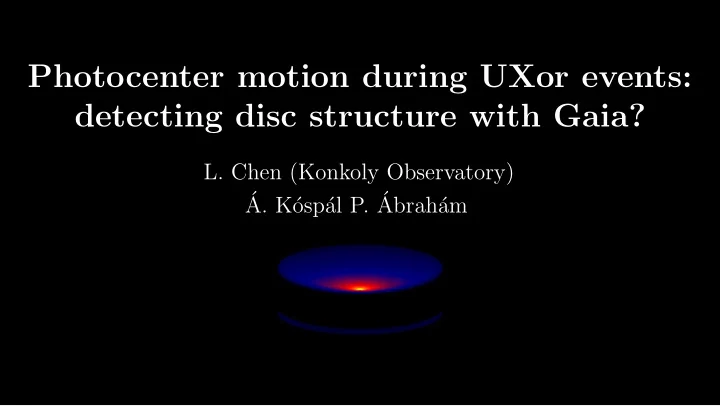
Photocenter motion during UXor events: detecting disc structure with Gaia? L. Chen (Konkoly Observatory) al P. A. K osp Abrah am UXOR: (sporadically obscured) star + inclined disc Gaia measures photocenter of the sys- tem


slide-1
SLIDE 1

Photocenter motion during UXor events: detecting disc structure with Gaia?

  • L. Chen (Konkoly Observatory)

´

  • A. K´
  • sp´

al P. ´ Abrah´ am

slide-2
SLIDE 2

UXOR: (sporadically obscured) star + inclined disc

  • Gaia measures photocenter of the sys-

tem (T. Prusti’s talk)

  • Typically not coincident with the star

(scattered light asymmetric)

  • The displacement is related to the disc

structure.

  • An obscuring event will enhance the

displacement.

Breaking news: Dodin, ..., Lamzin, ..., Safonov, ...,2019: Detected photocentre motion in scattered light of RW Aur

slide-3
SLIDE 3

General principle (For a system with a unresolved spatial distribution)

  • Astrometry

measures the centre

  • f

the brightness distribution (photocentre).

  • Not the centre of mass (barycentre).

Apparent motion includes:

  • Proper motion (barycentre)
  • Motion of photocentre w.r.t barycentre
  • Parallax

A standard five-parameter solution includes only proper motion and parallax.

slide-4
SLIDE 4

An example of photocenter motion: “variability-induced movers” (Wielens 1996).

slide-5
SLIDE 5

“Variability-induced movers” (Wie- lens 1996). Could be used to

  • detect

binary (using high- precision astrometry)

  • set constraints on binary pa-

rameters.

slide-6
SLIDE 6

VIMs in HIPPARCUS (Bertout+ 1999)

  • detect 8 binary (as VIM)
  • set constraints on binary pa-

rameters.

slide-7
SLIDE 7

Reference model

  • L∗ = 5L⊙
  • R = [0.2, 100] au
  • hin = 0.05
  • hout = 0.1
  • inclination: 70◦

Photocentre lies at north of the star, by 0.3 au. Moves to 4.3 au from the star if the star light is blocked.

slide-8
SLIDE 8

AV position (au) 2 4 6 8 1 2 3 4 5 B V R For eclipse of moderate depth, there is a wavelength-dependent displacement.

slide-9
SLIDE 9

AV ∆ mag 2 4 6 8 1 2 3 4 5 B V R

slide-10
SLIDE 10

∆ mag position (au) 1 2 3 4 5 1 2 3 4 5 B V R

slide-11
SLIDE 11

Why should we care?

  • ∼ 10 mas of angular shift.
  • A “noise” in astrometric measurement.

Parallax! (T. Prusti’s talk: UXORs tends to have bad parallax measurements.)

  • Information about disc
  • Identifying UXOR events.
  • Verifying UXOR theory.
slide-12
SLIDE 12

Inclination (degree) Maximum shift (au) 20 40 60 1 2 3 4

slide-13
SLIDE 13

Disk size [au] Maximum shift (au) 50 100 150 200 2 4 6 8

slide-14
SLIDE 14

Outer scale height Maximum shift (au) 0.02 0.04 0.06 0.08 0.1 1 2 3 4

slide-15
SLIDE 15

Motion ↔ Disk structure

  • Amplitude ↔ Disk size, inclination,

flaring...

  • Position angle ↔ PA of disk. (com-

pare with other measurement)

slide-16
SLIDE 16

VIMs in HIPPARCUS (Bertout+ 1999)

  • Some UXORs have VIM effects.
  • UX Ori: PA∼ 257◦
  • Disk major axis:

PA∼ 130 − −150◦ (Kreplin+ 2016)

  • UX Ori in Gaia?

(binary or not)

slide-17
SLIDE 17

Question:

  • Taken into account in astrometric mod-

elling (better parallax, proper motion)?

  • Studying UXOR with: Gaia time series
  • f photometry+astrometry?
  • Considered in Gaia alert?
  • With Gaia DR2, how to check whether a

give star might have additional motion

  • n top of proper motion and parallax

(bad fitting with 5-parameter model)?

Thanks!