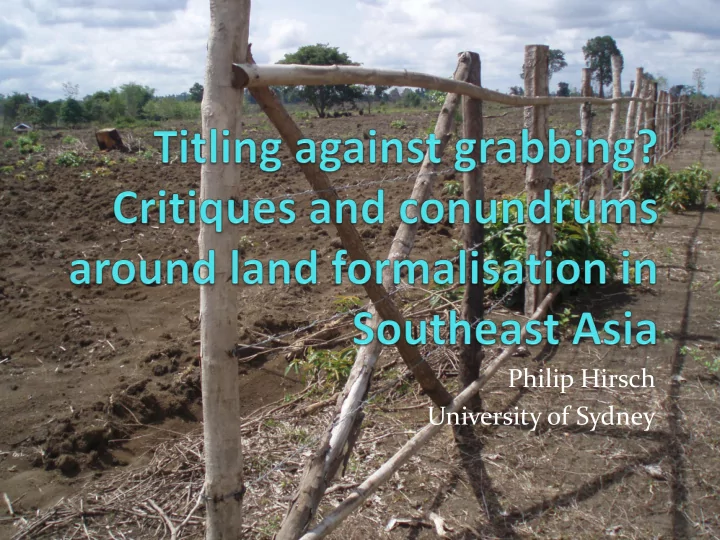
philip hirsch university of sydney land titling in se asia

Philip Hirsch University of Sydney Land titling in SE Asia Key - PowerPoint PPT Presentation

Philip Hirsch University of Sydney Land titling in SE Asia Key arguments/assumptions: Benefits for states legibility, control, revenue Security on the part of farmers productive investment Property effect


  1. Philip Hirsch University of Sydney

  2. Land titling in SE Asia  Key arguments/assumptions:  Benefits for states – legibility, control, revenue  Security on the part of farmers  productive investment  “Property effect”  collateral, fungibility as capital  Motor of economic development  Land titling programs  Colonial antecedents  World Bank/AusAID/LEI approach in Thailand, Laos, Philippines, Java  LMAP (Cambodia)  Red book in Vietnam

  3. Land grabbing in SE Asia  Historically land rich – land for the taking  Increasingly taken from someone else  Cambodia – economic land concessions, urban development  Laos – plantations, dams, mines  Thailand – forest reserve land  etc

  4. Claims and counterclaims  Does title enhance security of tenure?  Does titling reinforce existing inequality or merely formalise/secure existing patterns of land ownership?  Is the problem with titling that it goes too far or not far enough?  Does titling broaden or narrow land ownership?  Is titling consistent with national land policy and prevailing political economy of land?  Does titling lead to more intensive/productive use of land?

  5. Concluding conundrum  Most farmers and other landholders are pleased to obtain formal title over plots of land that they hold individually under more weakly demarcated and state- recognised arrangements….  …but the process of land titling in some areas can weaken security in others and can entrench or exacerbate existing inequalities in access to land.

Recommend


More recommend


Explore More Topics

Stay informed with curated content and fresh updates.