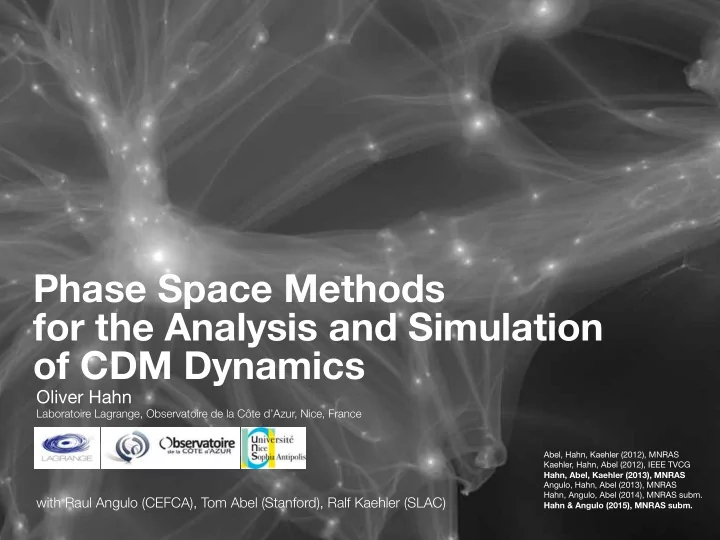
Phase Space Methods for the Analysis and Simulation of CDM Dynamics - - PowerPoint PPT Presentation

phase space methods for the analysis and simulation of
SMART_READER_LITE
LIVE PREVIEW

Phase Space Methods for the Analysis and Simulation of CDM Dynamics - - PowerPoint PPT Presentation

Phase Space Methods for the Analysis and Simulation of CDM Dynamics Oliver Hahn Laboratoire Lagrange, Observatoire de la Cte dAzur, Nice, France Abel, Hahn, Kaehler (2012), MNRAS Kaehler, Hahn, Abel (2012), IEEE TVCG Hahn, Abel, Kaehler


slide-1
SLIDE 1

Oliver Hahn

Laboratoire Lagrange, Observatoire de la Côte d’Azur, Nice, France

with Raul Angulo (CEFCA), Tom Abel (Stanford), Ralf Kaehler (SLAC)

Phase Space Methods for the Analysis and Simulation

  • f CDM Dynamics

Abel, Hahn, Kaehler (2012), MNRAS Kaehler, Hahn, Abel (2012), IEEE TVCG Hahn, Abel, Kaehler (2013), MNRAS Angulo, Hahn, Abel (2013), MNRAS Hahn, Angulo, Abel (2014), MNRAS subm. Hahn & Angulo (2015), MNRAS subm.

slide-2
SLIDE 2

What is Dark Matter?

microscopic negligible cross-section cold (or at most lukewarm) continuum limit vthermal ≪ vbulk σDM ≪ σem collisionless …and also the dominant gravitating component (~80%)

proton = 1GeV, WIMP 100GeV? -> 1021/g e.g. thermally produced at very early times, cooled since then weak-scale or even weaker at first order, structure formation is well described by assuming all matter is dark matter

slide-3
SLIDE 3

Oliver Hahn (ETHZ) GRAVASCO, Oct 14, 2013

Oliver Hahn ICTP , May 12, 2015 Cosmic Structures…

Dark Matter - properties on small scales

dynamic range

  • f simulation ICs

k P(k)

CDM

  • decr. particle mass

CMB

hot warm cold

position v e l

  • c

i t y

1+1D 1D

slide-4
SLIDE 4

Oliver Hahn (ETHZ) GRAVASCO, Oct 14, 2013

Oliver Hahn ICTP , May 12, 2015 Cosmic Structures…

1D behaviour under self-gravity

time position

cusp forms, shell-crossing, but no shock!

velocity velocity

Vanishing collision-term ⇒ not in hydro limit ⇒ velocity can be multi-valued ⇒ cannot stop at low order moments ⇒ have to discretize distribution function ⇒ singular caustics emerge

slide-5
SLIDE 5

Oliver Hahn (ETHZ) GRAVASCO, Oct 14, 2013

Oliver Hahn ICTP , May 12, 2015 Cosmic Structures…

Dark Matter - fluid flow

Lagrangian description, evolution of fluid element Q ⇢ R3 ! R6 : q 7! (xq(t), vq(t))

density
 constant density

ρ = mDM

  • ∂xi

∂qj

  • −1

For DM, motion of any point q depends only on gravity

( ˙ xq, ˙ vq) = (vq, −rφ)

∆φ = 4πGρ

So the quest is to solve Poisson’s equation

unlike hydro, no internal temperature, entropy, pressure

slide-6
SLIDE 6

Oliver Hahn (ETHZ) GRAVASCO, Oct 14, 2013

Oliver Hahn ICTP , May 12, 2015 Cosmic Structures…

N-body vs. continuum approximation

The N-body approximation: ⇒ EoM are just Hamiltonian N-body eq. (method of characteristics) hope that as N->very large numbers, approach collisionless continuum

i 2 {1 . . . N} 7! (xi, vi)

ρ = mp X δD(x − xi) ⊗ W for small N, density field is poorly estimated, continuum structure is given up, but ‘easy’ to solve for forces

slide-7
SLIDE 7

Oliver Hahn (ETHZ) GRAVASCO, Oct 14, 2013

Oliver Hahn ICTP , May 12, 2015 Cosmic Structures…

Lagrangian elements

Qi ⇢ R3 ! R6 : q 7! (xq(t), vq(t))

Define little piecewise maps:

a. b. c.

bi-linear bi-quadratic tetrahedral

cost: truncation error in EoM!

ρ = mDM

  • ∂xi

∂qj

  • −1

velocity density position

slide-8
SLIDE 8

Oliver Hahn (ETHZ) GRAVASCO, Oct 14, 2013

Oliver Hahn ICTP , May 12, 2015 Cosmic Structures… particle locations

time

Oliver Hahn

Describing the density field

IAU308 Tallinn, 06/23/2014

Oliver Hahn

q1(x,v) q3(x,v) q2(x,v) q1(x,v) q3(x,v) q2(x,v)

ρ = mp X δD(x − xi) ⊗ W ρ = mp X

streams

  • det ∂xi

∂qj

  • −1

ICTP , May 12, 2015 Cosmic Structures…

slide-9
SLIDE 9

Oliver Hahn (ETHZ) GRAVASCO, Oct 14, 2013

Oliver Hahn ICTP , May 12, 2015 Cosmic Structures…

Three dimensions

Same simulation data! (Abel, Hahn, Kaehler 2012)

rendering points for particles. rendering tetrahedral phase space cells.

slide-10
SLIDE 10
slide-11
SLIDE 11

Oliver Hahn (ETHZ) GRAVASCO, Oct 14, 2013

Oliver Hahn ICTP , May 12, 2015 Cosmic Structures…

Problem: How to measure the bulk velocity field?

  • Interpolate between neighbouring N-body particles
  • “neighbouring” in phase space, not configuration space
  • account for averaging over streams (“coarse-graining”)
  • Coarse-grained bulk velocity field:
  • result is discontinuous across caustics
slide-12
SLIDE 12

Oliver Hahn (ETHZ) GRAVASCO, Oct 14, 2013

Oliver Hahn ICTP , May 12, 2015 Cosmic Structures…

Derivatives of the bulk velocity field

  • Discontinuities make ordinary derivatives 


ill-defined without coarse-graining!


  • Away from discontinuities:


Need to explicitly evaluate action of derivative


  • n projected field:
  • Vorticity for std. gravity pure 


multi-stream phenomenon!! 


  • At discontinuities:


Derivatives are singular, but have finite measure.

compressive singularities
 at caustics

slide-13
SLIDE 13

Oliver Hahn (ETHZ) GRAVASCO, Oct 14, 2013

Oliver Hahn ICTP , May 12, 2015 Cosmic Structures…

Properties of the cosmic velocity field II

Hahn et al. 2014a

Dark matter fluid mechanics!

slide-14
SLIDE 14

Oliver Hahn (ETHZ) GRAVASCO, Oct 14, 2013

Oliver Hahn ICTP , May 12, 2015 Cosmic Structures…

Spectral properties of the cosmic velocity field I

CDM

  • Faster convergence (for WDM: convergence!)
  • Better small scale properties
slide-15
SLIDE 15

Oliver Hahn (ETHZ) GRAVASCO, Oct 14, 2013

Oliver Hahn ICTP , May 12, 2015 Cosmic Structures…

Problems of the N-body method: WDM

Main Problem: two-body effects, directly related to force softening Clumping/ Fragmentation Scattering Most obvious for non-CDM simulations!

Wang&White 2007

(e.g. Centrella&Melott 1983, Melott&Shandarin 1989, Wang&White 2007)

slide-16
SLIDE 16

Oliver Hahn (ETHZ) GRAVASCO, Oct 14, 2013

Oliver Hahn ICTP , May 12, 2015 Cosmic Structures…

Improving on N-body….

˙ xi = 1 m a2 pi and ˙ pi = m rxφ|xi

˙ xq = vq, and ˙ vq = rx|xq , with q 2 Q

˙ x↵ = v↵, ˙ v↵ = J1f↵,

N-body

point-wise and Hamiltonian

Lagrangian phase-space element

continuum structure (diff w.r.t. q), approx by

  • > EoM for polynomial coefficients

Pk = {π(q) | π(q) =

k

X

α,β,γ=0

aαβγ qα

0 qβ 1 qγ 2 }

explicit truncation error:

∆ ˙ v = J1

1

X

↵,,=k+1

f↵ q↵

0 q 1 q 2

need softening, no knowledge what it should be (empirical)

slide-17
SLIDE 17

Oliver Hahn (ETHZ) GRAVASCO, Oct 14, 2013

Oliver Hahn ICTP , May 12, 2015 Cosmic Structures…

Using tets for simulations: 300eV toy WDM problem

fixed mass resolution, varying force resolution:

PM 128

3/256 3

10 15 20

PM 128

3/512 3

PM 128

3/1024 3

TCM 128

3/256 3

h-1 Mpc

10 15

TCM 128

3/512 3

TCM 128

3/1024 3

T4PM 128

3/256 3

h-1 Mpc

10 15

h-1 Mpc

10 15

T4PM 128

3/512 3

h-1 Mpc

10 15

T4PM 128

3/1024 3

h-1 Mpc

10 15 20

sheet tesselation based method cures artificial fragmentation force res. features become sharper fragmentation appears

std PM tetrahedra monopole tetrahedra quadrupole

slide-18
SLIDE 18

Oliver Hahn (ETHZ) GRAVASCO, Oct 14, 2013

Oliver Hahn ICTP , May 12, 2015 Cosmic Structures…

First determination of WDM halo mass function!

Angulo, Hahn & Abel 2013

slide-19
SLIDE 19

Oliver Hahn (ETHZ) GRAVASCO, Oct 14, 2013

Oliver Hahn ICTP , May 12, 2015 Cosmic Structures…

Limitations - diffusion/loss of energy cons.

Mixing - (phase or chaotic)

need increasingly larger number of elements to trace the sheet surface

tesselated cube orbiting in non-harmonic potential hi-res N-body

slide-20
SLIDE 20

Oliver Hahn (ETHZ) GRAVASCO, Oct 14, 2013

Oliver Hahn ICTP , May 12, 2015 Cosmic Structures…

Need adaptive refinement

Hahn & Angulo 2015

  • a. element is flagged for


refinement

  • b. positions and velocities are

determined at mid-points

  • c. new elements are created

using the mid-point values

adaptive refinement:

m=1 m=2 m=3

approximate element mass distribution by recursively deposited ‘mass carrier particles’ (these are not active, i.e. no degrees of freedom)

slide-21
SLIDE 21

refinement + higher order!

tesselated cube orbiting in non-harmonic potential adaptively refined tri-quadratic phase-space element

first alternative to N-body in highly non-linear regime!

hi-res N-body

Hahn & Angulo 2015

+ able to track fine-grained phase space

slide-22
SLIDE 22

Oliver Hahn (ETHZ) GRAVASCO, Oct 14, 2013

Oliver Hahn ICTP , May 12, 2015 Cosmic Structures…

Orbit test

no refinement refinement

slide-23
SLIDE 23

Oliver Hahn (ETHZ) GRAVASCO, Oct 14, 2013

Oliver Hahn ICTP , May 12, 2015 Cosmic Structures…

Self-gravitating tests 1D

323 particle plane wave, axis aligned 323 particle plane wave,

  • blique
slide-24
SLIDE 24

Oliver Hahn (ETHZ) GRAVASCO, Oct 14, 2013

Oliver Hahn ICTP , May 12, 2015 Cosmic Structures…

let’s go cosmological

no shotnoise!!!

slide-25
SLIDE 25

Hahn & Angulo 2015

+ able to track fine-grained phase space

slide-26
SLIDE 26

Oliver Hahn (ETHZ) GRAVASCO, Oct 14, 2013

Oliver Hahn ICTP , May 12, 2015 Cosmic Structures…

Conclusions

  • Lagrangian elements can give new insights into existing simulations


(density/velocity fields, multi-stream analysis,…)

  • Provide also self-consistent simulation technique.


(functional when using high-order and adaptive refinement)

  • Solves two-body and fragmentation problems of N-body
  • First methodological test of N-body in deeply non-linear regime
  • Stay tuned for halo properties…