Pharmacovigilance & Social Media A new approach to Safety Signal - - PowerPoint PPT Presentation
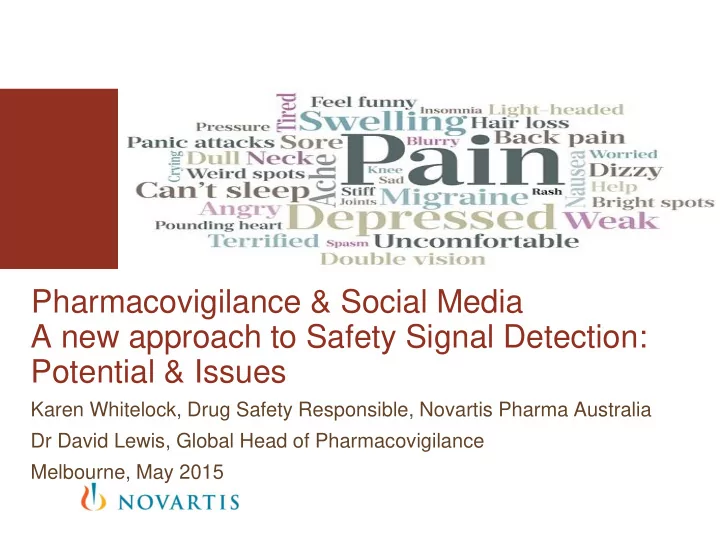
Pharmacovigilance & Social Media A new approach to Safety Signal Detection: Potential & Issues Karen Whitelock, Drug Safety Responsible, Novartis Pharma Australia Dr David Lewis, Global Head of Pharmacovigilance Melbourne, May 2015
Disclaimer
2
The information within this presentation is based on the presenters expertise and experience and represents the views of the presenter for the purpose of this presentation.
| Streamlining Multi-Centre Research May 2015 Workshop | Karen Whitelock & Dave Lewis|6 May 2015 | PV & Social Media| Business Use Only
Overview: Pharmacovigilance of social media
3
- Social media landscape and pharmaceutical medicines
- Regulations & guidelines for PV of digital media
- AE reporting via Social Media
- Overview of Novartis PV of digital media
- WEB-RADR IMI project
- Assessment of pharmacovigilance using social media
- Mobile reporting of suspected adverse reactions
- Digital Drug Safety Surveillance
- Data Protection for Health Apps - Data Privacy
| Streamlining Multi-Centre Research May 2015 Workshop | Karen Whitelock & Dave Lewis|6 May 2015 | PV & Social Media| Business Use Only
Trends in Consumer Technology
Computer & smartphone evolution The digital media landscape...
Internet-based applications that allow for the creation and exchange of user-generated content
From: Chopra R - Pharmacovigilance & Digital Media (http://de.slideshare.net/rkc78834/pharmacovigilance-digital-media)
4 | Streamlining Multi-Centre Research May 2015 Workshop | Karen Whitelock & Dave Lewis|6 May 2015 | PV & Social Media| Business Use Only
Multiple threads of digital media
Electronic Health (eHealth) Using information and communication technologies for the provision of health related services (diagnosis, monitoring treatment) Telemedicine Delivery of health care at a distance using information and communication technologies consumer healthcare. Mobile Health (mHealth) Using mobile communication systems for the provision of health related services Digital Health The intersection of the digital revolution with consumer healthcare, includes genomics (use of gene chips to store a patient’s genetic identifiers and responses)
| Streamlining Multi-Centre Research May 2015 Workshop | Karen Whitelock & Dave Lewis|6 May 2015 | PV & Social Media| Business Use Only 5
@Facebook 1.25b users @Twitter 302m users @YouTube >1b users @Pinterest 70m users
Engaging with patients via digital media
Social media
Use to provide information & engage with stakeholders. Also valuable within the
- rganisation to
encourage collaboration
Apps
An increasingly wide array in the market ranging from information
- nly through to
sophisticated sensors and medical devices
Gamification
Applying game design techniques and mechanics to “real life” applications in order to make them more engaging
Wearables and smart sensors
So far, largely only wristbands and sensors but the potential is for much more
| Streamlining Multi-Centre Research May 2015 Workshop | Karen Whitelock & Dave Lewis|6 May 2015 | PV & Social Media| Business Use Only 6
Pharmaceutical industry use of digital media
MAHs main use of digital media is for marketing and sales
- Sponsors are primarily using social media for commercial
purposes to distribute information about:
- Medicines (to healthcare professionals and non-HCPs)
- Diseases, and the treatment of disease
- Company matters including announcements
- To listen to patient and professional conversations about
marketed medicines, and not to support clinical research
- A minority of companies use social and digital media for:
- Patient engagement
- Patient recruitment and retention within clinical trials
7 | Streamlining Multi-Centre Research May 2015 Workshop | Karen Whitelock & Dave Lewis|6 May 2015 | PV & Social Media| Business Use Only
| Streamlining Multi-Centre Research May
TGA:Monitoring the internet or digital media
1.2.2
Sponsors should regularly screen internet or digital media under their management or responsibility, for potential reports of suspected ARs.
- includes digital media that is owned, paid for and/or controlled by the sponsor.
- frequency of screening allows for valid ARs to be reported within reporting timeframe
based on the date the information was posted on the internet site/digital medium.
- Sponsors may utilising their websites to facilitate collection of suspected ARs.
- If a sponsor becomes aware of a suspected AR described
in non-company sponsored digital medium,
- the report should be assessed to determine whether it qualifies for reporting.
- Cases from the internet or digital media, the identifiability
- f the reporter refers to the existence of a real person, that
is, it is possible to verify the contact details of the reporter
- e.g., an email address under a valid format has been provided
8
| Streamlining Multi-Centre Research May
| Streamlining Multi-Centre Research May 2015 Workshop | Karen Whitelock & Dave Lewis|6 May 2015 | PV & Social Media| Business Use Only
VI.B.1.1.4. Information on suspected adverse reactions from the internet or digital media MAHs should regularly screen internet or digital media under their management or responsibility, for potential reports of suspected ADRs. In this aspect, digital media is considered to be company sponsored if it is owned, paid for and/or controlled by the MAH.
- The frequency of the screening should allow for potential
valid ICSRs to be reported to the competent authorities within the appropriate reporting timeframe
- Marketing authorisation holders may also consider
utilising their websites to facilitate the collection of suspected ADRs
EEA Good Pharmacovigilance Practice (GVP) VI
PV guidance on digital media (July 2012) focuses on ICSRs
9 | Streamlining Multi-Centre Research May 2015 Workshop | Karen Whitelock & Dave Lewis|6 May 2015 | PV & Social Media| Business Use Only
Digital media and safety issues (GVP Module VI)
- VI.B.1.1.4. Information on ADRs from digital media (ctd.)
If a MAH becomes aware of a report of suspected adverse reaction described in any non-company sponsored digital medium, the report should be assessed to determine whether it qualifies for reporting.
- VI.C.2.2.6 Emerging safety issues
Good practice for the MAH to monitor special internet sites or digital media (e.g. patients’ support or special diseases groups)
- Check if they describe significant safety issues which may
necessitate reporting in accordance with VI.C.2.2.6.
- Frequency of the monitoring depends on the risks associated to
the medicinal product
10 | Streamlining Multi-Centre Research May 2015 Workshop | Karen Whitelock & Dave Lewis|6 May 2015 | PV & Social Media| Business Use Only
| Streamlining Multi-Centre Research May
MAH governance of the use of digital media
Most MAHs have developed controls governing use of digital media
- Nearly all MAHs have developed guidelines to address
use of social media
- General guidelines include:
- Rules for discussing company business on personal sites,
how to set up a page or site, and privacy issues;
- Guidelines concerning authorized and unauthorized uses by
personnel of social media;
- Social Media Advisory Board-specified practices;
- Guidelines for posting video online;
- Directives that stipulate one-way communication between
personnel and patients involved in clinical studies;
- Restrictions, e.g., for company business only.
11 | Streamlining Multi-Centre Research May 2015 Workshop | Karen Whitelock & Dave Lewis|6 May 2015 | PV & Social Media| Business Use Only
| Streamlining Multi-Centre Research May
AE reporting via social media
Source: White paper on Adverse Event Reporting by VisibleR , Oct. 2011, http://www.visibletechnologies.com/resources/white-papers/adverse-events/
All brand mentions 257,177 posts; 224 brands 100%
Filtered for relevance 24%
With AE terms
5%
Adverse Event reports 0.4% of all brand mentions 3.3% contain AE-specific data
Contain AE keywords 12,530 posts
3.3% mentions are case reports 1 in 7 = name & contact info
| Streamlining Multi-Centre Research May
Overview of Novartis PV of digital media
Highlighting challenges of monitoring the different channels
| Streamlining Multi-Centre Research May 2015 Workshop | Karen Whitelock & Dave Lewis|6 May 2015 | PV & Social Media| Business Use Only 13
Novartis Pharma Social Media Programmes Novartis Pharma Social Media Listening Programmes Novartis associate/vendor screening non-NVS controlled platforms Single Reports
- AEs with 4 minimum criteria
Aggregate Reports
- AEs with 2 minimum criteria
Single Case Safety Reports
- Within 24 hours
- Send to DSE in the country where AE occurred
(if UNK send to country where AE was received or reviewed (Local Programs) or Switzerland/US (Global Programs) Aggregate Reports
- Monthly reports / End of programme
- Send to country of the Programme Owner
Novartis associate/vendor screening NVS controlled platforms Single Reports
- AEs with 4 minimum criteria
- AEs with 2 minimum criteria
(Novartis product & ADR)
Single Case Safety Reports
- Within 24 hours
- Send to DSE in the country where
the AE took place (if UNK send to country where AE was received or reviewed (Local Programs) or Switzerland/US (Global Programs)
IMI WEB-RADR research on social media
WEB-RAdR consortium will explore PV of social media
Hypothesis Data capture, collation, timely data mining and appropriate analysis can provide actionable intelligence in relation to protection of public health. Research can provide value to stakeholders including patients, healthcare professionals, regulators and to the pharmaceutical industry.
- Emerging communication technology is changing the way people
interact with their healthcare providers and products
- Large body of health care data is being generated in social media
- Mobile technology creates an environment where people are constantly
connected to the Internet
- The value of such data is not fully established
- Mining and analysis of social media is an emerging science
- Regulatory guidance is behind the emergence of new technology
14 | Streamlining Multi-Centre Research May 2015 Workshop | Karen Whitelock & Dave Lewis|6 May 2015 | PV & Social Media| Business Use Only
| Streamlining Multi-Centre
| Streamlining Multi-Centre Research May 2015 Workshop | Karen Whitelock & Dave Lewis|6 May 2015 | PV & Social Media| Business Use Only
A brief history of Web-RADR over time...
Web-RADR is an IMI project involving academia, HAs and industry
- New technologies in mobile devices & new apps are
leading to an evolutionary change in the extent, geographies and modes of use of the internet
- Information gathering and sharing of experiences,
- pinions and suggestions is becoming routine
- Web-RADR is a ground-breaking EU
Innovative Medicines Initiative ( )
- funded initiative to recommend
policies, frameworks, tools & methods
- The project will explore the value of the new
developments to assess the insights versus traditional PV
WEB-RAdR IMI project
Comprises experts from regulatory agencies, academia, WHO & industry
- WEB-RADR consortium brings together expertise from
world-leading organisations in their fields
- Project structured to enable EFPIA partners to participate
in all areas
- WEB-RADR has the potential to shape the regulatory
framework of the future, thereby augmenting traditional pharmacovigilance
- WEB-RADR offers the maximum possible benefits from a
regulatory, societal & scientific perspective
16 | Streamlining Multi-Centre Research May 2015 Workshop | Karen Whitelock & Dave Lewis|6 May 2015 | PV & Social Media| Business Use Only
WEB-RADR Consortium structure
EFPIA Applicant Consortium
Regulators & Patients
Novartis (Lead) J&J (Deputy) Sanofi-Aventis Amgen AstraZeneca UCB Bayer + GSK MHRA (PM) EMA Halmed Lareb Eurordis Universities of London, Liverpool & Gröningen WHO (UMC), Epidemico and SRDC
17
| Streamlining Multi-Centre Research May 2015 Workshop | Karen Whitelock & Dave Lewis|6 May 2015 | PV & Social Media| Business Use Ony | Dr DJ Lewis | Web-RADR | 14 April 2015 | Business Use Only
Overview of Web-RADR work packages
Effective project management to link the work streams together
Mobile & social media usage patterns 2b
Regulatory framework WP 1
Scientific impact & new insights 4 Social media platform 2a Mobile ADR reporting app & safety comms 3a
19
Spontaneous Reporting Electronic Paper based
- ICSR quantity & appropriateness
- Quality (VigiGrade)
- Demography
- Duplication (VigiMatch)
- Signal generation
- Qualitative Analysis
- Integration
Comparisons
WEB-RAdR Scientific Impact Traditional pharmacovigilance vs. New
Adverse Drug Reaction Positive benefit risk assessment for each patient
Traditional model HCP-centric
- Signal generation
- Trustworthiness
- Integration
App- based Social Media
WEB-RADR model Patient-centric
Identify risks & tolerability issues
WEB-RAdR Pharmacovigilance of social media
Targeting advances beyond state of the art pharmacovigilance
- Novel signal detection techniques
- Indicators of completeness + quality
- Advanced geographic recognition
- Filtering capability using EMA IME
- Filtering for health system interaction
- International collaboration portal for all users
- Data export compatibility
- Multi-source spontaneous report comparisons
- Indicators of completeness + quality (vigiGrade)
20 | Streamlining Multi-Centre Research May 2015 Workshop | Karen Whitelock & Dave Lewis|6 May 2015 | PV & Social Media| Business Use Only
| Streamlining Multi-Centre Research May 2015 Workshop | Karen Whitelock & Dave Lewis|6 May 2015 | PV & Social Media| Business Use Only
Data quality indicators: healthcare vs patients
Assessment of Novartis data from SRs, literature and POPs
Initial and follow up all time Literature Spontane
- us
Marketing Programs n % n % n % Formulation 181 13.3 TTO 132 9.7 Demographics 1169 86.2 Indication 936 69.0 Dosage 891 65.7 Action Taken 557 41.1 Duration 19 1.4 Medical History 867 63.9 Lab Data 710 52.4 Dechallenge 225 16.6 Rechallenge 19 1.4 Total no of cases 1356 Average score 4.86946903 4960 65.7 2838 37.6 7058 93.5 4606 61.0 5529 73.2 3389 44.9 2571 34.0 3587 47.5 1135 15.0 1059 14.0 69 0.9 7551 4.740077 1345 73.7 694 38.0 1802 98.8 1371 75.2 1591 87.2 863 47.3 873 47.9 835 45.8 194 10.6 155 8.5 11 0.6 1824 5.6579509
Social media: caveats for patient safety
| Streamlining Multi-Centre Research May 2015 Workshop | Karen Whitelock & Dave Lewis|6 May 2015 | PV & Social Media| Business Use Only 22
New developments will lead to new challenges for pharmacovigilance
- MAHs must obey the law
- MAHs must operate ethically
- We must not cross the boundaries of the
doctor-patient relationship, or be misled by false data or spurious signals
- But we should be encouraged by the
- pportunities that digital media offer...
Future of social media: From telling to engaging
23
New apps and mobile technologies will continue to evolve
- Best practices include:
- Establish relationships through two-way dialogue and
human connections that encourage participation
- Demonstrate patient and customer responsiveness
through timely, transparent responses and request feedback
- Share content that makes the public want to interact
with the company and specific brands
- Use of innovative strategies to leverage information
and drive online influence
| Streamlining Multi-Centre Research May 2015 Workshop | Karen Whitelock & Dave Lewis|6 May 2015 | PV & Social Media| Business Use Only
| Streamlining Multi-Centre Research May 2015 Workshop | Karen Whitelock & Dave Lewis|6 May 2015 | PV & Social Media| Business Use Only
Digital Drug Safety Surveillance: Twitter
Monitoring pharmaceutical products in Twitter (Freifeld et al 2014)
- Existing post-marketing adverse event surveillance
systems suffer from under-reporting and data processing lags
- Social media services such as Twitter are seeing
increasing adoption, and patients are using them to describe adverse experiences with medical products
- An analysis of 4,401 of these ‘posts with resemblance to
adverse events’ (‘Proto-AEs’) from Twitter found concordance with consumer-reported FDA Adverse Event Reporting System reports at the System Organ Class level
- Further research is required to investigate this finding
Identifying instances of Proto-AEs in the UK
Pilot study results exploring PV of social media
Data collection scheme for Twitter & FAERS
| Streamlining Multi-Centre Research May 2015 Workshop | Karen Whitelock & Dave Lewis|6 May 2015 | PV & Social Media| Business Use Only 26
Study to compare AE reporting via Twitter and patient reports to FDA
Correlation by SOC proto-AEs in Twitter/FAERS
| Streamlining Multi-Centre Research May 2015 Workshop | Karen Whitelock & Dave Lewis|6 May 2015 | PV & Social Media| Business Use Only 27
Rank order (log-log scale): Proto-AEs = posts with resemblance to AEs
Social Media ADR Comparison to Pivotal Trial
Patient reporting can be of good quality and differs from HCP sources
Antibody abnormal* Herpes zoster (skin)* Swelling* Migraine* Paraesthesia* Weight decreased* Skin discomfort* Headache* Condition aggravated* AST increased Dyspepsia Vomiting Lymphopenia Albumin in urine Erythema Rash Nausea Diarrhea Pruritis Flushing Abdominal pain Social Media (n=42) 5 10 15 Pivotal Trial (Tx arm N=769) 10 20 30 40
dimethyl fumarate
Dec 1, 2013 through Jan 14, 2014, Twitter & Facebook drug:event pairs coded using MedDRA v16 ≥2% higher than placebo Trial Data: Tecfidera US PI
| Streamlining Multi-Centre Research May 2015 Workshop | Karen Whitelock & Dave Lewis|6 May 2015 | PV & Social Media| Business Use Only
Social media reports vs FAERS
Hypothesis generating for risk minimisation
| Streamlining Multi-Centre Research May 2015 Workshop | Karen Whitelock & Dave Lewis|6 May 2015 | PV & Social Media| Business Use Only
Note: Until methods for signal detection in social media and scientific analysis has been fully developed, refined and finalized, it is proposed that all data extracted from MedWatcher Social and initial findings will be treated as potential hypotheses for research purposes only.
Pilot Social Data Analysis for Drug List
Data used for refining algorithms (WP2A) and development of signal detection methods (WP2B) Data exported by MAHs for evaluation and analysis Data used for scientific impact evaluation (WP4)
Proposed Process Flow
Validate Findings from research >
- new insights
- n drug
safety profiles
- Drug Use
- Prescription
patterns
- Patient
compliance
- PV best
practices
Report to Health Authorities , Publication s (All) Signal Analysis and Risk Managem ent (MAHs) Share New insights with Patient Groups via Mobile (WP3A) (HAs)
| Streamlining Multi-Centre Research May 2015 Workshop | Karen Whitelock & Dave Lewis|6 May 2015 | PV & Social Media| Business Use Only
Key points: pharmacovigilance of social media
- Secondary data use – contact with reporter not foreseen
- Masking of pilot drugs for unbiased study
- Anonymous background data for comparative analysis
- Action after validation of process and signal algorithms
- Data sharing between Work Packages during pilot
- Use of findings to guide policy decisions
- Publication of results after completion of research
Proposal is aligned with secondary use of data per GVP VI
Relevance of Data Protection for Health-Apps
“The close interaction with the operating system allows apps to access significantly more data than a traditional internet browser.” “Apps are able to collect large quantities of data from the device (location data, data stored on the device by the user and data from the different sensors) and process these in order to provide new and innovative services to the end user.”
Personal data
- “Any information relating to
an identified or identifiable natural person (data subject)
Health data (sensitive, personal)
- Any personal data closely linked
to the health status of a person, such as genetic data or data on a person’s consumption of medicines
Personal Data in Apps
- Automatically generated by the
device, (e.g. geolocation data, network settings, IP address)
- Generated by the user through
apps (photos, notes, contact lists)
- Generated by the apps (e.g.
browsing history)
32
Data privacy - Who am I?
- Age: 50-year-old
- Gender: Male
- Suspected ADR:
Respiratory arrest
- Suspect drugs:
Diprivan, pethidine, alprazolam & sertraline
- PMH: Low BMI, vitiligo, lupus
- Outcome: Fatal
http://en.wikipedia.org/wiki/Death_of_Michael_Jackson
- Occupation: Rockstar
- Narrative: Patient was
being treated by his personal physician at his
- mansion. Administration of
propofol led to respiratory arrest and paramedics were called to assist. The resulting court case saw the attending doctor found guilty of involuntary manslaughter.
33 | Streamlining Multi-Centre Research May 2015 Workshop | Karen Whitelock & Dave Lewis|6 May 2015 | PV & Social Media| Business Use Only
Who am I? Personal medical data
- Age: 41 years
- Gender: Male
- Suspected ADR:
Possible drug interaction with alcohol
- Suspect drugs:
Fluoxetine, tiapride, and albendazole
- PMH: Alcoholism?
- Outcome: Fatal
- Occupation: Deputy Head of
Security, Ritz Hotel, Paris
- Narrative: Patient was driving
a Mercedes at high speed in the Pont d’Alma tunnel in
- Paris. He lost control of the
car and crashed, killing himself and two passengers.
34 | Streamlining Multi-Centre Research May 2015 Workshop | Karen Whitelock & Dave Lewis|6 May 2015 | PV & Social Media| Business Use Only
| Streamlining Multi-Centre Research May 2015 Workshop | Karen Whitelock & Dave Lewis|6 May 2015 | PV & Social Media| Business Use Only
Summary and vision of the future...
Early challenges are being overcome, now we need to generate more substantive data!
- Patients are increasingly aware of safety information
- Rapid growth of apps & digital media sites as MAHs exploit
- pportunities
- Potential for 2-way interactions is hard to ignore, so mobile
reporting & listening capabilities will increase
- MAHs must offer real benefits or advantages to patients,
and manage the risk of receiving AE reports
- Important that pharmacovigilance is carefully managed
- Web-RADR provides the opportunity to shape the future,
and to work with stakeholders to improve public health
1995 2014
Social media management strategy
36
2016 2016
| Streamlining Multi-Centre Research May 2015 Workshop | Karen Whitelock & Dave Lewis|6 May 2015 | PV & Social Media| Business Use Only
Questions?
| Streamlining Multi-Centre Research May 2015 Workshop | Karen Whitelock & Dave Lewis|6 May 2015 | PV & Social Media| Business Use Only 37